Sibling Relationships

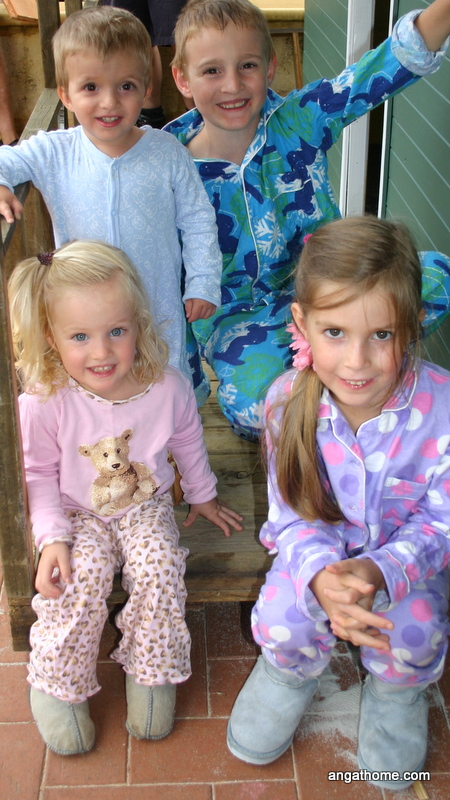
We all want our children to get along and to enjoy being with each other. I would take that one step further and say that I’d like them to develop life-long friendships and to be each other’s best friends throughout the childhood years. So what is our role in this process? Throwing them together and hoping for the best is unlikely to yield the outcome we are looking for, so some proactive parenting is necessary. Here are some specific steps we can take as parents to help siblings develop close relationships.

Have a routine. Too much time together, particularly unstructured time, is a recipe for conflict. Nerves become frayed and patience short. Think about the time of day that siblings play together. If they are tired and hungry things are unlikely to go well. The length of time is important. Wind it up while everyone is still having fun. Finish on a positive note rather than waiting until play turns sour.

Refer to them as best friends. Tell children regularly that they are each other’s best friends. Talk about how other friends will come and go but brothers and sisters will always be there for each other. Ask them if they are treating their sibling as a best friend should.

Supervise sibling play times. If children are not getting along well then they should not be given the freedom of unsupervised play together. Mum or Dad need to be within earshot and ready to step in before a situation blows up into a conflict. If you can hear a problem brewing and fail to do something about it then you as a parent are partly responsible for it. There is a place when children are older to let conflict run it’s course and give them the opportunity to use the conflict resolution skills you are teaching them. If they are never tested or given the opportunity to do what is right, then they will not be able to grow in this area. Be wise with this though.

Good modelling. Older children should be regularly reminded of their responsibility to be a good role-model. Even young children are a role-model if there is a younger sibling behind them or to friends outside of the immediate family. Teach children about good leadership; learning when to follow a good leader and when to be a good leader.

Non-conflict training. The majority of your training should be in times of non-conflict, rather than in the heat of the moment. Take time to teach Godly character. Act out and work through common conflict scenarios. Role-play conflict resolution and negotiation skills. Teach specific phrases for dealing with conflicts the children are likely to face; turn- taking for example.

Personality Types. Spend time teaching your children about the different personality types. Help them to identify their character strengths and weaknesses and to work on improving those weaknesses. Help them to understand each other better and relate with other’s needs in mind.

Dominion. All children need to have personal dominion over something. Special toys that are theirs alone and that they are not required to share is an excellent way of allowing them to exercise this dominion. Toys that they are not prepared to share should as a general rule not be used during playtimes together. If a sibling wishes to use that particular toy they must ask first and respect the answer given.

Memorise scriptures that relate to the conflicts they often face, such as “A gentle answer turns away wrath.” Ask children what God says about a particular behaviour? Make sure that children know the moral reason why. Read about sibling rivalry and its result in the bible. For example, Joseph and his brothers Gen 37 and Jacob & Esau Gen 25-27.

No means no. Teach children to respect another person’s “no” or “stop.” From a very young age we teach our children to stay “Stop please” when they do not like the play that is going on. They are expected to listen and stop the first time they hear those words. This includes parents and applies to wrestling, tickling, chasing and any other fun game. Children soon learn not to say “Stop please”unless they mean it as our play immediately halts. We avoid just “no” or “don’t” because children often shout those in fun when it is clear they do want the tickling to continue. “Stop please” is not something they would normally say unless they actually mean it.

Conflict resolution. Once a conflict between young children has occurred, walk through from the beginning and model the correct things to say. Ask older children what they should have said and then have them go ahead and say it. Require younger children to repeat the appropriate words after you. Give children specific strategies to address issues they face such as using a timer for turn-taking.

Pow-wow time. Older children can be asked to sit together to talk through the problem calmly and quietly until they reach a compromise that both parties are happy with. Some time apart to calm down may be necessary first. There is to be no yelling, raised voices or unkind words. This works best when a parent steps in before a conflict has had a chance to escalate into something serious. The solution decided on should be bought before the parent to ensure it is fair and equitable, otherwise one child may always assume the “peacemaker” role by simply giving in to their more forceful sibling in order to get the problem sorted out and move on. That is not a fair and suitable compromise. Watch out for older children manipulating younger ones. Both parties should be satisfied with the solution.

Justice and judgment. Teach children that if they are unable to resolve a conflict by themselves they should come to a parent. The idea that children need to just “work it out” is a faulty one. It leads to older, physically stronger or more dominant personality children always getting their own way and unpleasant character traits developing. “Might makes right” becomes the order of the day and good relationships will not be the result.

When someone has been wronged, you as the judge should listen to both sides of the argument. Have one child speak at a time with a calm voice – no interrupting. If there are tears, whining or loss of emotional control in any way, they may need a few moments to sit alone and regain their self-control before bringing the matter before you. Children should be expected to have taken steps themselves to work out the problem before coming to you. Pray for wisdom. The children may be able to come up with a solution themselves or need you to supply one.

When emotions are running high, it may work better to separate the children and hear one side of the story at a time without the other person participating initially. Sometimes this allows children to be more honest about their fault in the situation and what they need to do to make it right.

Telling tales. The difference between tale-telling, tattling or dobbing and sincere reporting of a problem for mediation is all in the attitude. If damage to person or property will occur they should be able to come immediately. The first step is to encourage the other sibling in right behaviour. When the intent is clearly to get another sibling into trouble, rather than a sincere effort to solve the problem, the tale-teller receives the consequence that would otherwise have been given to the offending child. When children first come to you they should be asked whether they have tried to encourage their sibling to do right and also whether they have done all that they can to resolve the problem first. “What have you tried to make this right?” is a good start.

Isolation. Children, especially older children, may need some time to work through the problems alone before coming back together to talk it through with the other party. Ask them to think through their responsibility in the situation, whether they have treated their sibling as a best friend and what God’s word has to say about it.

Physical touch. Hugging or shaking hands when the matter is resolved melts the tension and helps to repair friendships. Verbal forgiveness needs to be asked for and given. Shaking hands afterwards often helps children to break through that last barrier of unresolved anger or hard feelings towards their sibling. While children can forgive someone without hugging or shaking, often this physical contact will get them smiling at each other again.

Forgiveness and restitution. Saying “sorry” is for accidents, not for deliberate acts of unkindness. If the wrong was intentional then forgiveness is needed. Model this by asking for forgiveness yourself when you are in the wrong. Children are very forgiving and LOVE it when a parent apologizes and asks them for forgiveness. If something has been destroyed, taken or otherwise damaged, restitution or “paying back” must be made. A child who has knocked over another child’s tower can build it back up. A child who has drawn in a sister’s book can use their pocket-money to buy another one.

Consequences. Clear consequences for wrong behaviour should be given and acted upon consistently. Some examples of consequences for unkind behaviour are acts of service, losing the opportunity to play together and saying 3 nice things about the other person’s character – not physical features. See spoiled walls.

Reinforcement. Character reinforcement systems may be useful to jumpstart the process. Praise good behaviour and character when children do the right thing; catch them being good. Use specific praise that clearly labels what it is they are doing well. You may like to temporarily introduce a marble jar, praise plate, or treasure tree system.

The sorting out prayer is useful for the wronged child to work through and helps them to forgive their sibling. Based on biblical instruction, it is something we will introduce as the children get older and have to deal with more weighty situations.

“If… then…” charts are good for clear consequences. Take the time to write them up with the children’s help and refer to them when a problem occurs.

Resources:

I have linked to The Book Depository when products are available through them as that is the cheapest source for Australia in most cases. Other sources as stated.

Personality Plus: How to Understand Others by Understanding Yourself


For general personality information and identification see Personality Plus by Florence Littauer.

Personality Plus for Parents

Personality Plus for Parents is by the same author with more information specifically for parents.

Spirit-Controlled Temperament

Spirit Controlled Temperament is a Christian take on the 4 temperaments and how the Holy Spirit can help us overcome our inbuilt weaknesses and improve our strengths.

Making Brothers and Sisters Best Friends: How to Fight the Good Fight at Home

Making Brothers and Sisters Best Friends is a good tool for teens to read through either by themselves or with you, with time to discuss each chapter together.

Proverbs for parenting is an excellent resources for finding what the bible has to say about parenting related topics with Proverbs sorted into easy to reference categories.

 The Power of True Success How to build character in your life.

A good resource for the Christian family for teaching character to children.

Mom's Notes Volume 3 - Notes in Binder

Dealing with sibling conflict by Joey & Carla Link is a topic from the Moms Notes.  These are an excellent resource for all things parenting. Very detailed with ideas for all ages. Brilliant but it is pricey. Audio CDs also available.

For Instruction In Righteousness

For Instructions in Righteousness Pam Forster is another character training resource with bible verses, stories and other ideas for training and building character into your children. (Also available at Heart and Home Bookstore in Australia.)

Four Chart Special

The Brother offended checklist and booklet and If..Then Chart are helpful in the thick of dealing with conflict. Great to take children straight to to help work through their conflicts with a biblical framework. Available separately or in a set at Heart and Home and Doorposts.

Parents Arise

Janine Targett’s book Parents Arise and scripture CDs show you how to use God’s word to overcome character weaknesses amongst other things. This is the source of the “sorting out prayer.”

Hospitality V’s Entertaining

Are you hospitable or do you like to entertain? At first glance it seems like the same thing but it really isn’t at all. There is a difference between showing hospitality and entertaining.

Setting out to impress others, to have everything perfectly presented, to give a favourable impression – that is entertaining. Showing hospitality is bringing others into your home, making them feel welcome, comfortable and relaxed. Hospitality is sharing what you have willingly and joyfully. It doesn’t necessarily mean fancy or spectacular, but it does mean loving.

I have read several life stories from people who grew up with a crowd of visitors around the table for Sunday lunch. Their parents made it a habit to invite friends, family,  missionaries or travelling speakers, the new family at church, someone living away from family or an elderly person without transport into their home each week. I love the idea of my children being exposed to many different people and experiences within the safe environment of our home and having the opportunity to serve and show hospitality themselves to the extent that they are able. To hear the stories and experiences of a missionary at home on leave, to listen to a pastor talk about his experiences, or show friendliness to children from another family – what valuable and inspiring life experiences they would gain.

With a new baby and 5 other young children, I have to face the fact that having a mob of people around every weekend is difficult right now. Getting the house tidy and preparing a nice meal is not always easy to do. Especially if I am trying to entertain. But I can show hospitality. We can invite a family to stay for dinner after bumping into them while we are out, call someone for an afternoon drop-in and simply sharing what we already have prepared or have friends come back after church for a slap together lunch or even take-away pizzas to share at the park together. We can all show hospitality regardless of our situation and it is biblical that we do so – God tells us to do it!

When I really get down to it, most of the reasons why I do not show hospitality is because I am actually aiming to entertain. I feel the need to make sure the house is perfectly spotless, the dinner is fancier than usual (and complete with entrée and dessert) and the table-ware is coordinated. The children must look and act perfectly and for that matter, eat with wonderful manners. If I can take a step back and get past my pride, most of the reasons why I don’t go ahead and ask someone around can be quickly overcome when I simply seek to share life with others, rather than impress them.

Here are a couple of practical tips to help make hospitality more doable.

  • Plan ahead I try to have meals, desserts and fancy bread cooked and frozen that can be reheated when I want them. With the quick addition of a fresh salad, dinner is on the table.
  • Train the children to set up All the children can play a part in helping to set up. If they regularly do the same job for visitors you can train them to do it well and then simply ask them to do it with out supervision once they know how. Many hands make light work.
  • Have a house cleaning system Whether it’s a little bit each day or all at once on Saturday morning, everyone pitches in to get the house looking clean and tidy so that an overwhelming job is not ahead of you when you decide to ask people around.
  • “Visitors Coming” Scramble. Assign quick tidy-up the house jobs and practice doing them regularly so that when someone calls to tell you they are in the neighbourhood and want to drop around you can muster the troops and tell them it’s scramble time! Everyone dashes off to do the most important surface tidy jobs that make the house look vaguely presentable in the 10 minutes it takes for the visitors to arrive. That might be checking the condition of the toilet, cleaning off the kitchen table and bench, floor tidy-up or whatever else is likely to most need attention in your house. Even if the visitors are in the driveway before you know about them, you can have an emergency scramble. It’s amazing what can be done in the one minute it takes for people to get from the driveway to entering the front door if the children know what they are trying to achieve.
  • Train children to be hospitable. Teach them to ask visitors what they would like to drink, to carry a tray of nibblies and offer it around, write down tea and coffee orders, offer to take coats and bags etc.
  • Feed young children ahead. While we usually try to have everyone eating together, if the meal is going to be much later than usual it often works better to feed the younger children at their usual time. When the adults sit down to eat they can then choose a couple of extra fingerfood items or perhaps eat their dessert. Hungry, demanding toddlers do not make showing hospitality easy. If the meal I am serving to the guests is likely to be unpopular with the little ones, I simply have something else in reserve for them, even if it’s just toast. I try to make sure that the whole meal is child-friendly so that we can all enjoy it, but there are times we want to serve those spicy curries that I know the kids will not eat happily. I am not going to have a battle over food in front of company if I can help it.
  • Ask your visitors to help. In almost all occasions visitors are more than happy to help while you are getting the meal sorted out. Holding a baby, chopping up the carrots or any other small task is easily done and for someone who may be feeling a little bit unsure of themselves, it gives them something to do,  takes off the pressure and makes them feel at home.
  • Accept visitors’ offer to contribute to the meal. When we have a slap together occasion and people ask what they can bring, we usually say bread or softdrink or something similar, knowing that they can easily swing past the bakery or corner shop on the way over. With more advance warning, I might ask them to bring a salad, knowing that it’s the last minute preparation that can be difficult for me to do.
  • Visitor menu. Make a list of quick and easy meals (complete with sides and desserts) that you can throw together quickly and easily from ingredients you usually have on hand. That self-saucing pudding that takes 5 minutes to throw together goes on the visitor menu list and can be prepared without fuss at the last minute.
  • Have a visitor rotation. Perhaps designate one weekend a fortnight for family, the following weekend for friends, new people from church etc. We find family very easy because they are extremely relaxed, will help out when here and are happy to share whatever we would normally have. I still try to make it a little special, but when we’ve organised nothing ahead, I can still have family stay at the last minute with no idea what we are going to have and not find it a big deal. We’ve all made it clear that eggs on toast will do if that’s all there is! Asking people over every weekend (other than family) is too big a load for us right now.
  • Don’t forget date nights. Your husband should be your priority so don’t forget to plan special nights with him (See stay at home date night ideas here.)
  • Picnics. In fine weather, meeting other families at a park takes off the pressure of needing to get the house respectable. Picking up a couple of hot chickens on the way and making salad and rolls or many other very simple picnic ideas makes this an easy option.
  • Pot luck dinners. Having everyone bring a part of the meal is an easy way to have large groups around without the expense or hassle of cooking huge meals. Everyone contributes and all you have to do is provide the meeting place and accessories.
  • BBQ’s. An Aussie cliché but so easy. Everyone brings their own meat and we provide the salads. If many large families are coming, we ask them to bring a salad or dessert to share as well. I can prepare the nibblies, salads or whatever we need ahead and the men are happy to stand around chatting while they cook it on the day, leaving me free to feed a baby or look after the guests.
  • Small children timing. We find it easier right now to get together for breakfasts, morning & afternoon teas, or in the afternoon followed by an early dinner. Avoiding nap times and getting the children to bed at a reasonable time stops us having to suffer through over-tired children who are unable to get their responsibilities and school work done for the next 3 days.
  • Theme meals are easy to put together. A bring a pie night is fun (sweet or savoury),  soup and rolls lunch (I do soup, everyone else brings fancy bread and stir-ins for the soups), fondue (I do the sauce – including dessert fondue – and everyone brings a plate of food to dip), salad and rolls, make-your-own pizza, hamburgers, gourmet hot-dogs,  or whatever else suits your fancy and is easy to prepare.

Learning letter names and sounds

Whether you are homeschooling or have a young child at school, most of us will at some stage be helping our children learn their letter names and sounds. There are many different ways to do this, from rote learning with flash cards to games and hands on workjob style activities.

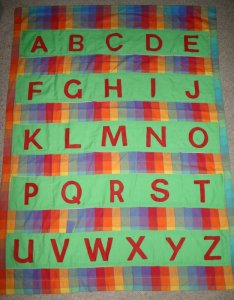
I use quite a few different methods depending on the child, their rate of learning and preferred learning style and the time I have available to teach them. One of the more hands-on approaches I have employed is an alphabet chart. Again, this is something I made way back in my Uni teacher training days that has been useful through 7 years of teaching and now has made it’s way to the third child in our family.

I do not introduce the letters for the first time using the chart – there are too many all at once and it is too overwhelming. We go through the alphabet one letter at a time, adding more as the child is ready. (I’ll post about this another time.) Once the child knows quite a few letter names and most sounds I introduce the pocket chart. It can be used in many different ways. Here are just a couple:

  • Matching lowercase letters to uppercase letters.
  • lucky dipping letter cards from a pillowslip, naming them, saying their sound and then sliding them into the correct pocket.
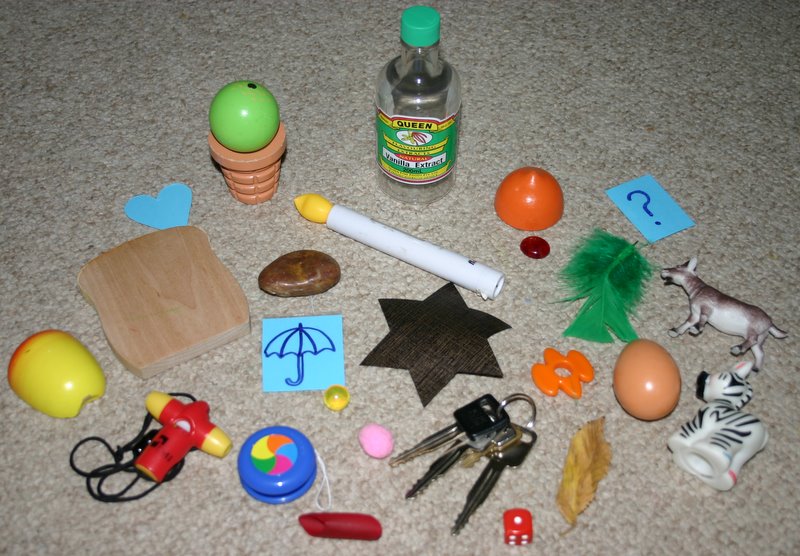
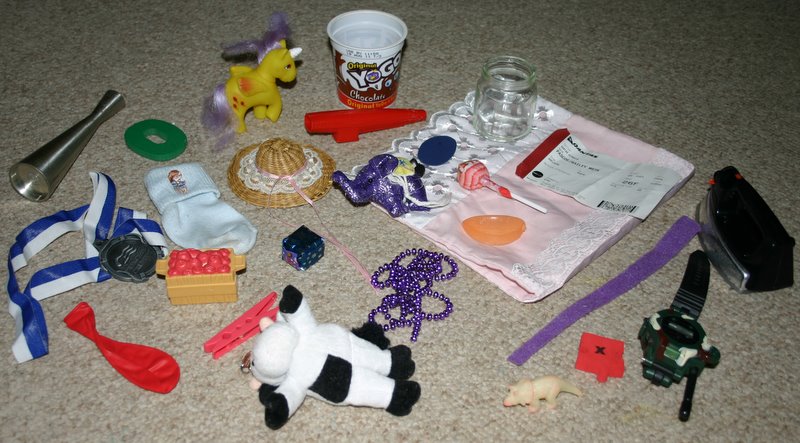
  • sorting small objects by their initial sound (first sound you hear when you say the word) into the correct pocket.
  • setting up a word bank system with picture and word cards that begin with each letter “filed” in each pocket for children to use during creative writing.
  • find the hidden toy games where the child checks the pockets for a hidden items and must name the letter and sound to be able to keep the item. (Just for the duration of the game though, although you could include a little treat surprise every now and then.)

These objects are one set I use for initial sound sorting.

A second set of objects for initial sound sorting.

To begin with, all alphabet chart work is done one-on-one with me, however once the child begins to grasp the concept of initial sounds, I give them a bag or box of objects to sort into the correct pocket as an independent activity. It is self-checking because there is never more than one object for each pocket so if they find one already there, they know they have made an error and can self correct.

If you are not able to sew a chart, you could make one using cardboard and add Velcro spots to attach the letter cards or large sturdy envelopes to act as pockets for the items. If you plan to use it for any length of time or with more than one sibling it would be worth taking the time to sew one up. It might be a nice project for Grandma perhaps??

Teaching Children To Read: Readers

It is very important to expose children to a wide variety of excellent quality literature from an early age. Way before a child can read, they will be able to appreciate a wonderful story and surprise you with their ability to concentrate and enjoy listening to a chapter or so at a time from quality chapter books that would otherwise be way above their reading level.

Those who are familiar with the Charlotte Mason style of education through living books will already be acquainted with the idea that children should be reading “twaddle free” literature that has not been “dumbed down” for children, but rather includes all the richness and fullness of the English language at it’s best.

Today I am listing the beginning readers that my children have enjoyed learning to read from because I do believe that there is a place for the more traditional first reading books or vocabulary controlled readers for beginning readers. Some parents are reluctant to use these because they do not fit into the “quality literature” category, however you need to be clear why you are using them. If they are your child’s only exposure to books then yes, they will not be getting the rich language experiences they need. However, if you are reading aloud or playing audio recordings of classic books and using readers in a structured fashion to teach word decoding and first reading skills, then they have a valuable purpose.

When children are learning to read they will often find it hard work and be easily discouraged with texts that are too difficult. With carefully levelled and graded readers, they will be able to see ongoing progression and experience success and that wonderful feeling of being able to say “I read it myself!” Once a good bank of sight words has been learnt, we go on from levelled readers to plowing through the many picture books in our collection. By the time we have exhausted them, the children are usually ready for easier chapter books and move gradually on to more general chapter books.

There are some beginning readers that are definitely better than others and the following are some of the best that we have used.

Bob Books First!Bob Books Set 3: Word FamiliesBob Books Set 2: Advancing Beginners

Bob Books Set 3: Word FamiliesBob Books Set 5: Long Vowels

Bob Books level 1 2 3 4 and 5  are a relatively cheap way to get a good set of beginning reading books. They have very plain line drawings with stories that have simple appeal. The difficulty increases in very small steps, unlike some early reading sets that jump very quickly from 3 letter words through to sight words, leaving some struggling readers behind. Each level is a boxed set of 12 reading books.

Little BearLittle Bear's VisitA Kiss for Little BearLittle Bear's FriendFather Bear Comes Home

Little Bear books have lots of basic sight words in simple stories that children actually want to read. Very appealing and most are presented in chapter book format to ease through the transition from picture books to chapter books. Level 1 in the “I Can Read” series is a good follow-on from the Bob Books.

Frog and Toad Are FriendsFrog and Toad TogetherFrog and Toad All YearDays with Frog and Toad

The Frog and Toad Series is another set of simple sight word books that have enough in the plot to keep children interested. Frog and Toad’s adventures together are engaging with a touch of humour. Level 2 in the I Can Read series is the next step up from the Little Bear books.

Amelia Bedelia

Amelia Bedelia and the rest of the series tell the story of a cheerful young lady who always seems to get things mixed up in a silly and humorous way. Level 2 in the I Can Read series. (I haven’t read all of these but we liked Amelia Bedelia.)

The Josefina Story Quilt

The Josefina story quilt tells the heartwarming tale of Josephina hen as she heads off with a family in a covered wagon. Level 3 in the I Can Read series.

Step into Reading Bravest Dog Ever

Balto tells the story of a sled dog who saves the day with his heroic trip through icy conditions bringing medicine to sick children and villagers. Level 3 in the I Can Read series.

Tornado

Tornado is a good beginner chapter book. More text but simple enough for children to move on with. It is the story of a dog who literally falls out of the sky during a tornado and becomes firm friends with a young boy. One slightly sad section that turns out happily in the end – I always warn my children about these sections as they tend to be quite sensitive to sad events in stories.

Courage of Sarah Noble

The Courage of Sarah Noble by Alice Dalgliesh is a Newbury honour book. An eight-year-old girl finds courage to go alone with her father to build a new home in the Connecticut wilderness and to stay with the Indians when her father goes back to bring the rest of the family.

The Velveteen Rabbit

The Velveteen Rabbit by Margery Williams is the story of a little boy’s stuffed rabbit and how he became real. Considered to be one of the classics by many and is stepping into longer chapter book reading.

Spoiled walls – bickering and sibling conflict

Bickering and nitpicking between siblings – it wears me down and spoils my day. I know they love each other, but some days the love is just not shining through. We all need long-term strategies that seek to address the underlying character issues in our children and must be constantly working on relationship building, loving God and each other and following the biblical mandates regarding speech, tone, building each other up and the like. There are times though, that a well-directed consequence is called for. I need consequences that I can consistently apply whether I am busy or not, repeat over and over, don’t require a heap of supervision and most of all, are effective in addressing the issue.

I recently sat the children down and had a little chat about the unkind speech that was being heard between them. We discussed how that made them feel, what we wanted our family to be like, read some relevant bible verses and then I made up my own little mini metaphor. I asked them to picture a freshly painted wall. How nice and crisp and fresh it looked and how pleasing it was to look at. I then asked them to picture the same wall with dirty fingerprints and food splashes all over it. We talked about how the dirt spoiled the wall in the same way that the unkind words spoiled their friendships.

I let that sink in for a moment or two before informing them that from now on, at the first sign of unkind speech or bickering, the offending child would be given a spray bottle and cleaning cloth to wash down a section of wall. As they cleaned, they can think about “washing” the dirt out of their relationship by replacing their unkind words with words that build others up.

It’s an instant consequence and is easy to enforce. The bickering siblings are separated for a while (which usually helps in itself) and something useful is getting done at the same time. I love it! The only problem is that the clean wall sections make the rest of the wall look even worse… Oh well, I’m sure there will be plenty more occasions that wall cleaning is called for.

Other posts you may like:

Getting dinner on the table

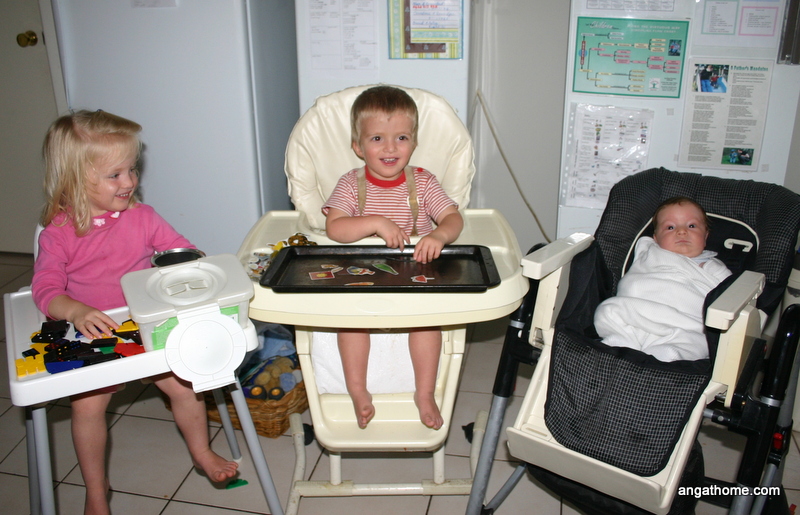
Highchair time at our house – 3 in a row!

I like to cook for fun. It’s enjoyable to potter around testing new recipes and trying them out on friends and family. I don’t so much enjoy having to get dinner on the table at short notice, with a bunch of hungry, cranky children getting on each other’s nerves as we battle through “arsenic hour” as I have heard it termed. So, how do I get a nutritious and delicious meal on the table on time every day that will please everyone from the baby, right up to Dad? Well, to tell the truth, that’s almost impossible – with 8 people sharing a meal on a nightly basis, someone is bound to disagree with the delicious part! However, let’s concentrate on the nutritious and “on time” part. We haven’t eaten cereal for dinner yet, although baked beans on toast is the equivalent as far as I’m concerned and we’ve had that a few times!

There are some practical ways that I have gone about structuring my days and time so as to make this touchy time of the day run smoothly and happily for all of us and still have a nice meal on the table. Strategies have changed over time, depending on the ages of the children and what time my husband is due home, but here are some of the ways we have structured the late afternoon period that have worked for us in the past.

Flexible routine. Having a routine running throughout the day makes a big difference at the end of the afternoon. If the children have spent too much time together, especially unstructured time, they will invariably be at each other by the end of the day. A good balance of time with me, with each other, time alone and indoor and outdoor time, all work together for a smooth afternoon. More on routines here.

Feeding toddlers and/or babies early. I prefer it when we all eat together, but there are seasons when that is just not viable. The was a time when 4.45pm was like a “switch” for my toddlers. Happy before, exceedingly cranky afterwards. My options were either to feed them a large afternoon tea earlier (and have problems at dinner with them not wanting to eat well) or to simply give them their main meal earlier. When the rest of the family came to the table they were given some finger food or perhaps fruit or dessert to enjoy with us before moving on to a highchair activity while we finished up. This allowed them to still be a part of the family, I could focus on feeding them and training table manners away from the family mealtime and enjoy my meal relatively peacefully later on.

Baths. Everyone preschool aged and under (i.e. all those who require my assistance during bath time) are all bathed around 4.30pm rather than after dinner when everyone is tired and likely to be fractious and uncooperative. Bath time is then an enjoyable experience for all and bedtimes are not held up if I am caught up feeding a baby or dealing with unexpected circumstances.

Table activities. For around half an hour before dinner, all the children do highchair activities (some ideas here, here, here and here ), table activities (some ideas here, here and here), mat time (some ideas here, here and here), puzzles or books. There is nobody roving about getting into trouble and plenty of interesting activities to do. I am then free to get the last-minute dinner preparations done.

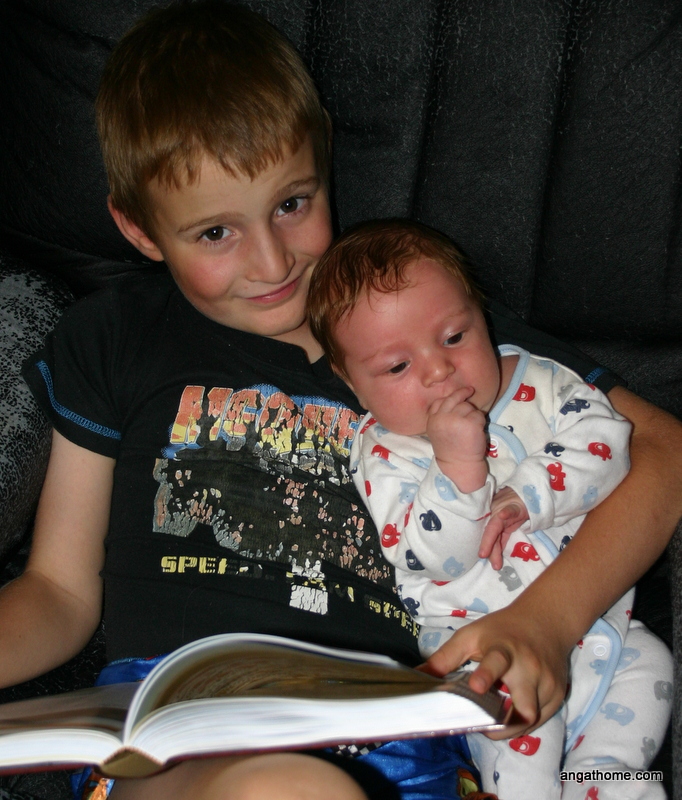
Sibling time. Sometimes the youngest children are unable to play independently at this time and need someone with them. This is when I assign an older sibling to spend some time with the little ones, reading them a story, playing on the mat with them, helping them with a simple puzzle or something similar. The eldest enjoy the responsibility and it helps build positive sibling relationships. They do not resent this time because it is not something they are required to do throughout the day in a random way or for large blocks of time.

Menu plan. Having a plan of which meals I will be making throughout the week is so important. Getting to dinner time and realising the meat is still in the freezer and trying to come up with plan B on the spur of the moment is never a great way to have a smooth afternoon period. Knowing what I am going to cook means I am prepared and can plan ahead, often using a few spare minutes here and there throughout the day to get some prep work towards dinner done. More on menu planning here.

Night time preparation. While I am caring for babies, homeschooling and looking after several older siblings, trying to fit cooking in during the day can be very difficult. There are usually several months after the birth of a new child when I do all my meal preparation in the evenings. And I do mean all. I set out breakfast dishes and ingredients and cut up fruit, bake or pull out frozen or pantry snacks for morning tea. I do all the peeling, chopping, grating, salad making or whatever other prep is needed for lunch. Dinner meals are pulled out of the freezer, ingredients are put in the slow cooker and veggies are washed and chopped – even to the point of putting the veggies in a saucepan of water in the fridge. It sounds over the top but, especially with the twins, I just didn’t have a moment to spare during the day. Being able to pull the crock pot out of the fridge and flick it on at morning tea time, knowing there would be a hot meal ready by dinner, was such a blessing. Even when things were going pear-shaped, I could throw a saucepan full of veggies on the stove as I walked past. Older children could set out prepared lunch or morning tea for everyone to help themselves if I was caught up feeding.

At other times, I didn’t have to cook at night, I used the time immediately after breakfast to get the dinner made. Everyone is fresh in the morning and it was a good time to get the household chores and dinner preparations under way. Now that I have older children to homeschool, this time is used for our more difficult subjects that require the most concentration, so dinner making is not a possibility.

Instant meals. For days when, menu plan or not, I have nothing ready for dinner, all supplies are frozen solid and my mind is blank, I am endeavouring to build up a collection of meals that are very quick and easy, that use ingredients I can keep on hand in the pantry or freezer without them going off and throw together in a matter of minutes. My rice cooker fried rice is a family favourite and assuming I have prepared my ingredients earlier, can be thrown together in literally 3 minutes. I haven’t timed it yet but I’m going to!! Ideas for nearly instant meals and pantry mixes are here and here.

Shopping lists. As an extra tip, shopping lists are a must to make life run smoothly around here. I have a shopping list pad with a magnet back that lives on the fridge. As I notice we are running low on an item, I immediately jot it down on the list. When I make out the menu for the following week, or check through the monthly menu, I add the items we will need to the shopping list too, after checking through the pantry first to see if we have what I think we have. It stops the random buying of stuff we don’t need and the irritating need to continually run to the shops to pick up one or two items here and there because they have just run out or I thought we had some.

Now the kids are older, they often come and tell me if something has run out or ask for small items like lead refills for a click pencil that we would never in a million years remember to get when actually at the shops. I also have multiple copies of a printed shopping list hanging inside the pantry. This list is all the items I buy on a weekly basis. When we are actually ready to go to the shops, a quick look down the list to cross off what we don’t need and to add the odd ingredients from the fridge list saves time and means we should get everything we need.

Montessori inspired practical life tray activities for toddlers: Tong transfer

With a general category in mind such as “tong transfer” and a drawer full of useful bits and pieces I have collected over time, I now find it very easy to come up with new tray activities for table time, highchair time or mat time that will keep my toddlers developing new skills while they learn to focus and concentrate at the same time. (See here for a list of materials and equipment that might be useful for creating Montessori style tray activities.)

Simple two container transferring is a good starting point.

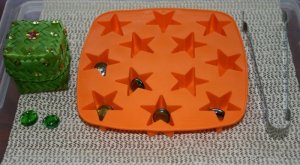
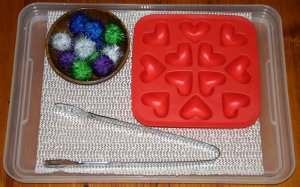
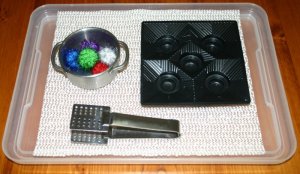
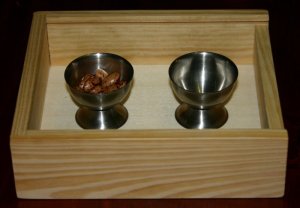
Using tongs is great preparation for writing and other skills that require fine motor control, helping to develop the hand muscles necessary for successful manipulation of writing implements.  All you need are tongs of some sort, 2 containers and something to transfer. Keep in mind that toddlers find it very difficult to manipulate tongs so look for small pairs that are not too stiff to close. Avoid those with a metal closing ring that slips down all the time – very frustrating! The best pair I have for beginners is a small set of ice tongs (see top photo) that I picked up at an op shop for 50 cents. Tea-bag tongs are also easy to squeeze and quite short. I found mine in a $2 shop.

Tonging activities link in well with other skills such as one-to-one correspondence. Plastic iceblock trays, egg cartons, chocolate trays or any other container with an obvious number of holes are ideal for this. Simply put, the child has to place one item in one hole. If there are any left over, or they run out before all the holes are filled, they are prompted by the empty space or left-over pieces to self-correct their work.

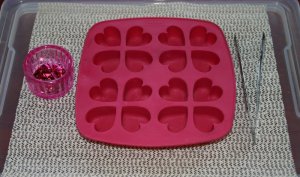
Flexible ice-block trays are an attractive material for children to work with. My girls LOVE this pink tray. (I should mention that it is the 6 and 4 year olds who clamour to do this one even though it is set out for the toddlers!)

Tea-bag tongs are easy for toddlers to manipulate.

Tonging is easily adapted to many other concepts, particularly mathematical skills. Beginning sorting with two simple categories is an easy way to combine the skill of tonging with a more challenging task for older toddlers and preschoolers. In the photo above, children sort the hair elastics into 2 separate colour piles; the first step along in learning the concept of sorting by colour.

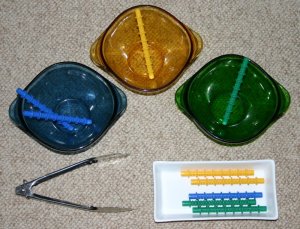
Here we move to a slighlty more challenging activity with items to tong that require greater dexterity, 3 colours to sort and 3 bowls to match them to.

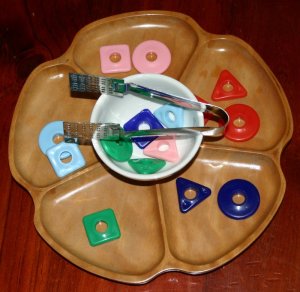
Attribute beads can be sorted more than one way and are quite difficult to pick up. They are a good challenge after simple tonging has been mastered.

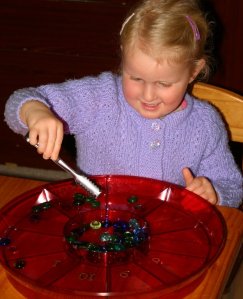
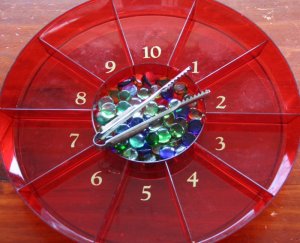
Linking tonging to counting is fun for the preschooler and provides valuable practice of fine motor skills. Here the child tongs the correct amount of jewels into each segment of the dip plate. My 3 year old is pictured doing this activity in the photo at the top of this post. The counting side of things wasn’t too difficult for her to do even early on, but it was a test of her endurance and concentration skills to persevere with the tongs to complete all 10 segments.

Montessori inspired practical life: dry pouring tray activities for toddlers

If you are looking for inspiration for toddler tray activities, dry pouring is a great place to start. It is a practical life skill that is easily introduced in a simplified form and can be gradually made more challenging as your toddler progresses. Learning to pour liquids carefully and accurately is difficult for young children, so starting with a dry material is a more forgiving and easily mastered beginning. Giving children cups and containers to pour water in the bath develops the skill in a non-messy environment and dry pouring activities are great for mat time, highchair time or table time.

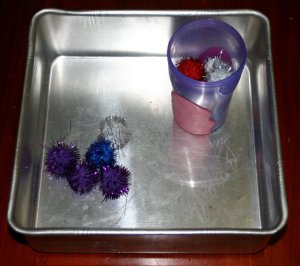
This is the first dry pouring experience I give my toddlers. Tipping the jewels out of the cup into a baking tin and collecting them up again is surprisingly absorbing and makes a satisfying racket as they do it. If you prefer a quieter option, try pompoms (see below), however I can guarantee the children will enjoy the jewels, beads, rocks or other noisy versions more!

Pouring from one container to another is the next step. Choose 2 containers of the same size, without handles. A set of straight-sided small tumbler type cups is best; something that is easily gripped in a toddler’s hand. Add small objects such as dried beans to pour from one to the other and change the containers and material to pour every so often to keep interest high.

Rice is one of the last materials to introduce. If you colour it, it is very attractive but it is almost guaranteed to spill and is not quite as easy to clean up. Toddlers need to be taught how to collect the spilt rice in one corner of the tray and carefully pour it back into the container.

I was able to find a cute mini dustpan and broom which I include with my rice pouring activities to clean up the spills which is a practical life skill in itself. Tape a square shape with masking tape in the centre of the tray and teach the children how to first sweep the rice into a little pile within the tape boundary before sweeping it into the dustpan.

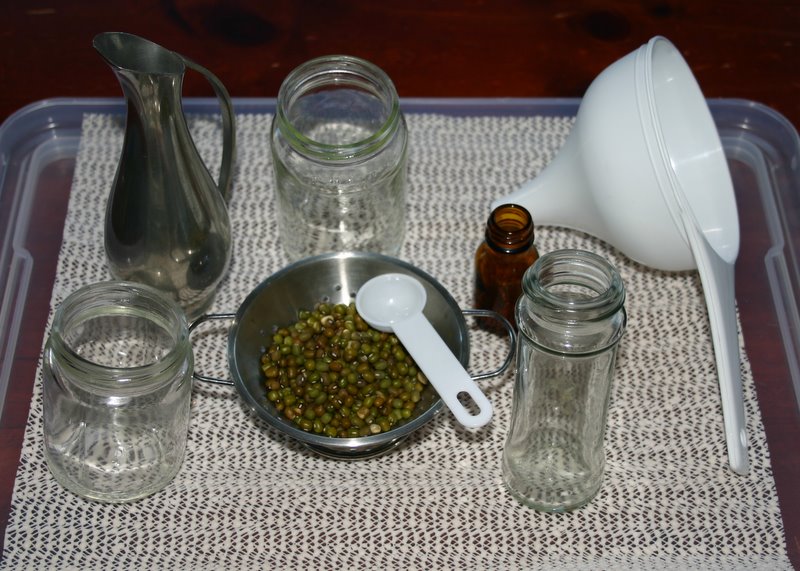
Adding funnels to a dry pouring activity adds yet another dimension and when I have had simple pouring activities available for quite a while, I set up a combined scooping, pouring and funnelling tray for a  more complicated experience. After I have changed this around for a while, I then add teddies and other small animals or toys and turn it into more of a pretend play type activity. This allows a broader scope of play and promotes longer engagement by older toddlers and preschoolers.

Our treasure tree reward system

Character development is an ongoing focus in our house. We finished with the marble jar reward system several months ago now and the children have been asking for a while for a return to our praise plates (more on them another day.) Rather than go back to something we have already used, I decided to introduce a “treasure tree” which linked in very nicely with our reading of “The Treasure Tree” by John Trent.

Our treasure tree reward system.

The system is very simple. When the children demonstrate positive character traits they are given a leaf to stick onto the tree. Character qualities like unselfishness, kindness, generosity and the like are promoted and reinforced throughout the day. Flowers are given when all the children have displayed Godly character together. A great chart of character qualities including a definition and the opposite negative quality is available here.

All you need is a painted tree, a bunch of paper leaves, paper flowers and sticky dots or a glue stick to stick them on with. The dots allow us to keep track of how many leaves need to be earned to reach our family reward – once the dots are all used, the tree is full.

You may like to tie it in with scripture memory work and focus on bible verses relating to treasure such as Proverbs 7:1, Proverbs 15:6, Matthew 6:21 and Luke 6:45

For a full explanation of the difference between bribes, rewards and goal incentives please see my post on marble jars. We don’t always have a reward system operating, but we do use them every now and then when the tone of the household is becoming negative and the children are beginning to bicker.

Rewarding right behaviour is not enough though, we need to spend time teaching what Godly character looks like in action. We use bible study, good books, songs and discussions during morning circle time and discuss how we can display these qualities throughout the day. It’s one thing to talk about serving, showing kindness and loving others, it’s another thing to practice it!

The Treasure Tree

“The Treasure Tree” by John Trent is an introduction to the 4 personality types for children. It uses the 4 main characters of a lion (choleric), beaver (melancholic), golden retriever (phlegmatic) and otter (sanguine) to tell the story. The animals have to work together to overcome some obstacles and find the golden keys to reach their destination of the treasure tree.

The personality types are woven into the way the animals approach each situation and can begin to give your children an insight into why they each behave differently and help them to understand each other and get along a little bit better.

While no means a detailed overview of the personalities, it does provide a great springboard for discussion and helped us to lead into identifying personality and character strengths and weakness that each child needs to be aware of and work on.

The children loved it and asked for the next chapter every day, even though we were only reading from it once a week! I’m looking for something a little more meaty to go on with, but I would recommend this story as an enjoyable read-aloud and worthwhile discussion starter.

Other posts you might like:

Rainy day and wet weather indoor activities

Now that the wet weather has begun, there will be days when we are inside most of the day. Energetic children need some outlet and without outdoor time to let off steam, some energetic indoor activities are a must. That surplus energy has to go somewhere and that “somewhere” will not be good if we don’t channel it appropriately. Here are some ideas for winter days to keep a variety of ages well occupied and to help create a peaceful (although not necessarily quiet!) and productive atmosphere in your home.

Dressing up Pull out the dress-ups and let the creative juices fly. A mirror low enough for them to see themselves full length greatly enhances the joy of this activity and once dressed up many other imaginative play activities can follow. Stock your dress-up box with pretty, spangly, sparkly bright things for the girls, but don’t forget to cater for the boys as well. While commercial costumes are great, they somewhat limit creativity. Op shops are a great source for props and perhaps the best items are a selection of large fabric pieces that can be used for anything that takes the children’s fancy. Choose different fabric types, colours and textures to promote different kinds of pretend play. Eg. chiffon is good for veils, stiff netting for tutus, red satin for hero capes etc. Don’t forget to take photos of the wildest outfits. Keep them for their 21st birthday parties!

Some specific ideas are scarves, hats, shoes, belts, beads, bangles, gloves, handbags, crowns, wigs, men’s ties, workmen’s safety clothing, old dancing costumes, bridesmaid and flower girl dresses and a variety of men’s and ladies clothing. Cut clothing down to suit younger children (eg. shorten sleeves in a men’s jacket, cut off the length in a ladies nightie etc.)  Raid Mum and Dad’s and the Grandparents’ wardrobes for the brightest, most “out there” items that you will never wear again and chances are they will be a hit. Take the kids with you to an op shop, swap-meet or market and let them help you pick out the most interesting items they can find. They may surprise you with what they like.

Our Doctor’s surgery. Certain children prefer to be patients, rather than Doctors or Nurses!

Pretend play Dressing up links in beautifully with pretend play and there are so  many options available. The children may be able to come up with their own ideas but I find that if I offer a little structure to begin with, the play is more purposeful and has a sense of direction. That usually takes the form of setting out a selection of objects to suit a theme, rearranging the furniture with the children’s input and spending a few minutes getting play started by joining in. Often I will model a couple of ways to “pretend” with the objects I have provided which sparks off ideas of their own and I then leave them to it.

There was a lot of pirate related pretend play while we were reading Peter Pan. The old street directory got a great workout as the ship was navigated about.

Some of the play ideas we have set up are:

  • Washing day Strong card box with flap as lid, filled with shredded paper or cornstarch packing beans. Milk bottle lids glued on as nobs, empty washing powder box and scoop, dolls clothes to wash and string line and pegs to hang clothes out. Maybe even real soapy water in the kitchen, bathroom or laundry if you are game and don’t mind a little mess!
  • Doctor’s surgery (See photo above) Pillow slip coat (cut hole for head and two holes in sides for arms or use an old white business shirt), doctor’s bag, identity badges, bandages (strips of old fabric/sheets) film canisters, empty bottles and containers for medicine, old mattresses/dolls bedding for human or toy patients to sleep in, notepads, telephone books, appointment pads, clipboards, pencils and pens. A huge hit for my children is a supply of currants to use as sugar pills after reading the Little Golden Book “Nurse Nancy.”
  • Shopping centre Pretend food, household items, money, tray for cash register, shopping bags and baskets. Making their own pretend money and items to sell keeps them occupied for a while.
  • Beauty salon/hair dresser Old clean bottles, jars, empty make-up containers, cotton wool balls, brushes, combs, sheets, curlers, hand mirrors and stools or chairs. You may like to warn children that there will be no real cutting of hair under any circumstances!!
  • Office/post office Computer keyboard/typewriter, variety of papers, files, clipboards, pens, pencils, scissors, telephone, envelopes, contact paper “stamps”, cardboard box with slot and back flap for posting letters, calculators and mail bag.
  • Fix-it shop Play tools, safe real tools like screwdrivers, old electrical equipment with cords removed for tinkering with, Mecano or other construction sets.
  • Icecream shop Card cones, pompoms, cotton balls or small bouncy balls, icecream scoops, empty icecream containers, felt, cardboard or other pretend toppings, squeezy bottles, paper cups, spoons, small bowls, pretend money etc.
  • Shoe store Chairs and foot stools (could be just a box), lots of shoes and shoe boxes, mirror.
  • Restaurant/cafe Tea sets, pretend food (felt, wooden, plastic, salt dough or pictures from food junk mail glued onto paper plates), paper or thin card to make menus, pens and pads of paper to take orders, table cloths, napkins, place mats, coasters, empty clean food containers (cereal boxes, milk cartons, coffee jars etc.) vases, aprons, trays. Making salt dough or cutting and gluing pictures of food onto paper plates to make meals is an activity in itself.
  • Vet clinic or pet shop Stuffed animals, vet outfit and doctor’s kit (see doctor above), box cages/beds, collars, leads, bowls, brushes and blankets.
  • Florist Artificial flowers, a variety of vases and containers, ribbons, block of florists foam to stick stems into. (The grey foam crumbles less than the green.) Make your own flowers with popsticks and pattypans, paper cut-outs, small branches from the garden etc.
  • Car wash (Outdoor idea) Turn the hose on low and add buckets, sponges, suds, “polish” cloths and empty container. Use to clean ride-on cars, trikes and other outdoor toys.

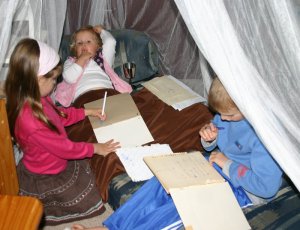
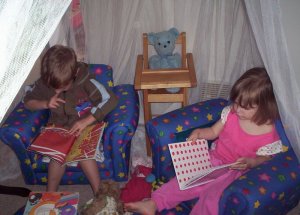
Reading corners When we set up this little reading nook with child and teddy sized chairs, blankets, cushions, pillows, foot rests and crates of books, the children sat and read for hours! Books that they hadn’t had off the shelves in months caught their attention simply because they were put out in full view again and it was like re-discovering old friends. The netting is a mozzie net for a queen sized bed that I loved the idea of and never used in our bedroom because the ceilings were not high enough. It has served as a room divider for countless pretend play areas and the kids love it.

Puppet theatres Hand and finger puppets are easy to make using socks, paper bags, wooden spoons, toilet rolls, felt, fabric, wool, ribbons, stuffed toys and many other readily available items or widely available for purchase. Set up pairs of chairs, use a broom or mop handle to hang the front sheet on and let the creative juices flow. Have periods of rehearsal and performances with the rest of the family acting as the audience. Older children could even write scripts and cooperate together to act out stories or find scripted plays already written by surfing the net or borrow from the library. Video the performances and watch them again later for another rainy day activity.

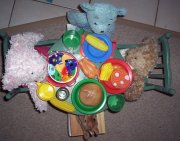
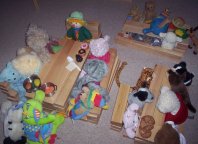
Teddy Bear’s Picnics Everyone has dolls and teddies and when all the favourites are pulled out it makes for quite a crowd. Get out all the pretend food (see ideas under “restaurant” in pretend play above) and provide non-messy snacks like sultanas and Cornflakes for the kids to enjoy as well.

Sheet tents, cubbies and camping games Get out the sleeping bags, pillows, sheets, doonas, suitcases, backpacks, bags and torches and clean off the table for some fun tent making. Couch cushions and lounges also work well, as do chairs. Once the camping area is set up, packing the bags with tonnes of camping necessities will keep them occupied for quite a while. If you have real camping items like billies, folding chairs, 2 man tents etc. let the kids incorporate these into their games. Of course the next question will be “Can we sleep in our tent tonight Mum?”

Jumping mattresses It needs some planning to keep it safe, but some mattresses or piles of pillows and cushions on the floor in an open area and something stable to jump off is a great way to get rid of extra energy. Teach the kids how to do forwards and backwards rolls and award points for the most interesting jumping styles.     

Dancing and moving Don the dress-ups, put on some boppy music and get moving. Double the fun if Mum joins in and great exercise for you too. Play musical bobs, statues, follow-the-leader or other games to keep interest going.

Stocking balls You need a covered back veranda or patio for this but it is a great activity for all ages, particularly older boys. See instructions here.

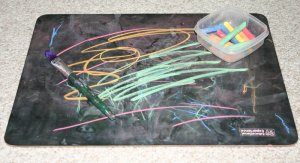
Chalk boards and table activities Not for energy releasing, but when you’ve moved around a bit and want something quieter to do, here is a list of ideas to sit down and do at the table. Surf the net for unlimited art and craft ideas for older children.

Bubble-baths Plop the little ones in a nice deep hot bath and toss in some bath toys, containers, scoops, watering cans and cloths and let them tip and pour to their heart’s content. Set the older children up just outside the bathroom door and read aloud from a good book or listen to an audio book while you supervise the little ones from inside the bathroom. There are thousands of free audiobooks available to download from www.librivox.org (Be aware that most bubble-bath liquids have toxic substances in them. If you are going to use one, do your research and buy a product that is not harmful to your children, especially girls. The suds won’t be quite as good but their health is more important than good bubbles!)

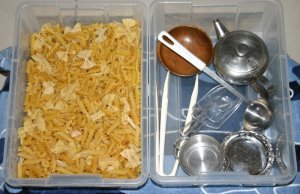
Our pasta play sensory table.

Sensory trays Again, not a physical activity as such but so many ideas to use that will keep all ages going, however many are directed at the toddler and preschooler ages. It’s this age that I find harder to keep well occupied for lengthier time periods anyway, the older children are able to direct the use of their time much more productively. Heaps of ideas and a full explanation here.