Sizzlers and grace.

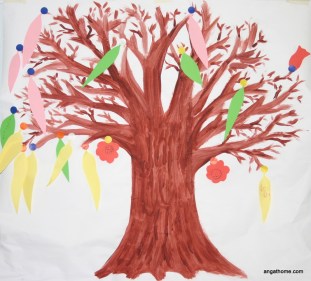
Our treasure tree after a day or two. (It is now quite well covered, but as we had cut up a LOT of leaves, it is by no means full.)

We are going out to dinner in a restaurant tonight. It is the culmination of our treasure tree character reward system. No, the tree is not full, but after reading “Give Them Grace” by Elyse Fitzpatrick we have decided to implement one of her suggestions. She mentioned marble jars and other reward systems and suggested that occasionally we should simply fill them up and have the reward as an act of grace towards our children.

We have been a very intentional recently about the message of grace and how we present the gospel to the children since reading her book. We have focussed more often on how our good works, right living and good character (being a “good” person) cannot earn our way to heaven or gain God’s forgiveness. We have discussed how we will never measure up to the perfect standard that God expects from us.

Of course, the message does not stop there. When we are finally able to admit our sin and see our need for a saviour, we can turn to Jesus and through His death on the cross, bearing the sin of us all, we can repent, receive forgiveness and be made holy in God’s sight.

We presented the children with the treasure tree chart and asked them what they were requires to do to earn their reward.  (Fill the tree with leaves by displaying acts of Godly character.) We asked if they had earned that reward – did they deserve it? As the tree is far from full, they could only say that they didn’t. By this stage, the older children were beaming as they had already guessed what was coming. We then announced that we would be taking them to Sizzlers as a demonstration of grace to remind them to think about the amazing free gift of salvation that they have available to them through Jesus, despite the fact that they haven’t earned it and don’t deserve it.

Who knows whether they will remember this in time to come, or if it will make any difference to their spiritual walk in the long run, but we will all have a wonderful family night out together and who knows what lasting impact it may have?

Family devotions

In my last post I mentioned that it is the Father’s role to lead his family spiritually. In many families this role has been handed over to the church, Sunday school, Christian school or sometimes Mum. While spiritual input from all of these areas can be very beneficial, it is primarily the Father’s responsibility. One tangible way that Dad can take hold of this role is by leading his family in daily devotions (sometimes known as family alter or bible study time.)

WHAT ARE FAMILY DEVOTIONS?

  • Regular bible study with the whole family. This time can also include worship (in the form of singing), prayer, and possibly catechism and scripture memorization. Catechism and scripture memorization are both important, however some families do them separately at other times throughout the day.

WHY SHOULD WE DO IT?

  • In short – God tells us to! It is not enough to take our children to church and youth group and hope for the best. We must disciple our children, teaching them in our homes, with the Father as the primary lead in this area.
  • We become the prime spiritual influence in the lives of our children – it allows us to shepherd our children’s hearts; preparing their hearts for the gospel and salvation, building their faith and strengthening a biblical worldview.
  • Worshiping and communicating with God is vital for the whole family, not just Mum and Dad.
  • It promotes personal spiritual growth, helping us (and our family) to learn the bible, it’s doctrines and teachings in order that we know what we believe and why. If our children do not know God’s word they will be unable to honour, respect and live by it. Children need to learn that the bible tells us what to do and gives us insight for daily life; that it is relevant to them and their everyday situations. As families study together, parents can weed out errors in belief and misunderstandings
  • Worshiping and studying God’s word together builds family unity, strengthening and building healthy family relationships.

HOW DO WE DO IT?

  • The “how” of family devotions changes with each family’s unique situation, time constraints, ages of children and a myriad of other factors. Find a way that works for you and do it – regularly!
  • Decide where; Lounge chairs, around the dining table, on the end of beds, sprawled on the lounge room floor…
  • Decide when; As soon as the family is awake, immediately before or after a meal, after dinner clean-up, just before bed? Ideally choose a time when children are fed and well rested.
  • Decide how long; this depends on the age of the children. Keep it to a reasonable time limit, but not so short that you cannot give adequate attention to God’s word.

TODDLERS AND YOUNGER

  • Give thanks before meals. Hold the child’s hands and encourage them to join in with “Amen” at the end. Encourage them to echo or say simple prayers as they are able.
  • Pray with and for the child at bedtime
  • Have your own devotions in front of the child
  • Read short, colourful bible stories. Perhaps ask a simple comprehension question or two afterwards.
  • Sing simple bible based children’s songs together
YOUNG CHILDREN TO MIDDLE YEARS
  • Bible stories are still important, branching out into the lesser known ones.
  • Spice up your devotion time by acting out stories, using puppets or pictures, involving the children in role play and re-tell.
  • Introduce real-life stories, applications and real Christian “heroes”
  • Ask questions for comprehension and real-life application of what they have read; “What would you do if..?”
  • As children can read, have them take their turn to read out the verses being studies.
PRE-TEEN TO TEEN
  • Discussion, sharing and engagement become much more important.
  • It’s ok to not always have the answer – model how to find out.
  • Personal devotions for the children should be well and truly up and running – perhaps set “homework” and discuss together, work through devotional books together or research tricky questions.
  • Discuss current affairs and politics and the biblical basis for decisions making in these areas. What are the biblical rights and wrongs of what is going on?
  • Teens take time – make sure you plan for it!
MULTIPLE AGES
  • Beware of dumbing everything down for the younger children, they will pick up more than you think.
  • use a mix of resources; some days may cater more for the younger, others the middle or older.
  • Young children may stay for the first part of devotions then head off to bed while the older children delve in more deeply.
  • Involve the older children in planning and running the devotion time.
  • Everyone may do the same bible study together, with younger children having a children’s bible story at night before bed and older children working through separate studies in the evening

FORMAT

  • Sing together. Perhaps a kids bible song, contemporary worship song  and a traditional hymn. Do not neglect the great hymns of the faith; the words in these will teach spiritual truths to children and will lodge in their memories for a lifetime. Voddie Baucham’s article on family worship touches on why we should sing hymns: http://web.me.com/voddieb/vbm/Blog/Entries/2009/11/5_Answering_Your_Questions.html
  • Study the bible. There are many ways to do this. A couple are: Chapter by chapter (simply work your way through books of the bible from start to finish in small chunks), following a theme or topic or read 1 proverb, a section of a psalm and a couple of verses from the New Testament each day.
  • Several great ideas are included in an article by Al Troester here: http://www.wholesomewords.org/family/famaltar.html)
  •  Perhaps Dad could read through the selected text to begin with, then ask those children who can read to take it in turns to read 2 lines each and those who cannot yet read to echo the words of each verse after you. Dad then teaches back through the selected text – children are asked to contribute to discussions or ask questions after he has explained each line or two. Each person finishes the bible study section by telling something they have learnt or can apply to their own lives. Always look for the applications and personal lessons after each reading and teaching time.
  • Pray. All family members take a turn to pray for whatever is appropriate that day. It is helpful to have some kind of prayer journal or recording system to help with purposeful prayer and to notice the answers to prayer that God gives us. Record the date it was prayed for, what was prayed and leave a column to record God’s answer.
  • Catechism. The catechism is a series of questions and answer that children memorise to learn the main doctrines of the Christian faith, building a strong foundation for world view and ensuring they know what they believe. (More info on this another time:)
  • Scripture memorization. (More ideas on how to do this another day too 🙂


Children who stand strong in their faith: Walking against the crowd

One of the topics raised amongst our GEMS leaders a little while back was how to go about raising children who are able to stand strong in their faith even when no-one else is walking with them and they are away from the sheltering influence of their parents and family. How do we prepare them to be in the world but not of the world; to be able to choose the narrow path and walk against the flow? (Even if that means standing alone because “every one else is doing it!”)

I believe the key is that our children must develop their own genuine saving faith and not be relying on ours to carry them through. They must have the Holy Spirit as their strength and their own conviction to stand on God’s word and to follow His commandments and statutes. Our teaching as parents must be overt, deliberate, ongoing, free from hypocrisy, giving a good role model and above all, reaching the heart of our children. Our teaching will be molding the external behavior of our children, but this must transition to heart knowledge, to the child internalizing the beliefs for themselves. We can only do so much here and pray that God will do the rest. In the end, when a difficult test comes, only if our children have chosen God and His ways for themselves will they make the difficult decisions and stand alone if necessary, because otherwise they simply will not want to!

Dads should be leading their family spiritually. There are many ways to do this, including holding family devotions, leading world view discussions on current affairs, discussing what they believe and why and relating that back to the bible. Be deliberate in teaching the bible, memorizing scripture, training character, reading inspiring books with a message and praying together. Soak your children in the beliefs, understandings and world view you want them to have well before a time of testing will come. Decisions made ahead of time without the emotions and pressure of the heat of the moment, decisions that have been discussed, thought through, prayed over and become an internalized way of life will not be overturned quickly. We all can think of actions and decisions made in the heat of the moment that we wish we could change and would have done differently had we previously thought through the issues involved.

You shall teach them diligently to your children, and shall talk of them when you sit in your house, and when you walk by the way, and when you lie down, and when you rise.

(Deuteronomy 6:7 ESV)

We need to keep the lines of communication open; talking about everything. Make time alone to share, bond and discuss those innermost thoughts and feelings. Work to surround your children with peers who are being raised with similar convictions, standards and beliefs. Two or more standing together is so much easier than one standing alone. Foster a close relationship. Fill their love tanks. A child who knows that they are unconditionally loved by their families will have an extra inner reserve of strength to stand firm. A needy, empty child will turn to those who fulfill those needs that are not being met at home.

Certain personalities will be more naturally able to take a leadership role and less likely to blindly follow the crowd. All of us need to be able to make the hard decisions though and learn not to follow when the leaders are leading in the wrong direction. Teach your children about personality types and love languages. Help them to identify their own strengths and weaknesses and areas that they will have to be particularly vigilant in. Help to identify why they feel the way they do and to be able to be objective about their decision making.

Guard your child’s ear and eye gate. Give them excellent literature to read that portrays great role models and biblical worldview; do not pollute their innocence with worldly ideas through literature, magazines or on screen. Choose television programmes very carefully or better still get rid of the T.V. completely. The more exposure to non-biblical thinking we give our children the more they will be subtly bought into the idea of the world’s norms and tend to adapt them as their own. Slow attitude change is often hardly noticeable but Hollywood has its own agenda and it shouldn’t fit with ours as Christians. If the role models they are watching and listening to are “doing it” then children are being nudged in that direction and may begin to normalize non-biblical behaviour and accept it as ok.

Shield your child by not putting them into situations that will likely test them before they are ready to handle it. Be aware of the scenarios faced at sleep-overs, parties, weekends away and the like. I had good friends who were fairly like-minded, with careful parents. It was only through the grace of God however that I came through the parties, sleepovers and get-togethers we attended relatively unscathed. I’m sure my parents would have been horrified to know what went on at some of the places we went to – even those with so-called responsible adults in attendance!

Substitute inappropriate situations with alternatives if there are such available. For example, the end of year 11 was a time to go away camping with all the highschoolers and a time of drinking, partying and a lot of other things we don’t need to list. There was no way my parents were prepared to let me go away unchaperoned and luckily for me many of my friends’ parents felt the same way. My Mother volunteered to take us all camping and attended as the supervising adult (much to my embarrassment at the time.) She did turn out to be remarkably “cool” and as it was this or nothing everyone came and we had a great time together.

There are no easy answers and no quick fixes. Equipping our children to stand strong on their convictions is a process and we build on to that equipping every day for years.

  [9] And let us not grow weary of doing good, for in due season we will reap, if we do not give up.

(Galatians 6:9 ESV)

Copywork and narration ideas for the new school year.

The school year start is fast approaching and I am aiming to be extremely organised as we will be interrupted soon into it by the arrival of baby number 6. Everything needs to be sitting there, prepped and ready to go, so today’s thought processes revolve around Charlotte Mason style copywork and dictation for the oldest.

Depending on the age of the child, this year’s copywork and dictation will be a selection from the following:

At least one of my children is excited by brand new fresh workbooks and the opportunity to fill them with beautiful work. I remember the feeling of being given a brand new pad in Primary School and ruling up those fresh unblemished pages. Surely everyone gets at least a glimmer of excitement out of new school books? Stationary shops? Organisational systems?? Hmmm, perhaps that’s just me!

Family Devotions with Joel Beeke

I highly recommend listening to Joel Beeke (here) as he speaks at the Conference for Pastors on Family Worship. He gives a simple yet profound message on the importance of family worship (family devotions/bible study time) with tips on how to go about doing it successfully. I think most Christians would agree that having time together as a family to study God’s word is important, but many find it difficult to know how or where to start. This talk may be what you need to get you equipped and off and running as you seek to lead your family to Christ.

Christmas traditions: Jesse tree symbols


As we continue to get organised for the advent season, I have put together a list of the items I want to collect for our Jesse tree this year. There are many different versions of the traditional readings (bible verses) for each day of December and the key characters to be included on the Jesse tree. The list below contains the ones we are focussing on this year and next year we will add completely different symbols, representing over time as many different parts of the bible as possible. I may end up swapping out a couple of these bible characters for others if I have trouble finding a suitable symbol.

Down the left are the “characters” and in brackets to the right are possible symbols for each. Readings can be found on so many different websites, I haven’t listed them here but I did include some links on my last Jesse tree post.

  • God (sun, Earth)
  • Adam & Eve (apple)
  • Noah (ark, dove, rainbow)
  • Abraham (tent, stars, camel)
  • Isaac (stick bundle, ram)
  • Jacob (ladder)
  • Joseph (coat, sack of grain)
  • Moses (burning bush, baby in basket, reeds)
  • Israelites (lamb)
  • God (10 commandments stone tablets)
  • Joshua (ram horn)
  • Gideon (clay pitcher, sword)
  • Samuel (crown, lamp)
  • David (shepherd’s crook, harp, 6 pointed star of David, sling shot)
  • Elijah (alter, raven)
  • Hezekiah (tent)
  • Isaiah (tongs, hot coal, scroll)
  • Jeremiah (tears, hand)
  • Habakkuk (watch tower)
  • Nehemiah (city wall, trowel)
  • John the Baptist (shell, fish)
  • Mary (white lily, letter M)
  • Elizabeth (Mother & child, letter E)
  • Zechariah (stylus & tablet)
  • Joseph (hammer, saw)
  • Magi (star, 3 gifts, 3 crowns)
  • Jesus (manger, star)
  • Christ (chi-rho symbol)

Christian families and Father Christmas

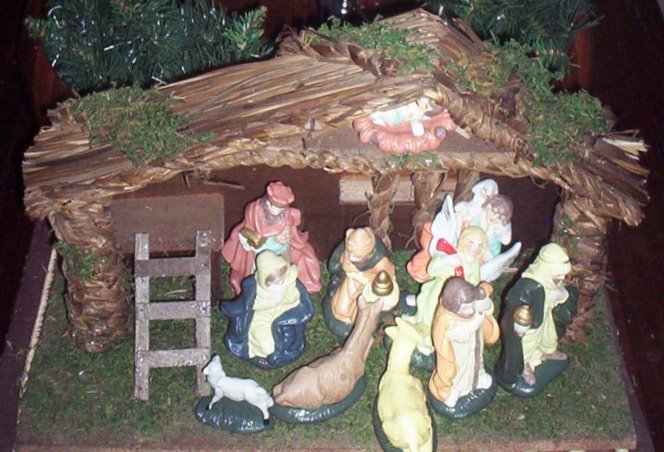
The children love to play with this nativity scene. In case you are wondering, baby Jesus is up in the hay loft.

I must admit, I hesitate to write this post knowing that many readers will disagree and perhaps even be offended. I apologise in advance to anyone who is offended but think that the topic is important enough to broach. I hope you will approach what I have to say with an open mind and make your own judgements based on biblical understanding and after prayerful consideration.

With Christmas decorations hitting the shops, I have turned my thoughts towards this year’s Christmas celebrations and plans. Is it possible to celebrate Christmas with Father Christmas or Santa Clause and still be honouring to God? Can we participate in all the pretend and story telling that goes along with it without lying to our children? How can it be ok to deliberately lead our children to believe that something is true when it clearly is not? The bible tells us that God is truth and Satan is the Father of lies. (John 8:44) Is it all just harmless pretend and imagination, or has it gone one step further than that?

We teach our children that being truthful and honest at all times is right and pleases God and tell them that pretending is fine as long as others know you are pretending. If our children report an event or happening to us that is not true, without making it clear that they are “telling us a story” or “pretending,” we treat this as lying and give appropriate consequences. I can’t reconcile that standard with telling them the traditional Santa tales, knowing that they fully believe every word of it to be true.

Why do many of us celebrate Christmas with the Father Christmas myths as a central part? For most of us, we grew up with it and loved every minute and our families (parents and extended family) may be upset if we decided to make a change. Many also seem to think that their children will miss out on the “magic” of Christmas. Some say they grew up with Santa and are still Christians so therefore there is no harm at all in doing it with their own children.

We are living in a time when reportedly up to 80% of those making decisions for Jesus walk away from the church or “backslide” as we often term it. Why take the chance with anything at all that could potentially harm our children’s faith?

We all know there will come a time when children will work out for themselves that Father Christmas isn’t real, but after years of hearing from trusted parents that he is real (and often that the Easter bunny and tooth fairy are also real), is the next step to question whether Jesus is real or just another pretend that Mum and Dad have told over the years?

At this time of year it’s hard to steer clear of the commercialism of Christmas and keep the focus on celebrating Jesus’ birth where it should be, without adding reindeer stories and Father Christmas into the mix.

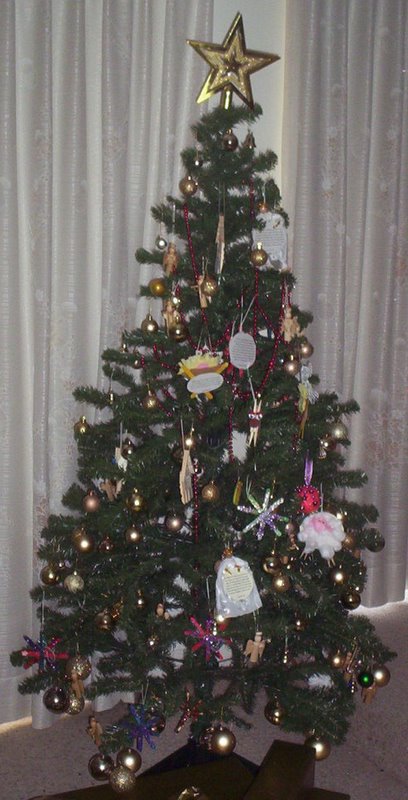
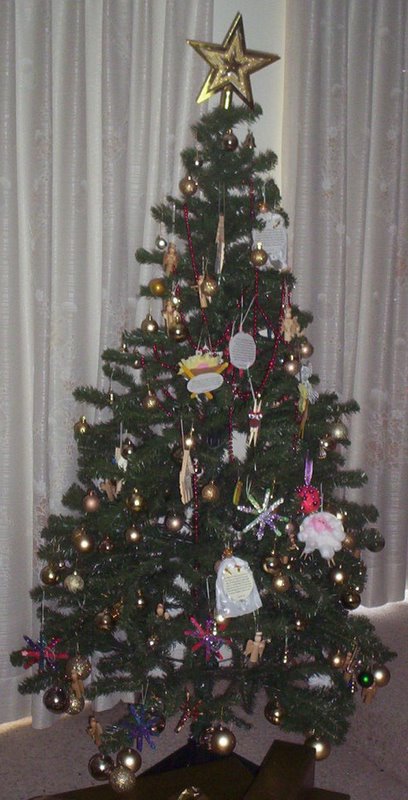
We feel that we can still make Christmas a wonder-filled time of joy and fun without involving Father Christmas at all. We do give gifts, but the focus is on celebrating Jesus’ birthday and the tradition of gift giving started by the wise men at Christ’s birth. We have a tree, but it is a Jesse tree with the symbols on it related to bible stories. We spend time together making decorations and dressing the tree, eating special Christmas treats and listening to joyful Christian Christmas music. We have an advent wreath with candles to light as we read Christmas devotions and other special Christmas stories set aside for just this time of year. We cook together, hold family get-togethers, feasts and invite special visitors and are endeavouring to build many other Christmas traditions to knit us together as a family.

Our children love Christmas and look forward to it with as much joy, anticipation and excitement as I think I ever did and we can have the peace of mind and clear conscience of knowing that we are striving to teach them to love God with all of their mind, soul and strength and endeavouring not to steer their hearts and affections away from God in any way. Just because something is traditional, cultural, I personally grew up with it and society promotes it doesn’t mean it is right.

We do teach our children the legend of Saint Nicholas and some of the possible origins of the Father Christmas tales. We also teach them that children from other families believe Father Christmas is true and it is not for them to tell them otherwise.

I encourage you to think the issue through, talk it over with your spouse, pray about it, read your bible and come to a decision for your family that is Godly and right.

Christmas traditions: Our Jesse tree


(Updated to add: See photos of the finished ornaments here,  a list of stories and symbol for each day here, advent and Christmas tradition ideas here or for a different take on Jesse trees, see our names of Jesus Jesse tree symbols.) 

I know it’s only November, but Christmas is fast approaching. Every year I have grand plans for advent style activities, but before we know it, December has started and I’ve missed the beginning again. Not this year!

In the after Christmas sales last year I ordered a bunch of books and several of them are meant to be read on a daily basis leading up to Christmas. These will be out and plans for our Jesse tree are underway (in my head anyway!)

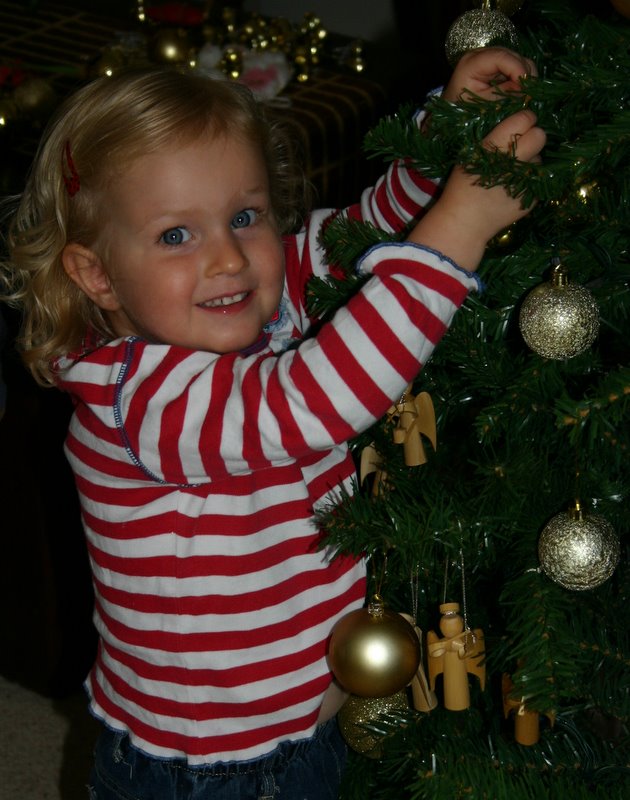
We have two Christmas trees already – a small one and a much larger tree. I have always loved decorating a beautiful tree and making it “just so” and didn’t want to add the children’s handmade decorations to “my” tree. Thus the little tree was theirs and the other was Mummy’s! As of last year however, I finally let go of my idea of a perfect tree and handed it over to the children. I arrived at this decision after allowing them to help me decorate my tree (after much begging and pleading) and finding the whole episode frustrating and annoying.

Later I sat down and reflected on the whole event. I want to create loving and memorable family traditions that the children will remember fondly throughout their lives and perhaps even carry on with their own family. Traditions are one of the ways we can create family togetherness – they knit us together. Decorating the tree should be a wonderful time of family togetherness and fun; not a time of grumping and correcting about how it was done. Sooo… my tree has gone and the large tree is now the family tree with everything on it (yes, I mean everything, sigh) and the smaller tree will act as our Jesse tree until the number of symbols builds up to the point we need to move to the bigger tree.

What is  a Jesse tree?

The Jesse tree is a representation of Jesus’ family tree. Jesse was the Father of David and God promised David that his kingdom would last forever. It was through David’s  line that Jesus comes and the symbols used on it traditionally represent those in Jesus’ family tree.

It is called the Jesse tree because of this verse in Isaiah 11:1-4:

A shoot will come up from the stump of Jesse; from his roots a Branch will bear fruit. The Spirit of the Lord will rest on him – the Spirit of wisdom and of understanding, the Spirit of counsel and of power, the Spirit of knowledge and of the fear of the Lord. He will not judge by what he sees with his eyes, or decide by what he hears with his ears; but with righteousness he will judge the needy, with justice he will give decisions for the poor of the earth. (Isaiah 11:1-4)

Rather than sticking to the traditional Jesse tree symbols, we plan to keep adding more and more symbols from as many bible stories as we can each year. I plan to collect objects from around the house, decorations we already have that match a symbol (eg, an angel) and buy a couple more every year to expand the collection. The children will make some cardboard creations, however I also want to collect a bunch of pre-made symbols that can be hung daily without us having to make something. Last year we started with the idea of making a symbol every day but it was just too hard to keep up. This year we will make a few and add a few.

Here are some useful links. Keep in mind that most of them are Catholic websites so use them as a guide and modify the readings and symbols chosen if desired.

http://www.cresourcei.org/jesse.html Lots of information about Jesse trees, including a very useful table of themes, scripture readings and symbols

http://www.domestic-church.com/CONTENT.DCC/19971201/FRIDGE/FRIDGE1.HTM Symbols with readings that can be copied, coloured and cut out to make your own homemade Jesse tree. Click on the symbol downloads to see the scripture references.

http://www.catholicculture.org/culture/liturgicalyear/activities/view.cfm?id=545&repos=3&subrepos=1&searchid=801729 Scriptures and ideas for objects that may represent them – some alternative ideas here.

http://www.shalfleet.net/advent/makeajessetree.htm Scroll down this page for more scripture readings and several alternative symbol ideas.

Hell’s Best Kept Secret

We have fairly recently come across the teaching of Ray Comfort. He is a preacher and evangelist with a strong message that no Christian should miss. “Hell’s Best Kept Secret” and “True and False Conversion” are both available for free download here. With information pertinent to any believer (or non-believer) and vital for us as parents seeking to prepare our children’s hearts for salvation, this message explains why around 80% to 90% of those making a decision for Christ fall away from the faith. Don’t let your children or loved ones miss out on this vital teaching. The book “Hell’s best kept secret” is available here.

Circle Time

I came across the concept of circle time through a homeschooling friend who directed me to Kendra Fletcher’s blog Preschoolers and Peace. I purchased her e-book about circle time and found it full of great ideas and well worth the $6.99 I paid for it. The basic idea of circle time in our family is starting the day with God as our priority and focus, before the business of everything else that we do crowds in and takes our attention away from where it should be. It ensures that we all (apart from Dad who has left for work at this time) spend some time together before we split up to begin our “school” subjects for the day. Circle time is not the same as family devotions (Dad does that in the evenings) and although everything we do at this time links to the bible in some way, it is not necessarily a bible study time. Circle time can be used for a huge variety of things with memorization and character based activities a focus for us. I love the idea of praying together, memorizing scripture together, teaching the children good character etc. but find that these areas tend to get neglected if I am not intentional about it. At the moment we start our time with some scripture memorization through song, followed by a character story, catechism story or one of our other great resources (I will post a list of more of my favourite resources soon) and finish off with a prayer time together. The children really enjoy the time and it makes for a positive start to the day.

Children Arise CD Volume 2

The Children Arise CD’s are scriptures set to music. They are very professionally done with catchy tunes that you find yourself humming through the day and don’t actually mind! I play the same verse each day for a week and at the end of the week the children receive a certificate if they have memorized the scripture. Even my 3 1/2 year old remembers the verses this way and they all love having a record of what they have achieved through the certificates, with each one having the verse printed on it. 9781605771342

We are reading through the “Help Me Be Good Series” by Joy Berry (they are not Christian and occasionally need verbal editing as I read!) and the children love them. We talk a lot about each page and how we can apply the positive character traits in our lives with each other. We are half way through “The Way of the Master For Kids: Teaching Kids How To Share Their Faith” by Ray Comfort and Kirk Cameron. Their adult materials and free sermons are great and we are enjoying this book with their signature message written for kids. The book has three age sections, starting with the very young and moving up, but the younger kids are having no trouble at all understanding the sections that are written for the older children. The Way of the Master for Kids: Teaching Kids How to Share Their Faith