Toddler bags for out and about: How to get through a restaurant meal with a toddler.

IMG_8763

Any parent of young children knows that a meal out in a restaurant can be taxing with a toddler in tow. There are ways however to minimise the stress and make it a pleasant experience for everyone.

Firstly, train your child at home to sit in their highchair after meals for a period of time with a few toys or activities, or perhaps a book or two and include playpen time (or room time) and mat time in your daily routine. Having these daily periods where your child is used to happily playing with the toys you give them, whilst staying within a boundary, is excellent preparation for other occasions when they will need to sit quietly for a longer than normal stretch of time.

Spend a little time preparing some new and interesting activities that are kept aside for use while you are out. Either purchased toys and books or some simple (and cheap) home-made ideas like the ones that follow. Toddler’s generally do not have a well-developed imagination and tire of toys that don’t “do” something relatively quickly, so having to buy new things continually to keep up with their changing developmental needs and interest can become very expensive. These home-made toys are great for developing fine motor skills and hand-eye coordination and when introduced at the right developmental level, will be stimulating and interesting for your young child. If a task is too easy it will not hold their interest. Too hard and they will become frustrated and lose interest.

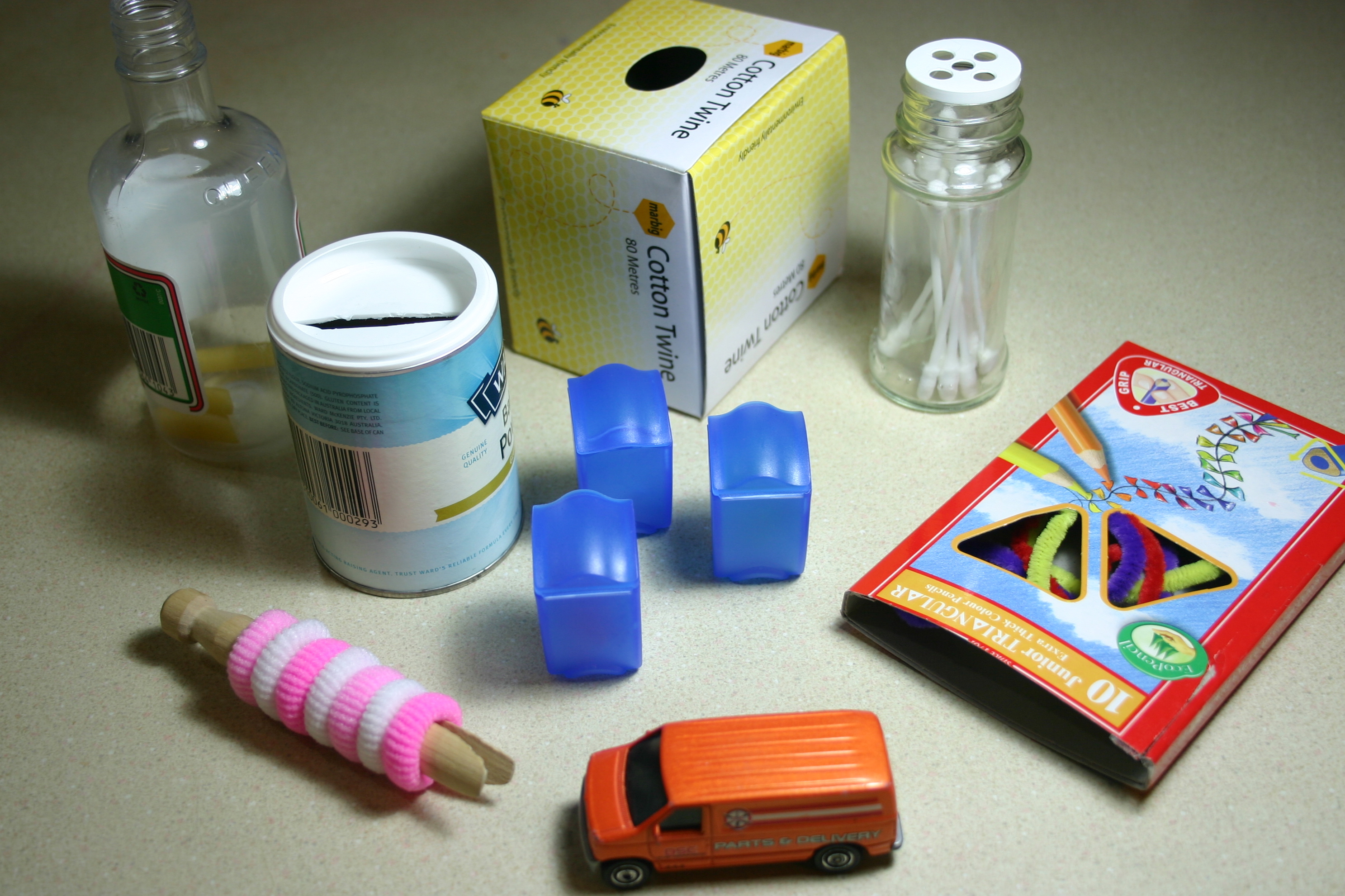
This is the bag of “toys” I put together for my 18 month old to use during a lunch we attended on the weekend. He only used a couple of them as I bought them out one at a time and only changed them over when necessary.

IMG_8759

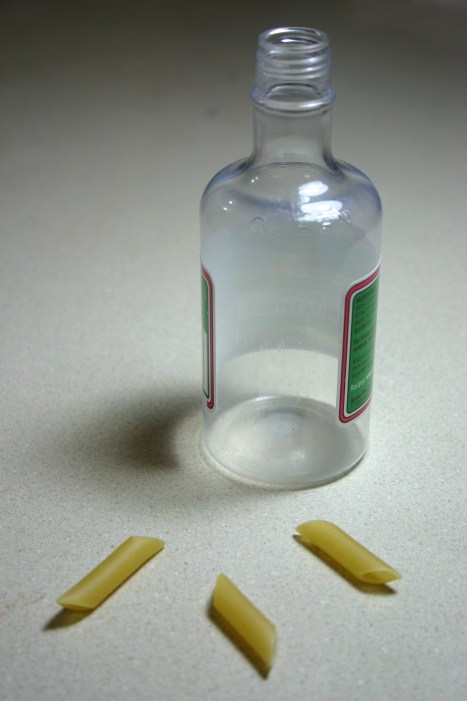
Posting bottle: Posting noodles into an empty vanilla bottle and tipping them back out again.

IMG_8761

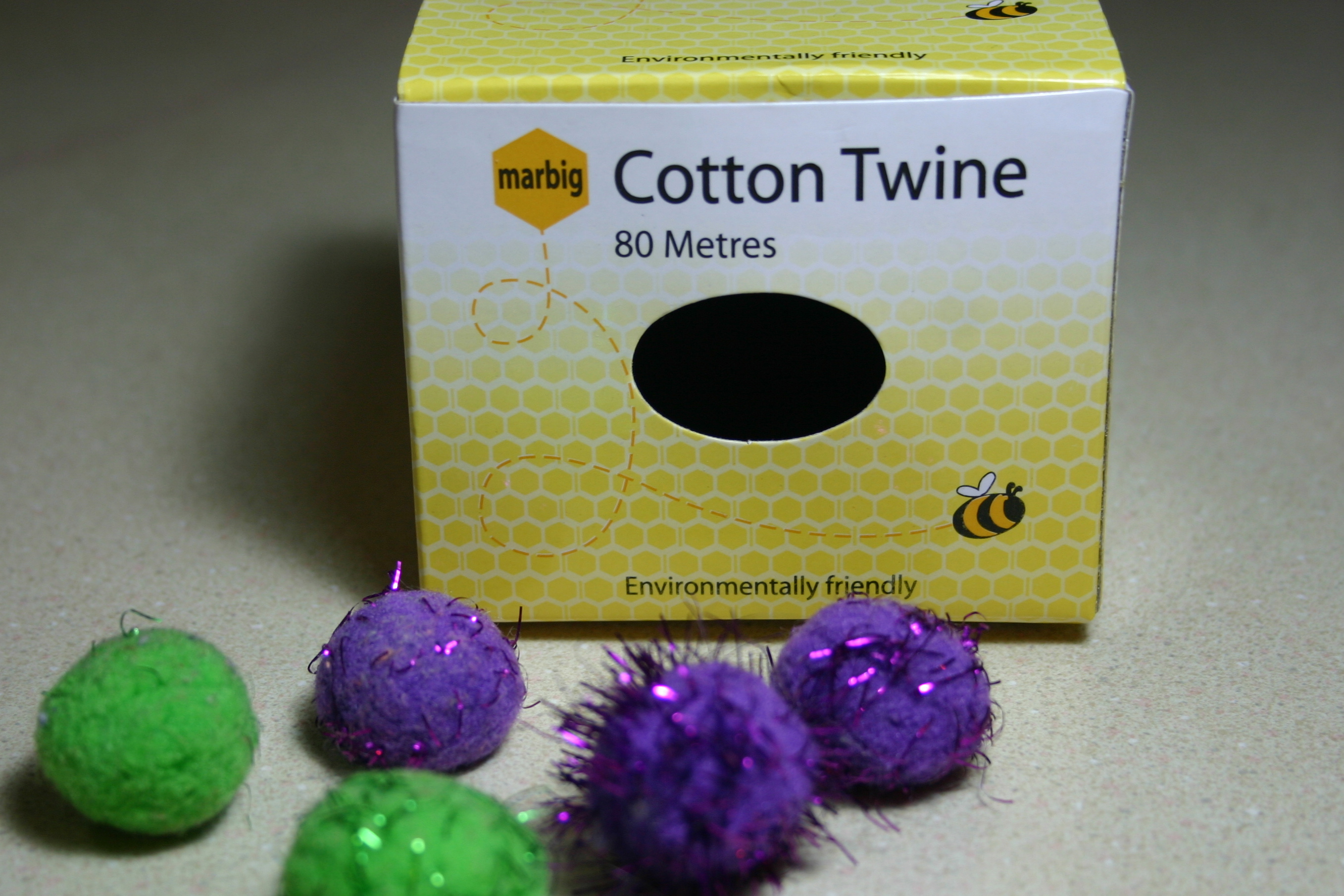
Posting box: Pushing pompoms into the hole in this twine box. Help is needed to open the box to tip them out again but as we are sitting right next to him this is not a problem.

IMG_8758

Small spaces jar: Posting earbuds into a spice jar with holes in the lid. He discovered after I had taken off the lid and tipped them all back out about 5 times that he could shake them out one at a time through the holes so that added a new dimension to the activity.

IMG_8752

Posting tin: Posting plastic poker chips through a slot into an empty baking powder container. Yes, I know, it’s another posting activity. But at this age, my son LOVES to post stuff so I’ll run with that for a while and change when he is no longer so fascinated!

IMG_8754

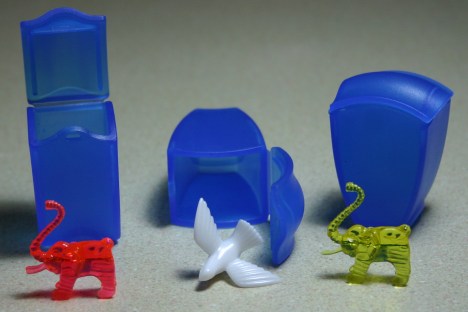
Surprise boxes: Opening and closing these little pill containers to find the small toy inside is great for fine motor development.

IMG_8749

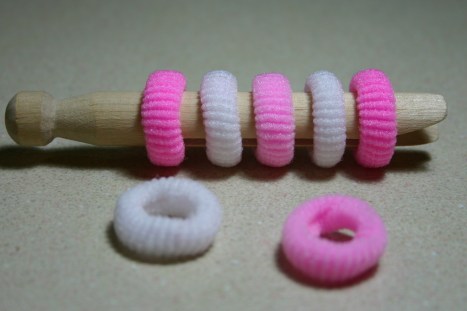
Dolly peg and hair bands: Sliding hair ties on and off a wooden dolly peg may be a little difficult for him but we will give it a go and see what happens. I haven’t used this one yet.

IMG_8750

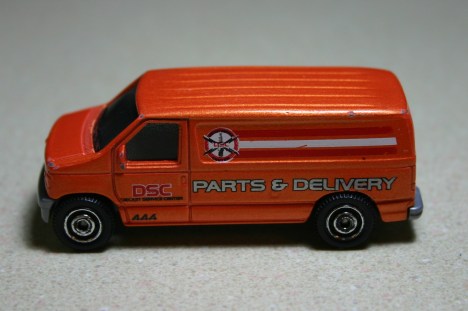
Dinky car: Having older siblings means that interest in cars has developed early and he knows how to play with them form observing his brothers.

IMG_8755

Pipecleaner box: Shoving them in and out and bending them into different shapes could be fun. (We haven’t done this yet either but I remember one of my older children using this idea as a toddler and spending a very long time poking the ends into the small holes in the chair he was sitting on.)

IMG_8764

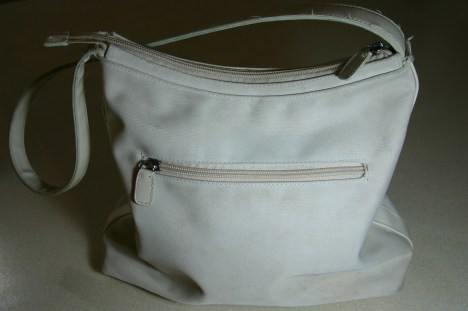
This old bag is how we cart the activities around. The fact that it has several different compartments as well as zips means that it is an activity in itself.

Having children will certainly change your life, but it shouldn’t stop you from doing the things you love. Train your children and you will reap the benefits.

Other posts you may find helpful:

Mat time on the go

Activities to make for toddlers and babies

Buffet training

Arsenic hour and toddler meltdowns

Toddler busy boxes

b and J using animal busy box IMG_8561

Toddler busy boxes are part of our flexible daily routine. They help me to homeschool  older children or get some chores done while my toddlers and preschoolers are well occupied on a worthwhile task.

busy box cupboard IMG_8556Our busy boxes (and ziploc bag activities, tot school, workjobs, shoebox tasks, preschool or Montessori style tray activities) are only available at certain times in the day to keep them fresh and interesting and to stop them getting spread throughout the house. We use them during school time in the morning and for table activities while I am getting dinner on the table in the evening. That way I do not need to change them too often because the children’s interest stays high and I can also keep some degree of supervision over the messier trays to avoid major pack up sessions afterwards.

They are also excellent to use for buddy time when an older child is assigned to play with a younger sibling. This is useful for example when the younger children have already finished playpen or room time and I just need an extra 20 minutes or so to finish working with one of the older children to complete their school activities. Turning toddlers loose to wander unattended throughout the house is bound to end in trouble, so some time with an older sister or brother gives the older children a break from their school work and builds good sibling relationships at the same time. The older children enjoy the responsibility because they do not get asked to do it all the time or for very long periods of time. It also gives them an excuse to play with all those attractive tubs as well!

This set of busy boxes is for my 3 year old twins, but many could be adapted to suit toddlers and older babies too. There are heaps of ideas on my other posts for the younger age group.blocks and animals IMG_8554Plastic animals and wooden blocks for building corals, zoos, farms and houses. Jenga blocks work well too.

counting Duplo blocks IMG_8550

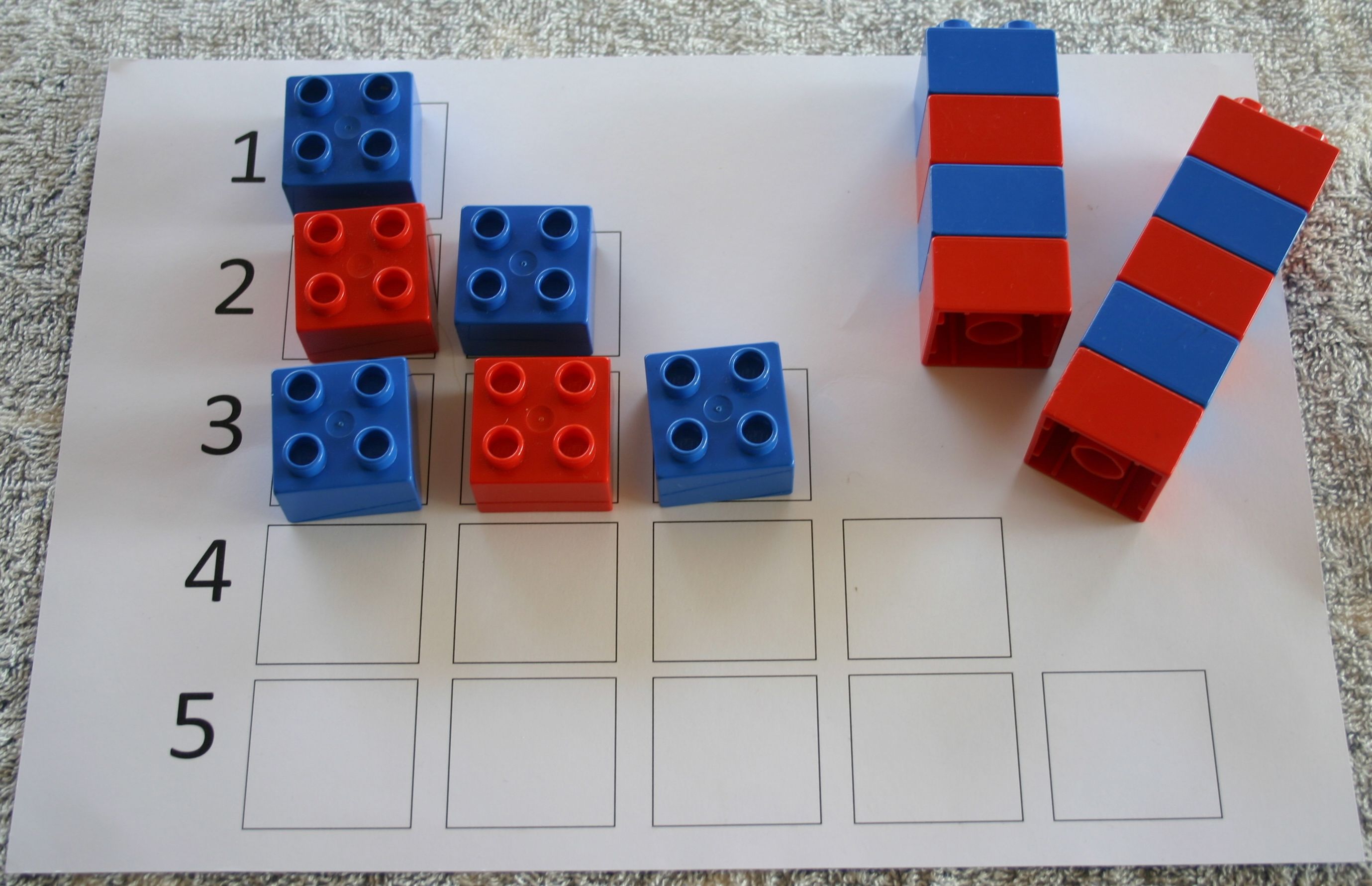
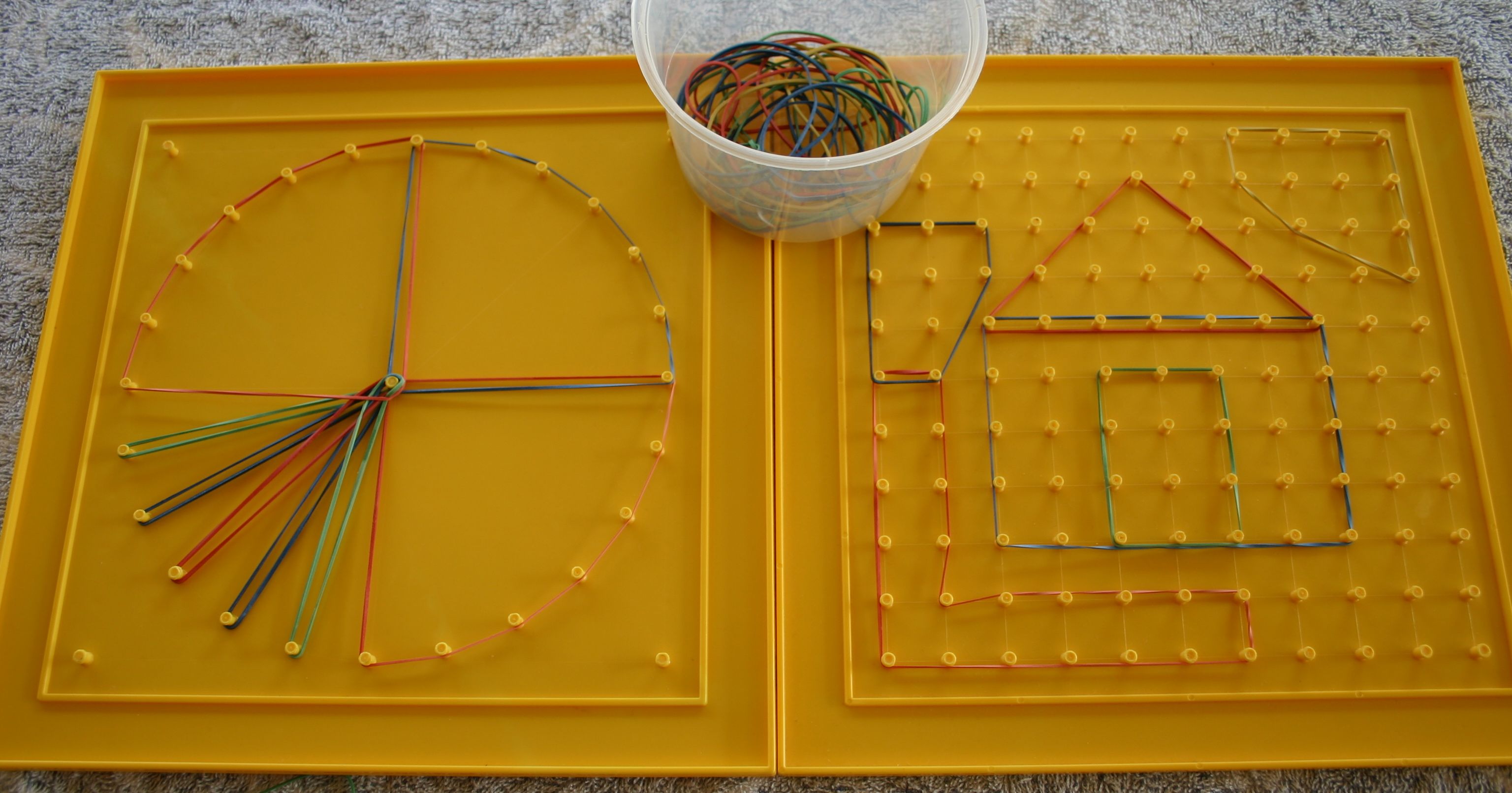
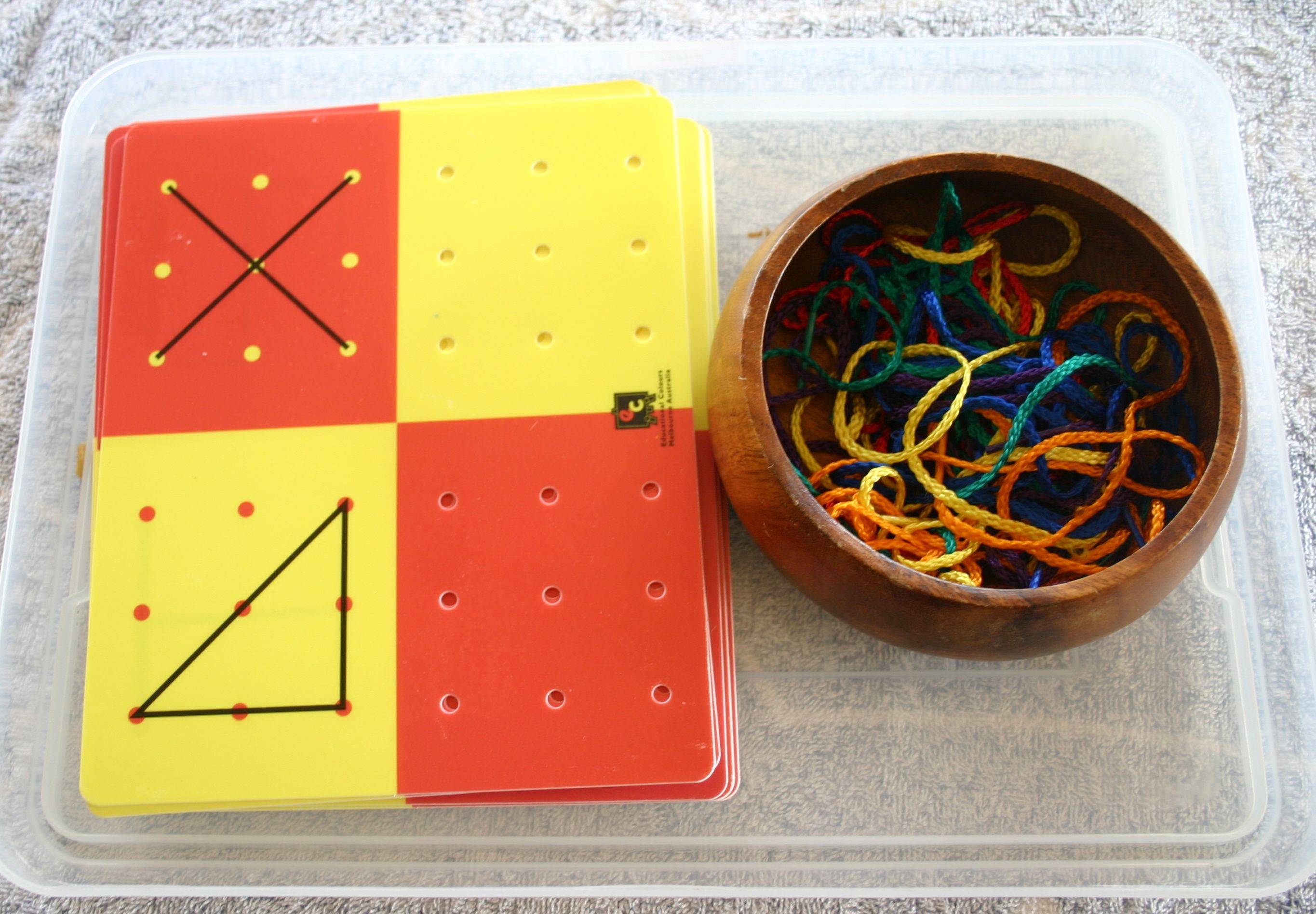
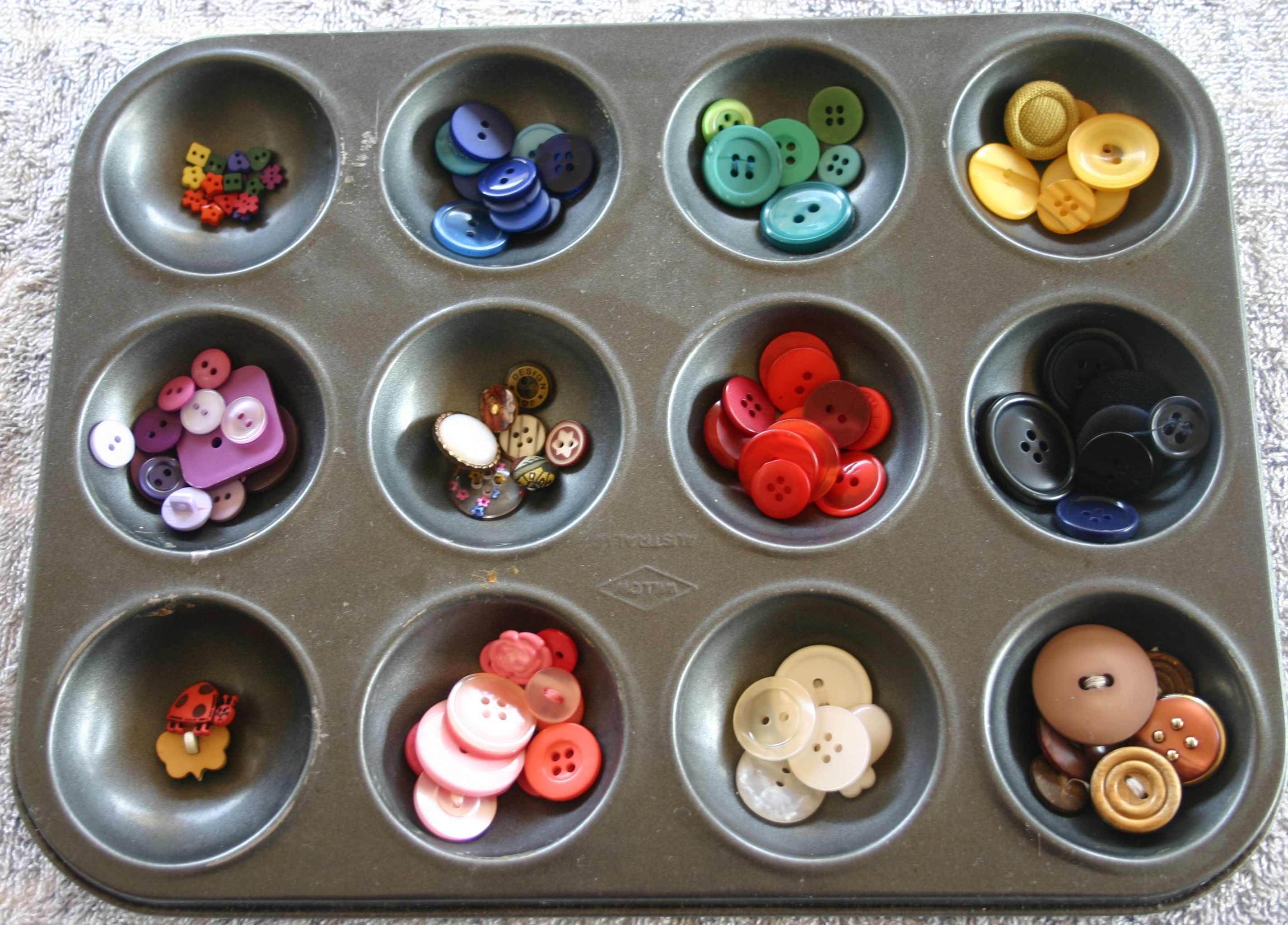
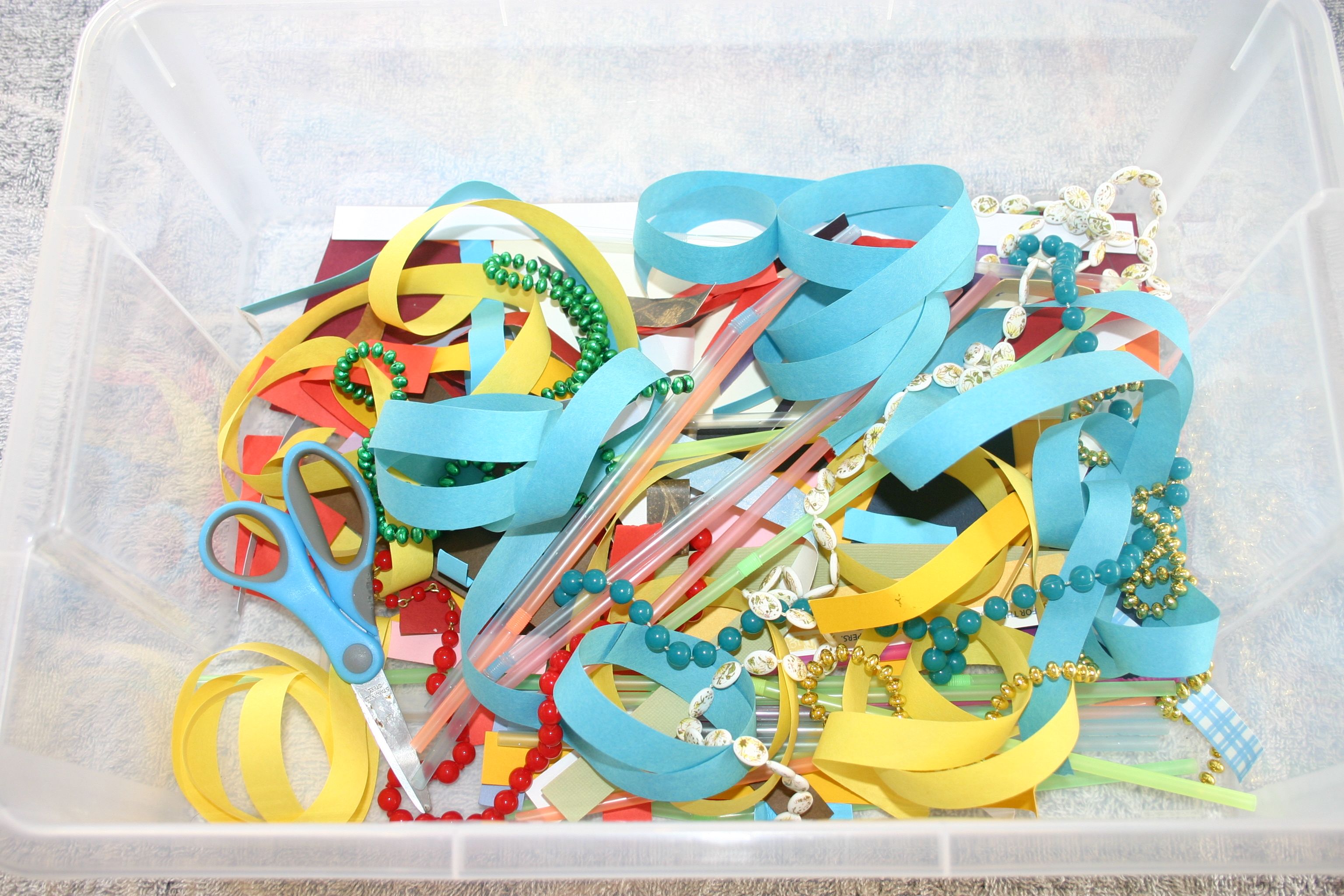
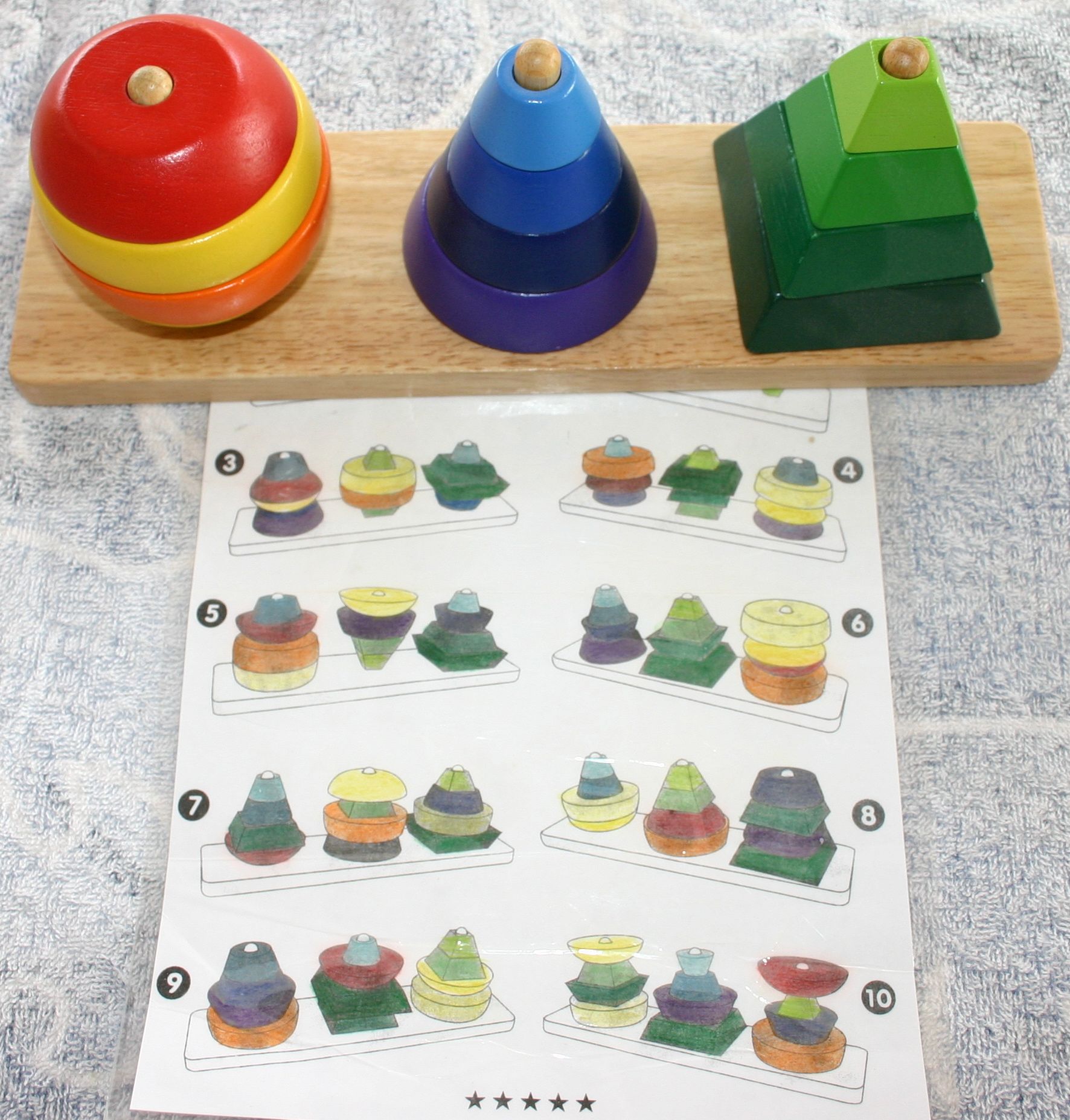
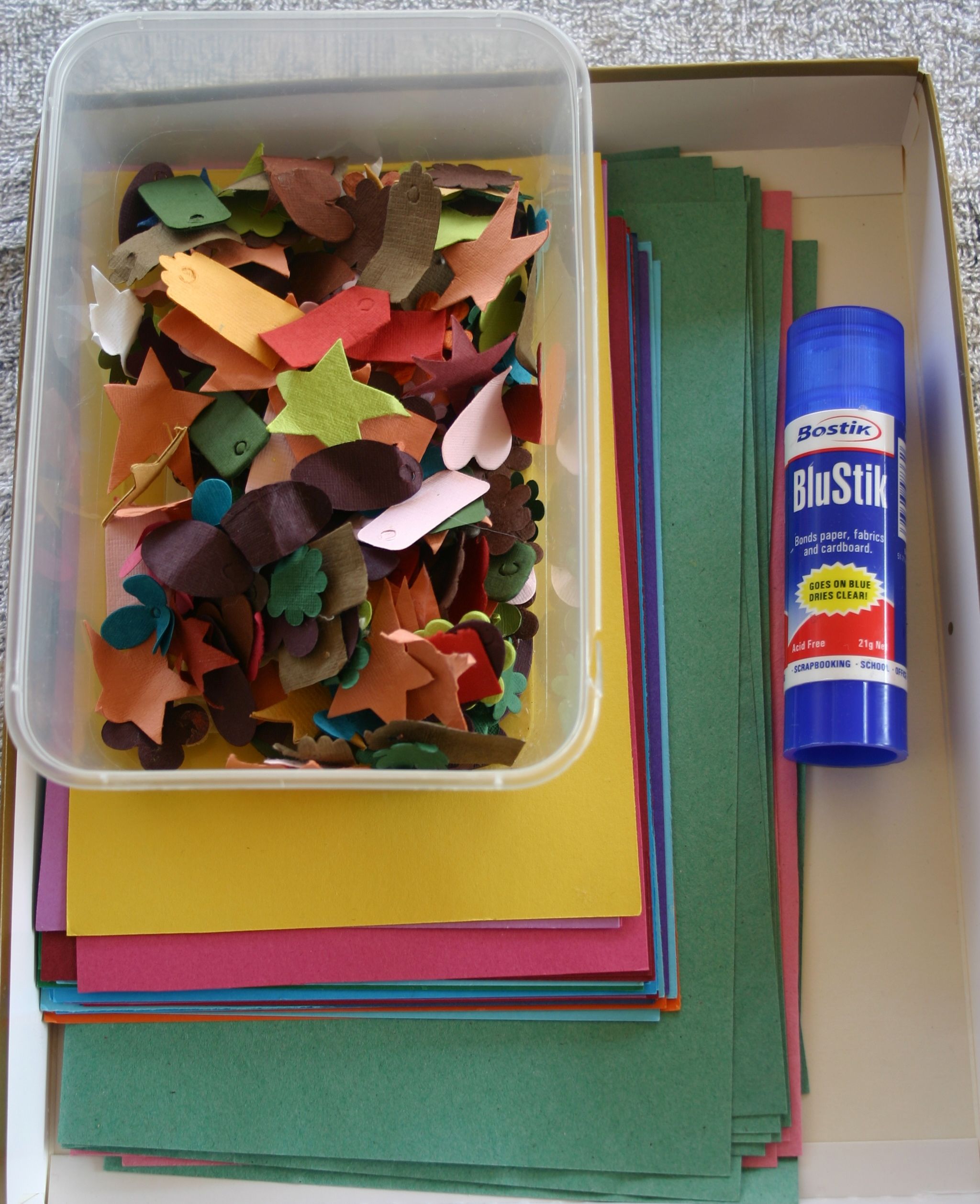
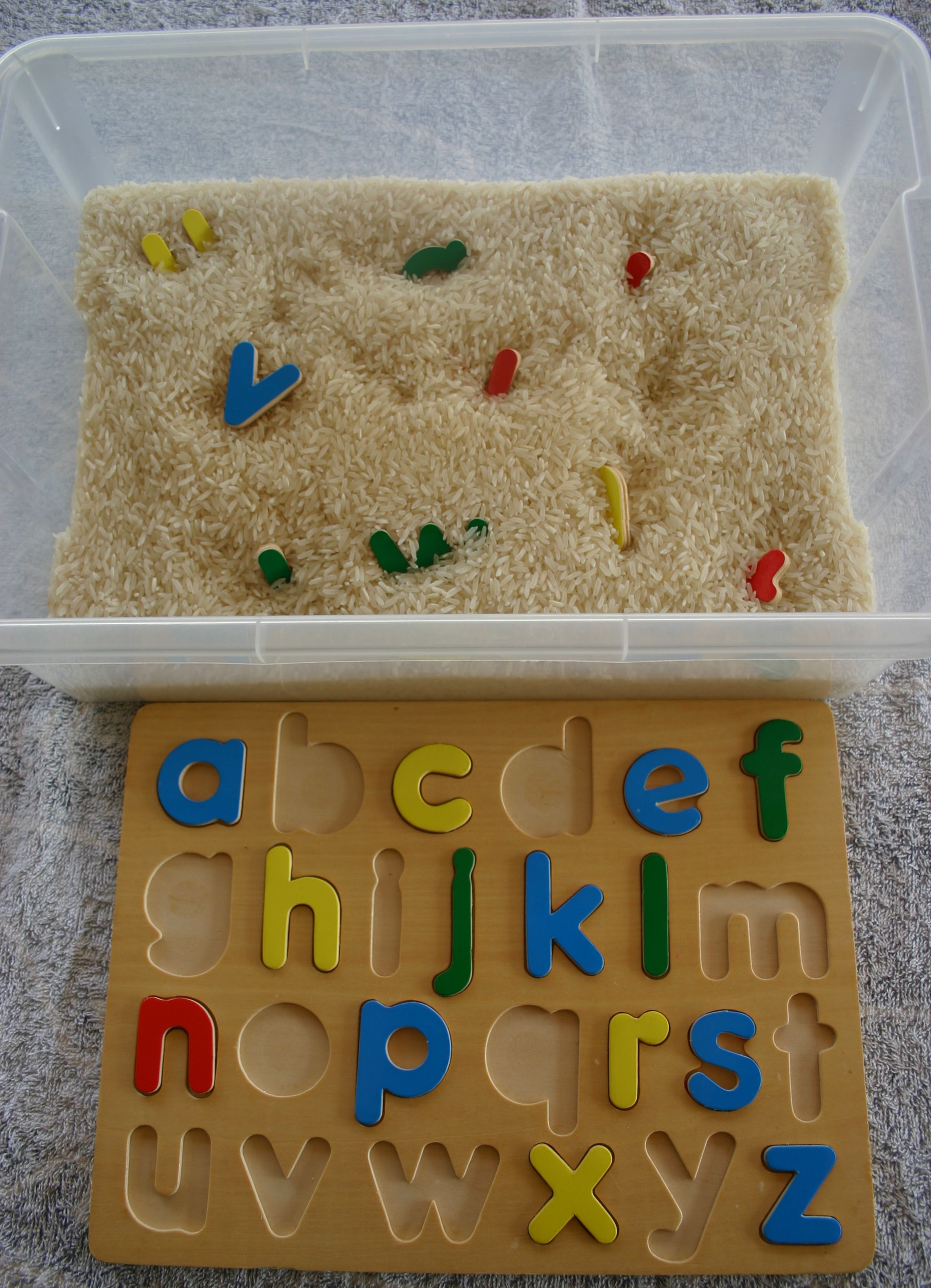
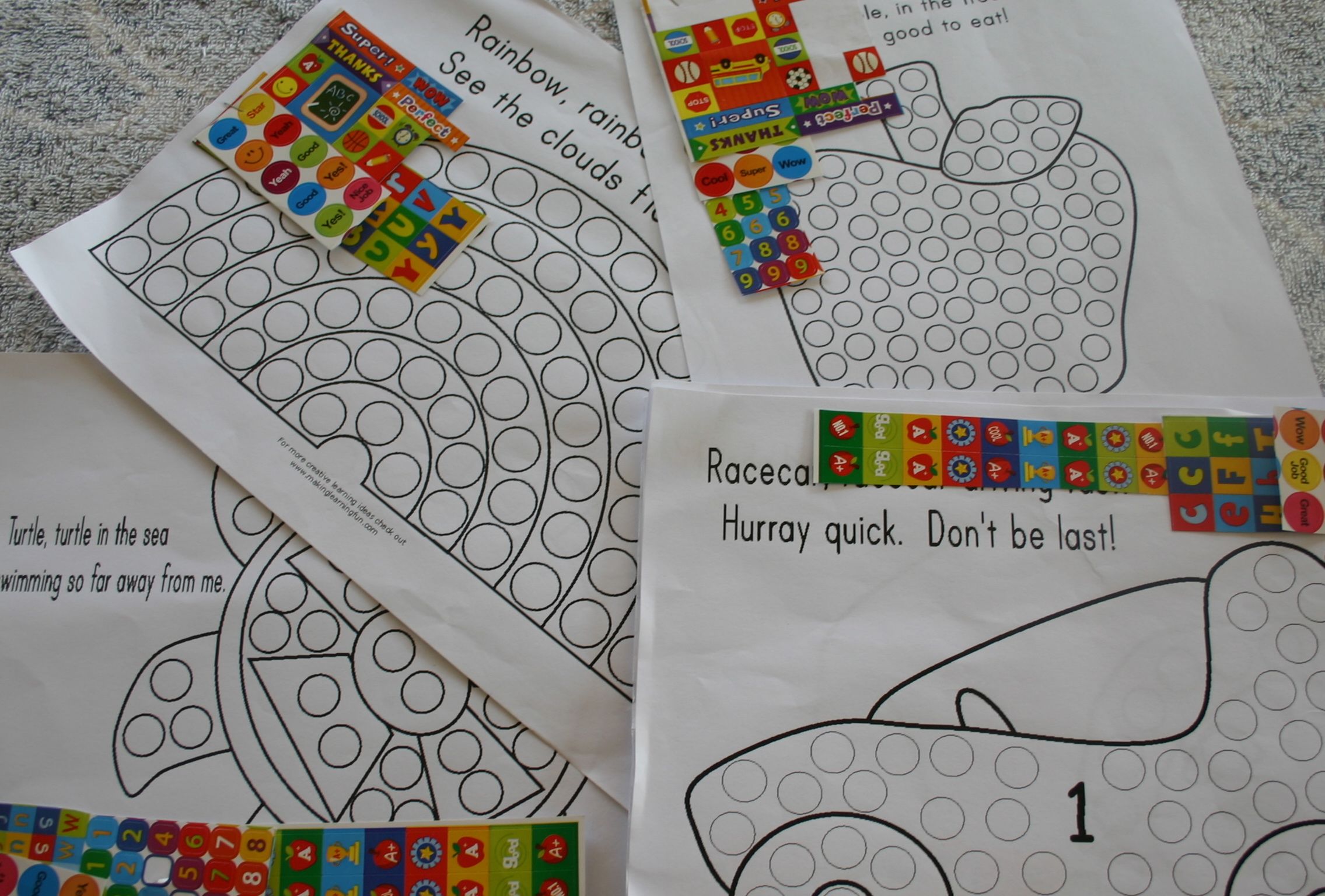
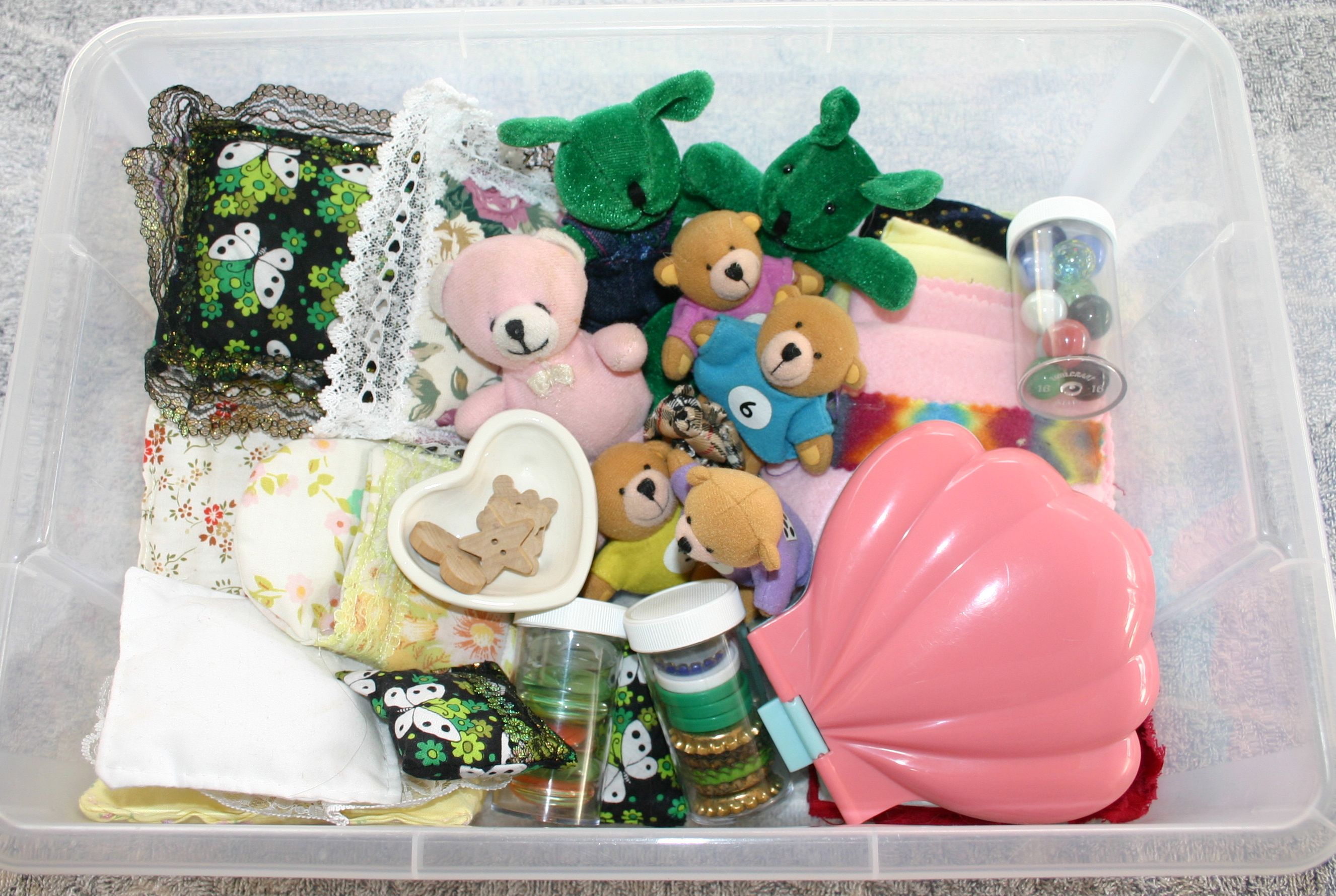
The 3 year olds have been learning how to recognise the numerals 1 to 5 and count small items. Combining building with Duplo as well makes this counting tray attractive, particularly to boys.geoboards IMG_8547Geoboards are a commercially produced mathematics tool. Great for exploring geometric shapes, perimeter, fractions or just for making pictures with elastic bands.dry erase board IMG_8546Personal dry erase boards (whiteboards) with pens and an eraser. sewing cards IMG_8543Sewing and lacing cards. These have a shape drawn for the children to copy. There are plenty of sewing and lacing shapes around to buy or make your own by punching holes around a cardboard picture using a hole punch.button sorting IMG_8542Sorting buttons into muffin trays is a hit with all ages. There is just something about handling all those different shapes and textures. The twins haven’t even gotten their hands on these yet – the 6, 8 and 10 year olds have been monopolizing them! cutting box IMG_8540Teaching toddlers to cut provides them with an absorbing activity that is great for their fine motor skills. The twins have had experience with all the materials in this box so this is just an assortment to chop up any old way they like. Paper streamers, card strips, beads, straws and other oddments such as tinsel or curling ribbon could be included. We let the bits fall back into the box and they can eventually be used for collage later on. The cutting box with free printable patterns I prepared a little while back was too advanced for them so I have put it away to use later on. wood puzzle IMG_8536A collection of good quality wooden puzzles is a good investment. This one came with a variety of patterns for the children to copy, making it much more  long-lasting.gluing IMG_8534Teaching toddlers to glue is another open-ended activity that they will love. Using a glue stick makes it a lot less messy to begin with. A selection of coloured card pieces and diecut shapes from a Kmart scrapbooking assortment pack made this very easy to prepare.rice box IMG_8531Sensory tubs have so many applications. Finding puzzles pieces hidden in rice is pictured above. See here for many more ideas.do a dot IMG_8530Do-a-dot pictures are great for fine motor skills. Bingo dot markers can be used to dot inside the circles or provide small stickers to peel and stick into the dots.  There are tonnes of free printable do-a-dot pictures around if you do a quick google search. teddies IMG_8528Imaginative cooking and doll/teddy play is always a hit. Small teddies, mini pillows, sheets and blankets, along with marbles, jewels and wooden button food makes an interesting selection. Bottle top plates and an old polly pocket toy as well as some screw-top jars finish it off.beads IMG_8526Pony beads and pipecleaners are great for threading and can be made into bracelets or tipped off and re-used next time. dinosaurs IMG_8523Our dinosaur tub includes play dough, plastic dinosaurs, popsicle sticks and popstick fences, a rolling-pin and plastic knife and some artificial leaves for plants and trees. The green bowl has been used to make a pond, cave and home for them as well.

Make sure you choose activities that are age appropriate, can be used independently, include attractive materials, are easily accessible, and easy to pack away. Being able to throw everything back into a robust plastic tub makes it easy for children to keep the activities together and tidy up after themselves.

The key to using these kinds of activities with your young children successfully though is training. No amount of pretty materials will keep a fidgety toddler with the attention span of a flea sitting in one spot for any length of time on a day-to-day basis. As soon as the novelty wears off they will be up and off again.

Take the time to train your children to stay in a designated area. (See mat time/blanket time and highchair time.) Introducing young babies to playpen time that transitions to room time later on is an excellent way to begin (see starting late) and the highchair and table make excellent places to sit a child with an engaging activity while you are nearby. Some children will naturally sit still for longer than others, but all can be trained to do so for a reasonable length of time.

If you are too busy to train your children to sit and concentrate then you are too busy!! Give up some of those good things you do and take on the better thing of training your children. They will need these focussing and concentrating skills in later life, especially at school and your home and others will be blessed by a self-controlled toddler.

For a list of toddler table activities, see here. For preschool ideas see here. For many more ideas for children of all ages, have a look around! For some more sensory tubs, try here.

Arsenic hour and toddler meltdowns

IMG_8182

Arsenic hour is that late afternoon time period where the short people in the household tend to have their meltdowns. Slightly hungry in the lead-up to dinner, tired from a day full of stimulation and unable to display the self-control necessary for “keeping it together” until dinner is served, young children (especially toddlers) tend to struggle during this time and easily tip over the edge. So how can we, as Mothers of young ones, structure our day to minimise the conflict and stress that is often experienced during arsenic hour?

Start by looking at your overall day. Who is in charge? You or your child? Who is making all the choices? Evaluate your overall day in light of this and see if some or much of the conflict is simply caused by you trying to get a reluctant toddler to do something they do not want to do after making their own decisions for the majority of the day. (See “choices” for a fuller explanation.)

Look at your routine. Do you have a flexible structure to the day with a good flow of events? It should include a mixture of time with Mum, time with siblings and time alone, physical activity, quiet time, structured play times etc. (See “routines” for ideas of what to include throughout your day.)

What time are you serving dinner? Are you expecting your young child to wait until Dad comes home in the late evening and trying to feed them when what they really need is to be getting into bed? Family meal times are a priority for us and very important, but if you husband is home later than is practical, consider feeding your toddler early and bringing them back to the table when Dad arrives for finger foods, a snack or a healthy dessert so that they can participate with the family. The bonus with this is that all your mealtime/manners training can be done on-on-one with the toddler, leaving the family table free from conflict.

IMG_7663

Bathtime can be difficult if left until after dinner. There has been seasons when I have bathed all the younger children at around 4.30pm when they are still coping relatively well and are unlikely to get into conflict situations. I can then pop them at the table, in the highchair or on their mat, with a suitable activity to keep them usefully occupied on a worthwhile task while I am free to finish dinner prep and serve them their meals.

Do not test your obedience levels during this time. What do I mean by this? Do not give directions to your toddler and expect them to obey. Rather than say, “Junior, go and get into your highchair please,” simply walk over to Junior, take his hand and cheerfully state “It’s time for highchair activities” as you walk hand in hand with him to the chair, pick him up and pop him in. When it is time for Suzie’s bath, rather than say “Suzie, go and get your PJ’s and go to the bathroom”, you grab the PJ’s and walk little Suzie to the bathroom, undressing her and plopping her in the bath. Don’t forget to give a 5 minute warning before making these announcements.IMG_7743

Having a good routine throughout the day, coupled with these practical suggestions will help make this time as enjoyable as any other period in the day.

Other posts you may find helpful:

Getting dinner on the table

Activities to make for babies and young toddlers

Playdough for toddlers – no biscuit cutters please!

Magnetic pompoms

man  on fridge IMG_8447

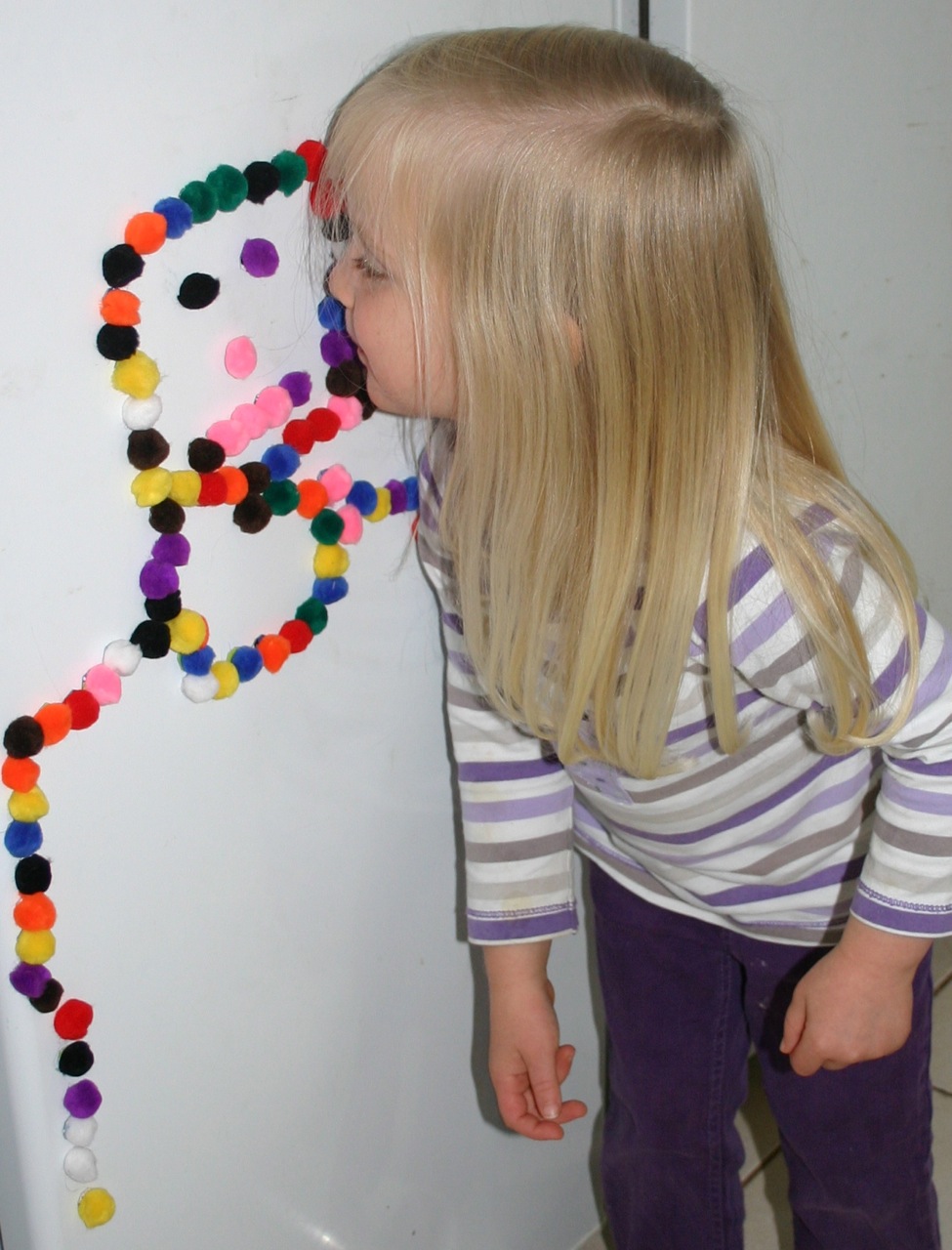
Magnetic pompoms are a great idea for table time, highchair time, mat time, while travelling with children or any other time you would like a quiet activity for your toddlers or preschoolers.

Simply buy your pompoms and hot glue gun magnets on the back. I used the free flexible strip fridge magnets that come in the mail on the back of advertising.kissing man on fridge IMG_8450

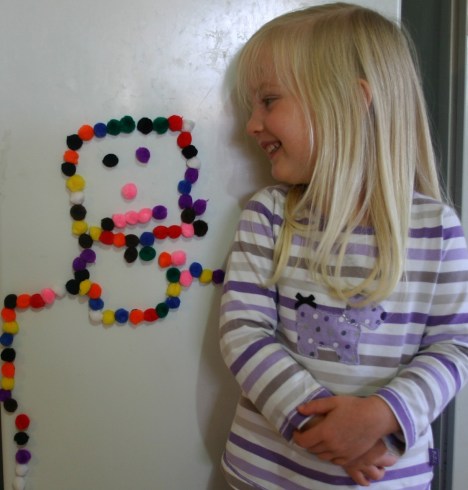
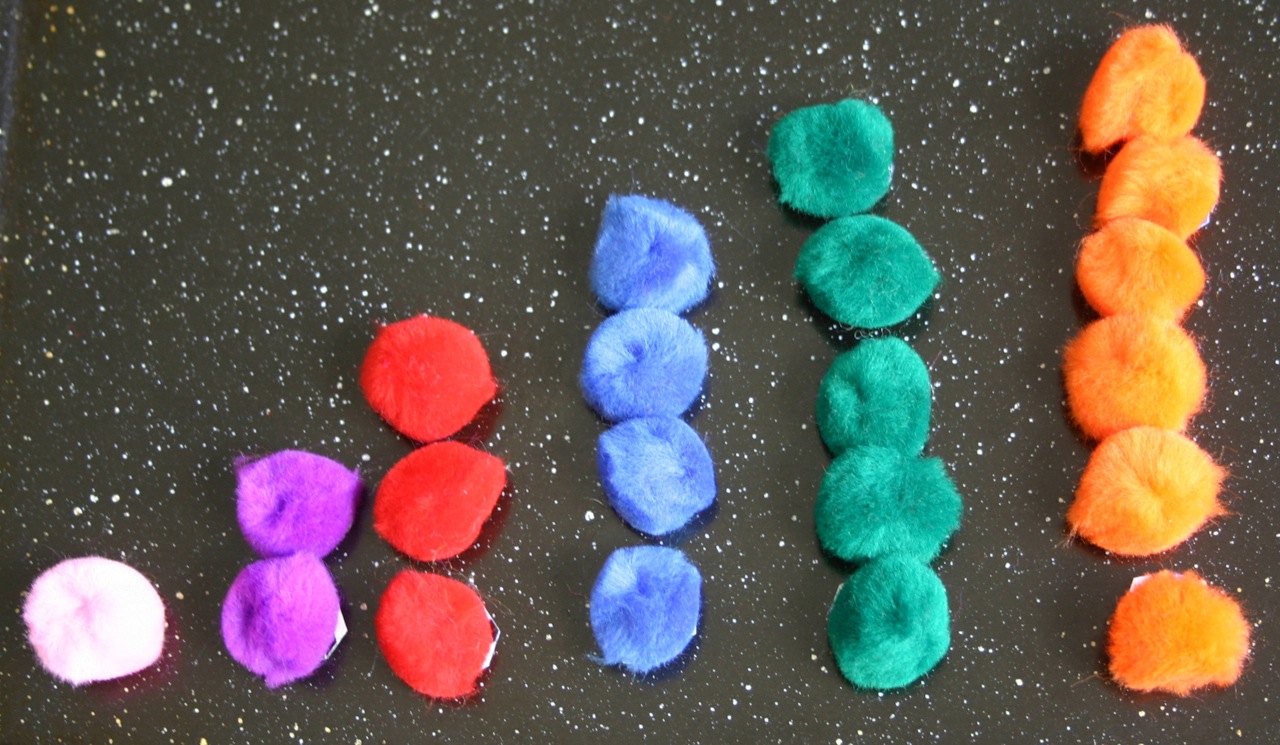
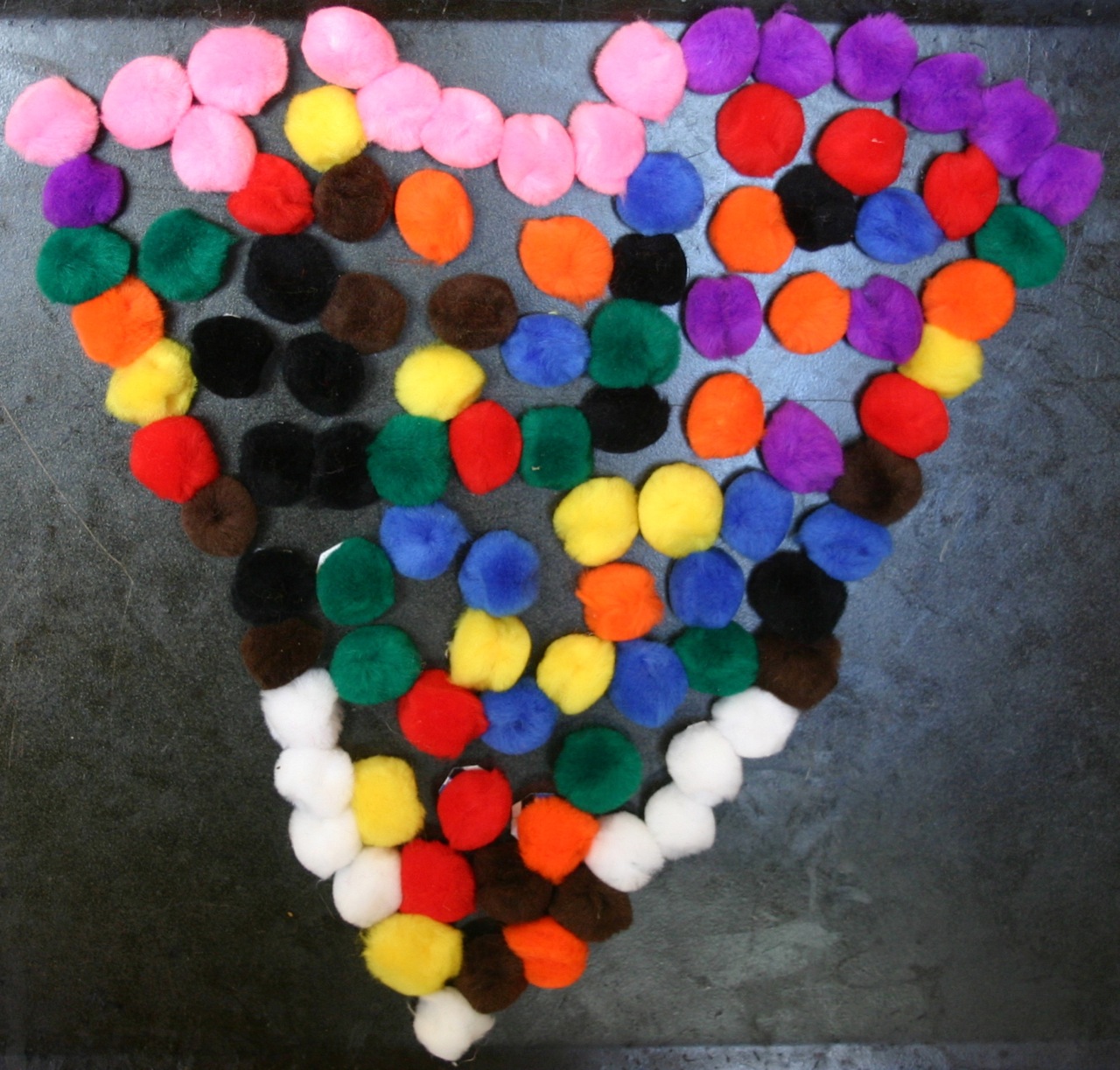
For a sit down activity, use a small magnetic whiteboard, biscuit or cookie tray or any other magnetic surface. They could easily be adapted for sorting by colours and/or counting or simply combined to make creative pictures on the fridge as my daughter is doing in these photos. counting IMG_8285

My original plan was to use them with the multitude of “do-a-dot” pictures that can be found on the internet, so I printed out a stack and laminated them for durability. (These pictures have circles all over them that you can dot with bingo markers or stick on small stickers for a fine motor activity.) The fridge magnets however are not strong enough to hold the pompom on to the surface through the laminate so I am going to make a second set with stronger magnets for that purpose and leave these for free creating. pompom heart IMG_8284

Dolls houses in a shoebox

G's shoebox dolls house IMG_8279

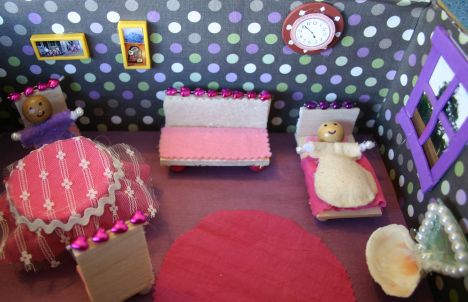
Dolls houses in a shoebox are a wonderful travel activity, take away toy for holidays, table activity, quiet time or room play idea or highchair activity for younger children. They are very portable,  simple to make (these examples were created by my 5 1/2 and 8-year-old daughters) and the possibilities for open-ended imaginative play are endless. We will be making them with a group of girls for our 8 year old’s birthday party next month and with a little bit of preparation, they will be an easy craft to engage a group of young ladies for a couple of hours.c's shoebox dolls house IMG_8272

I will be adding some miniature food (novelty erasers from a discount variety store) plus a couple of ceramic ornaments to use in their little houses and the girls will create the furniture, make wooden peg doll babies (instructions in my next post) and decorate their rooms.mini dolls house furniture IMG_8275

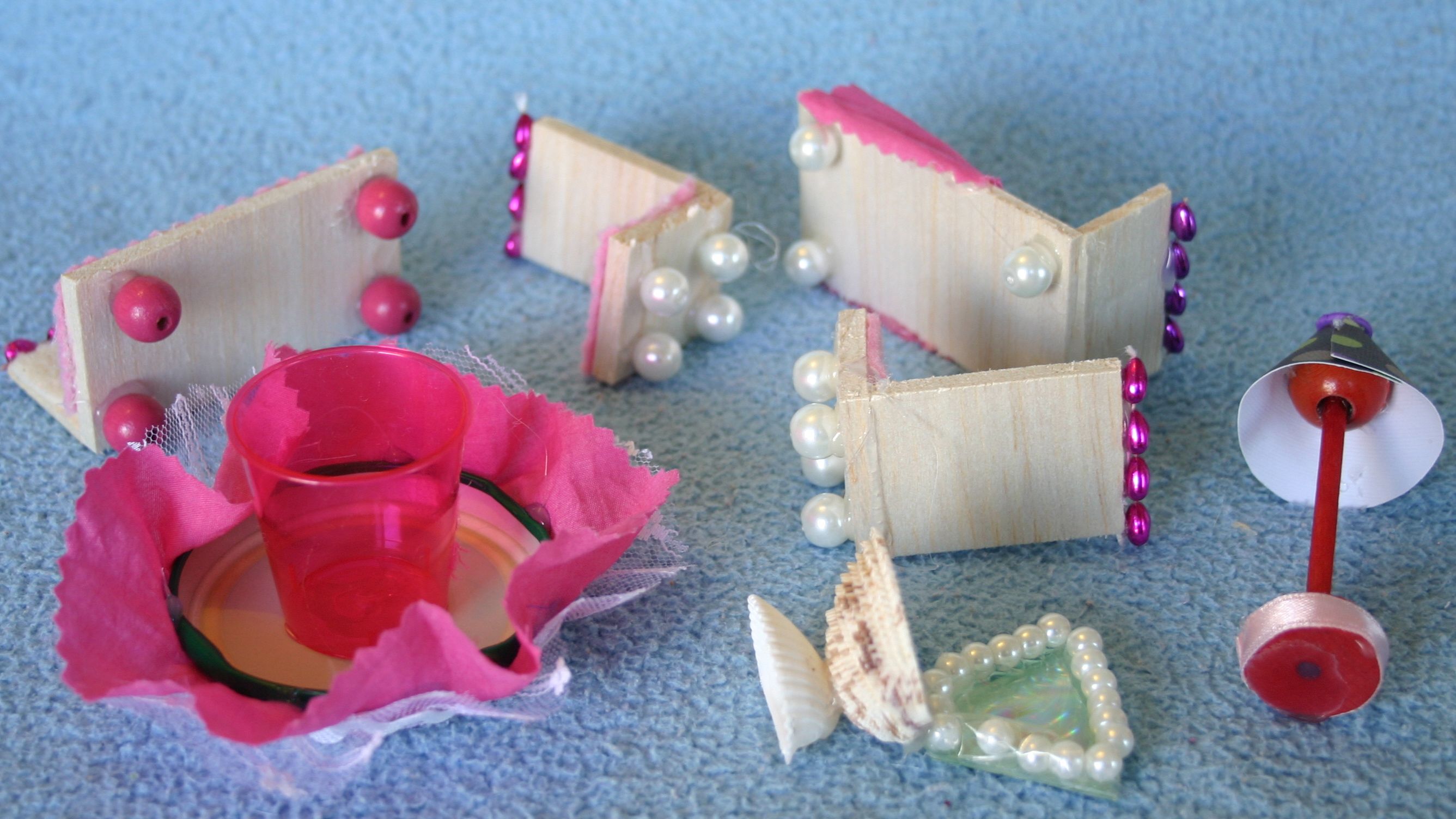
The furniture is made from balsa wood hot glued together with beads for legs and felt pieces for cushions. We cut up cheap plastic bead necklaces to decorate the top of the chairs. A jar lid glued to a plastic shot glass and covered with a circle of fabric and ribbon forms the table. The mirror is a piece of CD surrounded by beads and glued to two shells as the base. The lamp is a small craft stick with a large wooden bead on top and a circle of card cut to form the lamp shade. It stands in a wooden circle that came with the sticks.

A printed clock face glued to a plastic disk, plus some old tiles from a board game with miniature photos inside, decorate the walls. Photos and magazine pictures of outdoor scenes give our rooms a view.mini dolls house furniture bottoms IMG_8278The girls were able to wall-paper and “carpet” their boxes, plus put together all the contents in a couple of hours and with a little more preparation our party guests should be able to complete theirs in an hour and a half.

Lots of fun for all ages and a lovely gift for any little girl.

Other posts you may like:

Wooden clothes peg dolls house furniture

My next post (still to come) on simple peg dolls from pipecleaners and wooden beads.

Sensory tub ideas for toddlers and preschoolers

sensory tub A teddies IMG_8196

Sensory tubs are great for mat time (blanket time) or as a table activity and are excellent for when you need to school older children, cook dinner, or during any other time when you need your little ones well occupied and absorbed in a worthwhile activity.

They are quick and easy to put together, cheap or free (depending on what you already have lying around the house) and can be used daily as part of your flexible routine for babies, toddlers, preschoolers and even older children. Obviously the materials you present will change according to the age of the child who will be playing with them, with safety always a factor for little ones who may put small items in their mouths.

There is no limit to what you can put into your tubs. Ideally the materials will be open-ended; that is they can be combined and used in a variety of ways.sensory tub trains IMG_8187

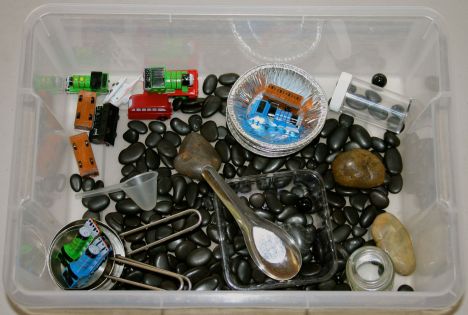
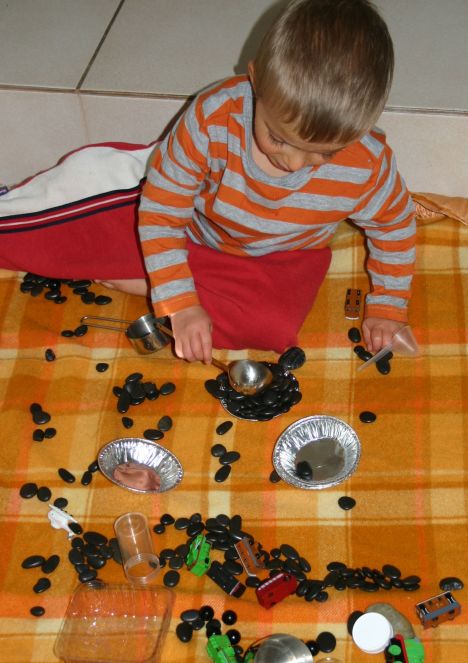
Younger toddlers do not have a well-developed imagination and therefore need more hands-on options, rather than pretend play materials. For example, in the trains tub above, I included a variety of scoops and containers to fill, transfer, tip and pour as well as the trains themselves. A young toddler may examine the trains before setting them aside in favour of transferring the stones from container to container. The older children may go straight for the trains and set up a complicated rail system with rocks delineating the tracks and the containers used as sheds for the trains. Another may decide to serve dinner on the silver pie tins or set up a picnic for the trains.

sensory tub trains JIMG_8193

I find that the tubs themselves are not large enough for the children to play within. They like to sort through, put aside what they are not using and generally spread out, so I use a blanket or sheet for them to play on. When play time is finished, the corners of the sheet are lifted up and all the materials can be quickly tipped straight back into the tub without a tedious pack-up session.

sensory box horses jewels IMG_8183

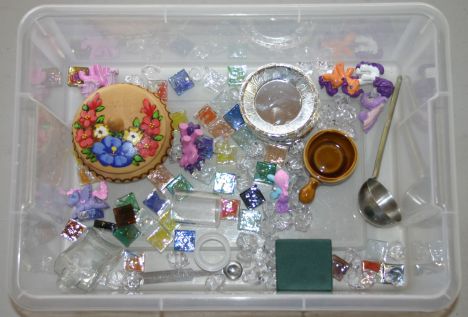
The older girls were practically drooling over this jewel and miniature pony tub as I was putting it together – usually a sure sign it will be well-loved by the younger children as well! Again, a variety of scoops, containers, bottles and boxes with sparkly jewel squares and pebbles. (The kind used in vases or to fill bowls – from the discount shop.)

sensory box sea IMG_8185

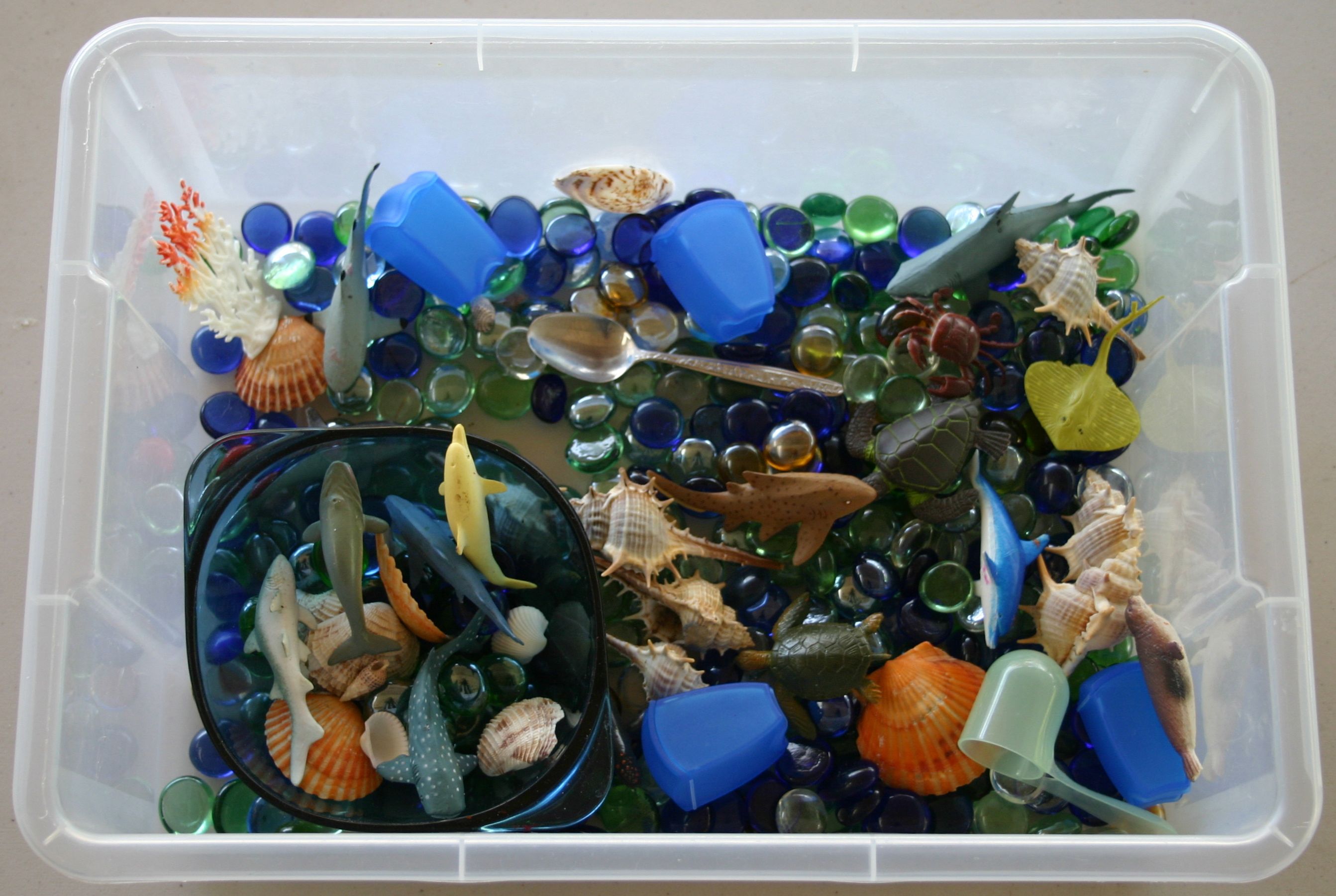
Blue and green gem stones, plastic sea animals, shells, bowl, spoons, scoops and empty pill boxes. This tub covers opening and closing skills, spooning, scooping, tipping, pouring (all transferring skills) and could be extended to sorting and categorizing as well as the pretend play options.

sensory tub S jewwels IMG_8192

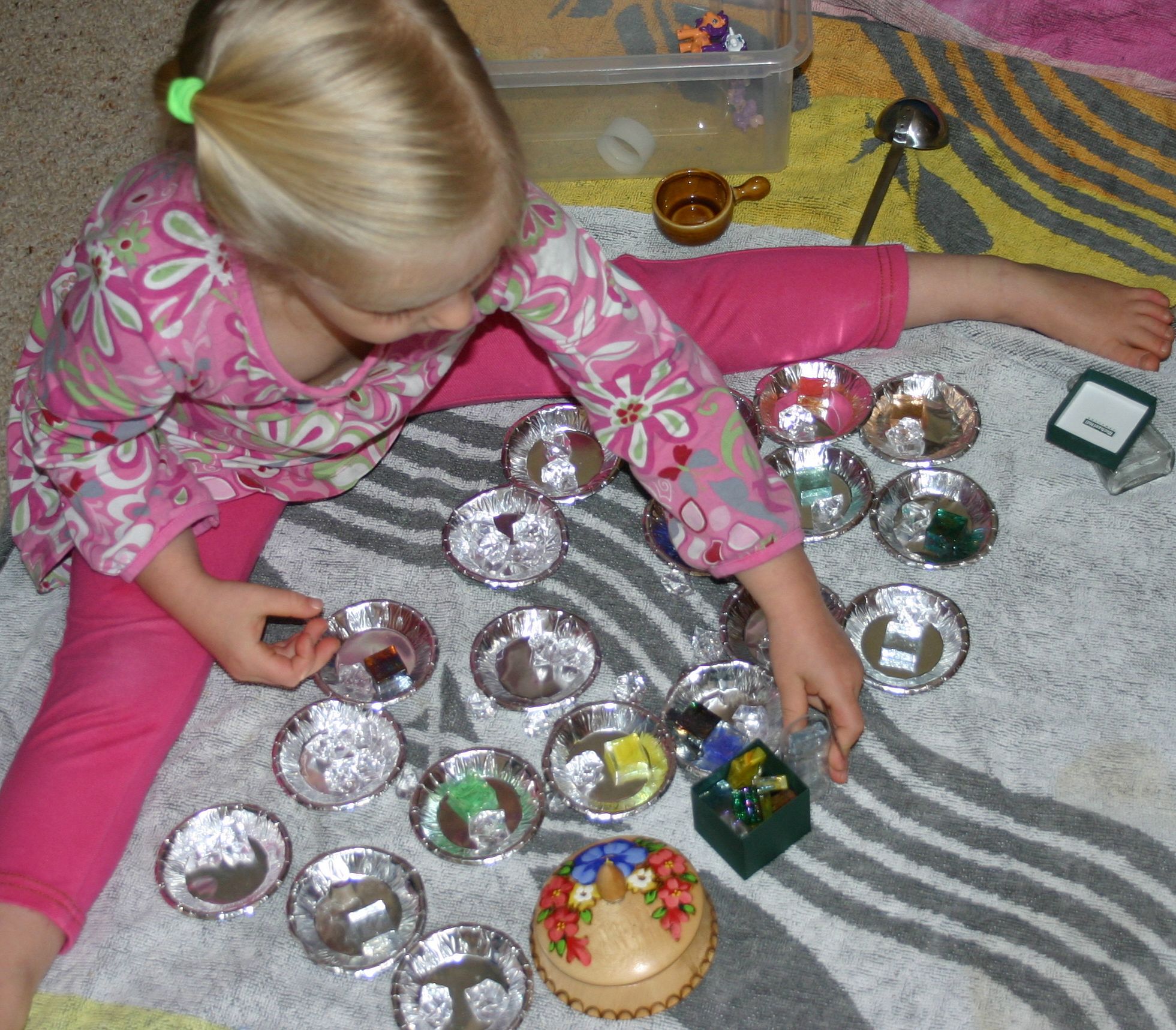
My youngest daughter used the pony and jewel tub this morning for the first time. She carefully removed all the ponies and put them back in the box before making a picnic for her teddy bear and the 12 disciples (!) with the containers and jewels. The older girls (6 and 8) have already asked to use it later and tell me they plan to set the jewels up as food for the ponies. The beauty of open-ended, attractive materials is that they will appeal to a variety of ages. My 15 month old can barely restrain himself and wants to dive straight in whenever he sees these tubs out. Unfortunately the pieces are just too small for him to use safely.

sensory tubs A teddies IMG_8194

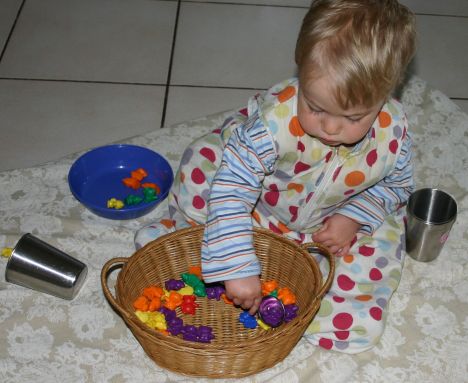
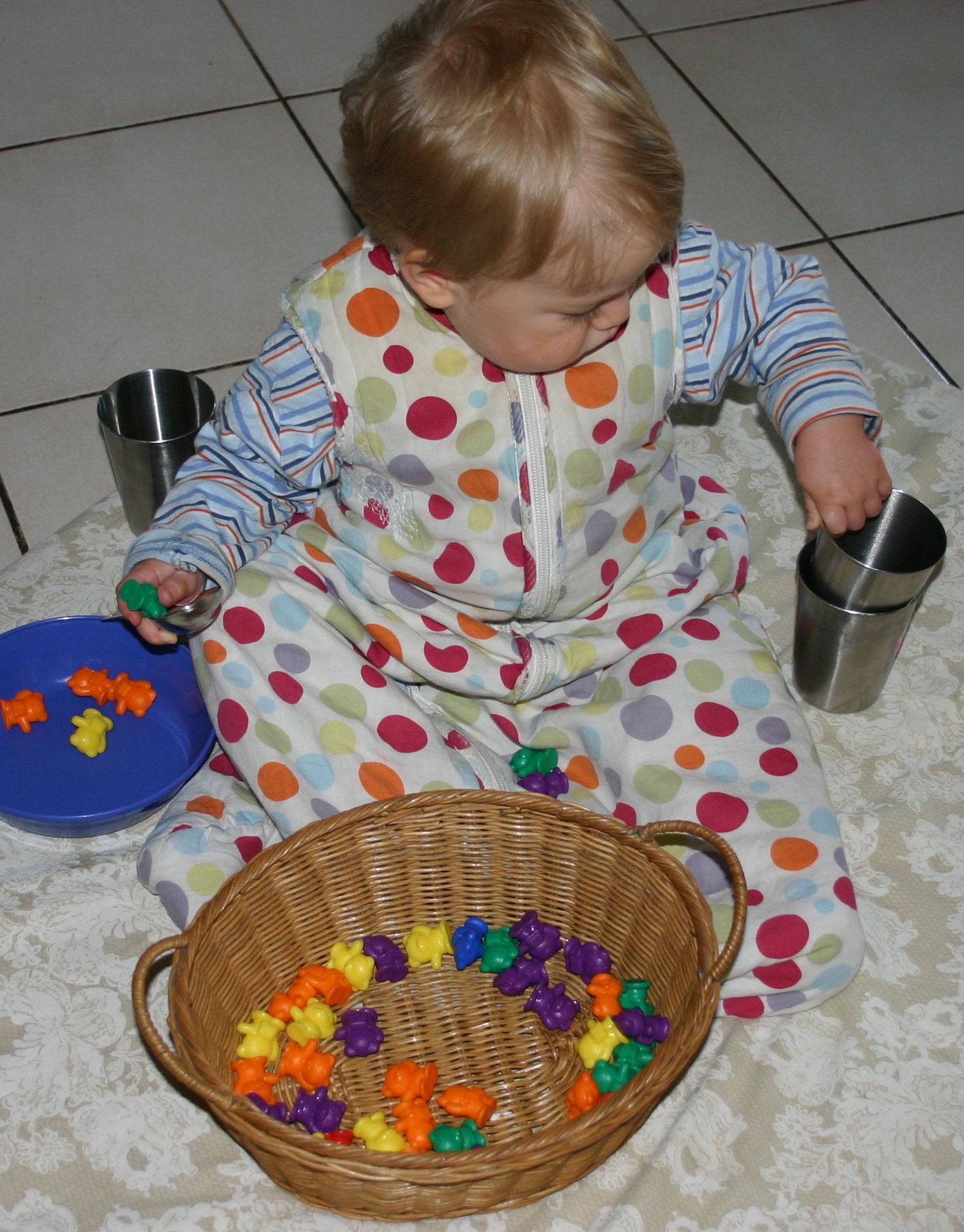
This is the 15 month old’s sensory “tub” this week. He loved it and used the scoop (a large measuring spoon) to transfer from the large basket to the small bowl, filled and stacked the metal cups and filled and tipped out the basket numerous times. Provide a container or two and something to put in and dump right back out again and it will always be a hit with anywhere from an 8 month to a 2-year-old. 12 to 18  month olds particularly love to fill and dump.

For a stack of ideas to fill your sensory tubs,see this post. Many of the other ideas I have posted as table activities, highchair activities or mat time activities would all work in a sensory tub. See pasta play and teddy food play as examples.

Montessori style practical life tray activities for toddlers

Today’s post is a potpourri of Montessori tray activity ideas. They cover a range of skills and fall into a number of practical life categories, but all are great for teaching your toddler to sit and concentrate for an extended period. I have spoken to a number of Mums recently about the difficulty they have in getting their toddlers to sit for any length of time at the one activity. One method that has helped me to achieve this with my toddlers is to include highchair time, table time, and mat or blanket time in our flexible routine. These are times when Mum chooses what the toddler will play with and where they will play. (See choices.)

I use my Montessori style tray activities for highchair time with my young toddlers or during table time for my older children. For those little ones who are “done” with an activity after only a minute or two, I have used a timer to extend them. I put it on for 5 minutes and let them know that I will give them a new activity to play with when the timer is done. They may choose to be finished with their current activity and just sit and wait for the next one or (and this is what usually happens very quickly) they will realise that since there will be nothing else to do until the timer finishes, they will choose to go back to the activity they have been given and work on it for a little longer. The timer I use is a visual timer so they can see how much time is left as it counts down. It also has an option to turn off the beeper so that if they have become engaged in a task the beep of the timer does not disturb their concentration. As they become more able to concentrate for an extended period, the time is lengthened accordingly and eventually the timer is no longer necessary.

The older preschoolers who have developed sufficient self control and concentration are given the freedom to choose their own tray activity, take it to a designated space, work on the task, pack it up and return it to the cupboard before choosing another activity.

If you are getting started for the first time with an 18 month to 2 year old, 5 minutes for each activity is reasonable and the entire session may only last for 15 to 20 minutes to begin with. A two year old will quickly work up to a 30 minute session, but still may need a change of activity after 5 minutes. If I was planning a half hour session of highchair time (long enough to cook dinner) I will organise the 6 activities I need to be on hand before I start. (It may be a good idea to keep them out of view to begin with to prevent their attention being diverted by another activity that looks more interesting!) As the child gets older, the complexity of the activities increases and their ability to concentrate without needing to change improves and therefore the number of activities I need to have ready becomes less. My 3 year olds will need only 1 or 2 different activities for a half hour period depending on what I have provided them with. They are also given some choice over which activity they work on.

The other benefit of having toddlers sit in a confined area to complete these tray tasks is that I can give them breakable and delicate equipment without fear that they will be accidentally damaged and also keep an eye on them with small attractive materials like coloured beads that little children are quite likely to want to pop in their mouths.
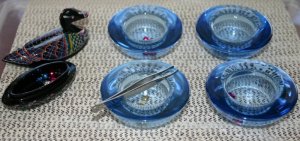
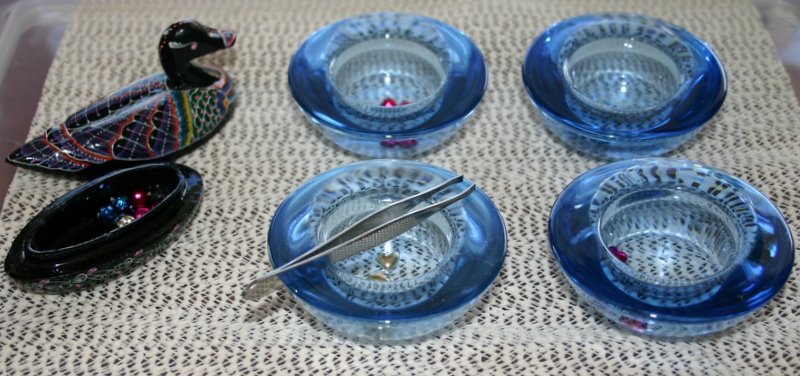
Now for some activities! Tweezer transfer activities are great for fine motor skills and require a similar grip to that used for pencil grip when writing. Transfer activities can easily lead into other beginning math skills such as sorting by colour. This duck container holds 4 colours of beads to be sorted into the 4 bowls. Younger children will have fun simply transferring them randomly and very young children may need a small spoon to transfer with, rather than the tweezers.
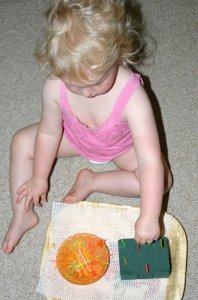
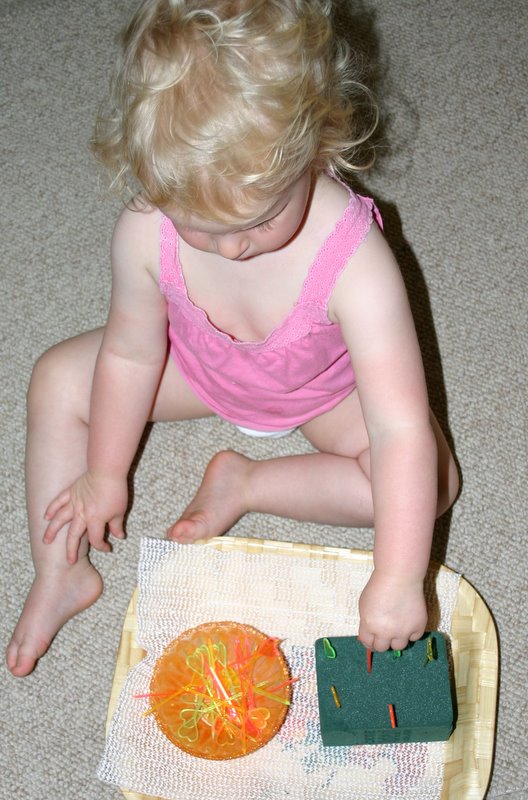
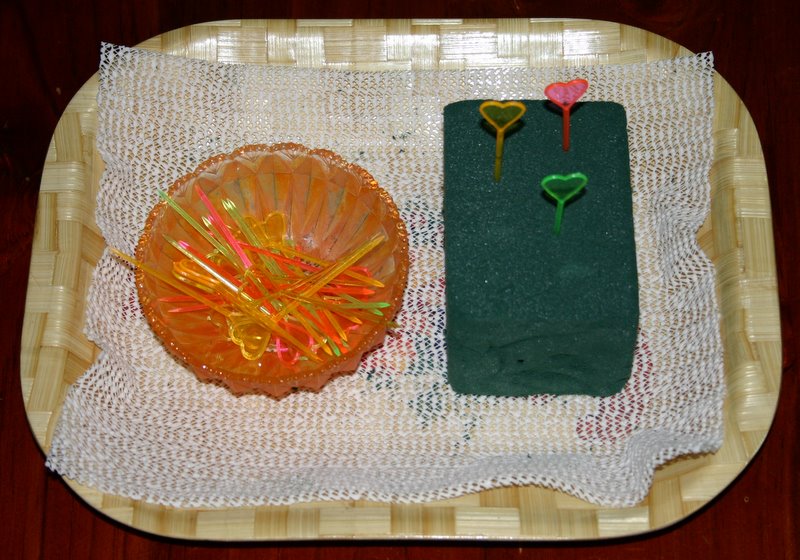
Great for even the youngest toddler, poking toothpicks into floristry oasis encourages pincer grip development. I found that the green oasis crumbled very easily so I would recommend covering it in open weave fabric to contain any dust. I have since been told that the grey oasis is much tougher and shouldn’t crumble or create dust. Foam blocks also work well. (See shape, cat and assorted pictures below.)
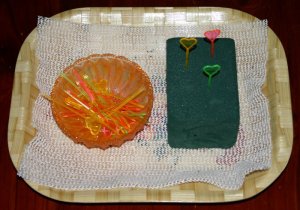
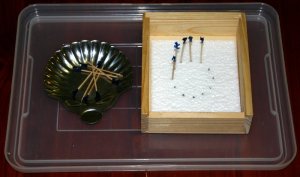
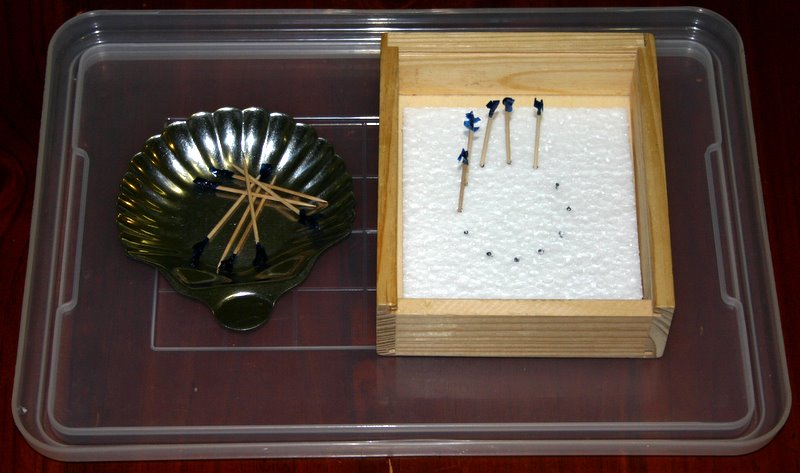
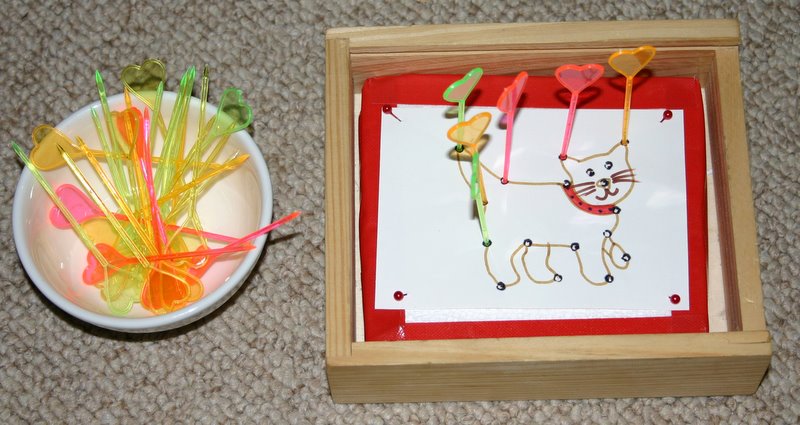
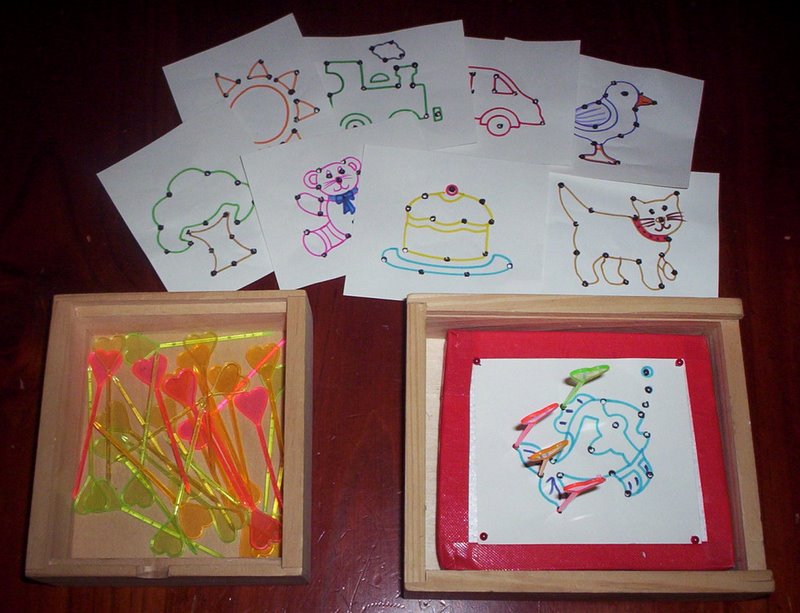
The follow-on activity was to place the toothpicks into marked holes to form simple shapes and then on to pictures.
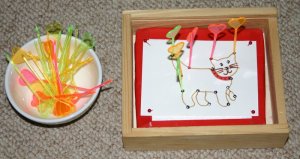
Keep the number of dots on each picture to a minimum for little ones. Too many make it difficult to get their hand in for the next toothpick.
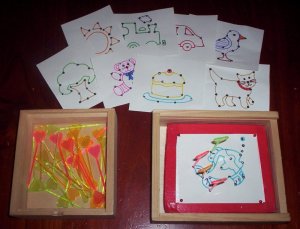
These pictures are drawn onto card and pinned onto styrofoam pieces cut to fit into the wooden box.
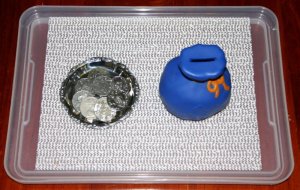
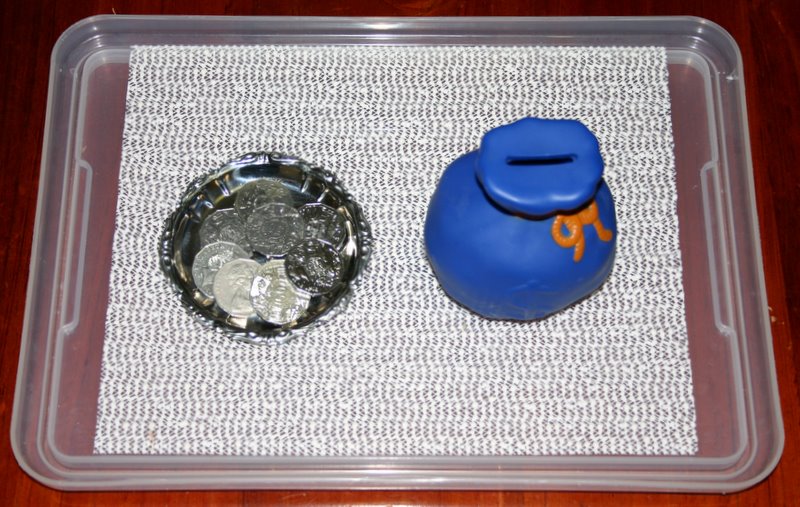
Posting coins through money-box slots. I left the bottom open so that the children can simply shake the coins out the bottom and do it again.
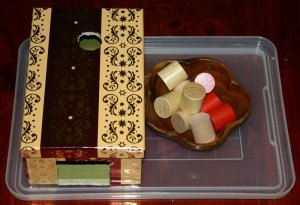
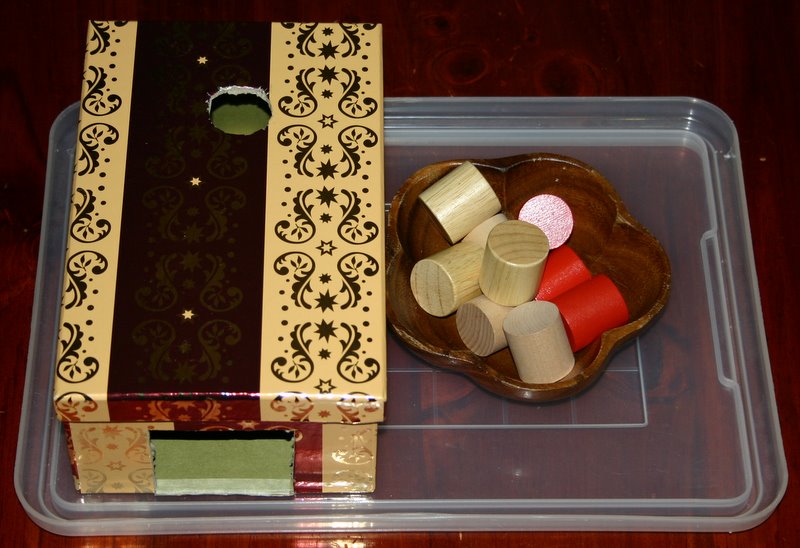
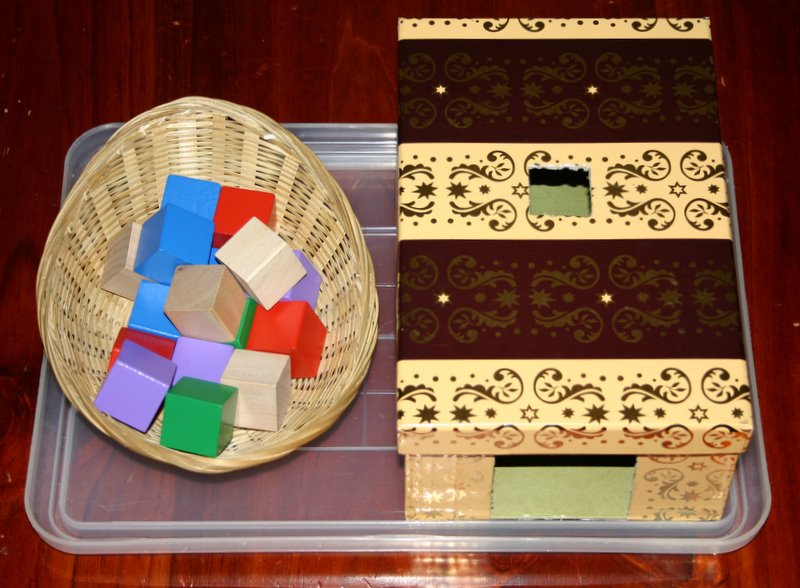
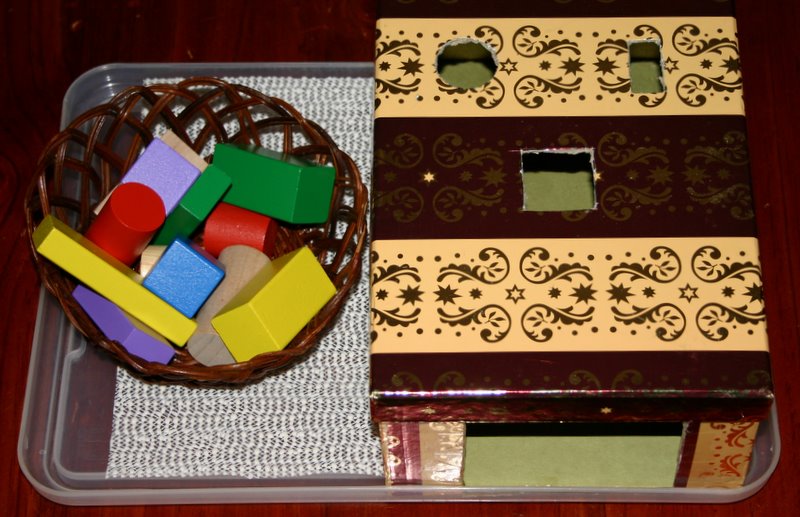
Posting wooden shapes is a good intro to shape recognition . Start with cylinders because it doesn’t matter which way the child puts it into the hole. Squares are next as they must line up but will still go in no matter which way up they are. The open slot at the front of the box allows the child to reach in and/or tip the shapes back out and for the little ones is very much part of the attraction.
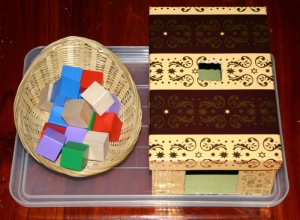
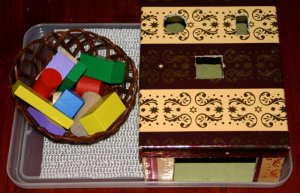
Add other shapes such as triangles or a combination of shapes to increase the level of difficulty.
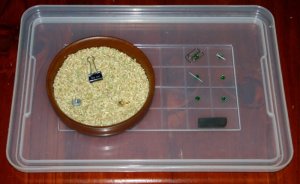
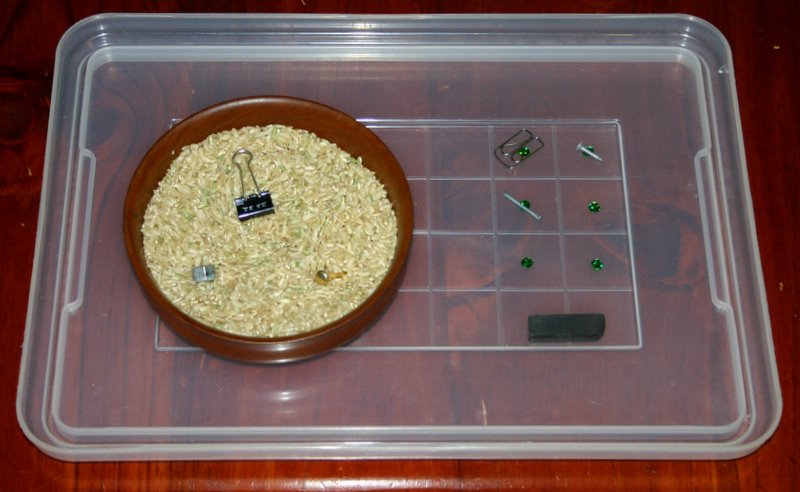
This magnet activity is fun. Hide lots of little items in a bowl of rice. The child moves a strong magnet around in the rice to find which items will stick. The number of spots on the tray designates how many magnetic items they need to find.
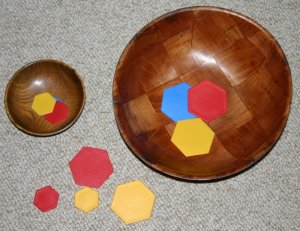
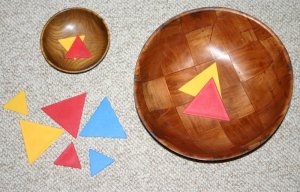
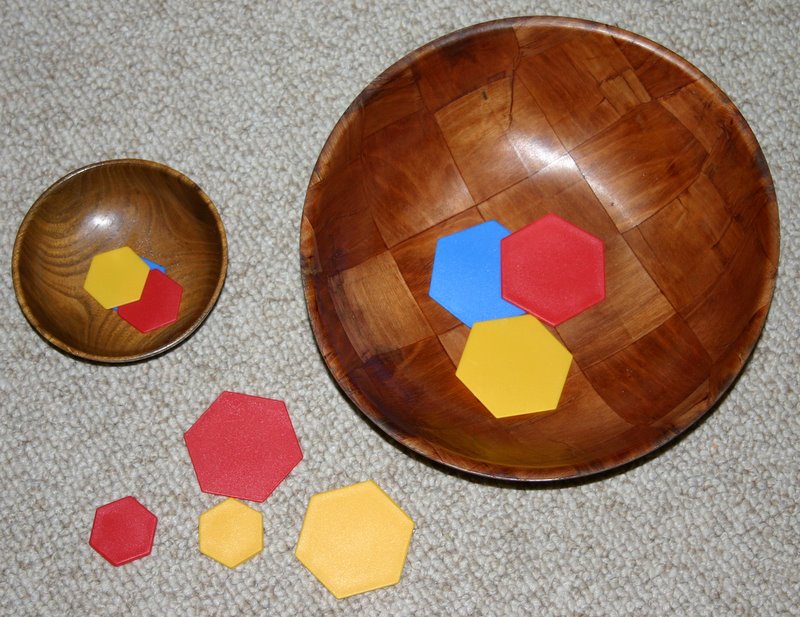
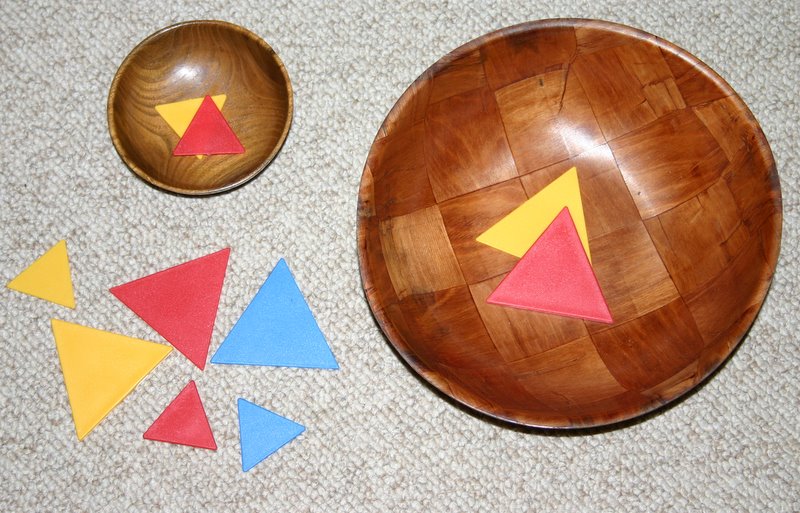
Sorting objects according to attributes is another basic mathematical concept. This beginning sorting activity has a large bowl for the large/big objects and a small bowl for the small objects. My just turned 2 year olds can usually handle this one.
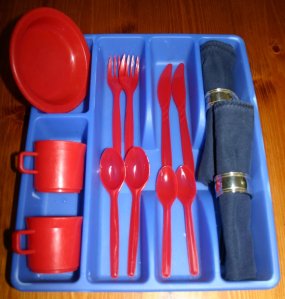
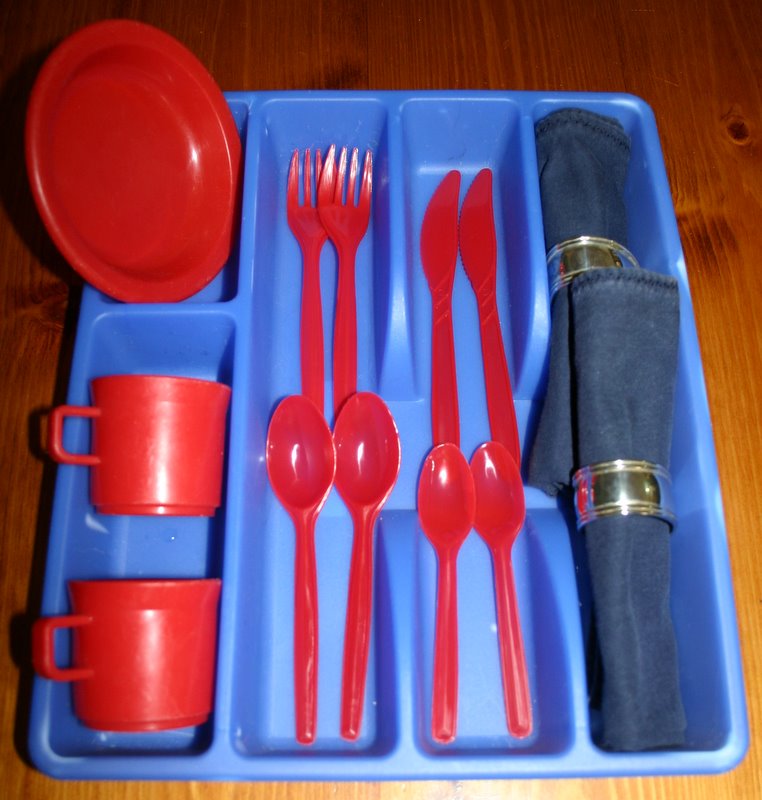
Learning to set the table is a household chore for us and learned very easily by actually doing it! Little ones however find it lots of fun to practise this skill with a couple of teddies and some play food. Provide 2 place mats (plastic, fabric or just a sheet of paper) with the outline of the items on them for little ones to match each item to so that they know when they have done it “properly.”
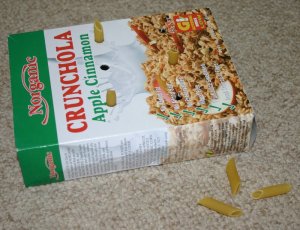
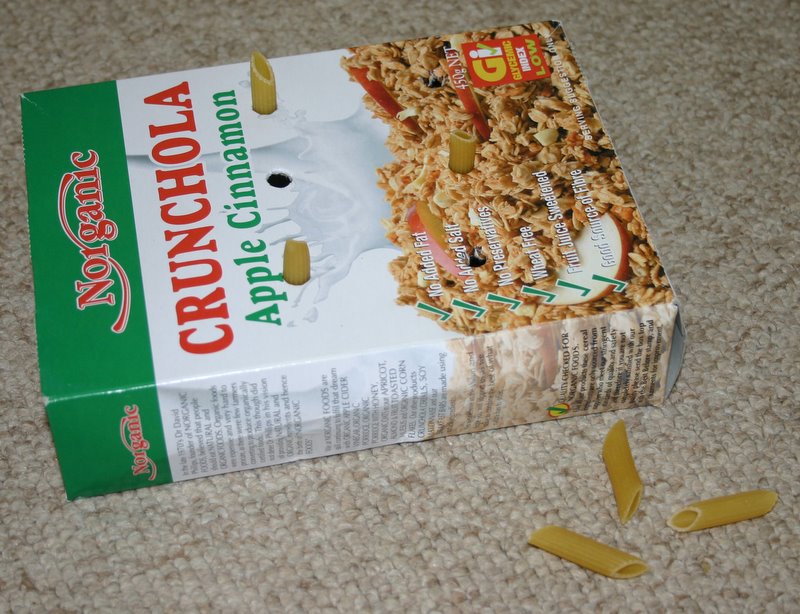
This one is for the very young. Babies do love to put things in and out of containers and if you keep changing the items and type of container, this style of activity is good for months. It is great for fine motor skills and concentration and pretty much free to make. Whip one up in just a minute or two and watch the intense concentration as they use that all important pincer grip (necessary for writing later) to grasp the end of the pasta and carefully post it into the holes. Use this activity for mat time, highchair time, table time or with straws (so they don’t eat the pasta when you are not closely supervising them) for playpen time or room time.

With all of these activities, if your child finds them too difficult and is still frustrated after you have shown them how to do it and given them some time to practice, put it away and reintroduce it in a couple of weeks or months. Many of the Montessori style activities are very developmentally based and when introduced at the right time will be stimulating and extending to a toddler, not frustrating and overly difficult.

Teaching young children to sit and concentrate for extended periods is a vital foundation for later learning and helps you as Mum to keep the house and family running as you can get your own tasks finished knowing that your little ones are happily and safely occupied with a valuable learning experience.

Buffet training

Something we try to remember as parents is not to expect our children to do anything while out that they do not do at home. For example, if my toddlers are unable to sit at the table for any length of time after a meal, I wouldn’t ask them to do so in a restaurant. We think it is unfair to expect something from them that we have not trained them to be able to do in the first place.

Asher in his highchair

With long-term goals in mind, we include highchair time as a regular part of our daily routine and our little ones are used to happily staying in their highchairs after meals with a couple of small activities to play with for a reasonable amount of time. We can then go to a restaurant or meeting and set them up with something to do and know that they will be happy to sit for quite a while without expecting to get straight down. At home, it means that I have time to finish cleaning up the table and kitchen and leave the area without having a trail of mess that I need to come back to later.

A sitting up on the mat

There are times when we visit others or find ourselves in a situation where there are just too many tempting items for the baby to get into. A young child will only stay in your arms for so long! Mat time training can help here. See introducing mat time and mat time on the go for ideas and explanations. Using a partacot (portable crib) as a playpen can also work well for those china filled houses. (See also starting late.)

Take a look around your table during a meal. If visitors were present, would you be embarrassed? Table etiquette and manners are something we need to go over and over (sigh..) but one strategy that has really helped us is the “3 warning” system.

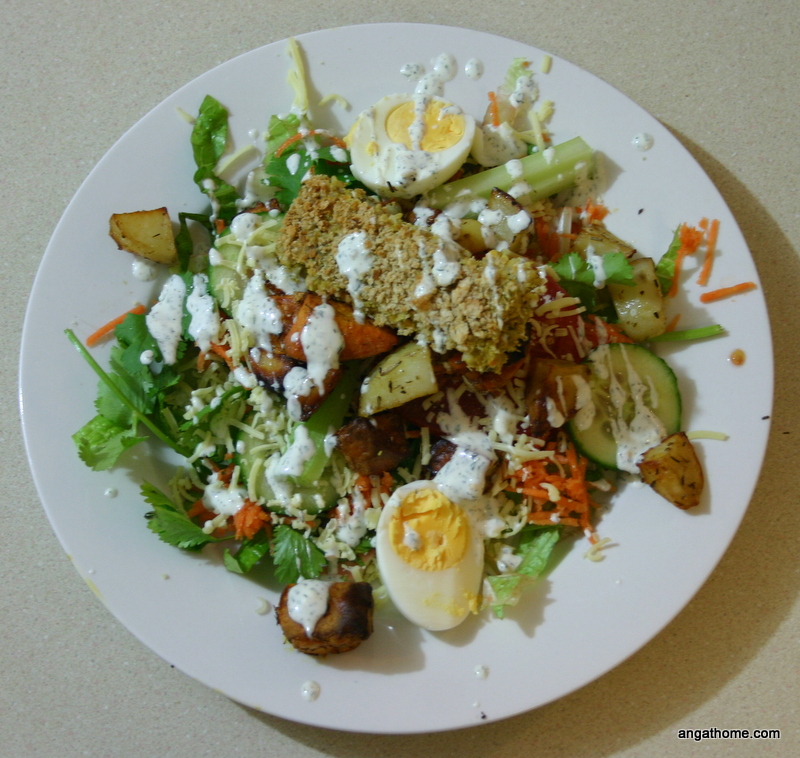
all in salad 1

We occasionally hold “buffet training” evenings. They are great for a family night activity and really very simple. All we do is put out a whole array of food on the kitchen bench in lots of bowls and have the children move along and serve themselves in the same way they would do at a buffet. We discuss etiquette at the same time and add our own rules to make it work for a home dinner. (For example, “You may skip over no more than 3 of the dishes” to ensure that the tomato haters are satisfied but the vegetable phobic children still end up with a few specimens of the veggie kind on their plate.) The children need to know how to take an appropriate amount, avoid wastage, to think of others coming behind them, use the tongs, general manners and so on.

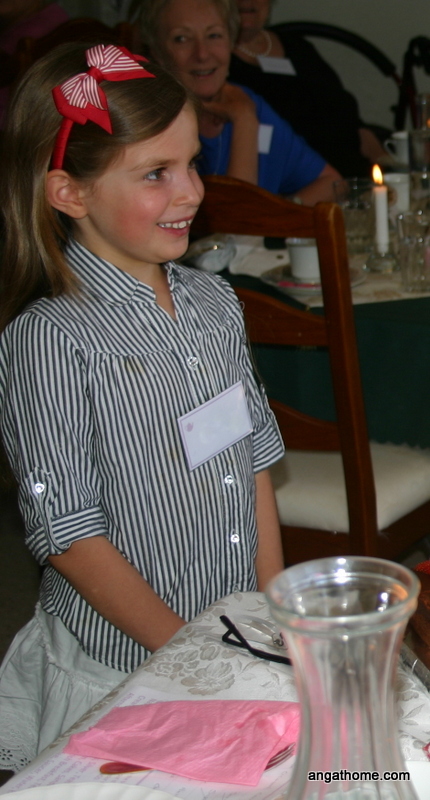
waitressing

Hosting high teas and other special events in our home and having the older children act as greeters, seaters, waiters and waitresses is also something they love and helps them to learn how to show hospitality and serve others by making people feel welcome and comfortable.

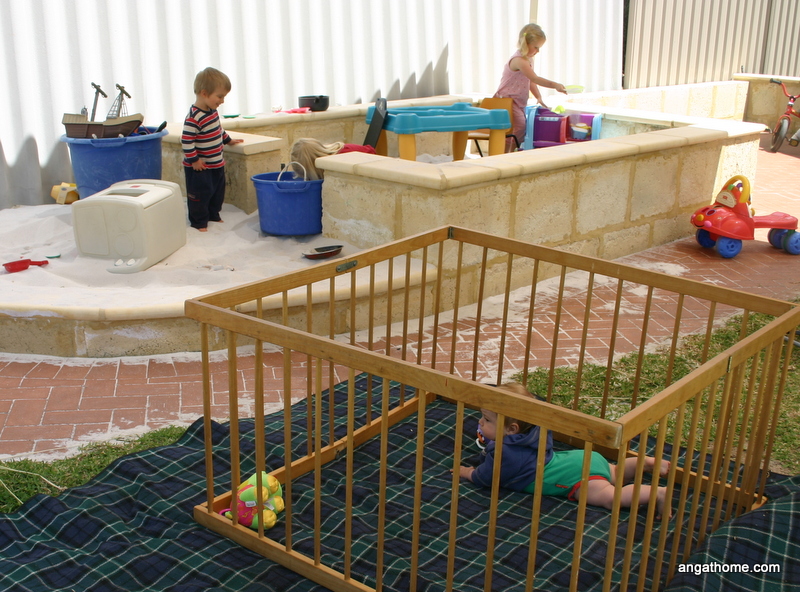
backyard boundaries

Have you ever had a visitor’s child waltz through your house as if they owned it, helping themselves to whatever they like? If children are used to having complete freedom in their own home to go wherever they like, touch what they like and do what they like, then don’t be surprised if they do the same while they are out.

As well as having a routine in place, limiting inappropriate choices and providing verbal, physical or visual barriers in our own home, when we arrive at someone’s house or a play area, one of the first things we do is identify the physical boundaries for the children.

We also spend a little time on the way there discussing the kinds of situations they may face and have the older children remind the younger ones of the manners they need to remember (a good review for them as well!)

A with teddy

To avoid having young children who will only sleep in their own cots at home, we occasionally put them to sleep in a variety of situations; in the portacot in another room, in the pram, on a sibling’s bed, in our big bed, at Grandparentss house for an overnight etc. While they never sleep as well when we are out, at least they will have part of a nap.

While far from perfect, the children are slowly growing and developing into young adults that we hope will be a blessing to us and to others.

Homeschooling with toddlers and preschoolers

Twin's tot school activities

Whether you like to call them Montessori tray activities, tot school, preschool, workboxes, workjobs, shoebox tasks or Ziploc bag activities, providing younger siblings with engaging, educational and worthwhile tasks to do while you homeschool older siblings is vital for a smooth day with well occupied children.

While you can get some schooling done while little ones are napping, I prefer to get the bulk of our formal schooling completed as early in the day as possible when the children (and I) are freshest. Last year we had around an hour while the younger ones were in room time (playpen time for littlies) and we could also use mat time (or blanket time.) Now that we have older children though, this is not long enough to complete all of their workload and the twins are turning 3 so a new era has dawned!
The twins will be “starting school” with the big kids. They will now be included in our morning circle time, followed by table activities before they go off to room time. The list of possible table activity ideas is almost endless but our “school” trays will be more Montessori in style.
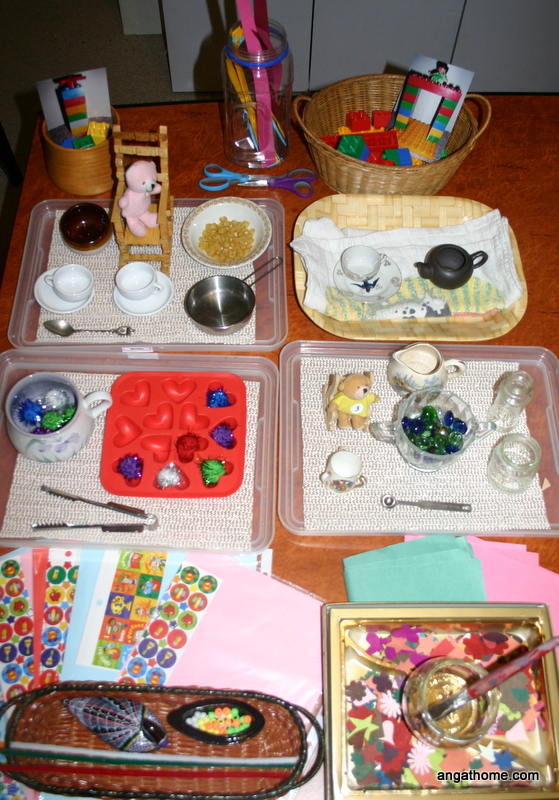
As I have done in the past, I have chosen a list of categories for each tray and put one example of each category out on the shelf. When it comes time to update the trays in a couple of weeks as interest declines, I will simply swap out the materials but keep the type of activity the same. (See starting out.) This term our trays are gluing, cutting, stickers and drawing, tong transfer, spooning/teddy play, scooping/teddy play, threading. Duplo copying and water pouring. 

The best thing about this year’s preparation is that in the past I have taken photographs of all our tray activities along the way. This meant that I could simply hand the older children a couple each and ask them to go and get everything in the photo and assemble the activity. I pointed out that this was an opportunity to bless their little brother and sister. They quite enjoyed doing it, especially as I gave them latitude to change the activities a little with different pretty pots and equipment to suit their own tastes. In about an hour we had a whole term worth of trays set up and ready to go. (Plus the extra half hour to put away all the mess that the children created as they were collecting the gear but I wont mention that!)

Scooping tray activities for toddlers and preschoolers

Scooping is one of the easiest Montessori style tray activities for toddlers and can be introduced at the same time as they are perfecting their spooning skills during meal times – giving them a little extra practise when spills are not so difficult to clean up!

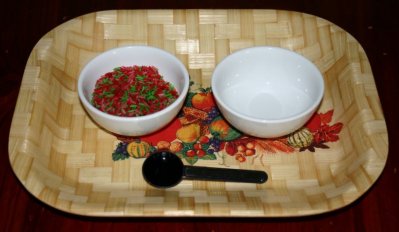
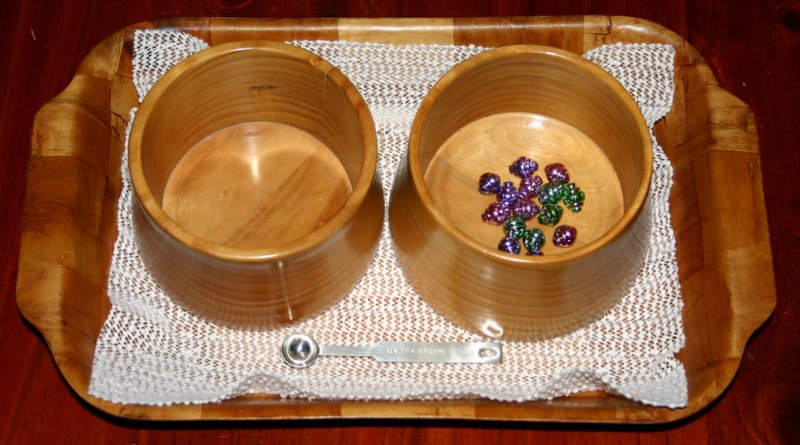
Start with large, non-slippery objects that fit easily into a scoop (see mega marbles) and move to more fiddly materials like the popcorn or rice examples below. All you need is two containers (one to  to scoop from and one to scoop into), something to scoop with (spoon, scoop, ladle, etc.) and something to scoop (pompoms, noodles, rice, jewels, marbles, beads, dried beans, pasta etc.)

Have a look through your art and craft supplies, kitchen cupboards and junk drawers and you will be surprised at what you can put together in just a few minutes.

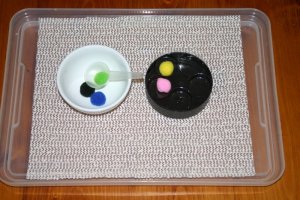
These pompoms are scooped into a plastic chocolate container insert with depressions in it. The scoop comes from a washing powder container.

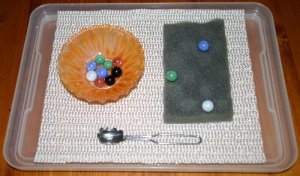
This is a piece of packing foam that has indentations all over it; perfect for filling with marbles. The scoop is a pasta spoon from a child’s cooking set.

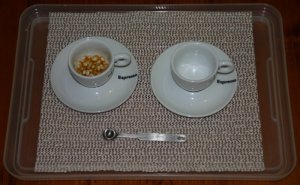
Dry popcorn kernels in espresso coffee cups with a 1/2 teaspoon measuring spoon.

Montessori trays are traditionally presented with the material to be scooped on the left hand side to help with left to right directionality for later reading and writing skills.

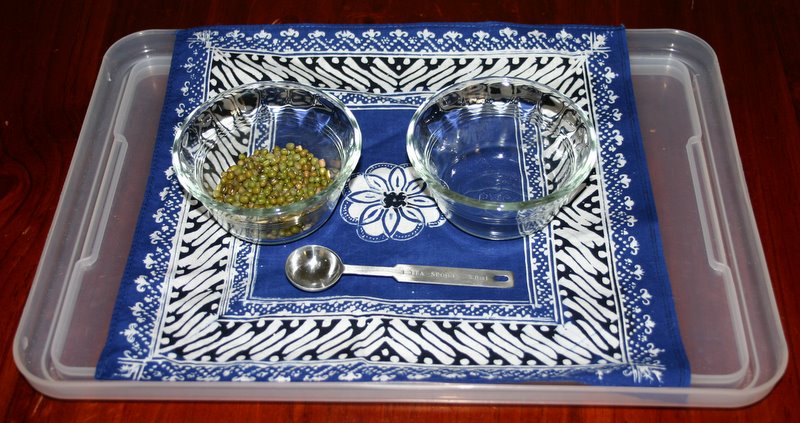
Green split peas are scooped from bowl to bowl.

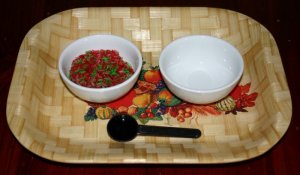
Coloured rice is a very attractive scooping material.

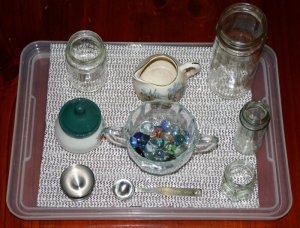
When my toddlers were older and no longer finding simple scooping activities very interesting, I gave them this tray with a variety of containers to scoop, pour and tip with. They loved it.