Building Focussing and Concentrating Skills in Toddlers

Patrice Walker was one of the speakers at our big GEMS night recently and she gave an excellent introduction to developing focussing and concentrating skills in our toddlers and young children. She has kindly given me permission to reproduce her notes here and while there is a lot to read, I think they are well worth the time. I have added links to further information or explanations from my blog posts as they relate to what she has to say.

Focussing and concentrating skills are habits and skills which are needed for a lifetime, as they affect all areas of our lives. An impulsive child who is always looking toward what is next rather than enjoying what is in front of them, becomes an unsettled adult, unable to stick with a single task very long. Whether it is in the classroom or workplace, this impulsiveness will often result in work that is poorly or incompletely done. This child or adult will be unlikely to achieve any personal sense of accomplishment or have the confidence to tackle bigger projects; they can be easily discouraged and give up quickly. We can help our children to use all the gifts and talents God has given them, if we help them develop the virtues of attentiveness and self-control.

So, let’s begin by looking at encouraging focusing and concentrating in the toddler years. What will help you most as a parent is to understand the need to manage the freedoms your toddler is allowed, and therefore, the routine and structure of his day.

We know that God has blessed our toddlers with an insatiable curiosity for the world around us. It’s so exciting to see a little one’s eyes open with wonder as they see something for the first time, maybe an ant moving along with a crumb… They lie down on the floor and watch it, maybe pointing with their chubby little fingers or poking it and making “gooing” noises. Very cute, right? Would it be so cute if it was an electrical power-point which had captured their attention? Probably not, and you would be justified in wanting to remove your little one from the danger. While we do not want to suppress the natural, healthy curiosity of a toddler it’s clear they should not be allowed unlimited freedoms to come and go with no guidance; to explore without limits or to touch without restraint. The boundaries that a toddler needs, however, go beyond just the health and safety concerns.
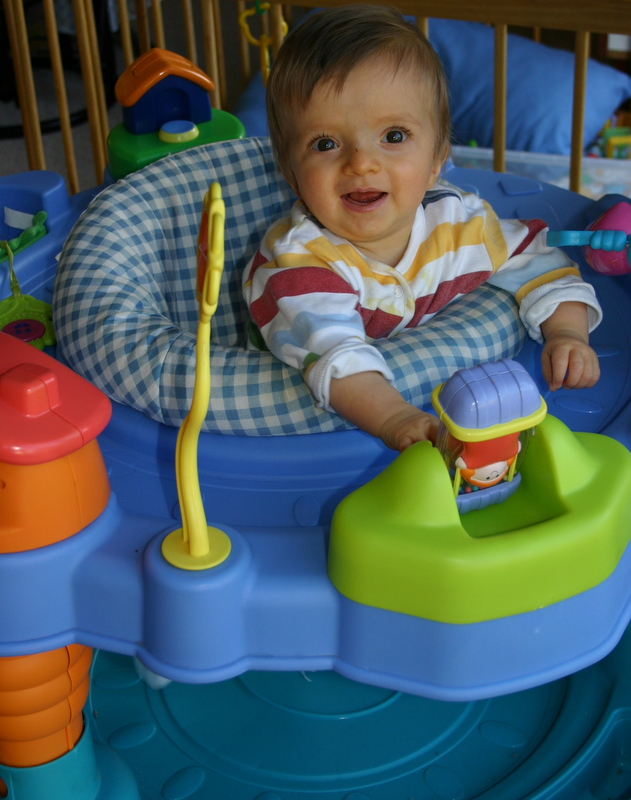
The best way that parents can establish healthy limits for their toddler is by making decisions for them, and setting reasonable physical boundaries. You should make the most of your toddler’s curiosity, by helping them pay attention, focussing and concentrating on what is best for them. That means Mums that you decide who does what, when they do it and where they do it. So you are able to make good decisions yourself, it is helpful to have some order and structure in your day.

It’s important to understand that a routine is meant to serve you and your family. It should give you the opportunity to make the most of the days that God has given us, to do the work that he has appointed for us. Having some structure and predictability in the day provides security for your little ones and helps you use your time effectively enjoying and training your toddler. There are many activities that can be included in your day which give healthy boundaries, use their curiosity and  attention, and will therefore encourage a toddler to focus and concentrate.

I will be explaining some of the activities we have included in our toddler’s days that are useful for developing these skills. Most of these I have learnt about from reading the Growing Families materials and observing the results in families we know who use these principles in their own homes, with their own children.
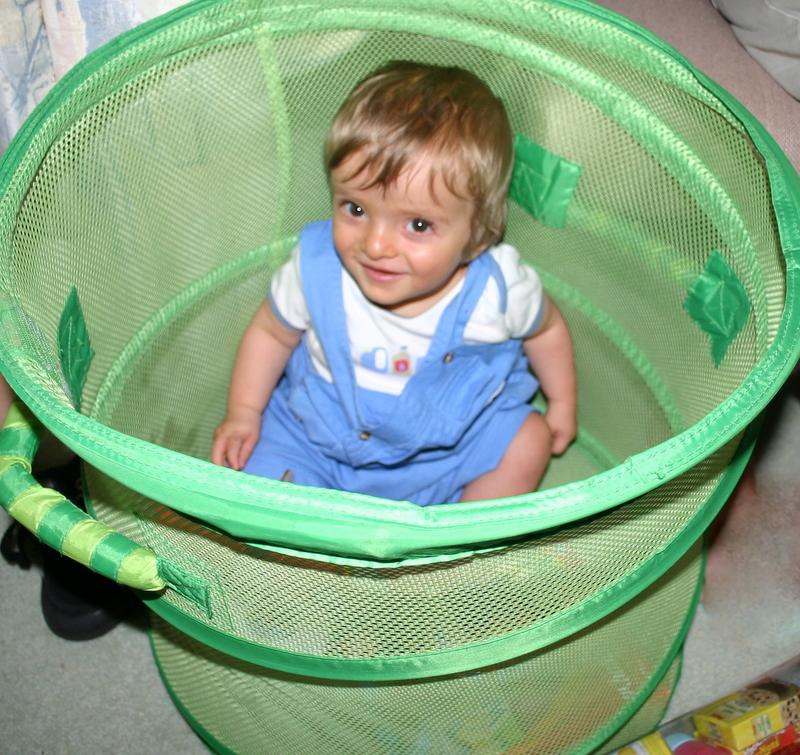
I’m going to begin with the activity that most toddlers have a “love-hate” relationship with – the playpen or room time. This is a time, determined by Mum, for your little one to have some time to play on their own.  Learning to play contentedly for a period of time without having someone there to entertain him is an important skill for a toddler to learn. Playpen time can be used from a very young age for short periods of time, initially only 10 minutes or so but increased over time, particularly as the little one’s sitting skills develop. We have used wooden playpens, a portacot or sometimes, when space was tight, their own cot. We have also varied the location, depending on the child and our home, but as much as possible tried to make it an area that is reasonably secluded from the rest of the family, sometimes even using a playpen outside.
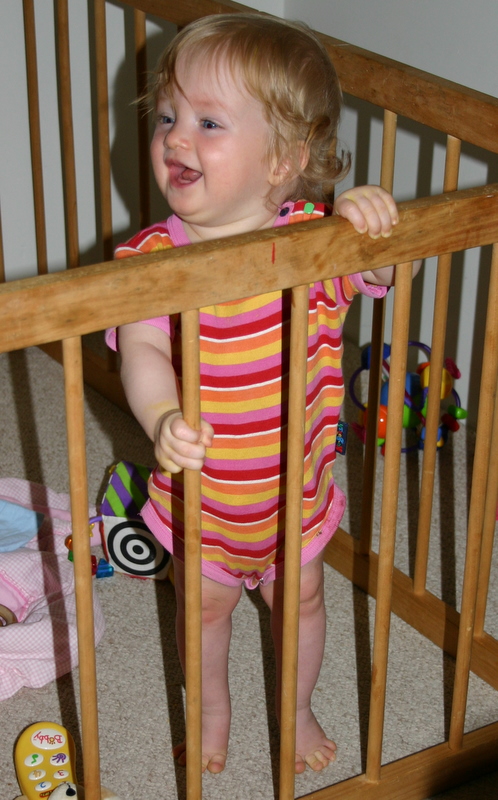
Playpen time transitions to room time around 18-20 months of age, when the toddler’s room is usually used as his play area. For some toddlers, going from a playpen to a room can be an overwhelming freedom, so a blanket placed on the floor as a visible boundary may help your toddler transition better. I used a quilt my mother-in-law lovingly made for our first to line the base of our playpen and then used that on the floor of their room during room time. Again, beginning with short periods of time, build up the time spent in room time as the toddler develops the skills of focusing and concentrating on their toys.

My children have all learnt to enjoy their room time for up to an hour by the age of two or so. When children are left alone it is amazing to see how content they can be playing with one simple toy after another, undistracted by the other people or noises in the home. I have, at times, had to encourage our other children to leave the little one alone to enjoy their play! Don’t confuse room time with a free play time in their bedroom – your toddler needs to learn to play in his room when you, the Mum, says it’s time to do so, for the period of time you decide.

Playing in his room also doesn’t mean he is able to do whatever he chooses in that time. Mum chooses the toys which should be age appropriate, rotating them regularly, keeping them interesting and challenging. As we know, bored children quickly find trouble! I have found it helpful to spend time showing a toddler how to play with their toys during the day before using it in either the playpen or room time. I’ve also spent time learning about age appropriate toys and activities through books, the internet and talking to other mums. For a while we belonged to a toy library and this was great for exposing us to different toys that were often more educational in nature. They had a variety of toys and activities that were not available in the local toy shop or were beyond the range of our family’s income. It’s also great for those toys which little ones only use for a short period of time.  Another way we’ve found to keep the interest levels high without having to keep purchasing new toys is to swap and share toys with other families. It’s a good way to determine which toys last well and whether the interest in a toy is high enough to consider purchasing it.

It’s important to include some free playtime in your day. This is when your toddler has the freedom to choose what he plays with. It is still supervised because you decide when he is able to do it but it is free time because the child is making the decision about what to play with, based on his interests. This time should usually be short, around 30 minutes to an hour, depending on the age of your toddler. I have found it best to decide where the play is to take place and usually encourage outside play several times a day as it’s important for little ones to have the opportunity to get fresh air and use up some of their never-ending energy. I try to encourage my toddler to sustain his interest in his chosen activity by not allowing them to flit from one toy to the next, leaving a trail of destruction behind them. Limiting the number of choices helps with this. For example, we don’t have all the toddler’s toys out in a huge box to be rummaged through but have several smaller containers of toys both inside and outside. We also teach our little ones to pack up one thing before moving to the next, meaning less desire to “chop and change” and less cleanup at the end of the day.

A structured, focused playtime with Mummy should be a priority for toddlers. Not only do they need your supervision, they need your love and attention. I’ve found that making a time each day for me to focus solely on the little ones really helps them feel loved and secure. Some days the time is shorter than other days and the activities are almost always chosen by me. We might read, play with toys or a game, do crafts, bake together, do a puzzle or so on. I have found with some of our children that spending this time with them early in the day has meant they are more content to play by themselves later in the day. When one of our children was younger they were becoming quite difficult in the early evening, but I discovered that if I spent a short period of time focussed on them in the late afternoon that usual fussy time was much less likely.  This time also provides me with the chance to encourage an older toddler with their attitude or behaviour we’re working on. The Terrific Toddler books by Mel Hayde are excellent resources for how you can build happy, healthy hearts in your toddlers – very practical, positive and encouraging.

A quiet reading or “sit time” is another essential element of our toddler’s day. During this time our little one is either in the high chair, on my lap or next to me on a couch with a few books. Starting with small increments of time, this can be increased as the child matures. Your toddler can learn to focus and concentrate, to love books and to develop the self-control to sit and read what, when and where he is told. This skill can be transferred to many situations outside the home, while waiting at the doctors, queues at the shops and especially at church. We do encourage our toddler to read quietly but this is an enormous task for some so I have found it helpful to concentrate on training our toddler to sit still first. Then, when they can demonstrate that consistently, I begin to train them to sit quietly. Separating the two skills has really helped those of our children who are chattier by nature. I will sit with them reading quietly myself, praising them and in time they learn that it is a quiet reading time. Sometimes, I’ve found that beginning this time by cuddling our toddler on my lap, reading a story to them first or perhaps asking them to find a particular character in a book for an older child, has helped those who have struggled to focus on a book for more than a minute or two. I also choose a quieter time in the day, usually after lunch, as a toddler is starting to wind down for an afternoon rest, sometimes the early evening works well too.

Attending our library’s storytime session was helpful for me in our earlier parenting years. We had an excellent storyteller who had a way of captivating the children’s attention by choosing only the best children’s stories and using her voice to really make the story come alive. I learnt many useful skills that have made more confident reading aloud to my children and also how to help them focus and concentrate on stories and their illustrations.

The virtue of attentiveness is one that can be greatly encouraged by expecting and maintaining eye contact and a verbal response when talking to your toddler. The best way to teach this to your little one is to demonstrate it to them. Show you care about what they have to say by stopping and listening properly to them when you can. This may mean getting down to their eye-level or bringing them up to yours when talking to them or listening to them. When giving an instruction to a toddler, don’t overtalk to them, explaining in great detail every little thing that they are probably not going to understand. You do need to speak clearly and make sure you tell, not ask. This could be as simple as picking up your one year-old and looking him in the eye and saying, “It’s time to go play in your playpen now” and then carrying him there. I would sometimes have to gently but firmly hold our toddler’s chins to encourage them to look me in the eye.
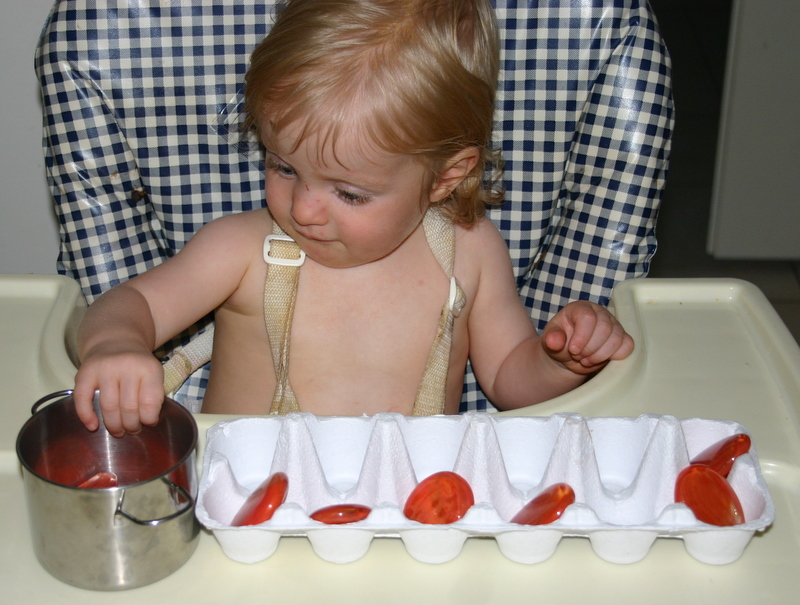
Another activity which encourages focusing and concentrating is a high-chair or table time. I use the high chair mainly for younger toddlers and a table time for the older ones. During this time the toddler is directed to an activity Mum has chosen in a place Mum has chosen– the highchair or table. Simple activities that will hold the attention of your toddler that don’t require much assistance or preparation from you mean that you can then do other things nearby. I often use this several times a day after meal times and particularly during meal preparation time, as the little one is then not likely to be needing too much of my attention while I’m handling sharp knives and hot food. Good activities for younger toddlers include a few small cars or dolls on the tray or mat, magnetic shapes or letters, wooden puzzles, stacking cups and rings, container of pegs or similar to put in and out. For older toddlers try paper and crayons or pencils, felt boards, play dough or threading activities. All my little ones have enjoyed playing with various kitchen items, mixing bowls, spoons etc copying me if I’m in the kitchen. Again, I start with small increments of time, but gradually, as your toddler develops the power of attention and self control, they can sit and play for increasingly longer periods of time. My good friend, Ang Pascoe has an excellent blog which has an abundance of articles and examples of activities and resources to use with young children. They are mother and child-friendly with lots of photo’s to encourage and inspire. Her blog address is angathome.com.

A few other factors to consider when planning your toddler’s day include deciding the best order of the activities, the transition times and the gender and personality of your child. I’ve found it’s best to keep to a similar flow of activities each day. This encourages the toddler to feel secure in what is expected of him throughout the day. I also think it’s best to alternate activities that our toddler does alone with those that he does with me or other children, those that are quiet with more active ones, and inside and outside activities. Watch the transition times between activities – don’t allow your toddler to wander aimlessly waiting for your directions. I would rather have my little one in the highchair, playpen or a stroller for a few more minutes while I organise what is happening next, than have them getting into all sorts of trouble because I’m not quite ready. I have often played a game with our older toddlers where I tell them they are my shadow, so they have to stay really close to me, this is very helpful during those transition times. I think it’s worth noting that, as a mother of four delightful boys I know very well that God made them all different to each other and also to my two lovely daughters. Rather than compare them, I do my best to accept that God has made each of our children with different needs, strengths and weaknesses. I need to be mindful of that when I’m choosing their activities and training them to focus and concentrate.

Please be encouraged that while it is hard work, it is possible to have wonderful days with toddlers! They can learn many positive skills and attitudes through playing and good direction of their time. The skills of focusing and concentrating are ones that will affect them for life and influence the development of virtues such as attentiveness and self-control. If most of this is new to you, don’t feel overwhelmed but choose one or two things which you can begin with. The small GEMS groups are a lifeline for many mums, myself included, to encourage and equip us by talking through issues and sharing ideas with others on the same parenting journey.

Montessori style hands-on maths workjobs: Counting 1 to 10

Following on from yesterday’s post about teaching children to count to 5, here are some ideas for extending counting to 10. Again, all you need is 10 of some kind of container, something to count and numerals to order (or already marked on the containers.) If the child is required to order the numerals themselves, then including a number strip to follow means that they can do it independently without already knowing the order.

Kinesthetic learners learn best through hands-on activities, however all young children need plenty of experience with manipulating concrete materials to develop early maths concepts. Workjobs are explained to the child (catering to auditory learners), demonstrated to the child (visual learners) and then completed by the child (hands-on or kinesthetic learners.) There is no need to use dry math work books in the early stages when these basic concepts can be so easily developed with materials that are enjoyable to use and simple to make.

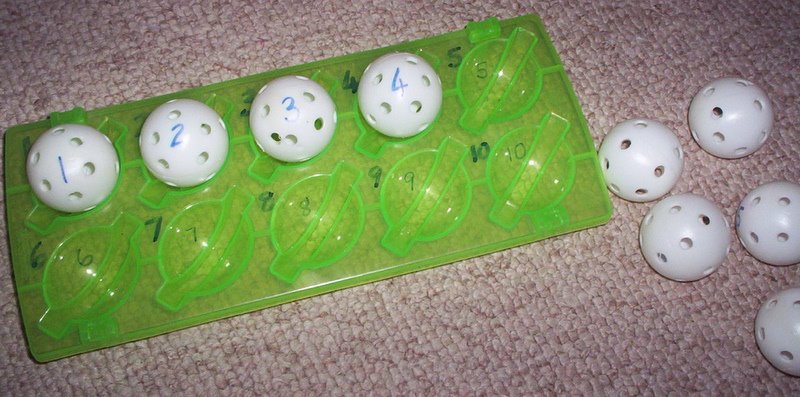
For children who do not yet recognise their numerals, this workjob is very simple and requires them only to match the number on the plastic balls to the corresponding number on the iceblock tray. I would then alter it into a counting activity by using plain ping-pong balls (no holes) with dots or tiny stickers on each one to count and match to the correct number.

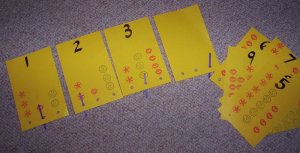
In this activity the child counts the number of stamps and pokes a matchstick through the hole underneath the correct group. The card is self-checking because when you turn over to the back, there is a circle around the correct hole.

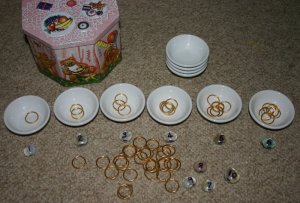
This "Princess rings" activity is a favourite of my girls. 10 tiny white jewellery bowls are set out then jewels with the numerals 1 to 10 are placed in order next to each bowl and the rings are counted into each bowl. The rings come from the wedding favours section of my local discount store. We made up all sorts of extra stories about how the princesses shared their rings out and had a lot of fun with this. Sometimes a good story adds so much to the fun of the activity!

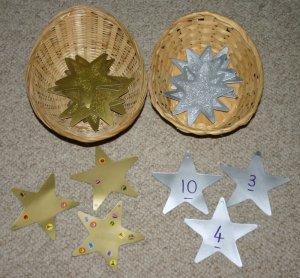
The child orders the silver stars (bought from a party supplies shop) from 1 to 10 then counts the stickers on each golden star before matching them to their pair.

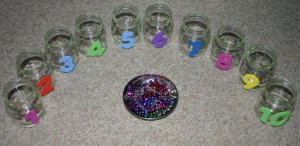
Foam stickers on baby food jars and some cheap party bead necklaces cut into lengths make this a bright and attractive counting activity. After ordering the jars from 1 to 10 the child counts the number of beads on each string and drops them into the correct jar. Not a good one for absolute beginners as the beads are quite small and it is easy to miss-count as the higher numbers are reached.

Hands-on maths workjobs: Counting 1 to 5

If you are blessed with a kinesthetic learner, providing hands-on learning experiences is vital. All young child however need to move from tactile or concrete mathematical experiences (where they manipulate objects to develop mathematical understanding) to abstract (“on paper”) experiences.

There is no better way to teach children to count than to have them go ahead and count! The first step is to ensure that they are able to recite the number order. The next step is to develop one-to-one correspondence (matching one number to one object.) After that, let the counting begin! You will need to step them through the process initially with lots of opportunities to count. Use everyday activities around the house to introduce this skill; setting out 4 plates, counting 3 sets of cutlery, placing 5 sultanas on a celery stick, collecting 5 hats for outside play etc.

To transition to the tray activities, you will also need to teach the children how to recognise and order the numerals to 5. This can be done as they complete the activities with self-checking number strips to match the numbers (see the egg carton castles example below) or taught separately before you give them the tray activities.

For homeschoolers, or those who are wanting educational ideas for highchair, mat or table time, here are some hands-on ideas for presenting counting from 1 to 5. While children can easily develop this skill through their every-day experiences around the home, these workjobs will help them to develop concentrating and focussing skills and are a great introduction to more complicated workjobs and Montessori style tray activities that will extend their skills as they grasp each basic beginner skill.

My older toddlers begin with these simple counting activities which virtually guarantee their success and I am able to teach them the general concept of how the experiences are presented and what they need to do. I can then change the materials, extend the numbers and gradually increase the difficulty of the experience to match their developmental levels. They love to manipulate the materials and enjoy the sense of accomplishment once they are able to complete each activity.

Before expecting a child to do the activities independently you will need to spend some time teaching them how to set out the containers, order the numbers and add the appropriate number of objects. Depending on their previous experiences with counting, this may be a very quick or more long-term process. Once they have mastered one counting experience though, the skill is then transferred to the next new activity with only a quick demonstration from Mum.

Any kind of container can be used and with a bunch of something to count and 5 numbers to order you are all set. Ideally workjobs should be self checking so that the child is able to self-correct their own work without your assistance.


This is the first tray counting experience I use. The popsticks are first sorted into colours (with the child already having completed many colour matching and sorting activities previously) before being counted and popped into the correct cup. If children do not yet recognise their numbers they are able to count the small chunks of popstick next to the number to find out which numeral it is. Those who are just beginning can simply match up the colours to find out which cup to put them in. If they are completing the activity with colours rather than numbers, I simply spend time with them counting the number of popsticks in each cup as we pack away the activity until they are able to transition to relying on their counting skills rather than the colours.

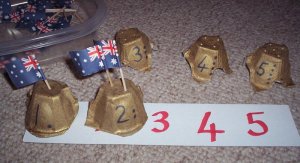
Including a number strip for the child to match to as they order their numerals means they can be successful without already knowing the number order. The dots next to the numerals on the side of the castles mean they can count to check how many even if they do not recognise the numeral itself. The correct amount of holes are poked in the castles so that the castle must have the correct number of flags.

Milk bottle tops marked with liquid paper are the numerals here (you could include a number strip to match to if needed) and the size of the cups can be ordered as well for an extra dimension. The child sets out the 5 cups, orders the numerals, then counts out the correct number of pegs for each cup. Pegging is also an excellent fine motor skill.

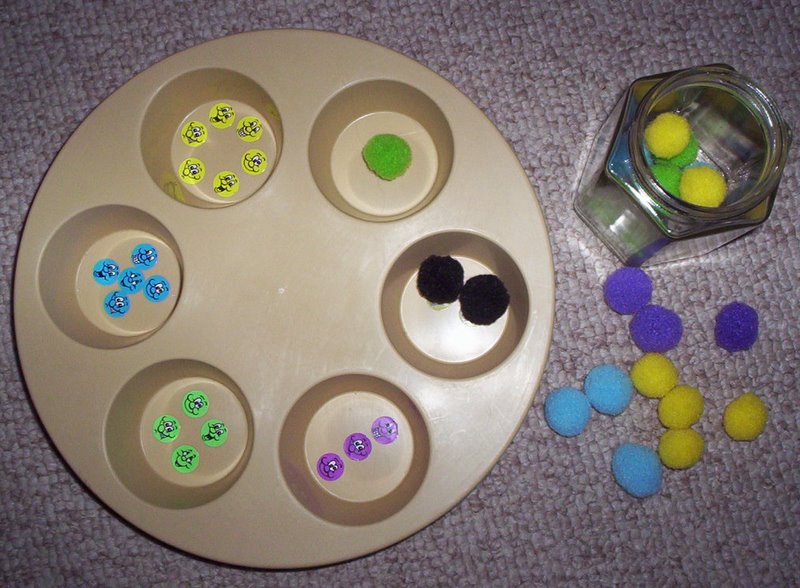
Coloured pompoms are matched to the same colour sticker in the muffin tin. This is more a one-to-one correspondence experience as no numerals are included, however I have the child count how many there are in each hole before they pack them away.

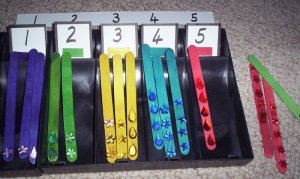
The numbers are set out first (following the number strip if needed) then the  jewels on each popstick are counted to match the correct number. Popsticks are colour coded to the numerals to make them self-checking.

Check through your cupboards to find a group of containers, write some numbers on anything handy, add something to count and you have a simple counting workjob. Two dollar shops and other discount stores are great for finding appealing bits and bobs to count and manipulate and a multitude of activities can be set up with very little expense or effort required. Young children love to do “school” with their older siblings and this is the perfect introduction for them.

Scripture memorisation

Most Christians understand the importance of memorising scripture; of writing God’s word on our hearts so that we may be able to live by it on a day by day basis. Those occasions where a scripture just pops into our heads when we are caught up in a situation, giving us a warning or guidance that is needed in the moment, are unlikely to happen if we have nothing stored up in our memory for just such an occasion. The same applies to helping our children memorise bible verses.

There are so many ways to go about teaching our little ones how to remember bible verses, the benefit to us being that as we do it together with them we are storing up scripture in our own memories as well. We have tried a few different methods along the way, some of which I’ll outline for you below.

Our favourite system so far (and the one we are using at the moment) is scripture set to song. We start a new verse each Monday during circle time and find that by Friday even our youngest participant (4 years) has easily memorised the song and therefore the scripture passage. There are a few resources around for this but we like the Children Arise CD Series. The music is professionally produced, with children’s’ voices and catchy tunes. They also stay true to the scripture, pretty much singing straight through word for word rather than altering and manipulating the bible verses to fit the music as some other resources do.

Another system we like is the Scripture box from Simply Charlotte Mason. Scriptures are stored on index cards in a simple flip box system and read through on a daily basis until all family members are able to recite the verse. The system details how to cycle through and review verses already memorised and is simple to set up and use.

We have a large white board on the wall near our dining room table and we have written verses we are working on up here. We have redeemed those wasted moments when children tend to lose control while waiting for the meal to arrive at the table by reciting the verses we are working on.

Another great place to pin scriptures that you want children to remember is on the bathroom mirror (you can even write it on in permanent marker and remove once it is well-known) or on the back of the toilet door. When there’s nothing else to do it’s amazing how many times your eyes will travel back over whatever is in front of them.

Pin verses around and about the house anywhere that they are likely to be noticed and read. Above the washing machine to glance through when throwing a load on, above the kitchen sink to contemplate while doing the dishes, above the computer keyboard or any other place you or the children will likely have a spare mental moment to read through and commit to memory.

Reciting verses as part of family devotions can also be very rewarding. Perhaps children who have memorised their verses with Mum can have the thrill of reciting to Dad what they have learnt. I have printed up certificates with the bible verses on them for each child to place into their own keepsake box or pin up on their pinboard as a small reward for learning each one.

However you decide to do it, it’s not as hard as you think once you get going. For me, I need to get a whole bunch prepared ahead of time so that there is no day-to-day planning involved, otherwise it just didn’t happen. You may like to choose scriptures on a day by day basis that are related to character or behavioural issues you are currently dealing with. Which ever way works for you, choose one and get started!

Jesus trees, Lent and Christian Easter activities for children

This Easter we are continuing to build family traditions as we focus on the biblical events that are the foundations of the Easter celebration. Here are some of the new activities we are trying out for Easter this year. The ones we like will become yearly traditions, the others we’ll have fun doing just this time. We haven’t actually made any of these yet so they are untried recommendations, however they look like fun and we’ll take the punt that they are worth the time and effort.

We have already missed the start of lent and with our latest baby due any time now we will not be attempting the 40 day count down, but this Jesus tree activity we’ll save for next year. Similar to the Jesse tree that we made for Christmas, a Jesus tree uses picture or object symbols to represent the major biblical stories culminating in the death and resurrection of Jesus at Easter. My plan for this is to collect 2 large branches and fasten them together to make a natural looking cross. We will then read the bible verses that go with each symbol, colour them in and add them to the cross over the 40 days of Lent. Free printable symbols are available at this blog, with a black and white and colour version as well.

In place of the Jesus tree count down we will use our resurrection eggs to count down the 12 days before Easer. (This year our resurrection eggs contain bible readings that retell the main events of Easter plus little symbols for each part that come from this blog.) I plan to hide one each day for the children to find and read during circle time.

These Easter story pecan cookies have an amazing amount of symbolism woven through the recipe. As each ingredient is added to the biscuits, a snippet of the Easter story is read that relates to that ingredient and even the way it is mixed or prepared has symbolism. The cookies are placed into the oven tomb are hollow when the tomb is re-opened. I can’t wait to do this one.

These resurrection rolls (scroll down at the link to find them) are also very symbolic, with the Easter story attached to the method of preparing and the ingredients used. Rather than buy a prepared dough that we probably can’t get in Australia anyway, I’ll just mix up a basic sweet dough in the bread maker and use that. Even sheets of prepared pastry would work.

We will use these symbols of Jesus to decorate Easter crosses by cutting out just the pictures and make cute cracked egg Easter cards. This article with general information about Lent was helpful as I really didn’t have much of an idea what Lent was all about and we’ll make these simple palm branches for Palm Sunday.

The legend of the pretzel was another great find this year. I had no idea that there was symbolism attached to pretzels or that they were traditionally an Easter food. We will attempt the paper pretzel pattern (although I made one myself and found it easier to do it by trial and error as I had no idea whatsoever how to follow the instructions they gave!) I think the children will have much more fun making real dough pretzels and topping them with a variety of flavours.

Another paper craft was this paper plate tomb and angel and a bunch of Easter lapbook activities from a variety of sites:

More ideas are available in my last post here.

Creating Christian Easter traditions

So much hype surrounds Christmas and with all the decorations, gifts and preparation we naturally spend quite a bit of time deliberately focussing on Jesus and the true meaning of the Christmas celebrations. Easter however tended to be very low-key and while we always read to the children about Easter in the bible we felt that much more could be done to mark this important Christian celebration than we had been doing. After all, Easter is when Jesus dies for our sins so that we may be forgiven and enabled us through His death to be judged fit to enter heaven. Probably the most important time in the Christian calendar and yet almost unnoticed for many families, other than a couple of chocolate eggs and a hot cross bun!

The following are a couple of ideas that we have begun and will extend upon over the following years in order to focus our children on the important meaning behind this time of year.

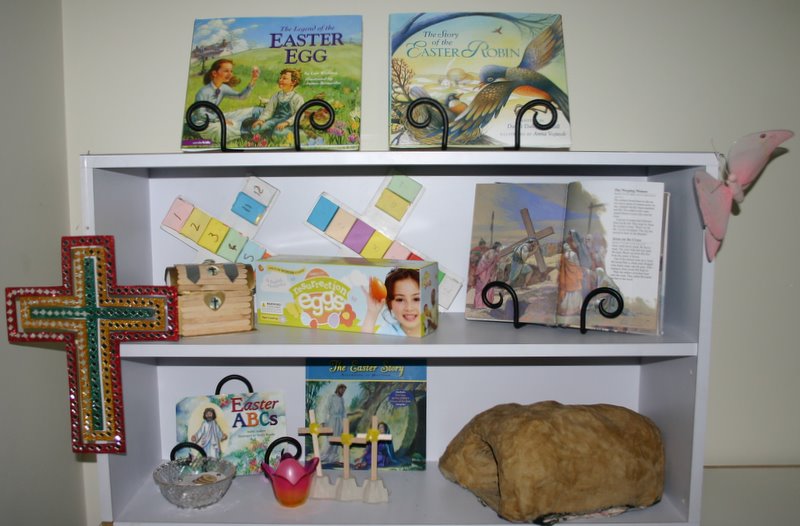
Decorations: We decorate for Christmas, why not Easter? We have started a selection of symbols, books and Easter resources that we use to make a display leading up to the Easter period. This year we are making a living Easter centrepiece that I found here: http://mustardseeds.typepad.com/my_weblog/2010/03/tutorial-hill-of-calvary.html

Traditions:

  • We use a sand tray to re-tell the Easter story with a yoghurt pot tomb, rock to cover the entrance, pipecleaner people, popstick crosses, etc. and leave it out for the children to manipulate and play with.
  • On Easter Friday we re-tell the story again using a paper mache tomb that we made together a couple of years ago (in the picture above), wrapping a pipe cleaner “Jesus” in a bandage and sealing him into the tomb by rolling the stone over the entrance. On Easter Sunday we get up before the children, unwrap Jesus and leave the cloth laying in the tomb, roll the stone aside and place an angel figurine from our Christmas decorations on the top of the tomb. The first time we did this my then 5 year old daughter was stunned and stood gaping at the tomb saying in amazement “Jesus really HAS risen!!” We had to explain to her that there hadn’t really been any Easter pipe cleaner man miracle!
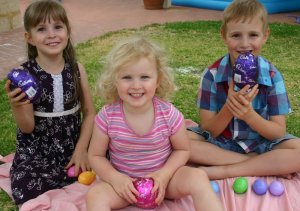
  • We do allow the children to have chocolate Ester eggs. For Christians wanting the focus to stay on Jesus at Easter, chocolate eggs can be quite controversial. We decided as the children would more than likely be given chocolate eggs anyway, we would use the egg and teach them the Christian symbolism behind it. The focus is on the egg being a sign of new life (Jesus coming alive again) and being hollow inside like the tomb after he rose. We read stories like “The Legend of The Easter Egg” by Lori Walburg which reinforce the symbolism behind the egg.

The Legend of the Easter Egg

  • We do have an Easter egg hunt on the Sunday. Instead of finding tonnes of chocolate eggs though, we use resurrection eggs. Commercial resurrection eggs are available online and in Christian stores and we do have a set of these, however we have made our own in a variety of forms over the last couple of years and used these. Resurrection eggs contain bible readings that retell the main events of Easter plus little symbols for each part. We usually finish the hunt with one chocolate egg each. This year our home-made resurrection eggs come from here: http://www.annieshomepage.com/eastereggstext.html

  • We have also had a treasure hunt on the Sunday where clues on large paper eggs led from one location to another. Each clue egg had the next part of the Easter story on it which we read together before following the clue to the next paper egg. We finished the hunt with real china egg cups with a chocolate egg inside for each child.
  • “The Lamb” by John Cross is another brilliant book to read at Easter or anytime really. It begins with creation and makes a clear identification between Jesus and the sacrificed lamb for forgiveness of sins. Each chapter starts with a review and has questions at the end to check understanding. Included with the book is a 60 minute CD, providing a word for word narration. I have seen my three year old come ahead in leaps and bounds in her understanding of the gospel, however it was more than sophisticated enough for anything up to teens to read on their own. An excellent resource for circle time, family devotions or just to read together.Only available in Australia here: http://www.goodseed.com/products/lamb-eng-book/


More ideas for Easter traditions and activities coming over the next couple of days.

Family devotions

In my last post I mentioned that it is the Father’s role to lead his family spiritually. In many families this role has been handed over to the church, Sunday school, Christian school or sometimes Mum. While spiritual input from all of these areas can be very beneficial, it is primarily the Father’s responsibility. One tangible way that Dad can take hold of this role is by leading his family in daily devotions (sometimes known as family alter or bible study time.)

WHAT ARE FAMILY DEVOTIONS?

  • Regular bible study with the whole family. This time can also include worship (in the form of singing), prayer, and possibly catechism and scripture memorization. Catechism and scripture memorization are both important, however some families do them separately at other times throughout the day.

WHY SHOULD WE DO IT?

  • In short – God tells us to! It is not enough to take our children to church and youth group and hope for the best. We must disciple our children, teaching them in our homes, with the Father as the primary lead in this area.
  • We become the prime spiritual influence in the lives of our children – it allows us to shepherd our children’s hearts; preparing their hearts for the gospel and salvation, building their faith and strengthening a biblical worldview.
  • Worshiping and communicating with God is vital for the whole family, not just Mum and Dad.
  • It promotes personal spiritual growth, helping us (and our family) to learn the bible, it’s doctrines and teachings in order that we know what we believe and why. If our children do not know God’s word they will be unable to honour, respect and live by it. Children need to learn that the bible tells us what to do and gives us insight for daily life; that it is relevant to them and their everyday situations. As families study together, parents can weed out errors in belief and misunderstandings
  • Worshiping and studying God’s word together builds family unity, strengthening and building healthy family relationships.

HOW DO WE DO IT?

  • The “how” of family devotions changes with each family’s unique situation, time constraints, ages of children and a myriad of other factors. Find a way that works for you and do it – regularly!
  • Decide where; Lounge chairs, around the dining table, on the end of beds, sprawled on the lounge room floor…
  • Decide when; As soon as the family is awake, immediately before or after a meal, after dinner clean-up, just before bed? Ideally choose a time when children are fed and well rested.
  • Decide how long; this depends on the age of the children. Keep it to a reasonable time limit, but not so short that you cannot give adequate attention to God’s word.

TODDLERS AND YOUNGER

  • Give thanks before meals. Hold the child’s hands and encourage them to join in with “Amen” at the end. Encourage them to echo or say simple prayers as they are able.
  • Pray with and for the child at bedtime
  • Have your own devotions in front of the child
  • Read short, colourful bible stories. Perhaps ask a simple comprehension question or two afterwards.
  • Sing simple bible based children’s songs together
YOUNG CHILDREN TO MIDDLE YEARS
  • Bible stories are still important, branching out into the lesser known ones.
  • Spice up your devotion time by acting out stories, using puppets or pictures, involving the children in role play and re-tell.
  • Introduce real-life stories, applications and real Christian “heroes”
  • Ask questions for comprehension and real-life application of what they have read; “What would you do if..?”
  • As children can read, have them take their turn to read out the verses being studies.
PRE-TEEN TO TEEN
  • Discussion, sharing and engagement become much more important.
  • It’s ok to not always have the answer – model how to find out.
  • Personal devotions for the children should be well and truly up and running – perhaps set “homework” and discuss together, work through devotional books together or research tricky questions.
  • Discuss current affairs and politics and the biblical basis for decisions making in these areas. What are the biblical rights and wrongs of what is going on?
  • Teens take time – make sure you plan for it!
MULTIPLE AGES
  • Beware of dumbing everything down for the younger children, they will pick up more than you think.
  • use a mix of resources; some days may cater more for the younger, others the middle or older.
  • Young children may stay for the first part of devotions then head off to bed while the older children delve in more deeply.
  • Involve the older children in planning and running the devotion time.
  • Everyone may do the same bible study together, with younger children having a children’s bible story at night before bed and older children working through separate studies in the evening

FORMAT

  • Sing together. Perhaps a kids bible song, contemporary worship song  and a traditional hymn. Do not neglect the great hymns of the faith; the words in these will teach spiritual truths to children and will lodge in their memories for a lifetime. Voddie Baucham’s article on family worship touches on why we should sing hymns: http://web.me.com/voddieb/vbm/Blog/Entries/2009/11/5_Answering_Your_Questions.html
  • Study the bible. There are many ways to do this. A couple are: Chapter by chapter (simply work your way through books of the bible from start to finish in small chunks), following a theme or topic or read 1 proverb, a section of a psalm and a couple of verses from the New Testament each day.
  • Several great ideas are included in an article by Al Troester here: http://www.wholesomewords.org/family/famaltar.html)
  •  Perhaps Dad could read through the selected text to begin with, then ask those children who can read to take it in turns to read 2 lines each and those who cannot yet read to echo the words of each verse after you. Dad then teaches back through the selected text – children are asked to contribute to discussions or ask questions after he has explained each line or two. Each person finishes the bible study section by telling something they have learnt or can apply to their own lives. Always look for the applications and personal lessons after each reading and teaching time.
  • Pray. All family members take a turn to pray for whatever is appropriate that day. It is helpful to have some kind of prayer journal or recording system to help with purposeful prayer and to notice the answers to prayer that God gives us. Record the date it was prayed for, what was prayed and leave a column to record God’s answer.
  • Catechism. The catechism is a series of questions and answer that children memorise to learn the main doctrines of the Christian faith, building a strong foundation for world view and ensuring they know what they believe. (More info on this another time:)
  • Scripture memorization. (More ideas on how to do this another day too 🙂


Children who stand strong in their faith: Walking against the crowd

One of the topics raised amongst our GEMS leaders a little while back was how to go about raising children who are able to stand strong in their faith even when no-one else is walking with them and they are away from the sheltering influence of their parents and family. How do we prepare them to be in the world but not of the world; to be able to choose the narrow path and walk against the flow? (Even if that means standing alone because “every one else is doing it!”)

I believe the key is that our children must develop their own genuine saving faith and not be relying on ours to carry them through. They must have the Holy Spirit as their strength and their own conviction to stand on God’s word and to follow His commandments and statutes. Our teaching as parents must be overt, deliberate, ongoing, free from hypocrisy, giving a good role model and above all, reaching the heart of our children. Our teaching will be molding the external behavior of our children, but this must transition to heart knowledge, to the child internalizing the beliefs for themselves. We can only do so much here and pray that God will do the rest. In the end, when a difficult test comes, only if our children have chosen God and His ways for themselves will they make the difficult decisions and stand alone if necessary, because otherwise they simply will not want to!

Dads should be leading their family spiritually. There are many ways to do this, including holding family devotions, leading world view discussions on current affairs, discussing what they believe and why and relating that back to the bible. Be deliberate in teaching the bible, memorizing scripture, training character, reading inspiring books with a message and praying together. Soak your children in the beliefs, understandings and world view you want them to have well before a time of testing will come. Decisions made ahead of time without the emotions and pressure of the heat of the moment, decisions that have been discussed, thought through, prayed over and become an internalized way of life will not be overturned quickly. We all can think of actions and decisions made in the heat of the moment that we wish we could change and would have done differently had we previously thought through the issues involved.

You shall teach them diligently to your children, and shall talk of them when you sit in your house, and when you walk by the way, and when you lie down, and when you rise.

(Deuteronomy 6:7 ESV)

We need to keep the lines of communication open; talking about everything. Make time alone to share, bond and discuss those innermost thoughts and feelings. Work to surround your children with peers who are being raised with similar convictions, standards and beliefs. Two or more standing together is so much easier than one standing alone. Foster a close relationship. Fill their love tanks. A child who knows that they are unconditionally loved by their families will have an extra inner reserve of strength to stand firm. A needy, empty child will turn to those who fulfill those needs that are not being met at home.

Certain personalities will be more naturally able to take a leadership role and less likely to blindly follow the crowd. All of us need to be able to make the hard decisions though and learn not to follow when the leaders are leading in the wrong direction. Teach your children about personality types and love languages. Help them to identify their own strengths and weaknesses and areas that they will have to be particularly vigilant in. Help to identify why they feel the way they do and to be able to be objective about their decision making.

Guard your child’s ear and eye gate. Give them excellent literature to read that portrays great role models and biblical worldview; do not pollute their innocence with worldly ideas through literature, magazines or on screen. Choose television programmes very carefully or better still get rid of the T.V. completely. The more exposure to non-biblical thinking we give our children the more they will be subtly bought into the idea of the world’s norms and tend to adapt them as their own. Slow attitude change is often hardly noticeable but Hollywood has its own agenda and it shouldn’t fit with ours as Christians. If the role models they are watching and listening to are “doing it” then children are being nudged in that direction and may begin to normalize non-biblical behaviour and accept it as ok.

Shield your child by not putting them into situations that will likely test them before they are ready to handle it. Be aware of the scenarios faced at sleep-overs, parties, weekends away and the like. I had good friends who were fairly like-minded, with careful parents. It was only through the grace of God however that I came through the parties, sleepovers and get-togethers we attended relatively unscathed. I’m sure my parents would have been horrified to know what went on at some of the places we went to – even those with so-called responsible adults in attendance!

Substitute inappropriate situations with alternatives if there are such available. For example, the end of year 11 was a time to go away camping with all the highschoolers and a time of drinking, partying and a lot of other things we don’t need to list. There was no way my parents were prepared to let me go away unchaperoned and luckily for me many of my friends’ parents felt the same way. My Mother volunteered to take us all camping and attended as the supervising adult (much to my embarrassment at the time.) She did turn out to be remarkably “cool” and as it was this or nothing everyone came and we had a great time together.

There are no easy answers and no quick fixes. Equipping our children to stand strong on their convictions is a process and we build on to that equipping every day for years.

  [9] And let us not grow weary of doing good, for in due season we will reap, if we do not give up.

(Galatians 6:9 ESV)

Preparing for a new baby: menu planning

A new baby on the way always prompts me to think about the areas that will need re-organising to make life as easy to maintain as possible. A small amount of preparation now goes a long way towards surviving enjoying life with a new baby after the birth! One area that usually gets tweaked is shopping and menu planning.

Menu planning saves me time: I remember to defrost the meat the night before I need it, I can quickly do a little prep towards dinner when I have a spare 10 minutes and I am not flapping around trying to come up with something to cook at the last minute. It also saves me money: I only buy what I need at the shops, I use what I have before it goes rotten and I am not as tempted to go running out to grab take-away at the end of a hard day. We also eat a more interesting and varied diet rather than dishing up the same old standby meals every week.

I have a bunch of lists and planning proformers that I print out and use to do my planning. They are in Word documents so feel free to print them out and alter them for your own personal use. They are not fancy (most are in black only because I don’t want to use up a bunch of coloured ink every time I print them) but they do the job.

Monthly menu plan. The 3 colour strips per day are for breakfast, lunch and dinner. I do not pre-date the planner so that I can use it for any month without having to make changes. I simply add the date in the corner of each day as I fill it in. I do plan all daily meals, however menus are very flexible and meals often do not match the day that I plan them for.

Weekly menu planner.  7 day planner for all meals plus morning and afternoon tea.

Index for menu planning. I have listed all the recipes I regularly use under meal types so when I sit down to plan a weekly or monthly menu I don’t have to search through recipe books.

Fruit and veggies shopping list. I print this out, cut it into strips, punch a hole in each one and hang them from a string inside the pantry door.  We shop for our fruit and veg separately to our regular groceries and when we want a list we rip one off and tick what we need.

Weekly groceries list. Again, I print this out, cut it into strips and quickly tick off what we need before a trip to the shops. I also have a pad on the fridge where we write items that have run out or are about to run out, or new items we need to remember.

Freezer stock-take list. This stays on the front of the freezer. As I add an item, I write the quantity on the stock-take list (adding a “1” to represent a meal amount) and when an item is removed, I cross it off. e.g. mince 1 1 1, chicken breasts 1 1  etc. This allows me to see at a glance what needs to be re-stocked when I am planning my shopping list, without scrabbling around in freezer drawers. It also helps me to use what I have first, rather than double up or buy unnecessary items.

The other thing I am doing is cooking heaps of bulk meals and freezing multiple dinners so that I have a couple of weeks worth of meals for after the baby comes. I have also cooked a heap of foods (meat balls, pizza, scrolls, sausage rolls, quiche etc) that can be plopped out to defrost with some fresh fruit or salad added to make a complete lunch. These are all cut into single serves so I can defrost only what we need for one meal at a time. Morning and afternoon teas are also stocking up. Again, all cakes, slices etc. are cut into small individual serves that can be pulled out and defrosted in a few minutes on the bench.

I don’t necessarily use these frozen items for straight after the baby’s arrival as my husband has holidays then. When he goes back to work for the first time is when I love the stocked freezer.

Surviving new babies, sick kids and interruptions

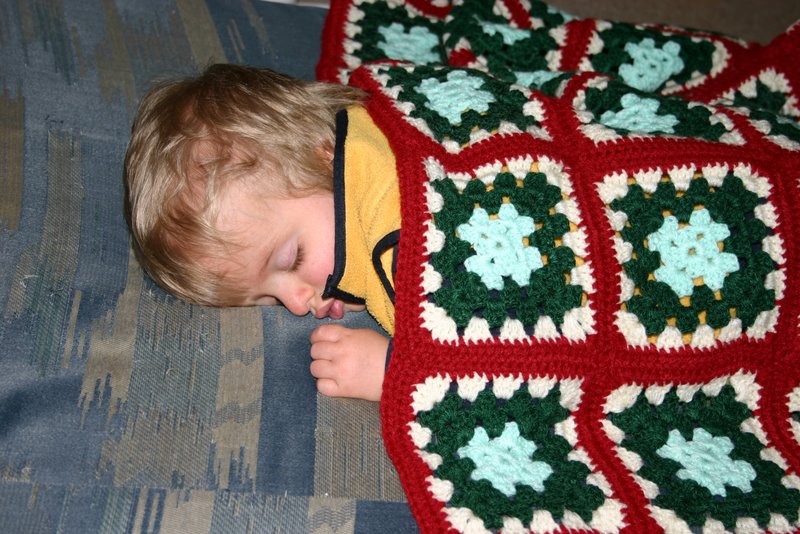
My child, who is normally a very light sleeper, slept on and off throughout the day on the couch in the middle of the gamesroom surrounded by siblings. He must be sick!

The larger your family grows, the more important it is to have some standby plans for managing those days when you have a sick child, the baby cried all night or unexpected interruptions take away all your usual “keeping things running” times in the day. It requires some preparation and planning ahead, but that investment is well worth it when one of “those” days arrives. Many of these tips are also useful if you are preparing for a new baby.

Here are a couple of my ideas to get our family through a day or two when life is just too difficult to even think about what you are going to cook for dinner.

Meals

  • Meals should be healthy – avoid takeaway if possible or sick children’s already overloaded immune system will be fighting off the effects of bad food on top of everything else.
  • Keep a supply of freezer stock meals to defrost for “those” days.
  • Make an emergency menu – meals that you or older children can put together in minutes and ingredients that are always on hand.
  • Put the crockpot/slowcooker on in the morning when sick children may be less likely to need your attention.
  • Have your regular menu already planned so that the meals do not require thought.
  • Teach your children to cook. In a pinch, my 6 year old can put together a salad, the 8.5yr old can prepare a simple main meal and the 4 year old can get the table set and water glasses set out. If your emergency meals are simple enough and you spend some time teaching your junior cooks how to make them without assistance, they will be well prepared and love to step up and help Mum out. It gives a child a great sense of accomplishment to be able to announce to Dad and the family that they cooked dinner all by themselves. (Obviously there are safety issues to consider – Mum may need to be the one who slides the casserole into the oven.)

Toddlers/preschoolers

  • Have a list of suitable toddler activities that can be pulled out from an easily accessible place with a good storage system (Ziploc bags, shoeboxes, crates etc.) Set it up so that an older sibling can get them out for your younger child.
  • Create a flexible routine that includes activities such as playpen time, table time, mat time and highchair time so that you know you will be free to attend to the children who need it. Implement it on a daily basis so that it is a usual part of your day and well established before “those” days hit.
  • Today it is ok to watch TV.
  • Today it is ok to play outside a lot (the well ones!)
Homeschooling
  • Teach your children to work independently.
  • Leave the subjects you absolutely must teach yourself for another day or a suitable moment throughout the day.
  • It generally works better if we go ahead with school regardless of sick children. Well children mixing with cranky sick children without a lot of structure is a recipe for a bad day.
  • Have systems in place so that all children, regardless of age, know what they should be doing on a daily basis and in what order, whether you are there or not. (Workbox systems, a shelf of activities per weekday, Ziploc bag tasks, workjobs in a shoebox, Montessori style tray activities, pictorial or written timetables and schedules or whatever system suits your children.)
  • Read aloud a lot while children colour/play quietly/fold laundry or simply rest.

Housecleaning

  • Train older children to help out with regular daily chores.
  • Do only what is essential (if today is washing day – skip it or use the dryer. You don’t have time to hang out those loads.)

Afternoon quiet time

  • This time is precious to me – older children have room time, younger children nap and I can then have a nap too (assuming the sick child does not require attention at this time.)
Remember that every day will not be like this and it is ok to just let it all slide and simply survive! Routines and schoolwork can all be quickly re-established, especially if your children are used to having a fairly structured day. With a new baby, you may be tired and lacking the drive to get things started, so perhaps putting in the preparation and endeavouring to keep things ticking along will be more successful than allowing it all to fall into a great heap that needs a lot of time and energy to get back out of later!
Mat time was uneventful this week – too tired to sit up, let alone play!