Scooping tray activities for toddlers and preschoolers

Scooping is one of the easiest Montessori style tray activities for toddlers and can be introduced at the same time as they are perfecting their spooning skills during meal times – giving them a little extra practise when spills are not so difficult to clean up!

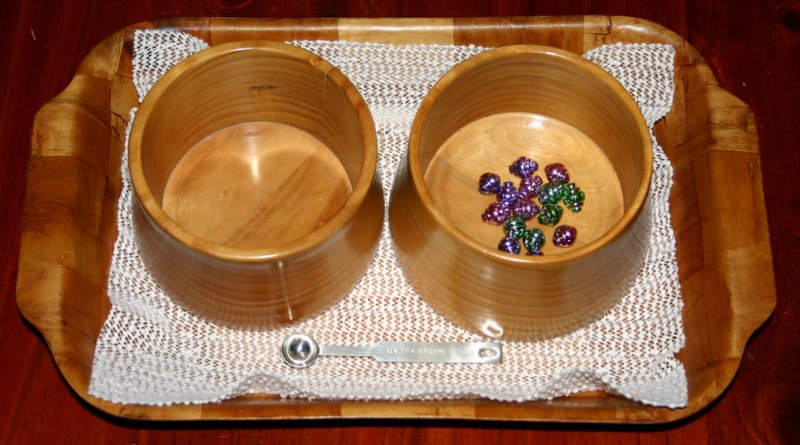
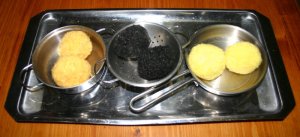
Start with large, non-slippery objects that fit easily into a scoop (see mega marbles) and move to more fiddly materials like the popcorn or rice examples below. All you need is two containers (one to  to scoop from and one to scoop into), something to scoop with (spoon, scoop, ladle, etc.) and something to scoop (pompoms, noodles, rice, jewels, marbles, beads, dried beans, pasta etc.)

Have a look through your art and craft supplies, kitchen cupboards and junk drawers and you will be surprised at what you can put together in just a few minutes.

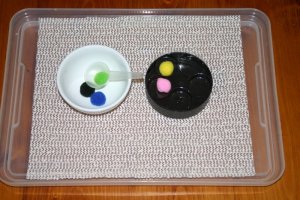
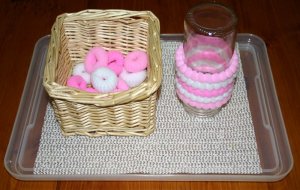
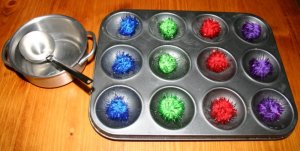
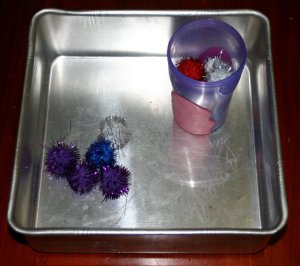
These pompoms are scooped into a plastic chocolate container insert with depressions in it. The scoop comes from a washing powder container.

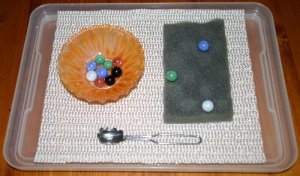
This is a piece of packing foam that has indentations all over it; perfect for filling with marbles. The scoop is a pasta spoon from a child’s cooking set.

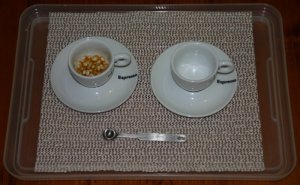
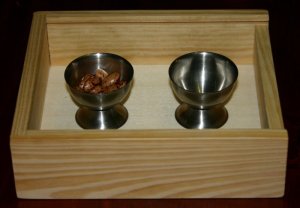
Dry popcorn kernels in espresso coffee cups with a 1/2 teaspoon measuring spoon.

Montessori trays are traditionally presented with the material to be scooped on the left hand side to help with left to right directionality for later reading and writing skills.

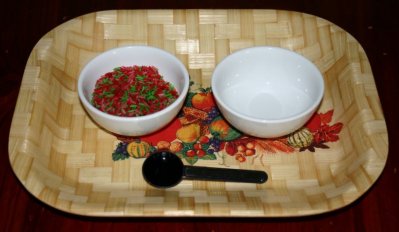
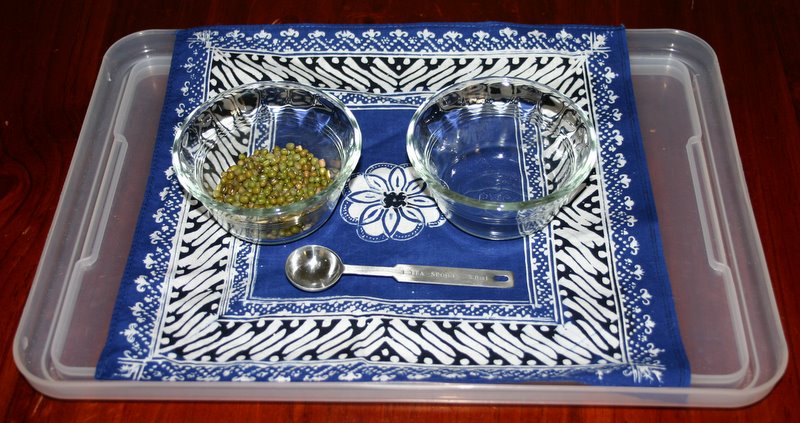
Green split peas are scooped from bowl to bowl.

Coloured rice is a very attractive scooping material.

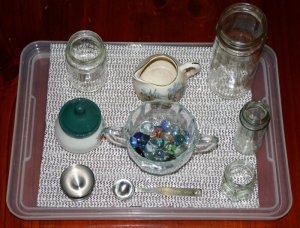
When my toddlers were older and no longer finding simple scooping activities very interesting, I gave them this tray with a variety of containers to scoop, pour and tip with. They loved it.

Activities to make for babies and young toddlers

Trying to find interesting activities to keep older babies and young toddlers interested and focussed for any length of time can be a battle, but it is one that is worth persevering with. If you spend the time training your young children to sit, focus and concentrate and extend this time as they grow, you will be teaching them the self-control that is vital for all learning later. Not to mention the fact that you can go out to a friend’s house, to a restaurant, a school assembly or any other public event and take your child along, with the peace of mind of knowing that you will be able to enjoy some uninterrupted time in an adult situation. Toddlers need to be taught hand, voice and body control and this can begin at a very young age.

Here are a few ideas for home-made or readily available activities you can give to an older baby or young toddler during times where they are required to stay in a set boundary and play with the toys you have supplied (e.g. mat time (blanket time), room time, playpen time, highchair time and table time.)

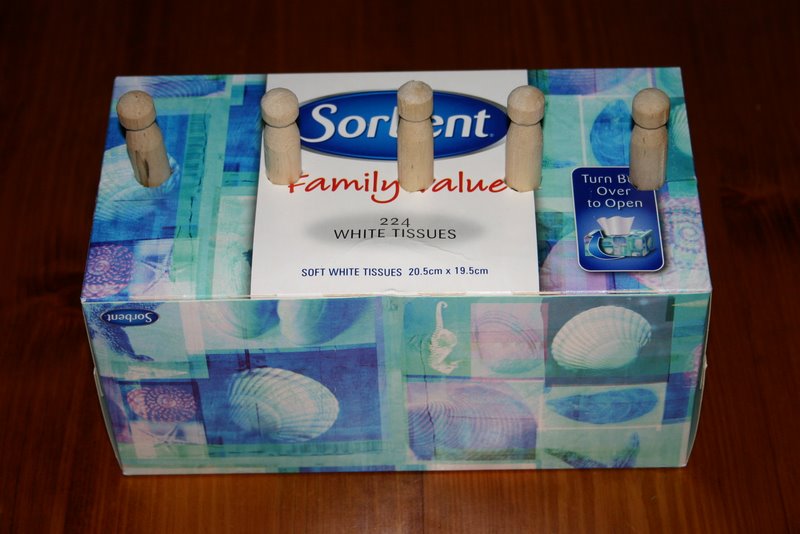
Even quite young babies will enjoy pulling these dolly pegs out of the holes in the tissue box and carefully inserting them back in again. If they are pushed all the way in, the hole on the bottom of the box allows the child to pull the peg out from underneath. Posting and small spaces activities are great for developing fine motor control.

Stacking and unstacking objects is fascinating for toddlers. I was given these melamine plates for Christmas and my twins used them over and over again.

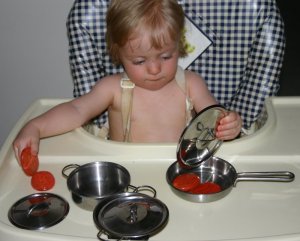
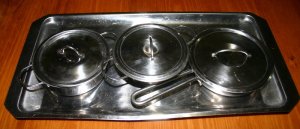
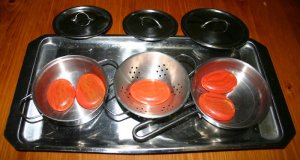
Cooking like Mummy is always popular. Go through your play food and cooking equipment and make up little sets. Don’t forget your kitchen junk drawer, pots and pans and any other smaller kitchen equipment that toddlers can safely use. Add small dolls and teddies for toddlers to feed.

My plastics are stored in a crate which I can plop out on the floor for little ones to unload and sort through. Stacking and unstacking, trying on lids and just exploring it’s contents is very absorbing. Perhaps you have a suitable cupboard that you can designate for young children to access while you are working in the kitchen.

I had trouble finding reasonably priced magnets that very young children could easily grasp. The flat, flexible style of magnet are not good for babies because they have trouble getting them off and end up peeling the edges back. I went to a $2 shop and bought 4 wooden jigsaw puzzles and a packet of strong round magnets. I glued the magnets on the back of the puzzle pieces and got a great, economical set of animals for the fridge, whiteboard, or metal biscuit try.

This very large bottle is a great posting container. Pegs, popsticks or any other thin object can be pushed through the lid hole and pulled back out through the open slot in the front. The edges are taped where they were cut to cover the sharp edges. I originally saw this used as a water pouring activity with a funnel in the spout and a large flat tray underneath to catch spills. The children were scooping the water out from the large front hole and tipping it back into the funnel at the top.

These oversized popsticks are placed into slots in the lid of the icecream container and can be pulled out and pushed back in.

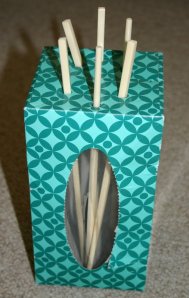
A set of plastic chopsticks has been used in many different ways over the years in my house. Another small spaces activity; poking them into the holes in the side of this tissue box

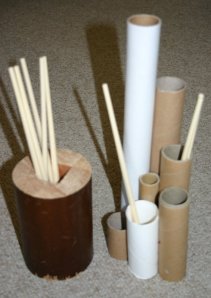
I glued a bunch of cardboard tubes together for the little ones to put the chopsticks in and out of.

This quoits set amused the babies for quite a while as they took the rings on and off.

This Velcro fruit makes a great ripping sound as you pull it apart and stick it back together. Include the wooden knife for older toddlers to practise their early cutting skills.

I used some polystyrene foam covered in wide weaved fabric (burlap I think?) for this early hammering activity. (The foam has a tendency to crumble with use and I didn’t want any of the young children being able to get it into their mouths.) Golf tees and a selection of washers to bang into the foam have been well used by all of our children.

Developing Fine-Motor Skills in Toddlers and Young Children

Self-control, concentration, following instructions and fine motor skills are very important foundational skills for all children. Teaching your young child to sit and focus on an activity and see it through until completion will go a long way towards preparing them for later learning – whether that be in the homeschool or traditional school environment. Some children seem to be naturally better able to do this, others need training and practise to do it. Children who do not develop these skills early will find it much harder to learn and you will find it more difficult to teach them!

Here are several Montessori style tray activities for toddlers and preschoolers that will help to develop their fine motor skills. Many parents of young children say that their children will not sit still long enough to attempt, let alone complete an activity like these and that may be the case right now. It is however most certainly possible to train them in this skill so that sitting and focussing becomes something they readily cope with, both at home and when out.

Putting a flexible routine into place and teaching your child to stay where you want them to stay will be an important first step. Introducing playpen or room time, highchair time or table time, mat time and other periods of planned activity to your child’s day will reap the rewards of a child who is able to sit and focus and learn from the materials available to them. Self-control will begin to grow and the benefit will spill over into all parts of their lives. Time for some free play with age-appropriate choice making is also important, however if a toddler’s whole day is unstructured and contains many choices you will be seeing many “sticky patches” as Mel Hayde terms them in her book “Terrific Toddlers.”

Start with very basic activities like the first couple below that do not take very long to do and are not too challenging to complete. Help the child to learn the process first: take the tray out, sit in the designated place, complete the activity in the same way you have demonstrated it, place everything in the same place on the tray as it was found before returning the tray to where it belongs.

You may like to attempt only one tray to begin with so as to finish on a positive note. Praise your child for their attentiveness, perseverance etc. Five minutes for a toddler who is not used to this kind of task is a beginning. Work up from there until they can sit for an extended block of time. My twins at 2 1/2 years can sit for 20-30 minutes with activities that change every 5 to 10 minutes, depending on what it is. My other three children would have spent 30 to 45 minutes working on these at the same age and even up to an hour at times.

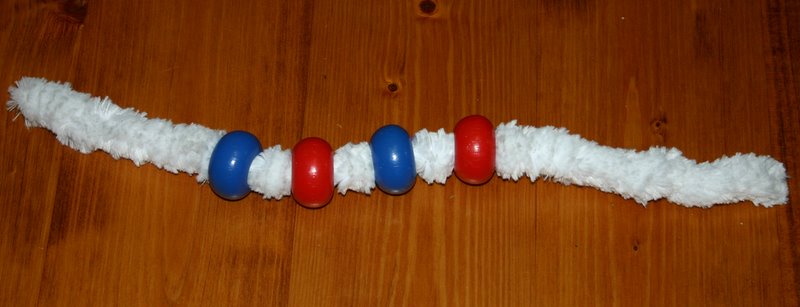
Threading and removing large wooden beads from these giant pipecleaners can be extended to pattern making for an older child. (Yes they are giant {about 40cms long} you just can’t tell from the photo!)

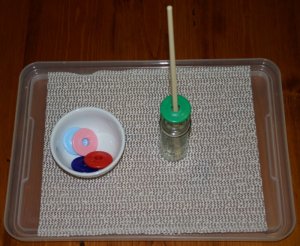
The chopstick is placed into the neck of the spice jar and large beads threaded onto the end.

sdsd

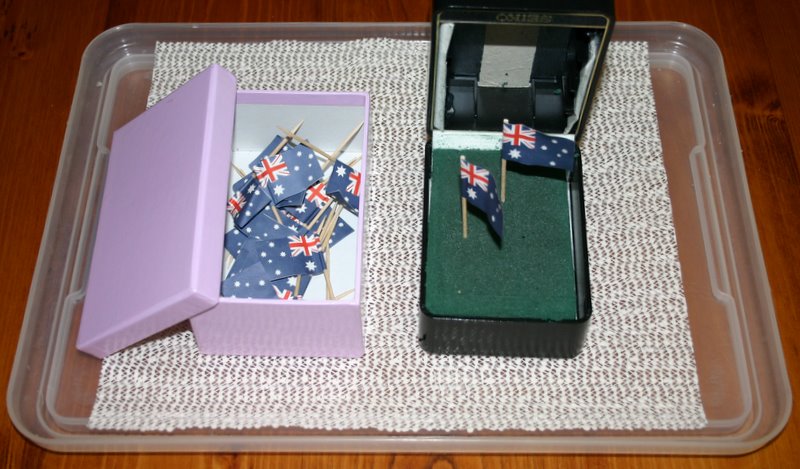
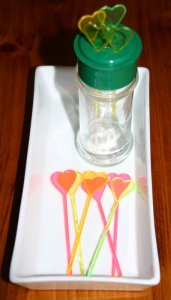
Toothpick flags are stabbed into the oasis. (Florist’s foam.)
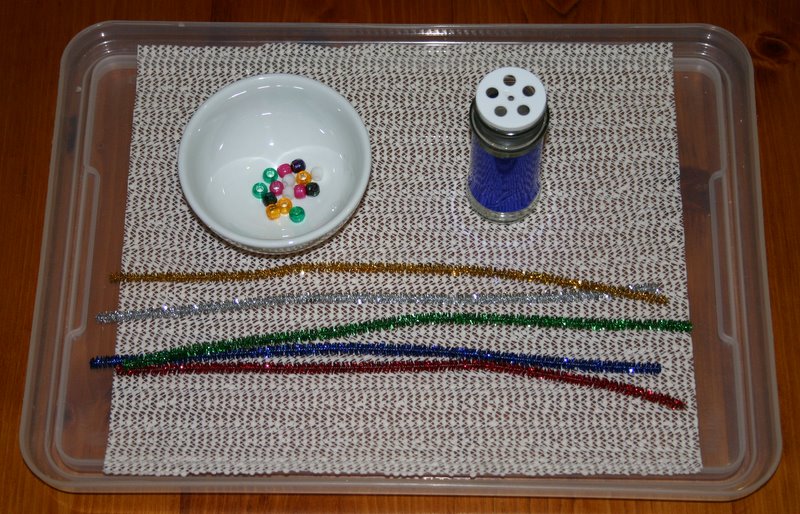
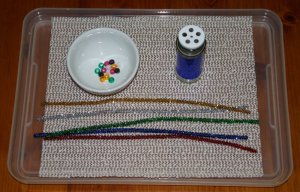
Small beads are threaded onto the pipecleaners which are then put into the holes in the lid of the spice bottle. (These smaller beads require a higher level of fine motor control and accuracy to thread.)
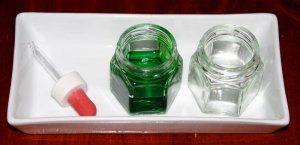
It takes quite a bit of coordination to operate an eyedropper. Transferring liquid from one small container to another is a challenge for many toddlers. Perhaps use uncoloured water to begin with and provide a sponge for spills.
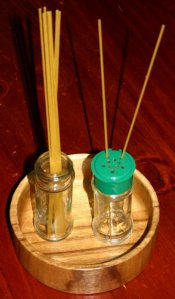
Yes, they will probably taste the angel hair pasta as they feed it into the small holes in this spice bottle but it’s only pasta after all!
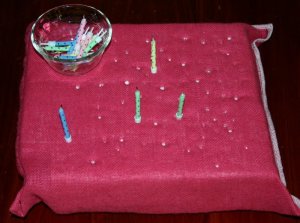
This is a piece of polystyrene packaging with a loose weave hessian cover. You could include a set of numbers and have an older child set out the correct number of birthday candles.
Another spice jar with toothpicks – don’t throw out those old spice shakers!
Stretching hair elastics over a jar is surprisingly difficult for young children but they enjoy it anyway.

Montessori style toddler activities: transferring and one to one correspondence

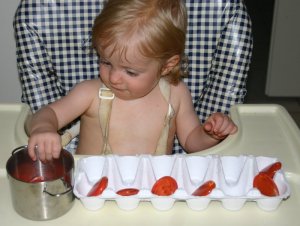
Egg cartons are a cheap and readily accessible option with clear depressions for each object. A large object to transfer such as these stones or wooden eggs will keep a toddler well occupied.

One-to-one correspondence is an important foundational maths skill. Here are some ideas I have used with my older babies, toddlers and into preschool years.

What is it?

  • Saying one number to one object as you count (therefore the “one to one” correspondence.)
  • Children often begin learning to count by saying numbers out loud while pointing or touching objects, without those numbers actually matching up with the objects being counted.
  • Children also count the same object more than once or skip objects entirely.

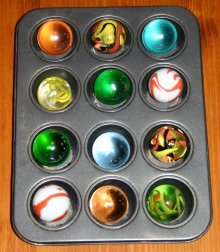
    These super sized marbles are a favourite material in our house, even for the older children. They fit perfectly into this mini-muffin tray.

    Making activities:
  • One to one correspondence activities should be self-correcting; there are exactly the correct number of objects for the receptacle. Any left over or running out before all the spaces are filled signals to the child that there has been an error.
  • Start with large, non-slippery objects that fit easily into a scoop or are transferred by hand and move on to activities that require greater fine motor control.
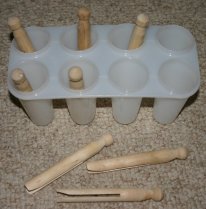
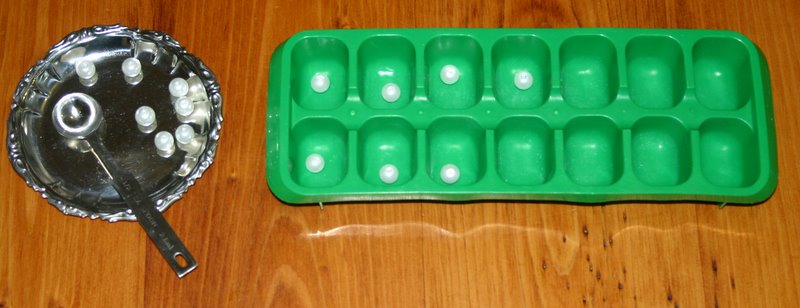
  • Even older babies can experiment with one-to-one correspondence. Babies love to put things in containers and tip them out again. A freezer popsicle tray is fabulously enthralling for a child at this stage. They work especially well if no more than one object can fit in each segment, but this is not essential.

Popsicle tray and wooden dolly pegs. It’s surprising how something this simple can hold a young child’s attention.

A basic activity for babies.

Extending activities:

  • Keep interest by changing the way objects are transferred; by hand, with  spoons, scoops, tongs then tweezers.
  • Change the material to be transferred; stones, pompoms, pegs, jewels, plastic animals or anything else you can think of. Keep in mind the age of the child and be wary of choking hazards.
  • Change the receptacle used; bowls, baskets, tins, containers, iceblock trays, egg cartons, jars or any other container with a definite number of depressions.

Pompoms come in many different shapes and sizes and are a safe material for little ones. The worst mine have ever done is suck on them or pull them apart.

Using their hands to transfer large, easily grasped objects is a great beginning for babies.

This tray came out of our fridge. It is meant to hold eggs but to my knowledge has never actually done so!

Be careful with jewels. They are very attractive but also feel nice to suck and babies and toddlers do tend to out them in their mouths.

For older children using small objects that require greater fine motor control adds a little more challenge. Combining one-to-one practice with beginning counting is the next step.

Ziploc activity bags for toddlers and preschoolers

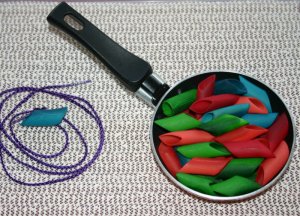
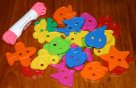
Noodle threading is always fun, just remember to tie one on the end to stop all the others sliding off while children are threading. When they have had enough of threading they can pretend to cook the noodles for dinner.

Ziploc activity bags are simply self-contained activities for toddlers, preschoolers and young children that include everything necessary for the child to complete the activity. Thus named because they are often stored in Ziploc plastic bags that are readily available from the supermarket. These bags have a plastic zip-style closing system that is easy for young children to manipulate, however we haven’t found them to be very long-lasting. Shoe boxes, trays or other containers are of course equally suitable but not so easily transported. Press-loc or snap-loc plastic bags are not as good because young children are not able to re-seal them independently, but if you don’t mind a few seconds to close each bag when they are done, they seem to last longer.

The kind of activity you can include is endless and their uses wide and varied. Some Mothers save them for school time activities while the older children require their attention. Others use them to take on holidays, while travelling in the car or when visiting with friends. They are useful for meals out in a restaurant, at home for mat time, blanket time, highchair time or table time activities. Whenever you need to keep a young child happily occupied these can be whipped out for hours of entertainment.

So what do you put in them? Almost anything really. Ideally they wouldn’t contain anything too messy if you want them to be easily transportable, but for home use anything goes.

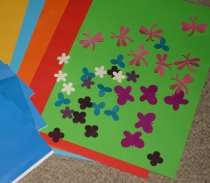
Department stores have packs of paper shapes in the scrapbooking section which are great for gluing.

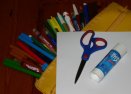
  • Glue stick and paper shapes for gluing

    When young toddlers first start to draw, tape one page at a time onto the table or highchair tray. For two reasons – it won’t keep slipping around and every page of the colouring book will not end up with a single blue line down the middle!

  • Drawing
  • Playdough
  • Stamping (stamp pads and ink stamps)
  • Lacing, threading or beading
  • Puzzles
  • Books
  • Construction toys
  • Pattern blocks
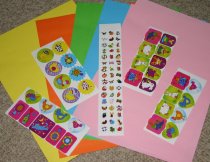
  • Stickers and sticker books
  • Small tea sets and mini teddies

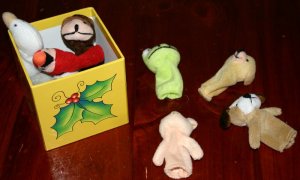
    Finger puppets work best when the characters represent well knows stories that the children have heard you tell before.

  • Finger puppets
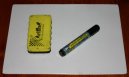
  • Mini whiteboard and eraser
  • Small chalk board and duster

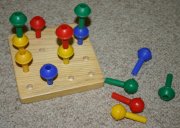
    Simple stacking pegs are interesting once toddlers have the dexterity for it. This one kicked in at about 2 years when they could handle the quite stiff pegs.

  • Peg boards
  • Board games
  • Dot-to-dots and mazes
  • Colour-by-number
  • Stencils

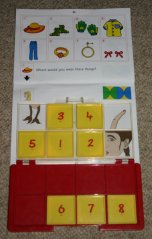
You could include learning activities for basic maths and language skills. Starter Styles are a maths activity that cover a variety of beginning language and mathematical skills.

There are heaps of brilliant websites and blogs with an abundance of ideas for Ziploc bag activities;

Chasing Cheerios is one of my favourites with lots of wonderful toddler activities.

Natural Parents Network has some good ideas, including coloured pasta beading, pasta sorting, mini-books and stickers, lid sorting, playdough, cut and glue collage bag, and mini-playmats with cars and things.

Intrepid Murmurings has preschooler activity bags here.

There are lots of ideas for what they call “tote bags” here – just scroll down. They get better as they go.

Getting dinner on the table

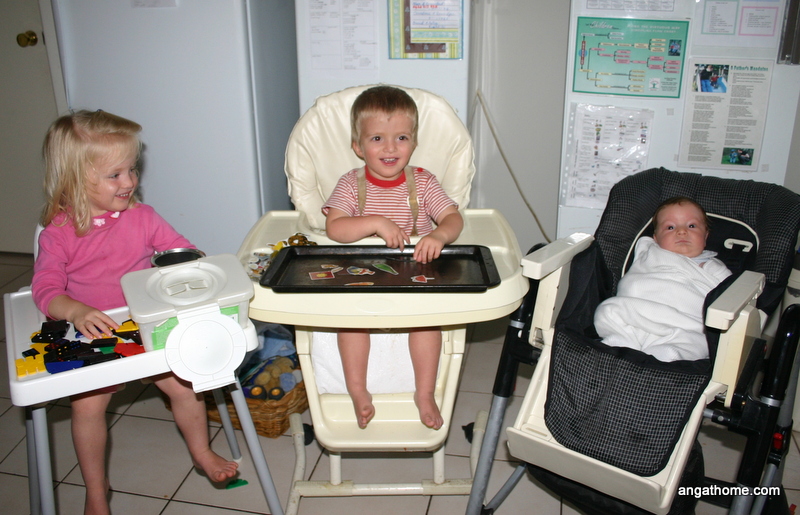
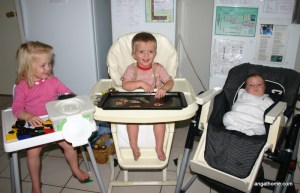
Highchair time at our house – 3 in a row!

I like to cook for fun. It’s enjoyable to potter around testing new recipes and trying them out on friends and family. I don’t so much enjoy having to get dinner on the table at short notice, with a bunch of hungry, cranky children getting on each other’s nerves as we battle through “arsenic hour” as I have heard it termed. So, how do I get a nutritious and delicious meal on the table on time every day that will please everyone from the baby, right up to Dad? Well, to tell the truth, that’s almost impossible – with 8 people sharing a meal on a nightly basis, someone is bound to disagree with the delicious part! However, let’s concentrate on the nutritious and “on time” part. We haven’t eaten cereal for dinner yet, although baked beans on toast is the equivalent as far as I’m concerned and we’ve had that a few times!

There are some practical ways that I have gone about structuring my days and time so as to make this touchy time of the day run smoothly and happily for all of us and still have a nice meal on the table. Strategies have changed over time, depending on the ages of the children and what time my husband is due home, but here are some of the ways we have structured the late afternoon period that have worked for us in the past.

Flexible routine. Having a routine running throughout the day makes a big difference at the end of the afternoon. If the children have spent too much time together, especially unstructured time, they will invariably be at each other by the end of the day. A good balance of time with me, with each other, time alone and indoor and outdoor time, all work together for a smooth afternoon. More on routines here.

Feeding toddlers and/or babies early. I prefer it when we all eat together, but there are seasons when that is just not viable. The was a time when 4.45pm was like a “switch” for my toddlers. Happy before, exceedingly cranky afterwards. My options were either to feed them a large afternoon tea earlier (and have problems at dinner with them not wanting to eat well) or to simply give them their main meal earlier. When the rest of the family came to the table they were given some finger food or perhaps fruit or dessert to enjoy with us before moving on to a highchair activity while we finished up. This allowed them to still be a part of the family, I could focus on feeding them and training table manners away from the family mealtime and enjoy my meal relatively peacefully later on.

Baths. Everyone preschool aged and under (i.e. all those who require my assistance during bath time) are all bathed around 4.30pm rather than after dinner when everyone is tired and likely to be fractious and uncooperative. Bath time is then an enjoyable experience for all and bedtimes are not held up if I am caught up feeding a baby or dealing with unexpected circumstances.
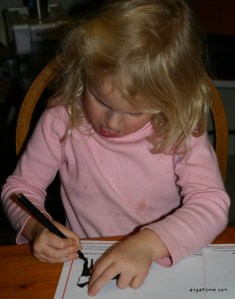
Table activities. For around half an hour before dinner, all the children do highchair activities (some ideas here, here, here and here ), table activities (some ideas here, here and here), mat time (some ideas here, here and here), puzzles or books. There is nobody roving about getting into trouble and plenty of interesting activities to do. I am then free to get the last-minute dinner preparations done.
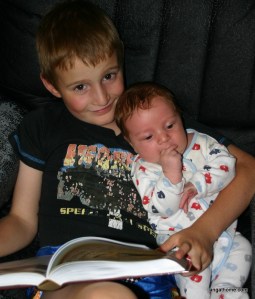
Sibling time. Sometimes the youngest children are unable to play independently at this time and need someone with them. This is when I assign an older sibling to spend some time with the little ones, reading them a story, playing on the mat with them, helping them with a simple puzzle or something similar. The eldest enjoy the responsibility and it helps build positive sibling relationships. They do not resent this time because it is not something they are required to do throughout the day in a random way or for large blocks of time.

Menu plan. Having a plan of which meals I will be making throughout the week is so important. Getting to dinner time and realising the meat is still in the freezer and trying to come up with plan B on the spur of the moment is never a great way to have a smooth afternoon period. Knowing what I am going to cook means I am prepared and can plan ahead, often using a few spare minutes here and there throughout the day to get some prep work towards dinner done. More on menu planning here.

Night time preparation. While I am caring for babies, homeschooling and looking after several older siblings, trying to fit cooking in during the day can be very difficult. There are usually several months after the birth of a new child when I do all my meal preparation in the evenings. And I do mean all. I set out breakfast dishes and ingredients and cut up fruit, bake or pull out frozen or pantry snacks for morning tea. I do all the peeling, chopping, grating, salad making or whatever other prep is needed for lunch. Dinner meals are pulled out of the freezer, ingredients are put in the slow cooker and veggies are washed and chopped – even to the point of putting the veggies in a saucepan of water in the fridge. It sounds over the top but, especially with the twins, I just didn’t have a moment to spare during the day. Being able to pull the crock pot out of the fridge and flick it on at morning tea time, knowing there would be a hot meal ready by dinner, was such a blessing. Even when things were going pear-shaped, I could throw a saucepan full of veggies on the stove as I walked past. Older children could set out prepared lunch or morning tea for everyone to help themselves if I was caught up feeding.

At other times, I didn’t have to cook at night, I used the time immediately after breakfast to get the dinner made. Everyone is fresh in the morning and it was a good time to get the household chores and dinner preparations under way. Now that I have older children to homeschool, this time is used for our more difficult subjects that require the most concentration, so dinner making is not a possibility.

Instant meals. For days when, menu plan or not, I have nothing ready for dinner, all supplies are frozen solid and my mind is blank, I am endeavouring to build up a collection of meals that are very quick and easy, that use ingredients I can keep on hand in the pantry or freezer without them going off and throw together in a matter of minutes. My rice cooker fried rice is a family favourite and assuming I have prepared my ingredients earlier, can be thrown together in literally 3 minutes. I haven’t timed it yet but I’m going to!! Ideas for nearly instant meals and pantry mixes are here and here.

Shopping lists. As an extra tip, shopping lists are a must to make life run smoothly around here. I have a shopping list pad with a magnet back that lives on the fridge. As I notice we are running low on an item, I immediately jot it down on the list. When I make out the menu for the following week, or check through the monthly menu, I add the items we will need to the shopping list too, after checking through the pantry first to see if we have what I think we have. It stops the random buying of stuff we don’t need and the irritating need to continually run to the shops to pick up one or two items here and there because they have just run out or I thought we had some.

Now the kids are older, they often come and tell me if something has run out or ask for small items like lead refills for a click pencil that we would never in a million years remember to get when actually at the shops. I also have multiple copies of a printed shopping list hanging inside the pantry. This list is all the items I buy on a weekly basis. When we are actually ready to go to the shops, a quick look down the list to cross off what we don’t need and to add the odd ingredients from the fridge list saves time and means we should get everything we need.

Montessori inspired practical life tray activities for toddlers: Tong transfer

With a general category in mind such as “tong transfer” and a drawer full of useful bits and pieces I have collected over time, I now find it very easy to come up with new tray activities for table time, highchair time or mat time that will keep my toddlers developing new skills while they learn to focus and concentrate at the same time. (See here for a list of materials and equipment that might be useful for creating Montessori style tray activities.)

Simple two container transferring is a good starting point.

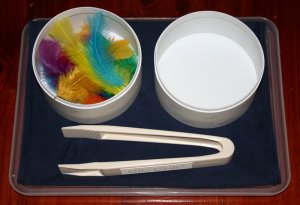
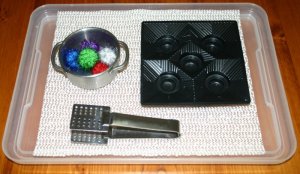
Using tongs is great preparation for writing and other skills that require fine motor control, helping to develop the hand muscles necessary for successful manipulation of writing implements.  All you need are tongs of some sort, 2 containers and something to transfer. Keep in mind that toddlers find it very difficult to manipulate tongs so look for small pairs that are not too stiff to close. Avoid those with a metal closing ring that slips down all the time – very frustrating! The best pair I have for beginners is a small set of ice tongs (see top photo) that I picked up at an op shop for 50 cents. Tea-bag tongs are also easy to squeeze and quite short. I found mine in a $2 shop.

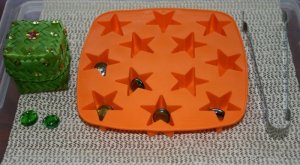
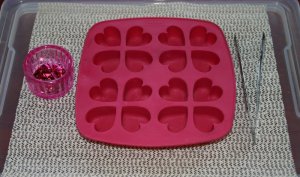
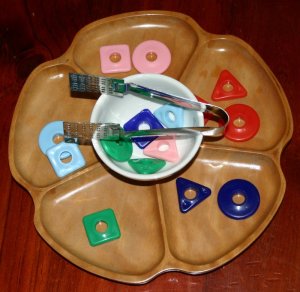
Tonging activities link in well with other skills such as one-to-one correspondence. Plastic iceblock trays, egg cartons, chocolate trays or any other container with an obvious number of holes are ideal for this. Simply put, the child has to place one item in one hole. If there are any left over, or they run out before all the holes are filled, they are prompted by the empty space or left-over pieces to self-correct their work.

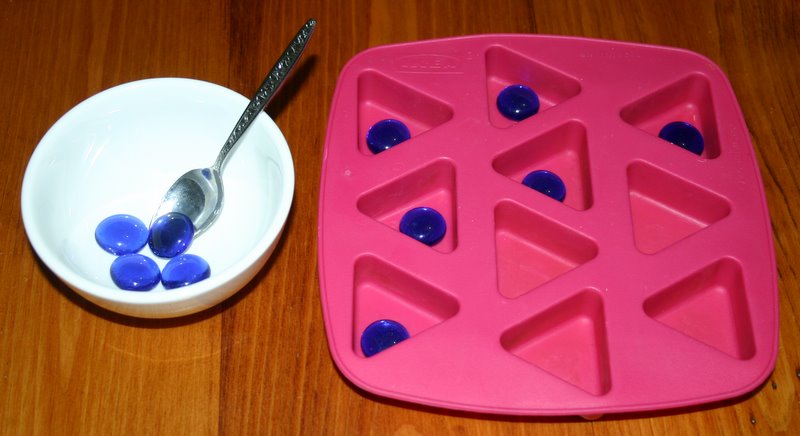
Flexible ice-block trays are an attractive material for children to work with. My girls LOVE this pink tray. (I should mention that it is the 6 and 4 year olds who clamour to do this one even though it is set out for the toddlers!)

Tea-bag tongs are easy for toddlers to manipulate.

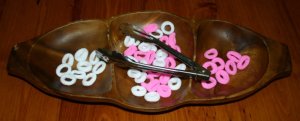
Tonging is easily adapted to many other concepts, particularly mathematical skills. Beginning sorting with two simple categories is an easy way to combine the skill of tonging with a more challenging task for older toddlers and preschoolers. In the photo above, children sort the hair elastics into 2 separate colour piles; the first step along in learning the concept of sorting by colour.

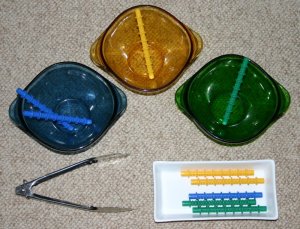
Here we move to a slighlty more challenging activity with items to tong that require greater dexterity, 3 colours to sort and 3 bowls to match them to.

Attribute beads can be sorted more than one way and are quite difficult to pick up. They are a good challenge after simple tonging has been mastered.

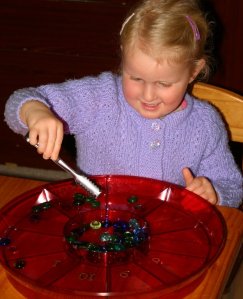
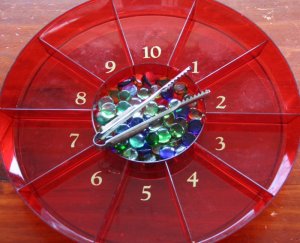
Linking tonging to counting is fun for the preschooler and provides valuable practice of fine motor skills. Here the child tongs the correct amount of jewels into each segment of the dip plate. My 3 year old is pictured doing this activity in the photo at the top of this post. The counting side of things wasn’t too difficult for her to do even early on, but it was a test of her endurance and concentration skills to persevere with the tongs to complete all 10 segments.

Montessori inspired practical life: dry pouring tray activities for toddlers

If you are looking for inspiration for toddler tray activities, dry pouring is a great place to start. It is a practical life skill that is easily introduced in a simplified form and can be gradually made more challenging as your toddler progresses. Learning to pour liquids carefully and accurately is difficult for young children, so starting with a dry material is a more forgiving and easily mastered beginning. Giving children cups and containers to pour water in the bath develops the skill in a non-messy environment and dry pouring activities are great for mat time, highchair time or table time.

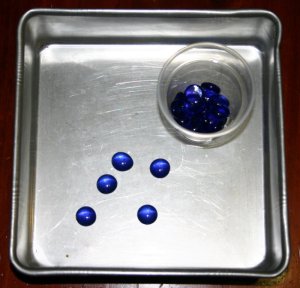
This is the first dry pouring experience I give my toddlers. Tipping the jewels out of the cup into a baking tin and collecting them up again is surprisingly absorbing and makes a satisfying racket as they do it. If you prefer a quieter option, try pompoms (see below), however I can guarantee the children will enjoy the jewels, beads, rocks or other noisy versions more!

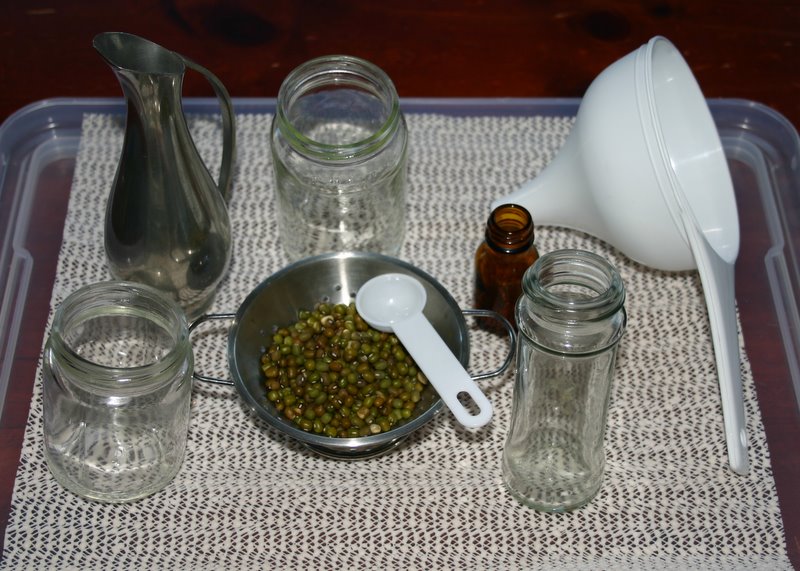
Pouring from one container to another is the next step. Choose 2 containers of the same size, without handles. A set of straight-sided small tumbler type cups is best; something that is easily gripped in a toddler’s hand. Add small objects such as dried beans to pour from one to the other and change the containers and material to pour every so often to keep interest high.

Rice is one of the last materials to introduce. If you colour it, it is very attractive but it is almost guaranteed to spill and is not quite as easy to clean up. Toddlers need to be taught how to collect the spilt rice in one corner of the tray and carefully pour it back into the container.

I was able to find a cute mini dustpan and broom which I include with my rice pouring activities to clean up the spills which is a practical life skill in itself. Tape a square shape with masking tape in the centre of the tray and teach the children how to first sweep the rice into a little pile within the tape boundary before sweeping it into the dustpan.

Adding funnels to a dry pouring activity adds yet another dimension and when I have had simple pouring activities available for quite a while, I set up a combined scooping, pouring and funnelling tray for a  more complicated experience. After I have changed this around for a while, I then add teddies and other small animals or toys and turn it into more of a pretend play type activity. This allows a broader scope of play and promotes longer engagement by older toddlers and preschoolers.

Make your own baby and toddler toys

There comes an awkward age somewhere between 12 months and two years where it becomes more difficult to keep babies and young toddlers interested in their toys. They are no longer content to just shake and slobber on something that feels and look appealing, toys now need to DO something.

To complicate matters further, children generally do not develop imaginative play skills until around the age of 2. New toys are appealing but often lose that appeal quickly once they have been explored a few times and are too expensive to be constantly purchased. You can swap with friends, join a toy library or simply make your own. For me, the make your own option is the easiest, the possibilities are almost endless and they often turn out to be the long-term favourites. Here are some of my home-made baby toys that I use for mat time, highchair time, playpen time, table time and room time.

Find a bunch of small flat-bottomed toys, blocks, shapes, plastic figures or suitable objects and a base to stick them to; piece of smooth wood, plastic lid, small tray etc. Use self-adhesive velcro to attach each piece to the base so that children can stick them on and take them off again, enjoying that satisfying ripping sound as they do so. If you have enough, it is better to cover the base with the velcro so that objects can be stuck anywhere rather than only on a small matching dot. Older toddlers like this too if small people, animals or other figures are used and enjoy manipulating the pieces to play-act and tell stories.

Use an old baby wipes container and any flat objects that are slim enough to fit through the slot and not so small as to pose a choking hazard. Old credit cards, large plastic construction pieces, dominoes, poker chips, Jenga blocks  or anything similar will do. When interest wanes, simply change the material to post.

Wooden dolly pegs have dozens of uses. Young children find it challenging to slide them on and off objects and enjoy the sound of plunking them into tins and containers. My youngest loved to take them off the sides of containers like the ones above but not to put them back on again. They only did that part once – when they packed the activity away! Posting bottles and tissue box posting are other ways to use dolly pegs.

Formula tins have a large number of uses. They are great as rattle cans for crawlers to push about and with a hole, slot or cross-shaped cut in the top, act as posting tins for any number of small objects. Pegs, popsticks, dominoes, wooden shapes, milk bottle lids or whatever you have will do.

Toddlers are fascinated with Mum’s purse although most of us will agree that it is not a toy and it is unwise to allow toddlers to access it in that way. Because of that, some parents feel that even providing a similar option is not a good idea, fearing that children will not know the difference and think it is ok to touch Mum and Dad’s. I wondered about this too but in my experience have found that by the time they are able to manipulate cards and photos in and out of a purse or wallet, they are old enough to tell the difference between the play version and the real thing.  Find a bunch of old family photos, some fake credit cards (the display version that comes in junk mail trying to get you to sign your life away) and any other small objects that will slide in.  An old handbag is another version that toddlers love. Pick one up from an op-shop with as many zippers, pockets, divisions and press-studs as you can find and fill it with a bunch of small items. This works great for mat time on the go and can be re-stocked with different items on a regular basis to keep interest high.

For more toddler and baby activities, click on the “toddlers and babies” or “workjobs and Montessori activities…” categories on the left hand side bar.

Highchair and mat activities: Montessori style practical life tong transfer activity for toddlers: Pom-poms, fruit and bugs

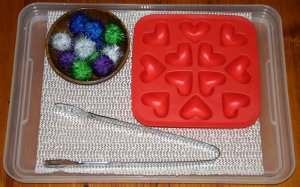
Over-sized pom-poms and tea bag tongs are a great starter set for tong transfer activities. The tongs are easy to manipulate and the pom-poms do not slip out.

As I have been tweaking my routine this week in readiness for our latest bundle of joy (now 3 days overdue!) I have been setting up some new tray activities for highchair time. Having toddlers on the loose while I breastfeed (especially when there are two of them) is a recipe for disaster. These activities can be used in a highchair, on a mat, for table time or for playpen time , however because I am introducing them to young toddlers and need to keep a close eye on them to begin with , I use highchair time.

Tonging is a simple practical life activity for toddlers and is excellent for fine motor control. Try to find small tongs that are not too stiff or your little ones may not have the dexterity to manage them. Tea bag tongs are easy to squeeze, as are ice tongs. Check your local opportunity shop (secondhand shops, $2 shops etc.) for supplies. Two containers and something to tong are your only other materials and usually with a bit of imagination you can find something around the house that fits the bill.

When I set up my trays I have a category for each kind of activity so that I can quickly change them over every couple of weeks without a lot of thought. Tong transfer is one category that I use and these are some of the examples I have set up in the past.

Slightly smaller pom-poms with the same easy to manipulate tea-bag tongs take the activity to the next level of difficulty.

The easiest first experiences are soft items like oversized pom-poms, cotton wool balls, balls of wool, or anything else that will not easily slip out of the tongs. Put only a few items in the container to begin with to encourage success as toddlers may quickly tire of the concentration and control needed to manage the tongs. Our “rule” with tray activities is that they should be completed before they are packed away so I want to ensure that the toddlers can be successful right from the beginning.

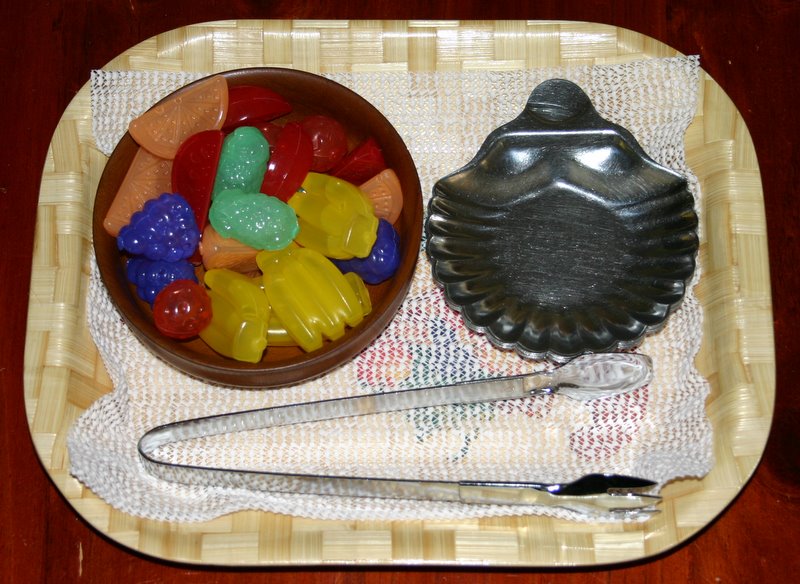
Larger and longer tongs are more difficult to use. These are still easy to squeeze but their length makes them more unwieldy to handle.The fruit are plastic iceblock shapes from the $2 shop.

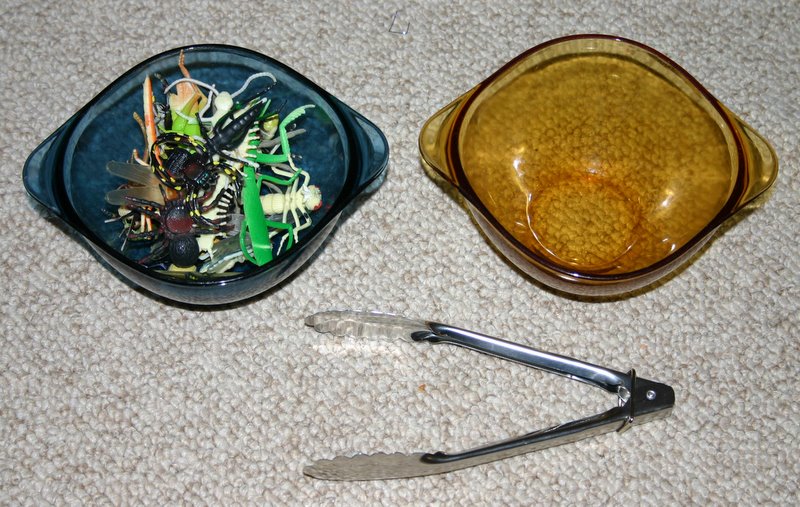
A small set of salad tongs and a bag of plastic bugs were all that was needed for this tray.

The reality of young toddlers and tray activities is that they will have a limited concentration span and the interest shown for each activity will vary. I try to make each tray so that they can be easily completed in around 5 minutes. This means that if you want 30 minutes of highchair time to be well occupied, you will need around 6 activities. Some will be very absorbing for the child and they will complete and repeat them over and over. They will find some very challenging and perhaps even difficult and may want to spend less time on these. Reduce the amount of material on these trays accordingly. If you see that an activity is too difficult for the child to complete successfully, simply remove it and re-introduce at a later date. The perfect activity has a bit of a challenge but not so much that the child is frustrated by their inability to complete it.

Other posts you may like:

Mega marble transfer

An introduction to sorting

Bucket of giant beads transfer