Sensory tub ideas for toddlers and preschoolers

sensory tub A teddies IMG_8196

Sensory tubs are great for mat time (blanket time) or as a table activity and are excellent for when you need to school older children, cook dinner, or during any other time when you need your little ones well occupied and absorbed in a worthwhile activity.

They are quick and easy to put together, cheap or free (depending on what you already have lying around the house) and can be used daily as part of your flexible routine for babies, toddlers, preschoolers and even older children. Obviously the materials you present will change according to the age of the child who will be playing with them, with safety always a factor for little ones who may put small items in their mouths.

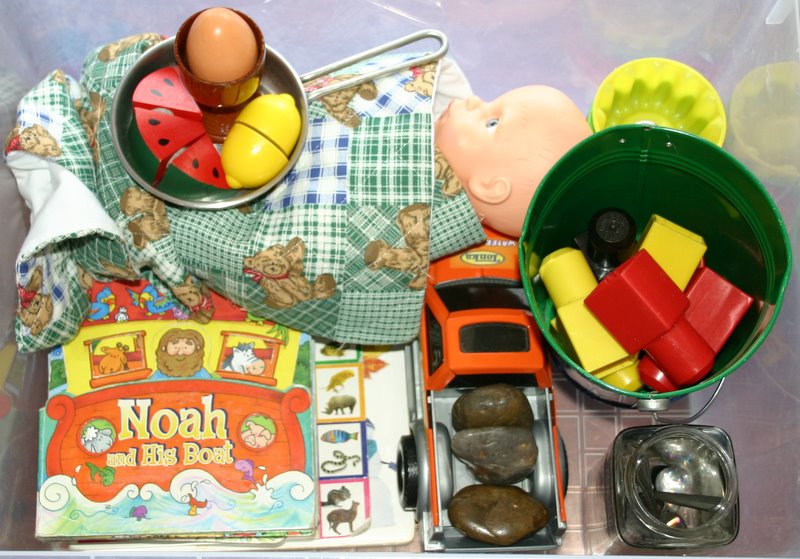
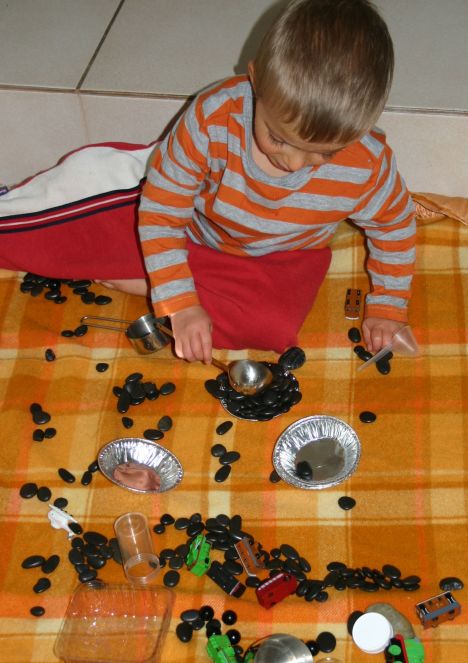
There is no limit to what you can put into your tubs. Ideally the materials will be open-ended; that is they can be combined and used in a variety of ways.sensory tub trains IMG_8187
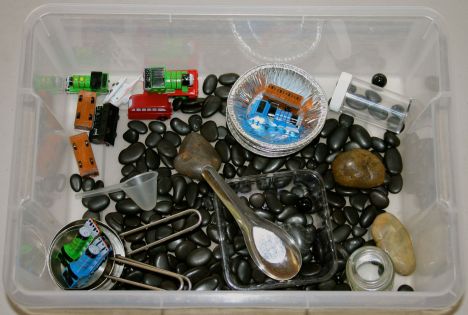
Younger toddlers do not have a well-developed imagination and therefore need more hands-on options, rather than pretend play materials. For example, in the trains tub above, I included a variety of scoops and containers to fill, transfer, tip and pour as well as the trains themselves. A young toddler may examine the trains before setting them aside in favour of transferring the stones from container to container. The older children may go straight for the trains and set up a complicated rail system with rocks delineating the tracks and the containers used as sheds for the trains. Another may decide to serve dinner on the silver pie tins or set up a picnic for the trains.
sensory tub trains JIMG_8193

I find that the tubs themselves are not large enough for the children to play within. They like to sort through, put aside what they are not using and generally spread out, so I use a blanket or sheet for them to play on. When play time is finished, the corners of the sheet are lifted up and all the materials can be quickly tipped straight back into the tub without a tedious pack-up session.
sensory box horses jewels IMG_8183

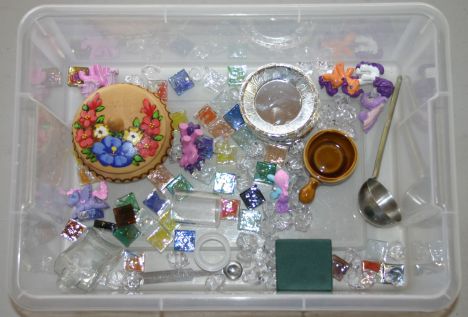
The older girls were practically drooling over this jewel and miniature pony tub as I was putting it together – usually a sure sign it will be well-loved by the younger children as well! Again, a variety of scoops, containers, bottles and boxes with sparkly jewel squares and pebbles. (The kind used in vases or to fill bowls – from the discount shop.)
sensory box sea IMG_8185

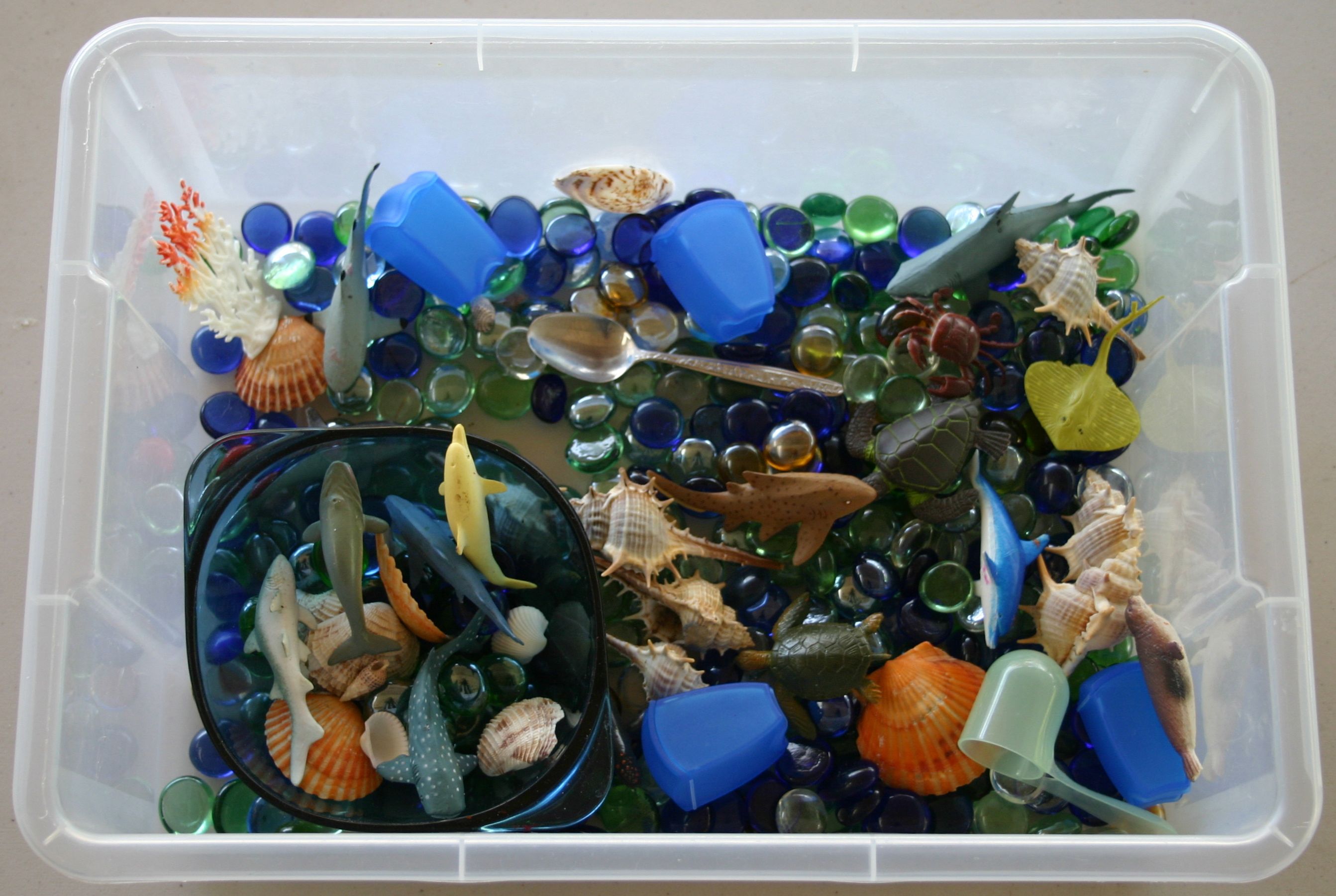
Blue and green gem stones, plastic sea animals, shells, bowl, spoons, scoops and empty pill boxes. This tub covers opening and closing skills, spooning, scooping, tipping, pouring (all transferring skills) and could be extended to sorting and categorizing as well as the pretend play options.
sensory tub S jewwels IMG_8192

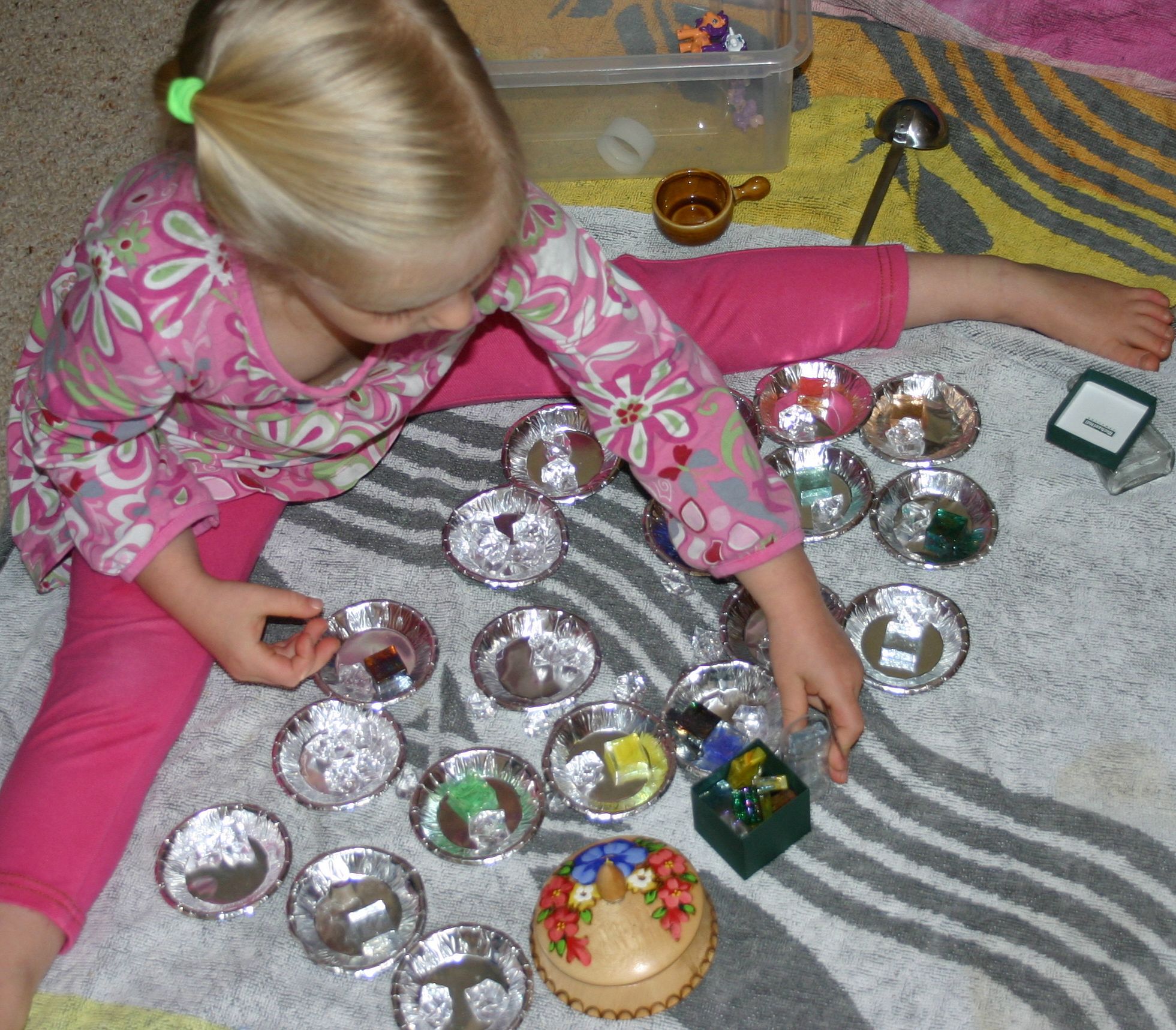
My youngest daughter used the pony and jewel tub this morning for the first time. She carefully removed all the ponies and put them back in the box before making a picnic for her teddy bear and the 12 disciples (!) with the containers and jewels. The older girls (6 and 8) have already asked to use it later and tell me they plan to set the jewels up as food for the ponies. The beauty of open-ended, attractive materials is that they will appeal to a variety of ages. My 15 month old can barely restrain himself and wants to dive straight in whenever he sees these tubs out. Unfortunately the pieces are just too small for him to use safely.
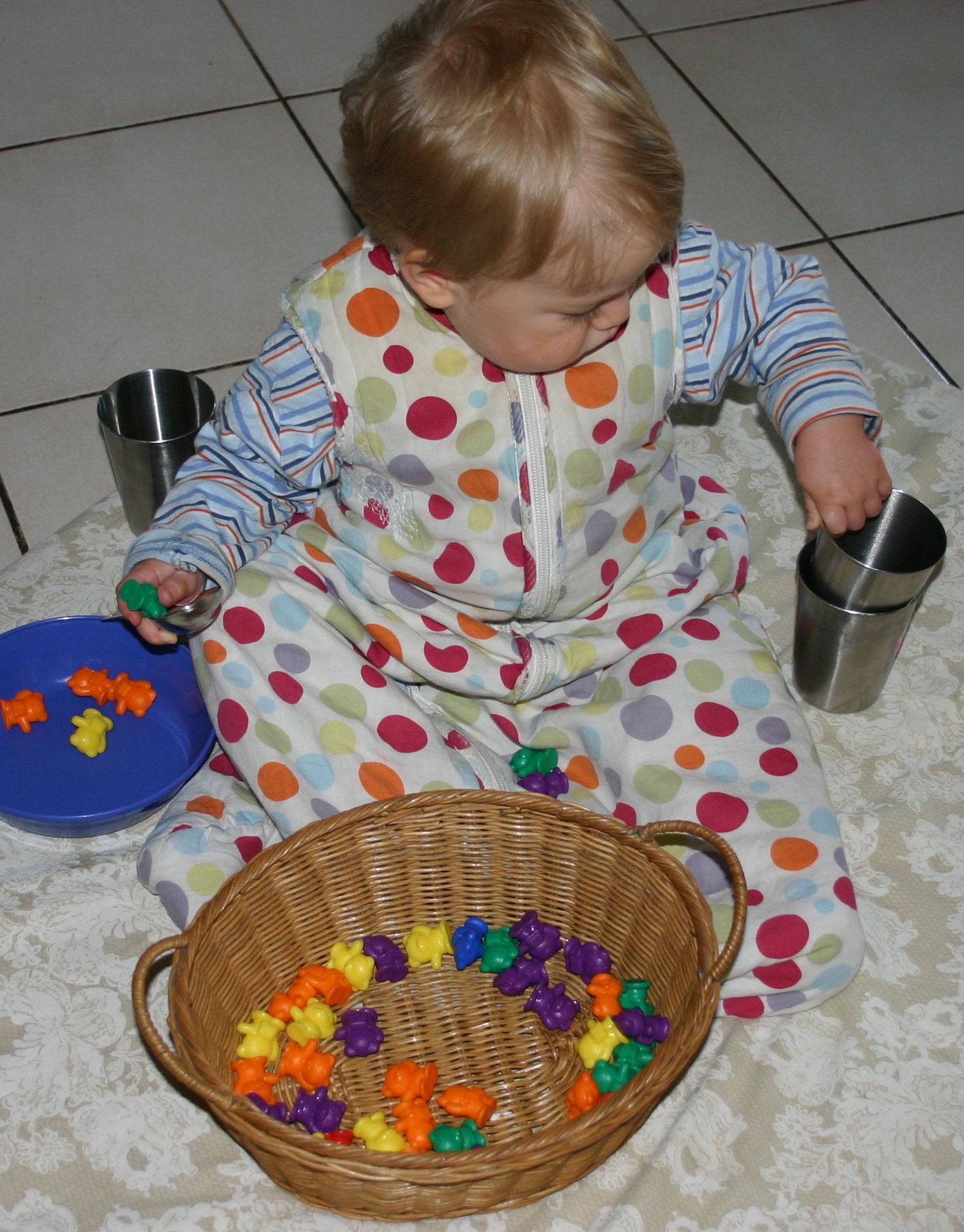
sensory tubs A teddies IMG_8194

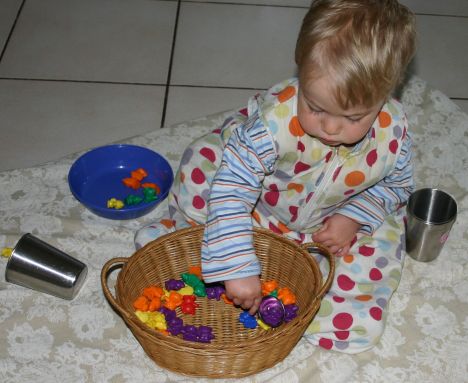
This is the 15 month old’s sensory “tub” this week. He loved it and used the scoop (a large measuring spoon) to transfer from the large basket to the small bowl, filled and stacked the metal cups and filled and tipped out the basket numerous times. Provide a container or two and something to put in and dump right back out again and it will always be a hit with anywhere from an 8 month to a 2-year-old. 12 to 18  month olds particularly love to fill and dump.

For a stack of ideas to fill your sensory tubs,see this post. Many of the other ideas I have posted as table activities, highchair activities or mat time activities would all work in a sensory tub. See pasta play and teddy food play as examples.

Getting dinner on the table

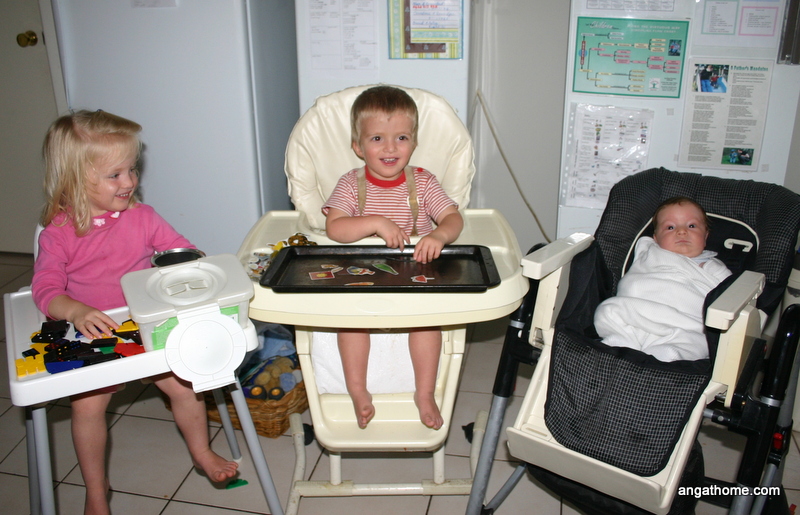
Highchair time at our house – 3 in a row!

I like to cook for fun. It’s enjoyable to potter around testing new recipes and trying them out on friends and family. I don’t so much enjoy having to get dinner on the table at short notice, with a bunch of hungry, cranky children getting on each other’s nerves as we battle through “arsenic hour” as I have heard it termed. So, how do I get a nutritious and delicious meal on the table on time every day that will please everyone from the baby, right up to Dad? Well, to tell the truth, that’s almost impossible – with 8 people sharing a meal on a nightly basis, someone is bound to disagree with the delicious part! However, let’s concentrate on the nutritious and “on time” part. We haven’t eaten cereal for dinner yet, although baked beans on toast is the equivalent as far as I’m concerned and we’ve had that a few times!

There are some practical ways that I have gone about structuring my days and time so as to make this touchy time of the day run smoothly and happily for all of us and still have a nice meal on the table. Strategies have changed over time, depending on the ages of the children and what time my husband is due home, but here are some of the ways we have structured the late afternoon period that have worked for us in the past.

Flexible routine. Having a routine running throughout the day makes a big difference at the end of the afternoon. If the children have spent too much time together, especially unstructured time, they will invariably be at each other by the end of the day. A good balance of time with me, with each other, time alone and indoor and outdoor time, all work together for a smooth afternoon. More on routines here.

Feeding toddlers and/or babies early. I prefer it when we all eat together, but there are seasons when that is just not viable. The was a time when 4.45pm was like a “switch” for my toddlers. Happy before, exceedingly cranky afterwards. My options were either to feed them a large afternoon tea earlier (and have problems at dinner with them not wanting to eat well) or to simply give them their main meal earlier. When the rest of the family came to the table they were given some finger food or perhaps fruit or dessert to enjoy with us before moving on to a highchair activity while we finished up. This allowed them to still be a part of the family, I could focus on feeding them and training table manners away from the family mealtime and enjoy my meal relatively peacefully later on.

Baths. Everyone preschool aged and under (i.e. all those who require my assistance during bath time) are all bathed around 4.30pm rather than after dinner when everyone is tired and likely to be fractious and uncooperative. Bath time is then an enjoyable experience for all and bedtimes are not held up if I am caught up feeding a baby or dealing with unexpected circumstances.

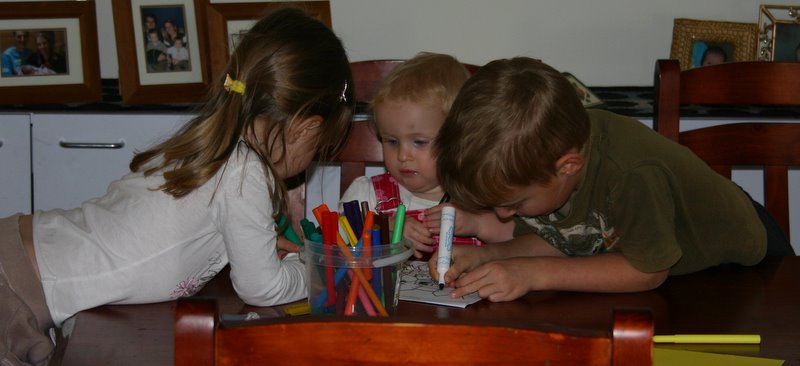
Table activities. For around half an hour before dinner, all the children do highchair activities (some ideas here, here, here and here ), table activities (some ideas here, here and here), mat time (some ideas here, here and here), puzzles or books. There is nobody roving about getting into trouble and plenty of interesting activities to do. I am then free to get the last-minute dinner preparations done.

Sibling time. Sometimes the youngest children are unable to play independently at this time and need someone with them. This is when I assign an older sibling to spend some time with the little ones, reading them a story, playing on the mat with them, helping them with a simple puzzle or something similar. The eldest enjoy the responsibility and it helps build positive sibling relationships. They do not resent this time because it is not something they are required to do throughout the day in a random way or for large blocks of time.

Menu plan. Having a plan of which meals I will be making throughout the week is so important. Getting to dinner time and realising the meat is still in the freezer and trying to come up with plan B on the spur of the moment is never a great way to have a smooth afternoon period. Knowing what I am going to cook means I am prepared and can plan ahead, often using a few spare minutes here and there throughout the day to get some prep work towards dinner done. More on menu planning here.

Night time preparation. While I am caring for babies, homeschooling and looking after several older siblings, trying to fit cooking in during the day can be very difficult. There are usually several months after the birth of a new child when I do all my meal preparation in the evenings. And I do mean all. I set out breakfast dishes and ingredients and cut up fruit, bake or pull out frozen or pantry snacks for morning tea. I do all the peeling, chopping, grating, salad making or whatever other prep is needed for lunch. Dinner meals are pulled out of the freezer, ingredients are put in the slow cooker and veggies are washed and chopped – even to the point of putting the veggies in a saucepan of water in the fridge. It sounds over the top but, especially with the twins, I just didn’t have a moment to spare during the day. Being able to pull the crock pot out of the fridge and flick it on at morning tea time, knowing there would be a hot meal ready by dinner, was such a blessing. Even when things were going pear-shaped, I could throw a saucepan full of veggies on the stove as I walked past. Older children could set out prepared lunch or morning tea for everyone to help themselves if I was caught up feeding.

At other times, I didn’t have to cook at night, I used the time immediately after breakfast to get the dinner made. Everyone is fresh in the morning and it was a good time to get the household chores and dinner preparations under way. Now that I have older children to homeschool, this time is used for our more difficult subjects that require the most concentration, so dinner making is not a possibility.

Instant meals. For days when, menu plan or not, I have nothing ready for dinner, all supplies are frozen solid and my mind is blank, I am endeavouring to build up a collection of meals that are very quick and easy, that use ingredients I can keep on hand in the pantry or freezer without them going off and throw together in a matter of minutes. My rice cooker fried rice is a family favourite and assuming I have prepared my ingredients earlier, can be thrown together in literally 3 minutes. I haven’t timed it yet but I’m going to!! Ideas for nearly instant meals and pantry mixes are here and here.

Shopping lists. As an extra tip, shopping lists are a must to make life run smoothly around here. I have a shopping list pad with a magnet back that lives on the fridge. As I notice we are running low on an item, I immediately jot it down on the list. When I make out the menu for the following week, or check through the monthly menu, I add the items we will need to the shopping list too, after checking through the pantry first to see if we have what I think we have. It stops the random buying of stuff we don’t need and the irritating need to continually run to the shops to pick up one or two items here and there because they have just run out or I thought we had some.

Now the kids are older, they often come and tell me if something has run out or ask for small items like lead refills for a click pencil that we would never in a million years remember to get when actually at the shops. I also have multiple copies of a printed shopping list hanging inside the pantry. This list is all the items I buy on a weekly basis. When we are actually ready to go to the shops, a quick look down the list to cross off what we don’t need and to add the odd ingredients from the fridge list saves time and means we should get everything we need.

Routines with a newborn

We now have a lovely updated colour-coded routine on our whiteboard. Of course, the 8th person included in this routine is a baby that hasn’t actually been born yet so things may need some tweaking once the reality hits 🙂 It is however, a very useful exercise to look over my current routine and to plan ahead for the multiple breastfeeding sessions I will need to fit into my day and the interruptions that will invariably come with a newborn.

We will be (and have done with all our children) following a flexible  feed, wake, sleep cycle with our little one which allows me to make a rough plan of approximately where the daily feeds will fall. Of course, some days will not go as planned and we will often have to switch activities that are side by side around to fit a feed in earlier or later than planned. That is where the routine serves us and our family needs, rather than the other way around.

For anyone who is interested, I would be happy to email you a copy if you thought it would be of any help to you and your family. I have been trying to upload it here without success and am sick of fighting with the computer!

Other posts you may like:

Routines: Room time

Amazing things can be created in room time!

At around 18 months to 2 years of age, a toddler is ready to transition to room time instead of playpen time. Having said that, my two and a bit year old twins still have playpen time rather than room time for a number of reasons – space and lack of available rooms being two!  The following are some ideas for how to go about room time. My next post will help you to transition to room time smoothly. (It may be helpful to have a quick read through these posts first: playpen time, toys and starting late, choices)

What is room time? A time each day that is set by Mum when a child plays in their room (or a designated room) for a period of time determined by Mum. Do not confuse room time with a child choosing of their own volition to spend time playing in their room. This is a time chosen by you, with toys chosen by you (or a limited choice for older children) for the length of time chosen by you.

Tips for successful room time: 

  • try to arrange the room so that you can check on the child but they can’t see you.
  • start with 10-15 minutes and work up to longer time periods over several days. Even children who have been contentedly spending an hour in their playpen need smaller time increments to start with. This is a new freedom and you want to be able to praise them for their success in staying in their room and making wise play choices. Once the transition has been made and all is running smoothly you can increase the time again.
  • get the child started on an activity they enjoy before you walk out.
  • do not plan to use this time for the first week or so. Hover nearby, check on children frequently and deal with situations before they get started. Remember, the purpose of the short time period to start with is to finish while it is going well and praise, praise, praise! Do not be tempted initially to extend the time because it is going well and leave it until a problem happens – end on a good note.
  • start when you know you will be able to be home for a few days in a row
  • for young children, consider doing it through the weekend until well established
  • have it at a similar time each day
  • set out the toys you want a toddler to use or provide a limited selection of toys for an older child to choose from – not unlimited access to everything in the room.
  • introduce packing away from first use – demo, help, then independent. Have an easy storage system such as open crates. Sort toys out. One large toy box for everything not a good idea. Toys get lost, pieces are mixed up, toys are buried and forgotten and children can’t be bothered digging through to find what they need.
  • The success of room time depends on the focus and control that you are modelling and teaching throughout the whole day. A child who has too many freedoms and will not obey you during the day will not suddenly obey you when it comes to room time. Using a gate in the doorway can be useful for little ones during the initial transition and takes away the temptation to keep coming out. However a child who is not being trained in obedience will find a way to get out if they REALLY want to, despite the barrier.

 Toys:

  • You may like to keep room time toys only for room time so that the interest level stays high. Alternatively, toys can be sorted into crates for each day of the week or changed on a monthly basis.
  • Have a system in place to put the crates/boxes etc. into. A low bookshelf or cupboard that the child can reach is ideal. A few shelves that are out of reach can also be handy for those toys that are not for general playtime but are saved only for room time or for playing with Mummy and Daddy etc.
  • Clear plastic crates allow you to see contents at a glance.
  • Remove lids and simply have open containers that slide onto shelves. Remember, the easier it is to pack away, the more likely the child will do it without a fuss.
  • Sort toys out into smaller containers of similar sort (as children get older, toys become more complicated and have more pieces – mixing sets or kits with other toys makes it difficult to access.)
  • Do not store toys in draw-string bags, cardboard boxes with lids etc. until the child is able to manage those by themselves. If they have to ask you to take a lid off for them, they will be coming out of their room to do so and/or unable to pack up without your assistance.
Transitioning from playpen time to room time:
  • Put the playpen in the bedroom to begin with.
  • Use a mat or some other kind of blanket/carpet etc under the playpen that will become the designated play area in the room once the playpen is removed.
  • Have the toys sorted out and in the same places you will put them when room time begins without the playpen.
  • Take down only one crate at a time and say every day that this crate must be packed away before another one can come out – while in playpen one crate is all they get, so include enough variety to last the entire session. This means that later there should be a controlled amount of mess – no more than the contents of one crate should ever be out at one time.
  • Pack up with the child to begin with, one kind of item at a time, in a methodical way – remember you are teaching them how to pack up for all those times later they will do it themselves. Say out loud what you are doing, “First lets put away all the cars, now lets find all the books” etc.
  • Once the child is used to helping you, do some together then leave them to finish a set amount. No consequence for not packing up is needed, they are simply not free to come out until it is done.
  • If  there is a lot to pack up, simplify the pile into perhaps one or two kinds of toys – too many items from different containers/kits will be confusing and children often end up sitting there packing away nothing at all. For example, if a box of Duplo is out, along with books and a puzzle, perhaps clean up the books and puzzles for the child and require them to do only the Duplo.

Removing the playpen:

  • Explain that they need to play on the mat or other area you have designated.
  • Remind them of the toys that they may choose from – the same system you have well established while still in the playpen.
  • Initially, continue with the crate system. As children get older and toys become more complicated, begin to slowly hand over the choice to the child eg. you choose 3 items from the shelf, I will choose the rest.
  • Pack away most of the toys in the bedroom to begin with and only have out a few options that the child can choose from. More can be added later.
  • Remove any treasures or irresistible things that shouldn’t be touched.
  • Always have a set place for items. Teach how to pack away every toy as it is re-introduced back into the bedroom or a new toy is added.

Troubleshooting:

  • Try to ensure that household traffic is not passing by the door of a child who is having room time or they will be constantly distracted and more likely to want to come out.
  • Keep activities that sound like a lot of fun away from the sight and hearing of a child in room time. If they love to paint and you use this time for the older children to paint, it is much more difficult for them to be content knowing what they are missing out on.
  • In large families where children share rooms there may not be enough room time rooms to go around. If you are homeschooling and have older children at home, they could perhaps use this time to complete school work and have their room time at a different time of day. I prefer to have everyone in room time together so I get a break therefore we use almost every room of the house. Toddler and baby nappers go in portacots in rooms other than those they sleep in. Middle ages have their own desks and toys set up in separate bedrooms, including their own sleeping room and the baby room. The eldest is the most mobile as his interested are more portable. A crate with wheels makes his Lego set moveable and books are easy to pick up and cart about. Any other project is collected before room time begins and moved to where he will be. This may be the family room or loungeroom or even outside if the weather is nice.
  • Make sure that the toys are age appropriate, interesting and provide enough stimulus to last the whole time. Older children move away from just toys and in my household are given their own desk around the age of 4. We give them a mini set of drawers stocked with all manner of craft and drawing items, scissors, glue, construction paper and all sorts of bits and pieces and they have a wonderful time creating with these every day. Construction toys are pretty much essential for boys and good books are great for all.

Having room time for everybody every day leaves me with a chunk of time every day to recharge and gives the children a much-needed break from each other. They are often refreshed and in much happier moods when they re-emerge. Those personality types who crave time alone are rested and recharged and the more sanguine children benefit from learning to be by themselves and using their time in a worthwhile fashion. The projects the older children get up to are often quite amazing and the time is rarely wasted.

Surviving new babies, sick kids and interruptions

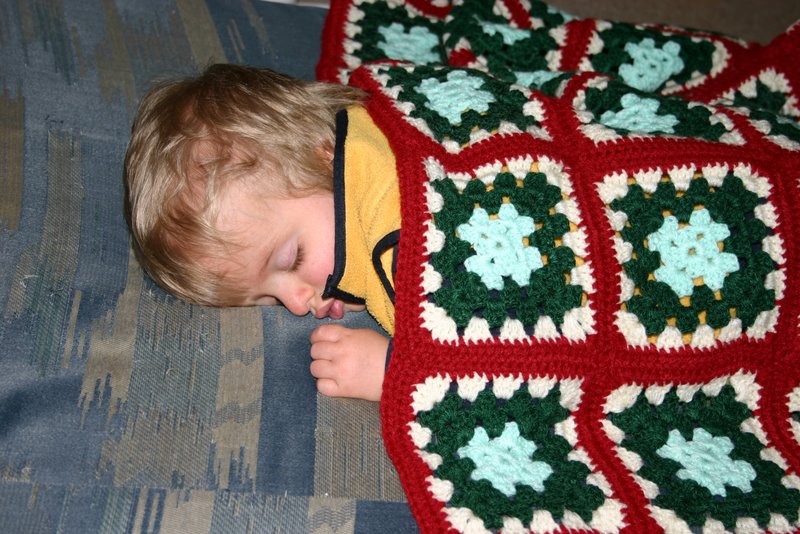
My child, who is normally a very light sleeper, slept on and off throughout the day on the couch in the middle of the gamesroom surrounded by siblings. He must be sick!

The larger your family grows, the more important it is to have some standby plans for managing those days when you have a sick child, the baby cried all night or unexpected interruptions take away all your usual “keeping things running” times in the day. It requires some preparation and planning ahead, but that investment is well worth it when one of “those” days arrives. Many of these tips are also useful if you are preparing for a new baby.

Here are a couple of my ideas to get our family through a day or two when life is just too difficult to even think about what you are going to cook for dinner.

Meals

  • Meals should be healthy – avoid takeaway if possible or sick children’s already overloaded immune system will be fighting off the effects of bad food on top of everything else.
  • Keep a supply of freezer stock meals to defrost for “those” days.
  • Make an emergency menu – meals that you or older children can put together in minutes and ingredients that are always on hand.
  • Put the crockpot/slowcooker on in the morning when sick children may be less likely to need your attention.
  • Have your regular menu already planned so that the meals do not require thought.
  • Teach your children to cook. In a pinch, my 6 year old can put together a salad, the 8.5yr old can prepare a simple main meal and the 4 year old can get the table set and water glasses set out. If your emergency meals are simple enough and you spend some time teaching your junior cooks how to make them without assistance, they will be well prepared and love to step up and help Mum out. It gives a child a great sense of accomplishment to be able to announce to Dad and the family that they cooked dinner all by themselves. (Obviously there are safety issues to consider – Mum may need to be the one who slides the casserole into the oven.)

Toddlers/preschoolers

  • Have a list of suitable toddler activities that can be pulled out from an easily accessible place with a good storage system (Ziploc bags, shoeboxes, crates etc.) Set it up so that an older sibling can get them out for your younger child.
  • Create a flexible routine that includes activities such as playpen time, table time, mat time and highchair time so that you know you will be free to attend to the children who need it. Implement it on a daily basis so that it is a usual part of your day and well established before “those” days hit.
  • Today it is ok to watch TV.
  • Today it is ok to play outside a lot (the well ones!)
Homeschooling
  • Teach your children to work independently.
  • Leave the subjects you absolutely must teach yourself for another day or a suitable moment throughout the day.
  • It generally works better if we go ahead with school regardless of sick children. Well children mixing with cranky sick children without a lot of structure is a recipe for a bad day.
  • Have systems in place so that all children, regardless of age, know what they should be doing on a daily basis and in what order, whether you are there or not. (Workbox systems, a shelf of activities per weekday, Ziploc bag tasks, workjobs in a shoebox, Montessori style tray activities, pictorial or written timetables and schedules or whatever system suits your children.)
  • Read aloud a lot while children colour/play quietly/fold laundry or simply rest.

Housecleaning

  • Train older children to help out with regular daily chores.
  • Do only what is essential (if today is washing day – skip it or use the dryer. You don’t have time to hang out those loads.)

Afternoon quiet time

  • This time is precious to me – older children have room time, younger children nap and I can then have a nap too (assuming the sick child does not require attention at this time.)
Remember that every day will not be like this and it is ok to just let it all slide and simply survive! Routines and schoolwork can all be quickly re-established, especially if your children are used to having a fairly structured day. With a new baby, you may be tired and lacking the drive to get things started, so perhaps putting in the preparation and endeavouring to keep things ticking along will be more successful than allowing it all to fall into a great heap that needs a lot of time and energy to get back out of later!
Mat time was uneventful this week – too tired to sit up, let alone play!

Routines: Table activity ideas

Following on from my post on table activities, I thought it might be helpful to include some ideas of the kinds of things I give my children to do at table time. The toddlers sit in their highchairs to do theirs (see highchair activities) and the older children sit at a variety of tables and occasionally on the floor.

  • Drawing
  • Playdough
  • Stamping (stamp pads and ink stamps)
  • Lacing, threading or beading
  • Puzzles
  • Books
  • Felt board
  • Construction toys
  • Pattern blocks
  • Contact collage
  • Water colour painting
  • Paper craft
  • Sticker books
  • Tea sets and teddies
  • Finger puppets
  • Mini whiteboard and eraser
  • Small chalk board and duster
  • Peg boards
  • Board games
  • Tap tap
  • Scrapbooking
  • Contact pictures
  • Dot-to-dots
  • Mazes
  • Magnadoodle
  • Colour-by-number
  • Stencils

I like to keep table activities separate from our other activities for a couple of reasons:

  • the children only use them during table time, which keeps interest levels high
  • they do not request activities that I do not want them to do at this time; those they may choose from are already set aside for this purpose
  • when I am choosing activities for the toddlers and younger children I don’t have to think of what to get or wander around looking for inspiration, I simply open the cupboard and choose from the selection there, rotating through those that are appropriate
  • the children have ready access and can pack up after themselves
Another time that we find table activities very useful is when we have visitors. We love having friends and family around but the children do get very excited. After some time to talk and play with the visitors (depending on who it is of course) I often direct the children to get out a table activity. It provides a focus, quiets down the excited behaviour and allows the adults to have a conversation. Sometimes Grandparents or other visitors will do the activities with the children (which of course they love) but we find it just gives them a great way to be around the adults and interact appropriately without dominating the entire evening.

Choices

Why do we need to teach our children to obey? The first reason for me to do so as a Christian is that God’s word tells me to:

Ephesians 6:1-3 Children obey your parents in the Lord for this is right. Honour your Father and your Mother, this is the first commandment with a promise.

Also, I believe that children who are taught to obey their parents are more likely to obey God as well. If a child cannot submit to the authority of their parent, how will they learn to submit to God’s authority in their lives as they grow?

If you are noticing many occasions during the day where you are having problems with a child who is reluctant to obey, whinges and whines while they obey or flat-out tantrums when they don’t get their own way, you may have a child who is becoming “wise in their own eyes.”

A child who is given too many choice begins to imagine that they are in charge and will question your authority in unpleasant ways during the day.

Have a think back over one of your typical days. Keep a look out for every single choice you are allowing your child. Who chose:

  • when to get up?
  • what to do when they did get up?
  • which clothes and shoes?
  • which cup and plate?
  • what food for breakfast?
  • what activity after breakfast?
  • which book for story time?
  • where to sit for story time?
  • when to go outside?
  • what to do outside?
  • when to come inside?
  • what to watch on TV?
  • which toys to have in the bath?
  • where to sit for dinner……
The list is endless and these are just a few examples. Are you making these seemingly small choices for your child or are they making them for you? Choices are closely linked with freedoms. The freedoms and choices a child is given should be in harmony with their age and moral and intellectual ability. A toddler is not able to handle the same freedoms as a preschooler, who is in turn not equipped to handle the freedoms and choice an older child can cope with.
Freedom and choices should be granted as the child ages and shows that they have the maturity and responsibility to make good choices and to use their freedom well. As moral responsibility is demonstrated,  more and more freedoms are granted until they reach young adulthood and are making almost all of their own choices and decisions.
As a rough guide, it is around the age of 3 that children are ready to make some choices (e.g. jam or peanut butter?) with freedoms gradually increasing from there. A 5 or 6 year old is ready to make more choices in their day and should be able to make appropriate choices because of the modelling you have been giving them over the previous years which shows them what good decision-making looks like.
This is not to say that a younger toddler can never have a choice, it just should not be a day-to-day, all day pattern of behaviour.
How do you know if your child is “addicted to choice?” Simply take away all choices for a day and observe what happens. If the child graciously accepts your decision-making then they are probably ready to handle those decisions themselves.
Be aware though, that a toddler who has had a lot of freedom with too many choices will initially have a very bad reaction to this loss of choice and behaviour will most likely be quite difficult for a couple of days. If you are calm and consistent and continue to make all the choices for your child they will actually be much happier and calmer in the long run too.
The concept of being “wise in your own eyes” comes from “On Becoming Childwise”  which is an excellent resources for parenting your 3 to 7 year old. It includes information on choices, freedoms, routines,  and many other parenting issues:
On Becoming Childwise: Parenting Your Child from 3 to 7 Years
Mel Hayde in her book “Terrific Toddlers” covers choices and gives extensive information on how to set up a toddler’s day. My favourite book for 18 month to 3 year olds.

Routines: Playpen time – Toys and starting late

An example of my playpen ready for playpen time. An attractive selection of age appropriate toys - not too many - of different types.

My toys are stored in plastic crates so that a good selection of toys of a variety of types are all ready for me to pop into the playpen. Crates are rotated from day-to-day so that interest in the toys presented stays high for quite some time.

For those of you who have older babies or toddlers who have not yet been introduced to playpen time, here are some notes on starting late.

Starting late:

For a baby or toddler who has had a lot of freedom, the transition to a playpen can take a little time.  Make sure it is a good time of day to begin (not when they are hungry or tired) and start will a small increment of time – even 5 minutes. Put in a small basket of toys, or a toy or two in each corner of the playpen, instruct the child that they need to play here and that Mummy will be back to get them in a little while.

Yes, they probably will cry and that’s ok. If you are consistent and stick with it, your child will come to play happily for this time. You may like to play a CD or favourite book on tape, letting you child know that they can come out when the CD or story finishes or set a timer and tell them that playpen time will be finished when the timer beeps. Having a cue of some sort to signal the end of playpen time is helpful in the training period because it lets the child know that it is the signal, not their crying, that has decided playpen time is over for the day.

Start with the small increment of time and stick to it, coming in immediately once the signal sounds (timer beeps etc.) and with a happy face and positive tone say something like “Playpen time is finished, you can come out now.” A well fed, well rested child, with age appropriate toys is not harmed in any way by a little time in the playpen, in fact it actually helps them to develop those all important concentrating skills that will enable them to learn so many important things later.

Initially, have playpen time 2 or 3 times a day for 5 minutes. Once your little one is used to spending this short period of time in a playpen, gradually start to extend the time. Once they are spending longer blocks of time in the playpen, reduce the number of times in a day you use it to two and then once a day. By around 12 months all of my children would happily play in the playpen for around 45 minutes which extended to an hour by the age of 18 months. I have watched them examining objects with intense concentration, seen the cogs ticking as they use it in different ways and investigate everything about it. Babies and toddlers often do not do this for longer than a few moments unless you create situations that foster this skill.

Once a child is characterised by happily spending time in a playpen then on odd days you can make exceptions when they are not happy eg. extra tired, sick etc.

Although you may be thinking “My boisterous 12 month old will never do that” let me encourage you that they will. There will certainly be a transition time involved, however if you are consistent, playpen time will be a pleasant time for you both.

Introducing playpen time as part of a daily flexible routine will greatly improve the success you have with it. Trying to implement one planned moment in a day of chaos and unlimited choices for a child will be very difficult.

Routines: Playpen time

What is playpen time?

Time when a baby or young child plays in a safe environment within a set boundary with a selection of age appropriate toys for a set amount of time.

Why have playpen time?

Playpen time is introduced as a regular part of a flexible daily routine. Independent playtime away from all other distractions teaches a child how to focus and concentrate on a few selected items, rather than flitting from one activity to another. It teaches them to be content on their own and to know that it is ok to be separated from Mum for a short time – that she will come back. It alleviates the separation anxiety many young children feel when Mum leaves the room because they know through experience that she will return and they will be ok.

Playpen time provides you as a parent with a period of time where you can take a shower, complete some of your own responsibilities or homeschool older children – all the while knowing that your younger child is safe and happily playing with their own toys.

How do I introduce playpen time?

Ideally, introduce playpen time from before your baby can even crawl. (See tomorrow’s post on starting late.) An emotionally healthy baby can lay or sit for a short period of time happily focussed on their own toys in a secure and safe environment. Make it a part of your daily routine, a couple of times a day for 10 or 15 minutes right from a very young age. If you wait until they can roll and crawl to get where they want and then suddenly impose a barrier, baby will be frustrated and let you know. If they are used to spending some time in a playpen every day it will simply be something they expect and happily participate in.

Obviously babies need lots of time with Mum and other family members, cuddles, attention and the like – I am not advocating using a playpen continuously throughout the day. It is for planned periods of time and for a reasonable length of time.

Where?

Somewhere that you can check on your child regularly, but where they cannot see you. Somewhere away from the traffic flow of the house. When siblings or others walk by, a child’s attention is diverted from what they are doing and they will swiftly become discontent with being there. If they see you check in on them, they will likely cry for your attention and want to get out, whereas once settled an uninterrupted child will happily focus for an extended period.

When do I use it?

When your child is well fed and well rested and at a consistent time each day. Make it a part of your routine so that the child begins to know what will happen throughout the day and is happily ready to go in when that time comes.

Toys

Choose a small selection of toys. Too much choice means that children will not focus on any one item but swap and change from one to another. Ensure that toys are age appropriate; not too easy or too difficult for them to use. If the toys are not interesting to the child, playpen time will be a struggle. Rotate toys so that there is regularly “new” toys to enjoy.

I sort my baby and toddler toys into several plastic crates – one for each day of the week. This way, I don’t have to go though wondering what to put in today – I simply put in the next crate. It also means they only see the toys once a week so they are fresh and interest stays high. When I only had one child, I didn’t have as many toys as I do now so rotating was harder, however I will be adding lots of ideas of toys to make for toddlers and babies so check out those blog posts for ideas. You could also swap toys with friends or join a toy library.

Toy storage

Do not expect children to pack toys in to bags or boxes, it is too fiddly and time-consuming. Open baskets and crates are best as toys can quickly and easily be plopped inside. Large toy boxes are also not a good idea as all the toys get jumbled together, pieces are all mixed up and it is very difficult to quickly pull out a good selection for playpen time.

I have a mental list of categories to help me ensure a good selection of toys which varies according to the age of the child:

(For babies) Something to:

  • mouth or cuddle (favourite teddy or any suitable baby toy)
  • look at (stimulating cardboard books, fabric books, photograph books)
  • listen to (music makers, squeakers)
  • feel (texture related toys)
  • kick or bat at (dangle toys, those that clip on the side of the pen)
(For toddlers) Something to:
  • read
  • push (vehicles)
  • stack
  • open and shut
  • touch and handle, tip or put into the containers (shells, rocks, pegs)
  • wear (hats, necklaces, bangles, scarves )
  • build or construct with (Mega-blocks, Duplo, magnetic blocks, stickle bricks, train tracks)
  • pretend play with (teddies, dollies, bottles, dishes, cups, clothes, food)
  • post (a hole in the top of a small cardboard box with something to post like noodles, blocks, pipe cleaners, straws or pegs)
  • practice with (I wander through the house looking for items they are currently interested in like hair brushes, hats, shoes, cleaning cloth, tea towel, hair clips)
  • solve – puzzles (beginner peg puzzles)
  • make music or noise with (maracas, clappers, drums or other percussion, pots and pans or battery operated toys)
Toddlers plus:
See this post on room time.
Packing away

Teach your child to pack up right from the first use of the playpen. Initially it will be you packing away with them watching. Encourage them to help you put the toys away, perhaps placing a small item in their hand and guiding it to the basket and thanking them with a big smile for helping Mummy pack up. It won’t take long for them to understand what you want them to do and you can gradually pull back on the amount of packing you do until the child is completely responsible for this task themselves.

Several of my children have been heard to vigorously start throwing toys back in the crate without me telling them to do so – a very clear sign that in their opinion playpen time is done! While this is very cute, it is important that they realise Mum decides when playpen time is done, not them, or they will simply pack their toys away after a few minutes and expect to come out.


Routines: Introducing table activities

Table time is a valuable addition to any flexible routine. Simply put, it is a time when the children sit at the table (or desk or kitchen bench or wherever) and work on a quiet activity. It is a time set by the parent for this to happen and the activities used are those that are previously approved and designated as table activities.

I choose the activities for my toddlers and younger children and set them out, the middlies usually get to choose between a limited number of activities (“Would you like drawing or felt board today?”) and the older children choose for themselves from activities that they know are already approved table activities. I chat to the children while they play at the table and am able to get the dinner made and served at the same time.

While my routines have changed over the years, for the majority of the time I have used table activities after bath and shower time and just before dinner time. This allows me to get everyone finished in the bathroom and send them to their activities as they are done – no roaming about the house getting into mischief.

I find that it is the transition times, the few minutes here and there between activities, that cause the most trouble and produce the most accidents. Left to their own devices, even for just a few minutes at this time of day, a cranky, tired, hungry toddler or child will rarely make good choices with their time!

The possibilities for table time activities are virtually unlimited. I have a cupboard with shelves that is designated for table activities which makes it easy for the children to see what they can do. Anything you have that can be used independently while sitting at the table is a suitable activity. Some families like to use this time for homework. I’ll be posting some table time ideas soon and of course, any of the toddler, workjob or Montessori ideas I post would be suitable, as long as your child can do them without assistance.