Toddler activities: Tissue box posting


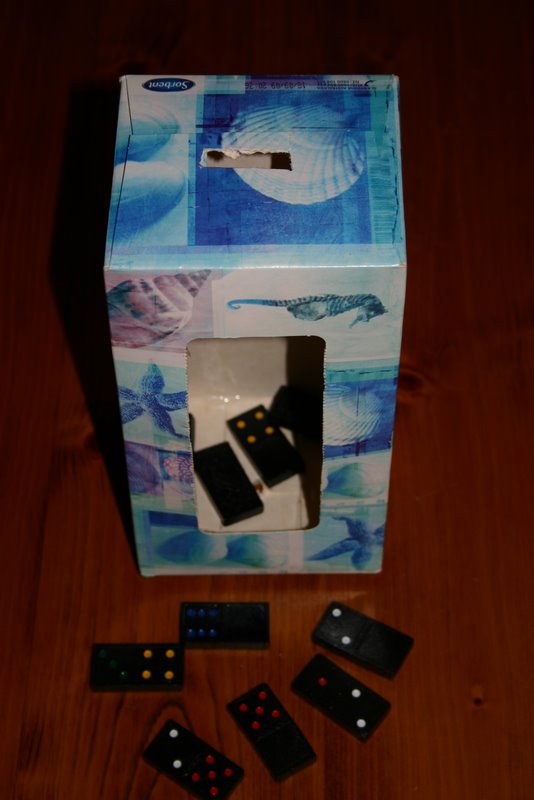
This is a very quick and easy toddler activity to put together and all for free! All you need is an empty tissue box and something to post. Most of us have something lying around that will do; pegs, long Duplo blocks, cutlery, old credit cards, dominoes, popsticks or whatever you can find.

Make sure that the material does not pose a choking hazard, demonstrate what to do and let them at it! For the younger child, simply make the posting hole larger. An older toddler will enjoy the challenge of having to place the item in exactly the right position to get it in.

A great activity to use for mat time, playpen time, or even highchair time if the child is tall enough to be able to see the top of the box.

DESCRIPTION:

  • posting given object (in this case dominoes) through a slot in the top of a tissue box.

CATEGORY/SUBJECT AREA:

  • practical life – posting

CONCEPT/SKILL:

  • fine motor development; hand-eye coordination
  • concentration and focussing skills

EQUIPMENT & MATERIALS:

  • tissue box
  • dominoes or alternative material to post (pegs, long Duplo blocks, cutlery, old credit cards, popsticks etc.)

Please see my pages titled “Workjobs and Learning Styles” and “Brief Montessori Overview” for more information.

Mat time on the go

In my previous post on mat time I wrote about how to use and introduce mat time to your little ones, including the benefits that mat time brings to you and your child. Mat time allows you to go anywhere and place a simple boundary on the ground for your child to play quietly in while you can relax knowing they are safe, quiet and happy.

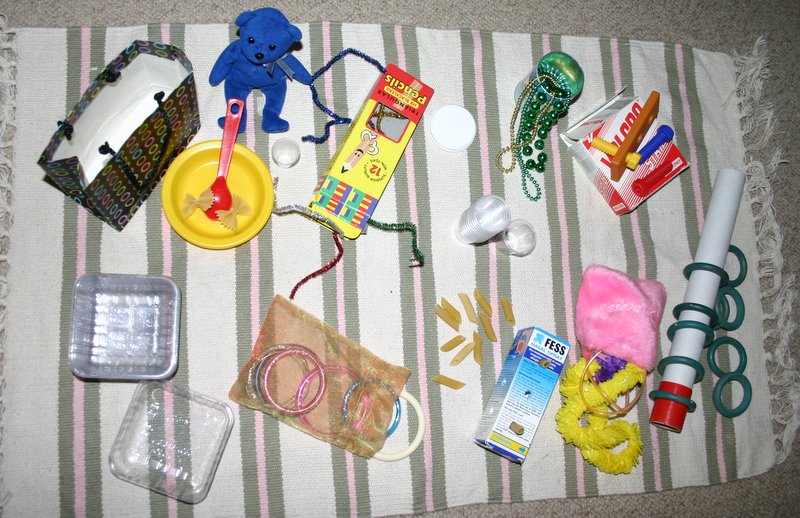
How do you cater for mat time when you are out and about though? I like to keep an activity bag in the car or near the front door with some special toys inside that are used only for this purpose to keep interest levels high when I do pull them out. I don’t have enough commercial toys to put a whole bunch out of circulation so I like these toys to be simple hand-made activities or items that won’t be missed. I have a small mat that also stays in the bag, acts as the boundary and gives the children something comfortable to sit on.

I put everything into little bags, containers or boxes as this doubles the interest factor. Once we have finished with the toys I do have to spend a few minutes returning everything to its own container but as I don’t use them all the time, I’m happy to do that.

I use the following categories to help me come up with ideas of what to include:

  • books
  • vehicle (dinky car, Duplo)
  • stacking toy (plastic containers, cups, bowls)
  • containers to open and shut (bags, boxes, zippers, flaps, press-studs, drawstring, handbags)
  • something to wear (hats, necklaces, bangles, scarves )
  • something textured or unusual to handle, tip or put into the containers (shells, rocks, pegs)
  • construction (Mega-blocks, Duplo, magnetic blocks, stickle bricks, train tracks)
  • pretend play (teddies, dollies, bottles, dishes, cups, clothes, food)
  • posting toy (a hole in the top of a small cardboard box with something to post like noodles, blocks, pipe cleaners, straws or pegs)
  • household (I wander through the house looking for items they are currently interested in like hair brushes, hats, shoes, cleaning cloth, tea towel, hair clips)

With a small amount of preparation and some training at home, you can have a toddler who happily sits down for an extended length of time to focus and play quietly with their own toys. Perfect for Grandma’s trinket filled house or a coffee date with the girls.

5 minute warning

Picture it: You are sailing in the ocean on your pirate ship, catching huge child-sized marlin as you go, just about to reach the treasure chest that is buried on the abandoned island and…Mum calls out “Bath time, come inside please.” Imagine the battle raging in a child’s heart between the desire to continue on with the game, to just find that treasure first, to whine, complain, tantrum and otherwise fail to display obedience in this situation and the moral requirement to obey.  When we put our children into this kind of siuation we set them up for failure.

Think about what it’s like as an adult to be in the middle of a project, or just about finished with something you are working on and to be called away. Frustrating!!

There are times when a child just needs to obey without a warning; first time, straight away, when Mum gives the instruction. Much of the time however, we can prepare their hearts to obey with a simple warning of the instruction about to come. Once the instruction is given, obedience is expected: immediately, first time, without complaining.

It may sound something like this:

Mum: “Pirates.”

Pirates: “Yes Mum?”

Mum: “In 5 minutes I’ll be asking you to put your ship away and come inside for a shower.”

Pirates: “Yes Mum.”

Mum (5 minutes later): “Pirates, put your ship away now and come inside please.”

Pirates: “Yes Mum”

The pirates have had time to find their treasure and prepare themselves to obey and the struggle that may otherwise have taken place inside the children has been much reduced. When a child hears themselves agree to obey, they are much more likely to follow through and actually obey.

Counting after an instruction has been given and ignored simply trains your child that obedience is not expected until the third or fourth repeat of the instruction or at “3” which is when Mum or Dad now actually require obedience. If your child can obey at “3” why not train them to obey when the instruction is given for the first time. It may even save their life one day.

The idea of giving a 5 minute warning comes from the book “On becoming Childwise”, available here.

On Becoming Childwise: Parenting Your Child from 3 to 7 Years

Stay-at-home date nights

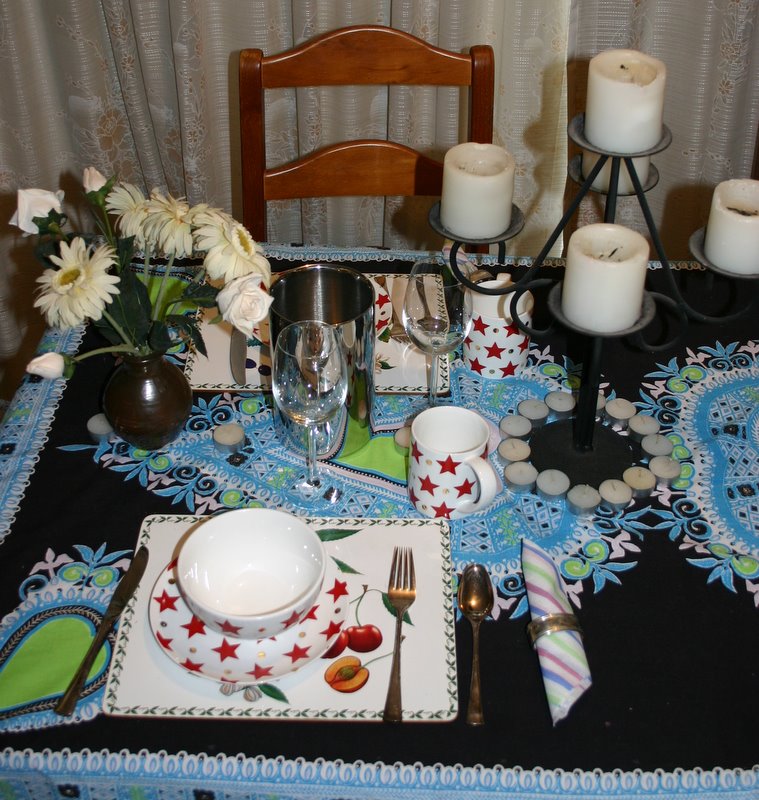
My 8 year old son set the table for our stay-at-home date night last night. He included everything he could to make it as special as possible, even placing a hidden note informing us that a CD had been selected and was in the player ready to go.

Once children arrive, going out for date nights is no longer as easy as it once was. If you have ready access to babysitting you may be able to go out regularly, but many of us find that it becomes more and more important to spend some time and effort planning special evenings at home, to be enjoyed after the children are in bed.

Good date nights take planning and effort. Decide ahead of time what you will do. If left to the night itself, most of us find that we simply lack the energy and inclination to peel ourselves off the couch to get to bed, never mind make a date night special. Pick a night each week or fortnight that will be your non-negotiable date night and don’t change it unless something extra special comes up instead. Perhaps arrange babysitters for one or two nights a month and plan to have date nights at home for the other nights.

If you are lucky enough to have two sets of Grandparents, you can alternate between them which means you only require them to babysit for you once a month – not too much of a load on those already often committed parents of ours. If you find it difficult to find babysitters, perhaps you could get together with another trusted family and swap babysitting with them – you go out one week while they watch your children and they go out the following week while you watch theirs.

Keep in mind your spouse’s love language. These date ideas will cover acts of service, quality time and easily lend themselves to physical touch, but don’t forget gift giving and words of affirmation. You could write a special invitation and leave it in the letterbox or email it to hubby at work, telling him how much you love him, how wonderful he is and building anticipation for the evening to come. A love note can be included on the dinner table or in the picnic hamper or written on the bathroom mirror in the morning before the date night and of course, you can spend the date itself speaking affirming words that you know will be meaningful to your husband.

Simple, inexpensive gifts can also be easily incorporated into the evenings. Why not wrap up the massage oil for the bathroom evening for example and hide it in his briefcase before he goes to work? You could tuck a wrapped new pair of socks into his undy drawer for a sock wrestle later and instruct him to wear them to the date or the brand new CD he has been wanting could be playing on the stereo as a surprise with the case wrapped up for him to open as the date begins. Simple items that will be a part of the date night anyway – even his favourite chocolate – can be given prior to the actual date to have him looking forward to it excitedly or as a part of the date experience itself. As you can see, all of these ideas are relatively inexpensive and easy to do but do require pre-planning. All communicate love!

Don’t forget that you are romancing your husband so take the time to look nice and present yourself in the way you know he likes. If he has a favourite outfit, why not wear it? No one else is around to see you so please his tastes, rather than your own, when you choose what you will wear. Take a shower and get dressed up – the same as you would when going out. Put on some makeup, the perfume your spouse loves and more importantly for him – the undergarments he loves! Anything he has chosen for you will usually be appropriate here. You don’t have to go out so you don’t have to wear them for too long and if you let him know you have it on at the start of the night, he’ll be fairly keen to take it off you by the end of the night!

Now for some ideas:

  • Do you have a trampoline? Take out the doonas, sleeping bags and pillows for some cuddling and star watching. Sock wrestling on the tramp is fun too – each of you wears socks and tries to pull the socks off the other first. Lots of giggling and close body contact here.
  • Set up a restaurant dinner at home with candles, tablecloth, wine – the lot. If you have one, hang a mozzie net around a small table and chairs on the back patio for an intimate setting. Alternatively, a table for two in your bedroom may work well. Perhaps the older children could even wait on the table for some extra pocket-money, just like a real 5 star restaurant.
  • Try a picnic on the grass in the backyard – don’t forget the portable stereo for some mood music. In wet weather, a picnic on the lounge room or bedroom floor can be nice.
  • What about a board game championship play-off with all the old board games you used to play and enjoy growing up. Maybe the winner gets to choose something the looser can do to (or for) them. Maybe this is your chance to try strip poker?
  • Set up a tent in the backyard with the kids during the day and have some fun playing in it with them first. In the evening before hubby gets home, turn it into an “adults only” area. Fill it with a mattress, doona, pillows and the like. Maybe set up the coffee table and lots of cushions around it for Middle Eastern style reclined dining. How about roasting marshmallows over the camp stove? You could even sleep out over night.
  • Cook a meal together. Something difficult and fiddly that you never usually have time for, or a favourite meal that you miss because the kids won’t eat it – super spicy curry, a highly expensive seafood platter…
  • Clean the bathroom from top to bottom during the day. (There’s nothing romantic about sitting in a mouldy, sandy, finger-marked bathtub – or is that only my bathroom?) Deck the bathroom out with ALL your candles, sprinkle rose petals, put on some mood music and fill up the bathtub. Set out the best towels for afterwards. Perhaps have some massage oil or a back massager on hand. Wash each other all over and go from there. If it’s the kid’s bathroom that has the tub, make sure you remove all those toys and other paraphernalia – you want the setting to be romantic.
  • Movie nights are great occasionally but don’t let this be the default option on a regular basis. Hire an old favourite or a DVD that you with both enjoy. Set up the lounge for the full cinema experience – low lighting, blankets, make popcorn and snacks and put them in paper cones or cups.
  • If babysitting allows, how about having the children looked after in the morning instead (or even better, overnight at the Grandparents for bonus date night AND morning). One of the things we miss most is a sleep in, leisurely breakfast, coffee and reading the newspaper in the mornings. We like to go out to breakfast and coffee at a café too if we get the chance, maybe stroll around the shops, markets or wherever we are, before collecting the children at lunchtime.
  • Hold a karaoke night for just the two of you. Not my thing, but some love to sing along and since there’s no one watching, why not give it a go.
  • Dust off that icecream maker, waffle maker, or simply set out a bunch of toppings and icecream flavours to create your own tasty treats – perhaps make a huge icecream Sunday to share.
  • Climb up on the roof with a blanket and do some stargazing and have a heartfelt conversation. All right, not all roofs are suitable and we don’t want any broken necks, but you’d be surprised how easy it is to find a comfy position on some. Don’t put your foot through the tiles though; climb up the ridge capping rather than across the centre of the tiles.
  • Check out many more stay-at-home date night ideas at http://www.healthymarriage.org/homedates.htm

Toddler activities: Sensory tables

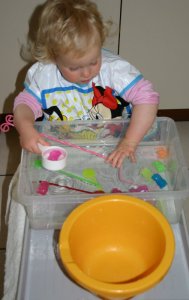
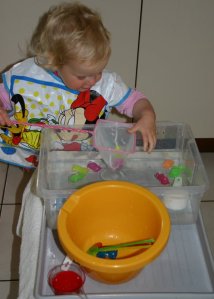
My sensory table in the kitchen; set up for water play.

Sensory tables are an excellent way to keep a toddler absorbed and concentrating for a good length of time while you homeschool older children, cook some dinner or wash the dishes. They are filled with open-ended activities and once the basic set-up is in place, are easily updated with the addition of household items for a new “theme.” Toddlers will love them and learn to focus and concentrate in the process.

A low table is ideal, however a large crate with lid, old television stand, coffee table, big wooden box or regular bench or table with the legs cut down will all suffice. I used a very large, sturdy crate with a fitted lid and covered it with a beach towel for a non-slip surface.

The sensory tray itself needs to have low sides (around 20 cms high) and be quite large. Under-bed storage crates or something similar are ideal because plastic lends itself to water and sand play and can be easily cleaned out. If the shallow crate comes with a lid this is even more ideal as it can be clipped into place when the tray is not in use.

For water play (as in the photo above) I have a smaller crate that I fill with water and a very shallow tray that goes underneath. This gives me a dry area for the accessories that are not in use and somewhere to put muffin trays for sorting and other activities near the water tub. For dry activities like pasta, the accessories can be kept in the large tray with the pasta and just put to one side.

The tray needs to be low enough for a young child to stand at comfortably, with their hands able to reach to the bottom of the tray. With very young children, you may choose to provide a sturdy step to bring them up to height, rather than cutting the table down too low – remember they will grow very quickly.

Think about age suitability. Scissor activities are not appropriate if it is likely that your 12 month old will get hold of them! Put towels underneath the table for indoor wet play. Plan for an easy clean-up by spreading out a sheet or blanket underneath when your child is using dry materials and simply gather the spills up in the sheet to tip back into the sensory tray when they are finished. You may choose to line it with fabric to cut down the noise, although this is sometimes part of the fun!

Now – what to put it in? (Keeping in mind of course that some materials pose a choking hazard and will not be appropriate for children who still like to put everything in their mouth.)

Some ideas are listed below and there are heaps of other great ideas at:  http://www.perpetualpreschool.com/sensoryideas.html


material in tray accessories to add
cheap costume bead necklaces (On strings for children to cut apart.)  Tie scissors to table legs so they are always available and do not get lost in the tray. Provide large tweezers to pick beads up and sort into muffin tins or other multi-compartment trays. Use beads for art and craft activities once interest has died.


sand plastic flowers, garden tools, rocks, pebbles, gloves, spray bottles for garden play.
sawdust or washed blue chip gravel or pea gravel or dried coffee grounds or dried tea leaves trucks, cars, rocks, pebbles, road signs
sawdust or shredded paper or packing cornstarch beans magnetic bingo wand and magnetic bingo chips (Chips will attach to wand as it is swept through the tray) or large horseshoe magnet (or similar) with paper clips, cutlery, metal pencil sharpeners etc
water aquarium rocks, pebbles, plastic bait fish or sea animals ($2.00 shops are a good place to look) aquarium net, small containers/buckets for caught fish.
water or wheat (Extremely large bags of wheat are available for at places like City Farmers.) turkey basters, squeezy sauce bottles, cups, containers, funnels, tubes, measuring spoons, sifters, egg cartons, pots, pans, jugs, measuring cups etc.
shredded paper or cotton balls or packing cornstarch beans or birdseed, wheat, pasta, rice, split peas or other clean grain. plastic or wooden letters/numbers/shapes and sorting trays to place in once found. Could be colour coded trays/containers to encourage sorting. Puzzle pieces – put puzzle tray for pieces to be inserted into once found, until picture is complete.
smaller tray – can be a table activity buttons, tweezers and iceblock trays for sorting.
chosen dry material foam board (from craft shops cut into animals or shapes to sort.)
smaller tray – can be a table activity beans and numbered egg carton (child to put correct number in each egg cup.)
ribbons, segments of curling ribbon, strips of crepe paper etc small sections of gutter guard, small hole chicken wire or commercially available weaving mats to thread ribbon through.
water sinking and floating – ping pong balls, boats, sponges, rocks, shells, other household  objects that float and sink. Encourage child to make a prediction before they check to see if the object sinks or floats. Aquarium nets to fish out objects once tested.


sand, shredded paper, crepe paper strips, sawdust or birdseed, wheat pasta, rice, split peas or other clean grain. plastic animals, bugs, rocks, shells. farm accessories etc.

(Wheat is available from places like City Farmers for $10.00 for a huge bag. Cheap enough to just sweep up spills and throw out if dirty.) Provide insect or animal books for children to look up their “catch” as they unearth their finds.

iceblocks of a variety of sizes use salt to stick blocks together to create ice sculptures
water different kinds of rocks to scrub, wash and dry (provide t/towels, scrubbing brushes, cloths etc.) Set up a couple of factual book about rocks away from the water for children to try and find their rocks and research rocks in general.)


shredded paper, packing beans fishing pole (wooden pole with string tied to the end and a magnet tied on the end of the string.) Cut fish shapes out of card and glue a paper clip to the nose of each. Write numbers, letters, sight words or whatever you are working on onto each fish and have child name them as they are caught. If they cannot recognise the letter etc. toss the fish back and catch again later. Do not work on too many new letters or numbers etc. at a time – ensure most catches are successfully named!


dog food stuffed animals, pet accessories, bowls (For the child who is old enough to resist the urge to eat the biscuits!)


nature items dry leaves, rocks, sticks, pine cones, honky nuts etc. with magnifying glass. Add plastic animals, bugs, cars etc. later, after the interest in the nature items themselves has worn off.
straws provide different sizes and colours for children to chop up. Tie scissors to leg of table to stop them getting lost in the tub. Once straws are all cut into smaller pieces, hide other objects (as for the ideas above) to find and sort or use cut straws for threading.
fossil dig freeze plastic dinosaurs in a deep tray in a thin layer of water coloured with food colouring. Once frozen, add another layer of different coloured water and so on. Dig out the fossils with metal spoons. Read dinosaur books and information about palaeontology as an intro or follow-up.

De-bone a chicken and soak bones overnight in bleach. Bury “fossils” in selected material for children to dig out.


cutting bright scrap paper, wrapping paper, magazines, pictures etc. for children to cut as desired. Hole punches, fancy scissors and staplers can all be added.


water pure soap flakes and hand beaters.


soapy water dolls clothes, tea sets or plastic dishes to wash and dry up or peg onto string line. Add dish mops, sponges, pegs, bottle washers etc.


corn starch packing beans can be used to hide many objects and are edible (ensure you get the correct ones. Encourage children not to eat them, just know they won’t be poisoned if they do!)

Once you have used them for a while dry, you can provide spray bottles filled with water to dampen the beans which are then mouldable.


soap and paper clay grate one bar of  soap and mix with equal amount of water then combine with one roll of white toilet paper (torn up) to make a mouldable sculpture material.


cities layer bottom of tray with garden soil and sprinkle well with grass seeds. Provide water spray bottles for daily watering. As the grass grows, lay small blocks for roads and add cars or other accessories. Make junk model city buildings and houses and trim “lawns” with scissors.


sand shells, seaweed, flags, buckets, yoghurt pots or other containers and water spray bottles to dampen sand.
chosen dry material spray small rocks gold or use plastic jewels or vase rocks as treasure. Link to pirate stories. Make box pirate ships to pile treasure into.
marble run clear flexible tubing, wooden blocks or real pipe and a variety of joiners to create pathways for marbles.
chemistry lab fill a container within the main crate with water. Provide “lab coats” to keep scientists clean and dry. Have a number of small jars containing vinegar, baking soda, flour, salt, oil, red, blue and yellow coloured water. Put small teaspoons in non-liquids and eye droppers in liquids. Children choose two ingredients for each experiment to mix, observe result, then rinse mixing jars in water. Provide t/towels for drying before starting a new experiment.
colour mixing as above, but only with the 3 prime colours in water. Perhaps use before introducing chemistry lab.
soap finger paint beat pure soap flakes, a little food colouring and water to form a thick, shaving cream consistency. Finger paint in crate or directly onto table surface. If painting onto table surface it is better done outside and hosed off once finished. Provide shirts or aprons to protect clothes. Make a print of painting by smoothing paper over lines drawn with fingers or plastic objects.
supersand equal parts cornmeal and dried coffee grounds make “supersand.” Use with many of the ideas listed here.
water different sized bottles and containers. Draw lines for children to fill to. Work together to decide which holds more.


Highchair time: home-made toddler activities – pasta play

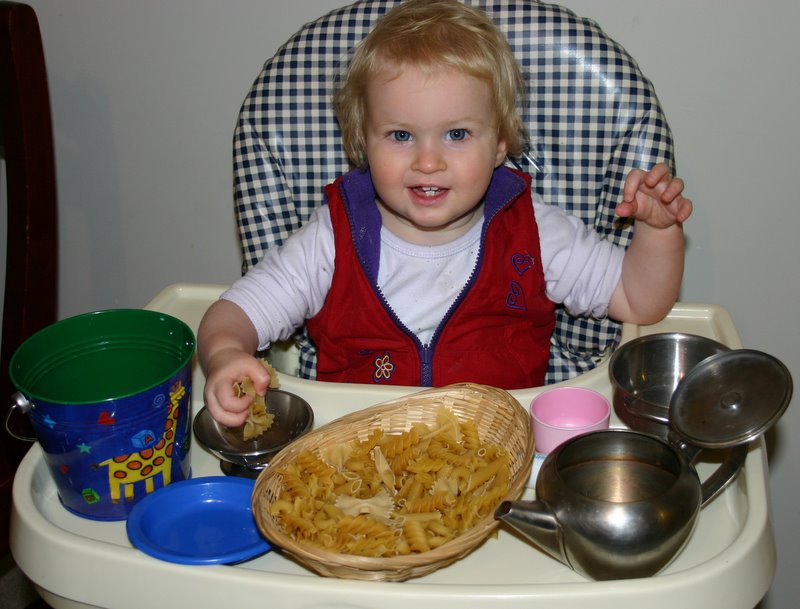
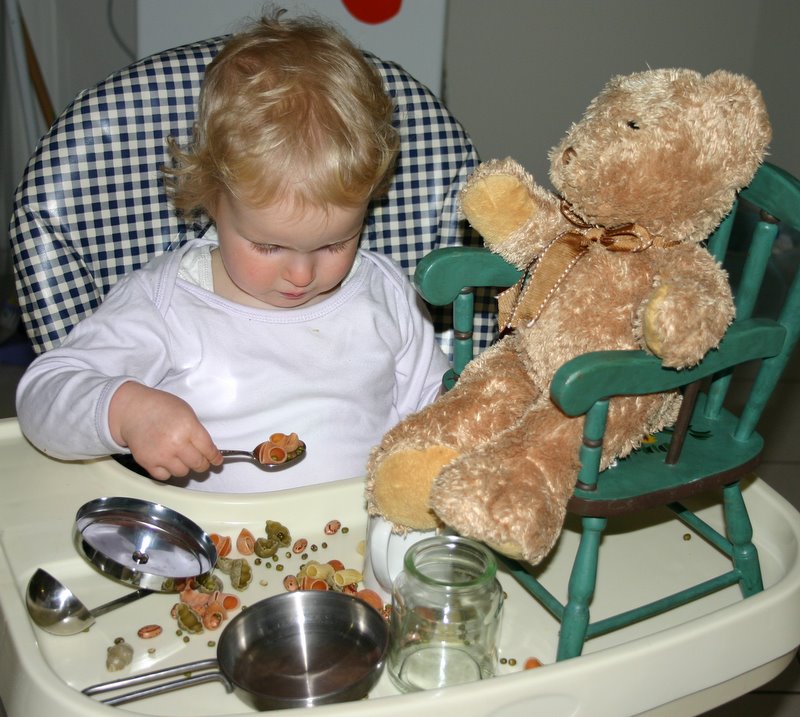
One of the easiest “home-made” toddler activities for high-chair time is pasta play. Raid the pantry for some interesting pasta shapes and gather a bunch of little containers of different varieties and you’re done. While most toddlers will have the self-control not to put the pasta in their mouths, keep an eye on them simply because of the choking hazard it could pose. As far as them having a bit of a chew though, there’s really no problem – it is just pasta!

If you start simply, changing materials as interest wanes, there are unending ways to extend this kind of play. Some ideas are:

  • a cup of pasta and cake tin to tip it into. (Tipping out and refilling a cup is surprisingly absorbing for a toddler and a good introduction to dry pouring.) The tin also makes a satisfying  sound as the pasta is poured.
  • a cup of pasta, cake tin and scoop. The child now learns how to scoop the pasta back into the cup from the tin.
  • a container of pasta and a second container to transfer it into. Transferring is another practical life skill that develops fine motor control. Vary this by changing the kid of tool used for the transfer (spoons, scoops, tongs, ladles etc.)
  • a jug and something to pour into.
  • a variety of different sized containers
  • glass containers (It is interesting for the child to be able to see the container filling up from the outside.) Think about the floor underneath – glass and tiles do not mix!
  • add a teddy with a plate and spoon
Pasta play is an open ended activity that can be independently accomplished and will keep a toddler’s interest for a significant length of time, particularly if you are regularly training them to expect high-chair time throughout the day. Use the time to wash the dishes, make the dinner, homeschool your older children or whatever it is you need to get done.

Routines: Commercial activities for highchair time

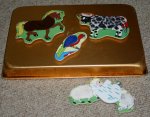
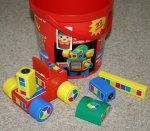
Following on from this weeks posts about highchair time and highchair time activities for babies, here are some pictures of commercial toys I use with my babies and toddlers for highchair times. Go for a walk around the house and see what there is to collect. If you have older siblings, you’ll be surprised what you can borrow from them to keep a toddler happily playing.

(Home-made practical life and other toddler activities will be posted individually from time to time under workjobs and Montessori activities.)

Routines: Highchair time activities for babies

After the post about highchair time yesterday, I thought it would be timely to follow-up with some suggestions as to what to give an older baby or toddler in a highchair to hold their attention and promote the concentration and patience we are working on.

I like to think of toy types in phases of development:

1 to 12 month old babies love toys that are good to mouth and sensory based toys that make sounds, feel interesting and look visually stimulating. Obviously within this age range there is a big difference in the kind of baby toy they are interested in, but in essence they are all “baby” toys for holding, touching, pulling, sucking, crinkling etc.

12 to 20 months olds enter the transition zone. Over the next few months the baby toys begin to lose their appeal and imaginative play has not yet kicked it properly. This means that the shiny red car is looked at, possibly mouthed for a minute or two, shaken, the wheels are spun around a couple of times, possibly pushed along and interest is gone. It doesn’t DO anything exciting and the child does not yet identify it as a small version of a car and drive it around making car noises because the pretend play element is not there yet. What they do like are toys that respond to their actions – that DO something. Pull a lever and an animal pops out, pop a ball in and music plays, tap the pegs and the turtle’s head pops out. This is the hardest age to supply toys for, because interest dies very quickly and those bright, colourful and interactive toys are expensive. You can join a toy library, swap with friends or make your own. (Lots of ideas coming soon.)

20 to 24 month olds and up are beginning to use their imagination, especially if they have siblings or a willing parent to show them how to play. They will begin to have tea parties, feed a teddy, set up the train tracks and create their own pretend play situations. The possibilities open up enormously and this age is so much easier to cater for.

In general, there are some great baby and toddler toys that can be purchased, however interest in most is short-lived as the child moves on to the next developmental level or simply has seen it enough to no longer be attracted to it.

Why not capitalise on the toddler’s natural attraction to learning new skills, copying Mum and Dad and using “real” things around the house to put together your own activities. They are cheap to make and can be disassembled once interest has passed. Important practical life skills can be introduced that will be used every day, many of them developing fine motor skills that will be vital for pencil grip and general hand control later on.

Here is my list of activities to make for babies with instructions for each. Practical life and general toddler activities will be posted individually from time to time and categorized under workjobs and Montessori activities so keep an eye out for them.

Routines: Highchair time

Do you want your baby or toddler to be able to sit and focus for an extended length of time? Do you want them to be able to sit and wait patiently during an unexpected delay in a public situation? Do you want time to tidy up the kitchen after meals, clear and wipe down the table and move to the next activity of the day without leaving a trail of devastation that needs to be cleaned up later?

Like all behaviours and character traits, we must actively work to build patience and concentration in our children. Highchair time is a practical way to achieve this goal with our little ones. It is easy to consistently implement and work into the daily routine without having to change much at all.

After each meal is finished, simply wipe up your child and hand them a book to read or small toy to play with. Around 20 minutes is a good time to aim for and if put into place after breakfast, lunch and dinner, gives you three daily training periods to work on these skills.

Initially, your little one may not be thrilled with Mum’s new plan and a common response will be to cry, complain, whine, throw the books and toys down and other such behaviours. If you ignore this kind of behaviour and simply go about cleaning up the kitchen, you will find that over the next few days, your child will be showing great strides towards happily sitting and concentrating on whatever it is you have chosen to give them.

If you pick up toys that are thrown down, then a very amusing game of fetch will be instigated. You may leave a child for 5 minutes and then return a dropped toy, instructing them that they need to stay in the highchair until Mummy is ready to get them down. If it is dropped again, leave it there. They will soon come to the conclusion that it is better to have something to do than nothing at all and keep what they have been given.

You may need 3 or 4 little toys or books and change them over every 5 minutes or so to keep their interest,  however this should be in Mum’s timing, not the child’s.

If you have heard about the 4 personality types, you will know that a choleric child loves to be in charge. A lot of the battles you have throughout the day and at bedtime with any child, particularly the choleric child, will be eliminated by instigating a parent led routine throughout the day, rather than allowing your young child to plan their own day or giving them large blocks of free time to fill.

An excellent resource for routine planning is Terrific Toddlers by Mel Hayde. It is my “must have” toddler and young child training book and I have gone back to it over and over. It is an easy read but is full of wisdom and excellent advice that will enable you to love the toddler years and eliminate the “terrible two” syndrome that everyone talks about. I will be posting ideas of activities to give your little one during highchair time over the next couple of days.

Camping with little ones, heat and ticks.

School holidays are upon us. For those of you who are heading off camping with your families over the school break, well done! You are creating memories that will last a lifetime and taking one more step towards building a strong family identity. I thought I would post the following story which I wrote after a camping trip with my family at the beginning of the year . With five children 7 and under at the time, it was an interesting experience and yes, we will do it again over the Christmas break! (Just without the ticks this time.)

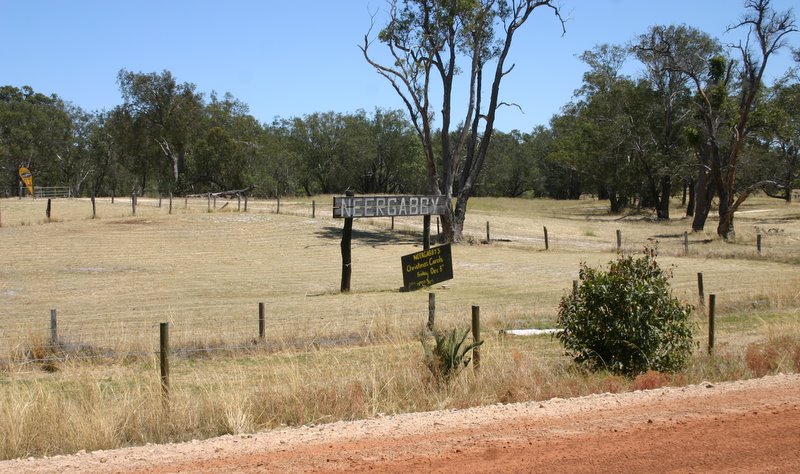
After 2 days of planning and organizing around all the usual daily activities, we woke early and were on our way by 8.30am, which wasn’t a bad start as it was only 30 minutes after we had hoped to leave. We drove the 1 ¼ hour distance to the Neergabby campsite and were pleasantly surprised at how close it actually was. We pulled into the driveway to be greeted by Nan and Granddad and the rest of their 4 wheel drive club and informed that the campsite was riddled with large ticks. After some debate it was decided that it may be best to set up camp away from the trees and longer grass as there appeared to be less of an infestation there. (This of course meant that we were in the full sun on a 31 degree day.) We set up camp without much assistance from the children who were eager to get out and meet the gang and begin events for the day.
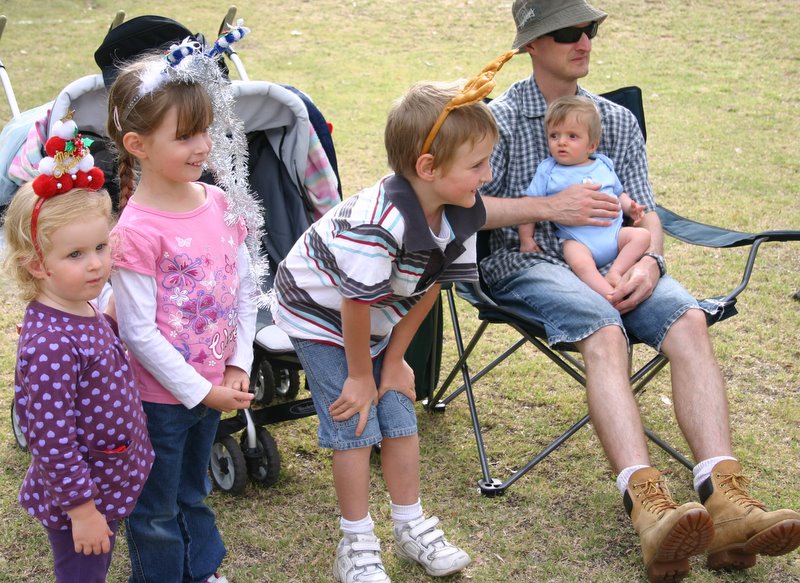
We enjoyed a pleasant day of games and craft with the whole group, young and old, lunch on the verandah, cups of teas and chit chat – while looking after our 5 of course. The twins found several willing hands to be passed around to and the older children had a couple of other playmates to run about with. They received an extremely generous Christmas bag from a club member and copious amounts of lolly bags and chocolate prizes throughout the day to give the kids that sugar rush we parents always love.
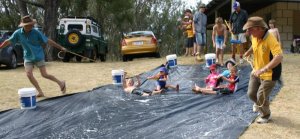
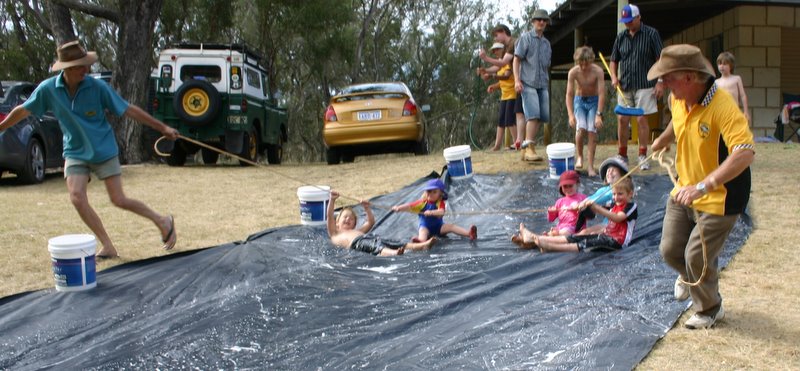
The late afternoon was filled with sliding down the plastic sheet waterslide pulled by a rope which was enjoyed immensely but ended tragically as the soldier ants whose nest we had apparently disturbed finally came out to find out what was going on over their heads. Several children (including 2 of ours) suffered painful stings. We cleaned up for a sumptuous Christmas banquet under the beautifully decorated rotunda. Mum and Dad were camp directors and had knocked themselves out making it special for everyone and didn’t sit down the entire weekend.

All children were bedded down by 8 and quiet when I checked on them (I think they heard me coming) and all was well for a while, until Master 7 appeared to tell us that one twin had been woken up by everyone else talking. We settled him down, got all the others quiet and Daddy stood guard for noise outside the tent while I returned for the raffle draw. The stayers kept on for the guitar led singsong, but we retired fairly early to bed.

We both struggled to go to sleep, being either too hot in our sleeping bags or too cold out of them. The night wasn’t tooo bad – I was only awakened once for the toilet, twice for “I can’t get back in my sleeping bag” (from a previously hot but now cold child who was under the bag rather than in it), once to feed a baby (also awakened by the sleeping bag incident) and finally to push another child back onto her own mattress (she had turned sideways and was trying to get comfortable at her brother’s feet – grumpily telling him “Don’t, stop it, stop it,” as she was kicked in the head while he tried to push her off him in his sleep.) The kookaburras started at 4/4.30am but went away fairly quickly, the first neighbours were chatting around 6am and the first child was awake at 6.30am, needing to go to the toilet.
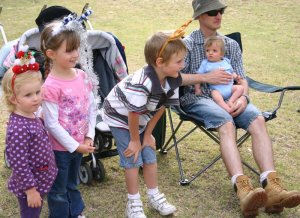
Breaky of toast, eggs and leftover ham was up on the verandah in a lovely cool breeze and after this leisurely start, we faced the task of packing everything back in the car and trailer again.

We spend 2 hours in the already boiling sun re-packing all the gear into the car and trailer while the twins sleep in their pram in the shade (lucky them!) Miss 3 1/2 completely lost it and spent the whole packing time crying about her sore arm, sore tummy and how tired she felt and the oldest two pestered us continuously to eat more lollies and chocolates from their Christmas bags. Fellow campers flipped camper-vans back together in 20 minutes and enjoyed a cuppa in the shade whilst pondering the joys of being Grandparents rather than parents and packing for 2, rather than 7. We spent the morning wondering whether all our fond memories of camping growing up were due to the obliviousness of childhood and selective memory, however Mum tells me that no, it wasn’t anywhere like this much work for them!

We finished eventually and took leave of the camp-site, electing to skip the car museum trip and simply head home with our tired crew. Master 7(who sits between the twins) was very patient and kept busy giving the twins offers of milk and finger food during the trip while Miss 3 1/2 told us over and over that her tummy and arm hurt until she finally fell asleep.  Twenty minutes down the road, Master 7 informed us that there was a brown substance (that looked exactly like melted chocolate but unfortunately wasn’t) on the baby toy, his hands and oozing out of a twin’s nappy into the car seat. We stopped by the side of road to change said twin, including his clothes, wipe his seat, Master 7’s hand and wrap up the toy to deal with later. We resumed the trip again to hear a yell from the back seat that there was a tick on the feeding pillow. We stopped the car again and I threw the tick out of the window with my bare hands (Mummy to the rescue yet again.) The final tick count for the weekend: 3 off the sides of the tent, 2 off the floor of the tent, 4 off the children, 3 off Daddy, 1 off me and many sightings. God answered my prayers and none actually bored into skin.

Twenty minutes further into the journey Miss 3 1/2 woke up, cried and threw up in her lap. We stopped by the roadside yet again to clean her up the best we could, wondering throughout whether ticks were crawling up my legs or were they just flies I could feel? As we set off yet again, Daddy and I laughed uncontrollably at the absurdity of the situation and wondered what could possibly go wrong next. We FINALLY reached the city and the home stretch, only to hear Master 7 tell us that he needed to go to the toilet and no, he couldn’t wait 15 minutes until we got home. We pulled off the freeway and stopped by a clump of out of the way bushes for longer than would ordinarily be necessary (apparently he really did need to go) and set off again.

At the next set of lights, the guy in the next car wound down the window to tell us that we were dragging an occy strap, so we pulled over once more, wondering what it could be as we don’t have any occy straps?! Turns out to be someone else’s occy strap which has hooked around the trailer lights and pulled them out of the socket (meaning we’ve had no lights for who knows how long) and badly damaging the attachment which miraculously turns out to still work when reattached but will need replacement later. After looping through the South Terrace area to get back on the Freeway we noted that we had taken 20 minutes to go 5 minutes worth of distance.

On arrival home (which we were amazed to see was only 2 hours after leaving instead of the 3 hours it felt like) we fell out of the car, fed lunch to the now crying babies and older children (not crying but complaining at the removal of their lolly bags for later), washed and re-dressed Miss 3 1/2, put twins to bed, send older 3 to room time, spent ½ an hour unloading the car and dumping everything to be dealt with later, ate some lunch ourselves and collapsed in a heap.

We looked around the house and noted that it had not cleaned itself in our absence and was now littered with all the camping gear as well and decided not to go camping again until all children were old enough to carry their own gear and put up their own tent… until the next time that is – got to build those childhood memories! We hear Dunsborough is nice over Christmas time…..