Sorting: Montessori Style Tray Activities

Here are some more Montessori style tray activities for sorting. These are a little more open-ended and follow on from sorting experiences already presented (Click here for an explanation of how to introduce and sequence sorting experiences and here for the follow-on with 4 and 5 category sorting ideas.)
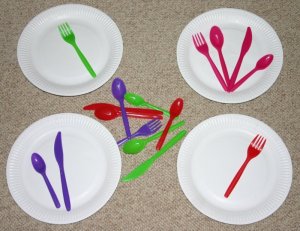
DESCRIPTION:

  • The child uses the plates to sort the plastic cutlery according to their chosen attribute. There is more than one way to sort the cutlery and once children have sorted one way (usually by colour) I ask them to see if they can do it another way (by type; knives, forks, small and large spoons.)

CATEGORY/SUBJECT AREA:

  • Mathematics

CONCEPT/SKILL:

  • Sorting, classifying, identifying attributes

EQUIPMENT & MATERIALS:

  • 4 plates
  • 4 sets of real or plastic cutlery

DESCRIPTION:

  • Children place the chopsticks into the egg carton holes then drop the beads onto each chopstick according to their colour.

CATEGORY/SUBJECT AREA:

  • Mathematics

CONCEPT/SKILL:

  • Sorting, classifying, identifying attributes

EQUIPMENT & MATERIALS:

  • large beads (same shape) with 4 colours or
  • large beads of the same colour with 4 different shapes
  • 4 chopsticks
  • egg carton segment

DESCRIPTION:

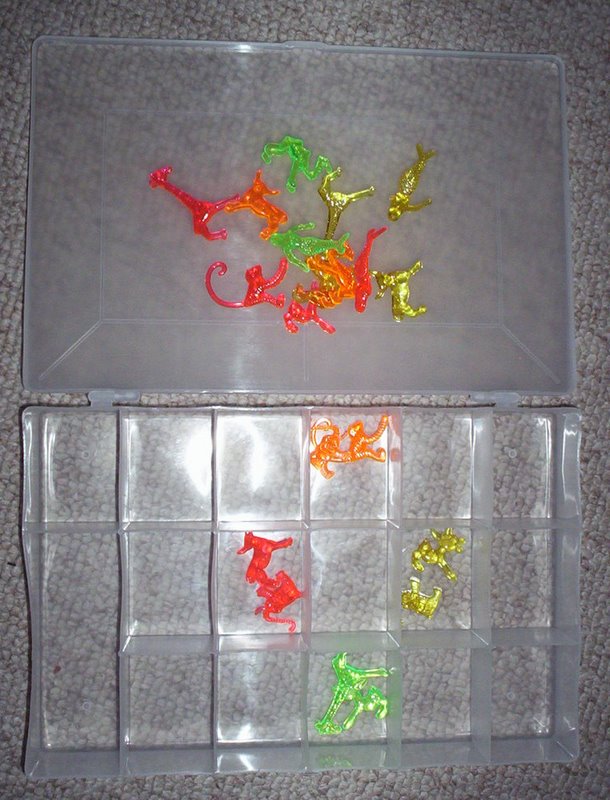
  • Children sort the animals into the craft container according to their chosen attribute (type of animal, colour, number of legs, zoo or farm etc.)

CATEGORY/SUBJECT AREA:

  • Mathematics

CONCEPT/SKILL:

  • Sorting, classifying, identifying attributes

EQUIPMENT & MATERIALS:

  • plastic animals (these are called cocktail animals and came from the party section of a discount variety store.)
  • segmented container or collection of small containers to sort animals into.
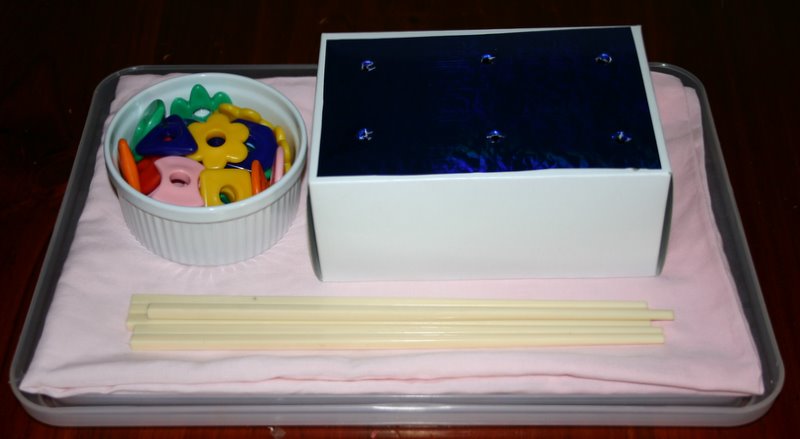
DESCRIPTION:

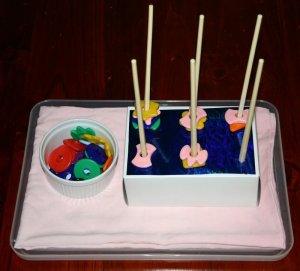
  • Children place the chopsticks into the holes before sorting the beads onto each chopstick according to their chosen attribute. (This is a commercial set of attribute beads and can be sorted by several different attributes.)

CATEGORY/SUBJECT AREA:

  • Mathematics

CONCEPT/SKILL:

  • Sorting, classifying, identifying attributes

EQUIPMENT & MATERIALS:

  • attribute beads
  • 6 chopsticks
  • cardboard box with contacted top for strength and holes for chopsticks

Please see my pages titled “Workjobs and Learning Styles” and “Brief Montessori Overview” for more general information on Montessori and workjob activities.

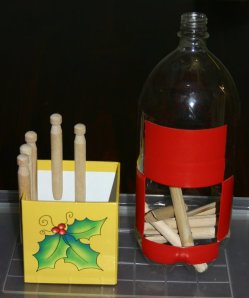
Make your own baby and toddler toys: posting bottles

Babies and toddlers just love to put things inside small spaces and empty containers out. It is great fine motor practise and they will often concentrate for amazing lengths of time if the challenge level is just right. If a child is frustrated by their inability to do the task, simply change the activity for now and re-introduce it a little later. It should have an element of difficulty, but not so difficult that they cannot be successful. This is a great activity for highchair time, playpen timemat time or table time.

DESCRIPTION:

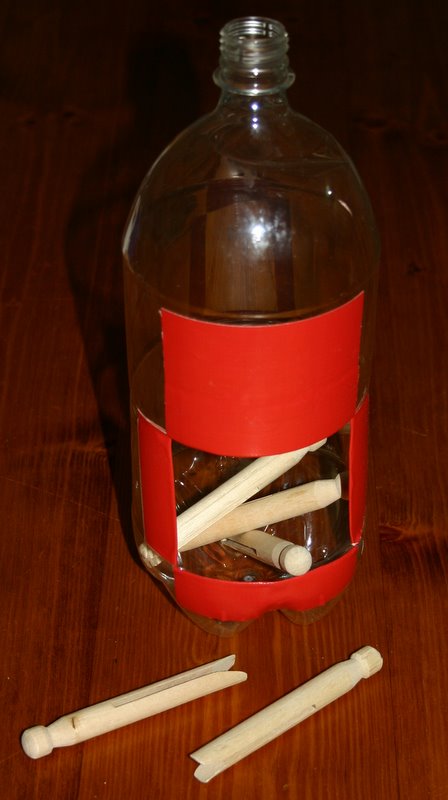
  • The child posts the dolly pegs into the lid of the bottle and pulls them back out the bottom.

CONCEPT/SKILL:

  • Fine motor development

EQUIPMENT & MATERIALS:

  • Large plastic bottle with hole cut into the front. (Tape hole to cover sharp edges)
  • Dolly pegs or any other suitable object to post into the top of the bottle (regular pegs, wooden peg halves, popsticks etc.)

In this example the solid bottle adds a different dimension and the pegs are shaken out once posted.

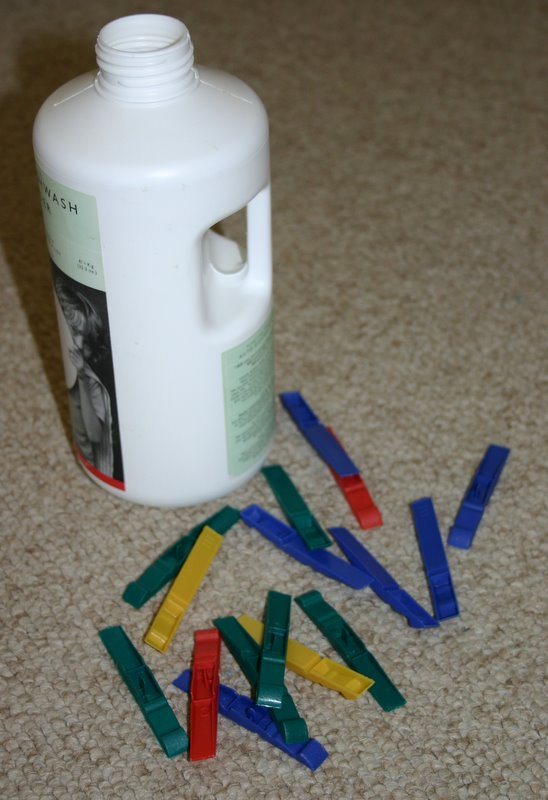
The posting bottle can be combined with other skills. Sliding the dolly pegs on and off the edge of a sturdy cardboard box is a complete activity in itself. My children usually enjoyed taking the pegs off the box but did not choose to put them back on again. When they were finished with the activity we slid them back on to the box together as part of the packing up process and they happily practised this skill.

Please see my articles titled “Workjobs and Learning Styles” and “Brief Montessori Overview” for more information.

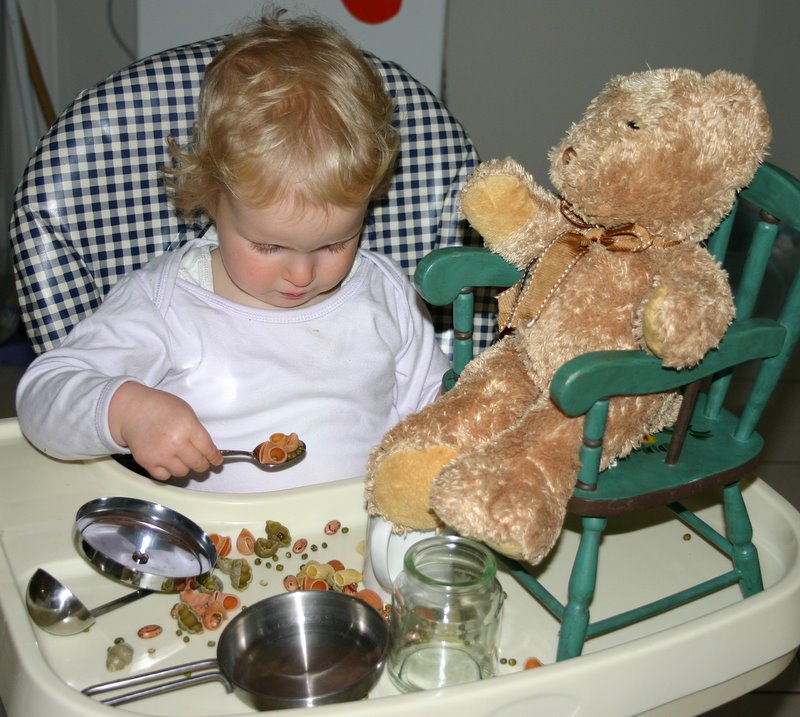
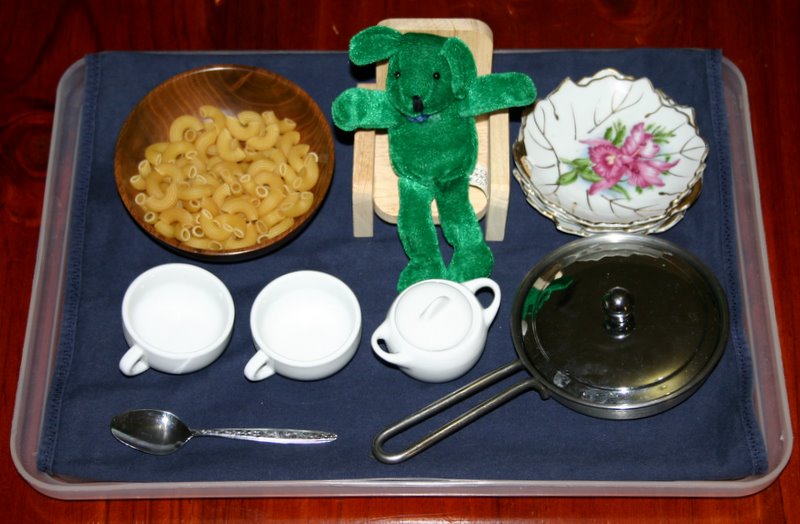
Make your own toddler toys: teddy food play


Teddies, cooking equipment and food are such an easy activity to put together for toddlers. Little boys and girls love to pretend cook and feed their willing teddy companions. I use this kind of activity for highchair time, mat timeplaypen time or as a table activity and it’s open-ended nature lends itself to long periods of concentration.

It is easily updated and kept fresh by simply adding some different containers, cooking equipment, food or teddy. It can be a “new” activity every week without much work on your behalf.

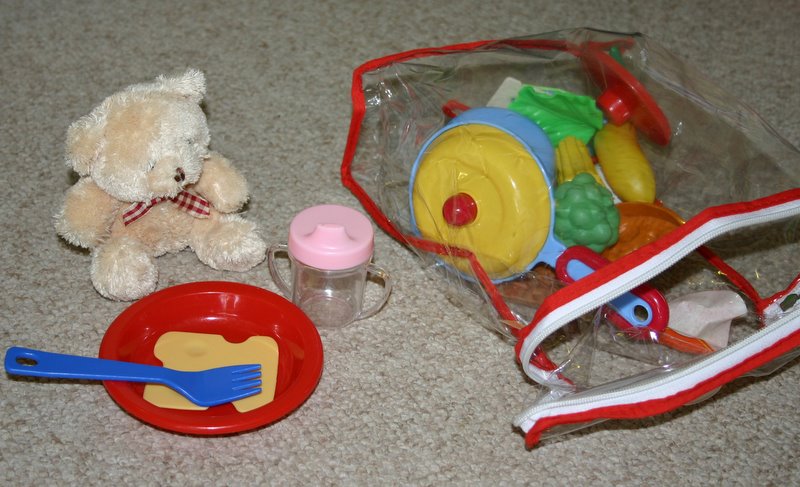
Simply look around the house, gather up some interesting containers, plates, cups, cutlery and the like, some kind of “food”, a teddy and you are set. Keep in mind the age of the child and choking hazards. Beans, pasta and jewels are best used under supervision or not at all if a child is very tempted to stick them in ears, noses and mouths or anywhere else they shouldn’t be!

Sometimes I use doll-house sized teddies and doll-house furniture so the teddies can eat at the table, go to sleep in a little bed afterwards and even sit on the couch to relax. I have used plastic food, felt food, wooden food, dry pasta and beans, jewels and rocks and even pictures of food glued onto card from junk mail.

As soon as your little one has begun use their imagination (pretend play) you can introduce this activity. For the very little children, you might even sit and play with it with them first, teaching by your example what to do with each item. Children with older siblings have had this modelled extensively, but a first child will not always know how to play unless you show them. They will of course work it out for themselves, but if you want a young child to use this kind of activity enthusiastically for an extended time, some modelling will go a long way to extending their play.


Recipes and food: Snacks – juice pops

Showing off their banana milkshake juice pop moustaches. (We call them juice pops regardless of the ingredients!)

Now that the warm weather is here again, it’s time to dust of the frozen popsicle molds and make some juice pops. These are so quick and easy to make (I can even ask the older children to do them for me) and keep almost indefinitely, so there is always a snack sitting in the freezer ready to go. I like the fact that they are not too filling as some of my smaller eaters don’t need much of a snack before their appetite for the following meal is affected. Also, if I make the ones without sugar syrup in them, they are a healthy snack that even the toddlers love.

I should have put a bib on!

What do you need:

  • A mold (shop bought popsicle molds, plastic cups and popsticks, plastic cups and teaspoons, or scooped out orange halves and popsticks.)

Ingredients:

  • juice of any kind with fresh fruit chunks
  • pureed banana and coconut milk
  • milkshake mixture
  • pureed rockmelon, sugar syrup and a twist of lime
  • left-over softdrink
  • pureed berries or fruit and sugar syrup

Simply puree your ingredients, fill the mold (adding fruit chunks to the bottom first if desired) and freeze. Adding sugar syrup to the juice pops helps prevent ice crystals forming, however I usually don’t include it to keep the children’s sugar intake down and they love them anyway!

Sugar syrup:

  • 1/2 cup sugar
  • 1/2 cup water
  • 2 strips of lemon zest

Heat the ingredients together until the sugar has dissolved. Remove zest and add to puree of choice before pouring into molds.

5 Category Sorting: A Montessori style tray activity

(For a detailed introduction on how to introduce sorting to toddlers, it may be helpful to read this post first.)

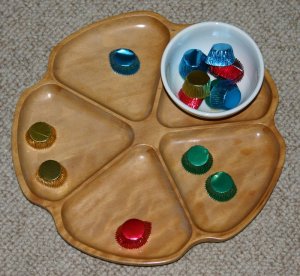
4 colour metal patty-pan sorting.

After my toddlers have been introduced to sorting and have extended their skills to independently identifying 4 or 5 attributes or more, I continue to swap the materials that they sort, but keep the base tray or sorting containers the same. This means that I can change the material and present a “new” tray activity with little or no explanation. The children are immediately familiar with the type of activity and therefore already know what to do.

This is important for when I am teaching older children at the same time as a toddler is working on their Montessori style activities so that I am not constantly interupted. It also means that I am not having to demonstrate or “teach” every single new tray activity – once the format is familiar, I can change materials and off they go.

I set up each term’s worth of tray activities with chosen categories (transferring, sorting, matching, counting, pouring etc.) and simply update the materials as necessary without having to re-introduce each activity.

This wooden tray lends itself well to 4 or 5 attribute sorting and by simply changing the materials I can easily update it throughout a term with very little effort. I also add a pair of tongs, tweezers, scoop or spoon to incorporate fine motor skills and turn it into a transferring activity at the same time, which adds an extra level of challenge to the activity.

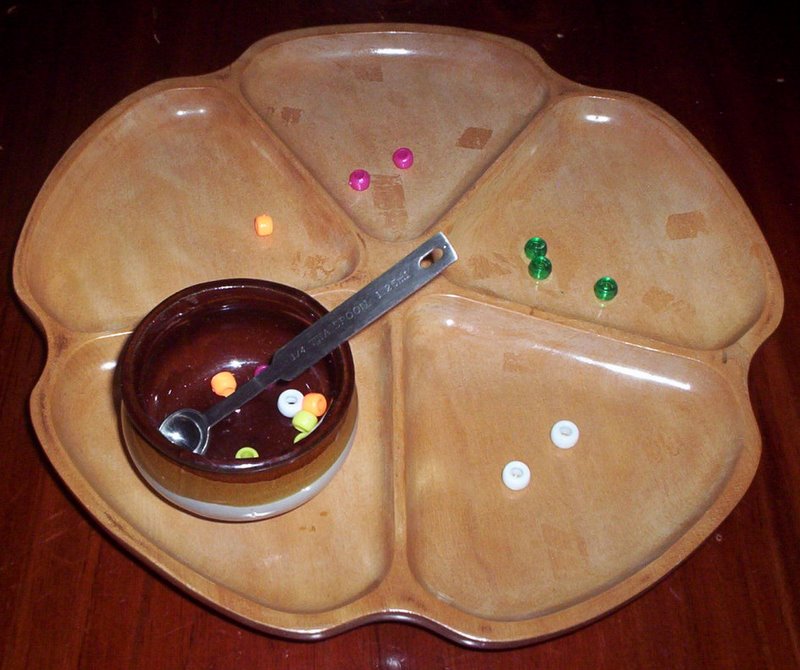
5 colour pony bead sorting. (The bowl needs to be moved off to the side to provide room for the 5th colour.)

5 colour jewel sorting. Most of these objects pose a choking hazard so take care with young children who still like to put things in their mouths. Jewels are so tempting for toddlers to suck on.

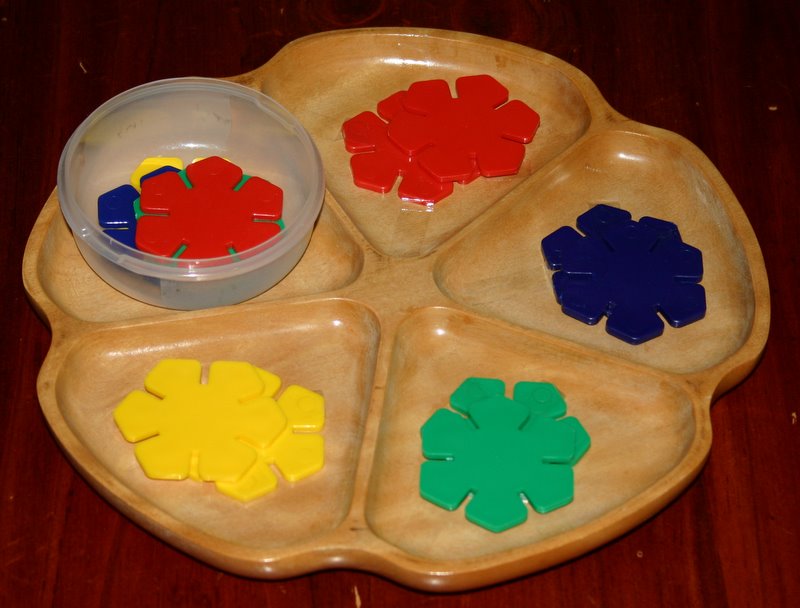
4 colour plastic flower sort.

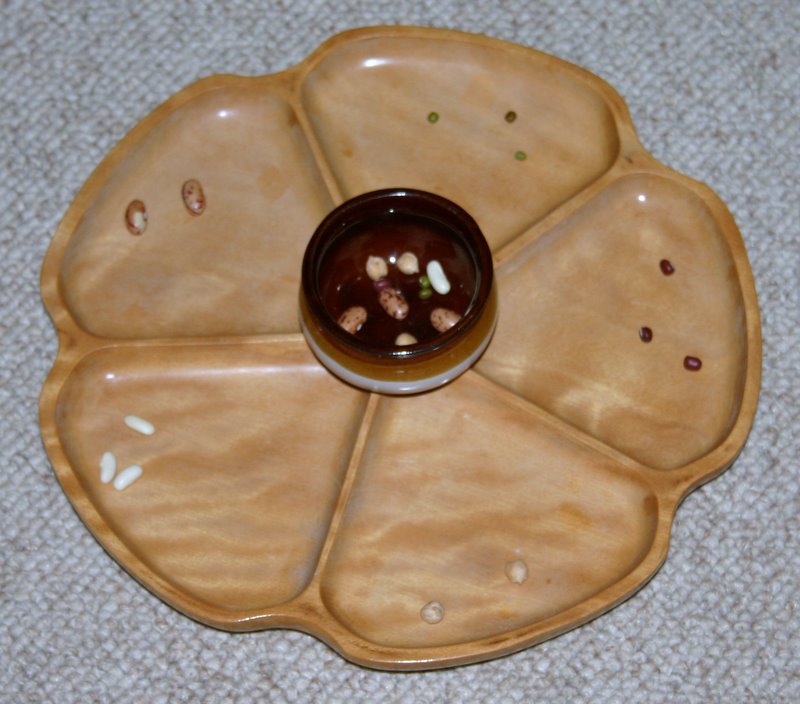
5 types of dried beans.

5 kinds of buttons.

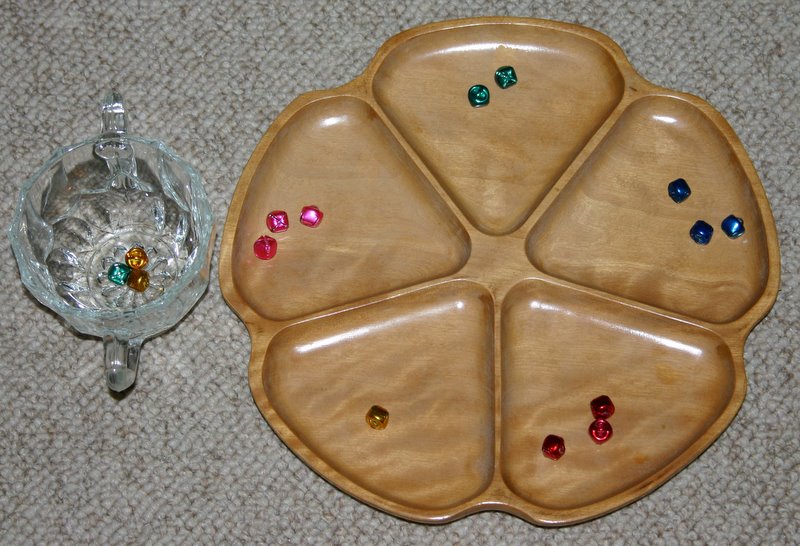
5 colours of Christmas craft bells.

5 kinds of pasta and dried beans.

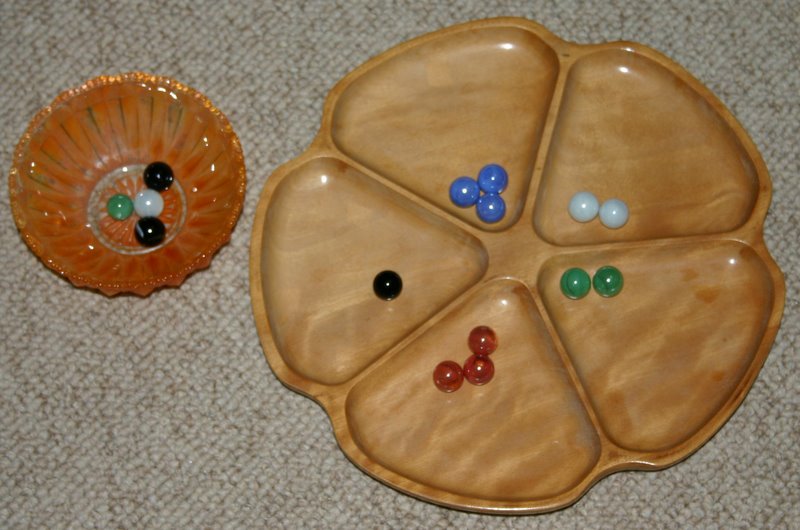
5 coloured marble sort.

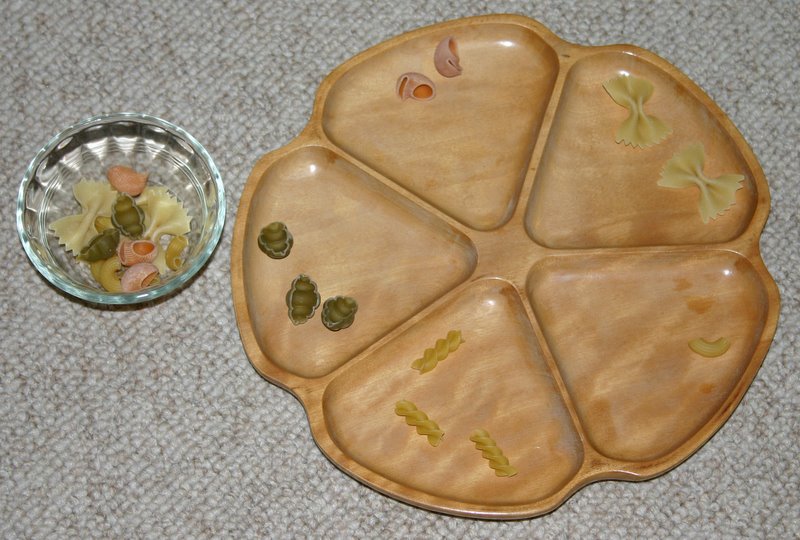
5 kinds of pasta.

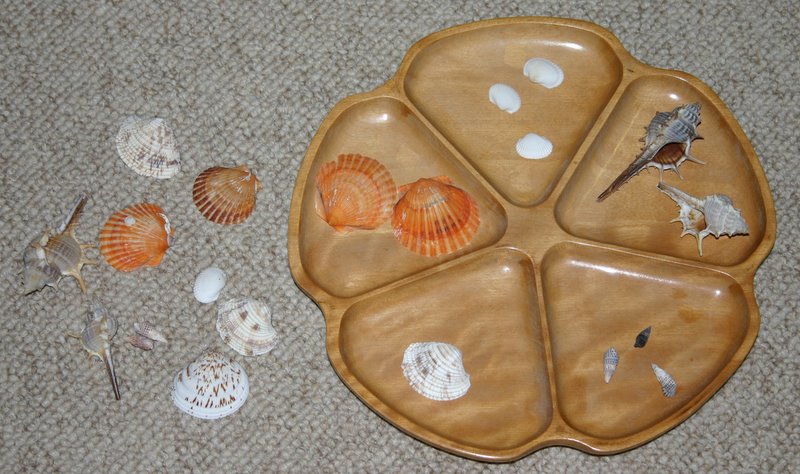
5 kinds of shells.

5 kinds of farm animals.


An introduction to Sorting: A Montessori Style Tray Activity

Two colour bead sort with attribute or category already given. The first exposure to sorting for my toddlers.

Sorting is an important foundational skill requiring reasoning, logic and mathematical thinking. It enables children to be able to look at a group of objects and identify similarities and differences and to make logical decisions as to how to categorise the objects. Sorting skills will transfer into other academic subjects such as science and mathematics later in life.

Sorting frequently covers other basic skills such as colour recognition and counting and if combined with some kind of transfer tool such as tongs, spoons, tweezers or scoops, will develop fine motor skills at the same time.

I usually tape a peg to the top of each container to designate the attribute category until the child is able to determine a category independently.

I present sorting to my toddlers with only 2 categories to begin with, in the form of a Montessori style tray activity. In other words, only 2 attributes are present. These attributes could be the colour of the object, the shape, size, length or thickness etc. but whatever it is, there are only 2 possible ways to sort them. I also tape or glue one of each kind of object to the sorting container so it is essentially a matching activity as well as sorting for their first experience.

Once they are able to look at the objects (in this case beads) and identify the similarities (all beads of the same size and shape) and differences (colour) they are ready to sort according to the attribute they have identified without a pre-determined category to guide them.

We talk about the objects; what they are, what colour, size, shape etc and focus on what is the same and different about them. I then sort the first few objects (talking about their attributes) while the child watches and ask them to see if they can tell why I am separating them as I am. If they are able to tell me, I ask them to see if they can sort the rest or simply explain why I have sorted as I did and demonstrate further before asking them to have a go.

Once they are able to sort by the two attributes with a category already given (one of each object taped to the container) I present two attribute sorting again without the categories already chosen and help the child to identify the two attributes themselves and sort accordingly.

An example of 3 category/attribute sorting. Generally colour is an easy way for toddlers to sort as a beginning skill. More abstract attributes can be introduced later.

After they have mastered sorting 2 attributes with a variety of objects, I extend the possible attributes or categories to 3, 4, 5 or more attributes, until they are able to sort any objects set before them and justify their reasoning.

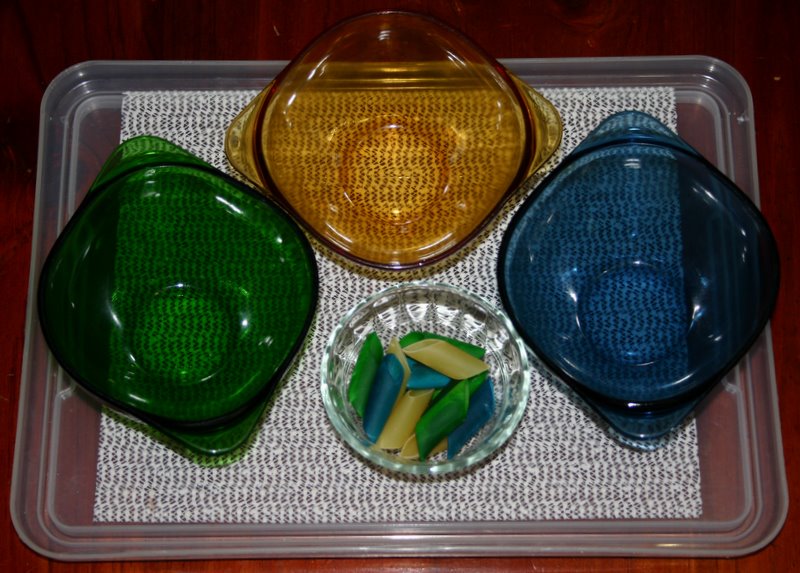
In this example the coloured bowls determine the category or attribute so it doubles as a matching activity also.

Make your own toddler toys: Jar of spoons

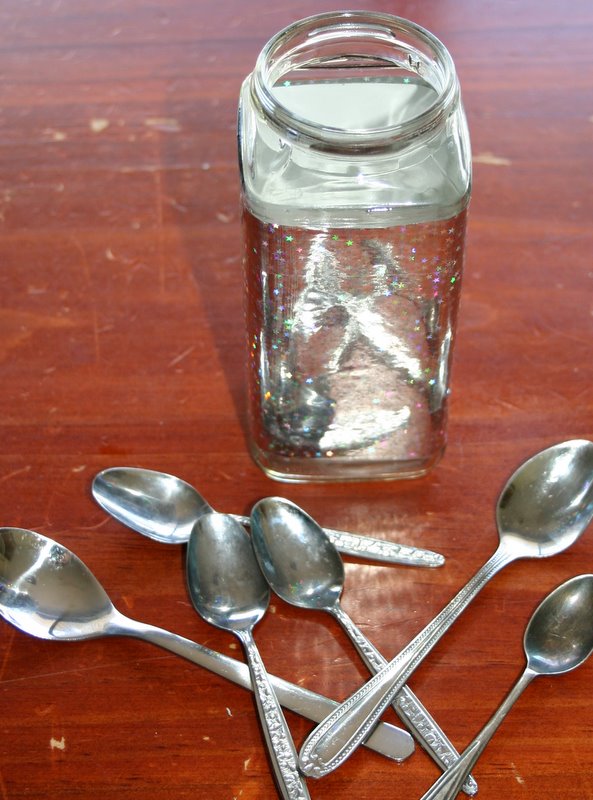
I love this kind of activity. It takes approximately 30 seconds to put together and older babies and toddlers love it! Obviously being glass, care must be taken so that it will not drop onto a hard surface. I use my jar for highchair time, in the playpen or for mat time as these all occur over carpeted floors. You may prefer to replace the glass with something metal but make sure it makes a great sound as that is part of the attraction.

DESCRIPTION:

  • The child drops the spoons into the jar which makes a satisfying jangle and tips them back out again. That’s it!

CATEGORY/SUBJECT AREA:

  • Baby and toddler toys – beginning posting

CONCEPT/SKILL:

  • Fine motor development
  • Concentration

EQUIPMENT & MATERIALS:

  • 1 jar
  • a bunch of small spoons

Routines: Highchair time activities for babies

After the post about highchair time yesterday, I thought it would be timely to follow-up with some suggestions as to what to give an older baby or toddler in a highchair to hold their attention and promote the concentration and patience we are working on.

I like to think of toy types in phases of development:

1 to 12 month old babies love toys that are good to mouth and sensory based toys that make sounds, feel interesting and look visually stimulating. Obviously within this age range there is a big difference in the kind of baby toy they are interested in, but in essence they are all “baby” toys for holding, touching, pulling, sucking, crinkling etc.

12 to 20 months olds enter the transition zone. Over the next few months the baby toys begin to lose their appeal and imaginative play has not yet kicked it properly. This means that the shiny red car is looked at, possibly mouthed for a minute or two, shaken, the wheels are spun around a couple of times, possibly pushed along and interest is gone. It doesn’t DO anything exciting and the child does not yet identify it as a small version of a car and drive it around making car noises because the pretend play element is not there yet. What they do like are toys that respond to their actions – that DO something. Pull a lever and an animal pops out, pop a ball in and music plays, tap the pegs and the turtle’s head pops out. This is the hardest age to supply toys for, because interest dies very quickly and those bright, colourful and interactive toys are expensive. You can join a toy library, swap with friends or make your own. (Lots of ideas coming soon.)

20 to 24 month olds and up are beginning to use their imagination, especially if they have siblings or a willing parent to show them how to play. They will begin to have tea parties, feed a teddy, set up the train tracks and create their own pretend play situations. The possibilities open up enormously and this age is so much easier to cater for.

In general, there are some great baby and toddler toys that can be purchased, however interest in most is short-lived as the child moves on to the next developmental level or simply has seen it enough to no longer be attracted to it.

Why not capitalise on the toddler’s natural attraction to learning new skills, copying Mum and Dad and using “real” things around the house to put together your own activities. They are cheap to make and can be disassembled once interest has passed. Important practical life skills can be introduced that will be used every day, many of them developing fine motor skills that will be vital for pencil grip and general hand control later on.

Here is my list of activities to make for babies with instructions for each. Practical life and general toddler activities will be posted individually from time to time and categorized under workjobs and Montessori activities so keep an eye out for them.