Montessori multiplication trays: Hands-on mathematics

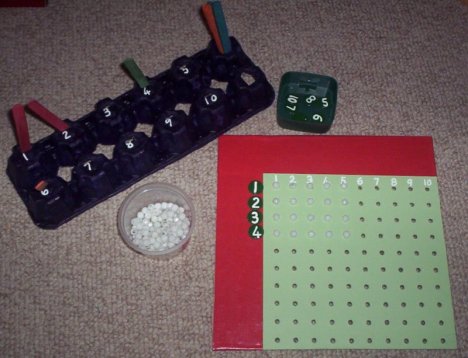
multiplication board

Wooden peg-board (the kind you use to hang tools from in the garage) is a cheap and simple alternative to purchasing a multiplication board.

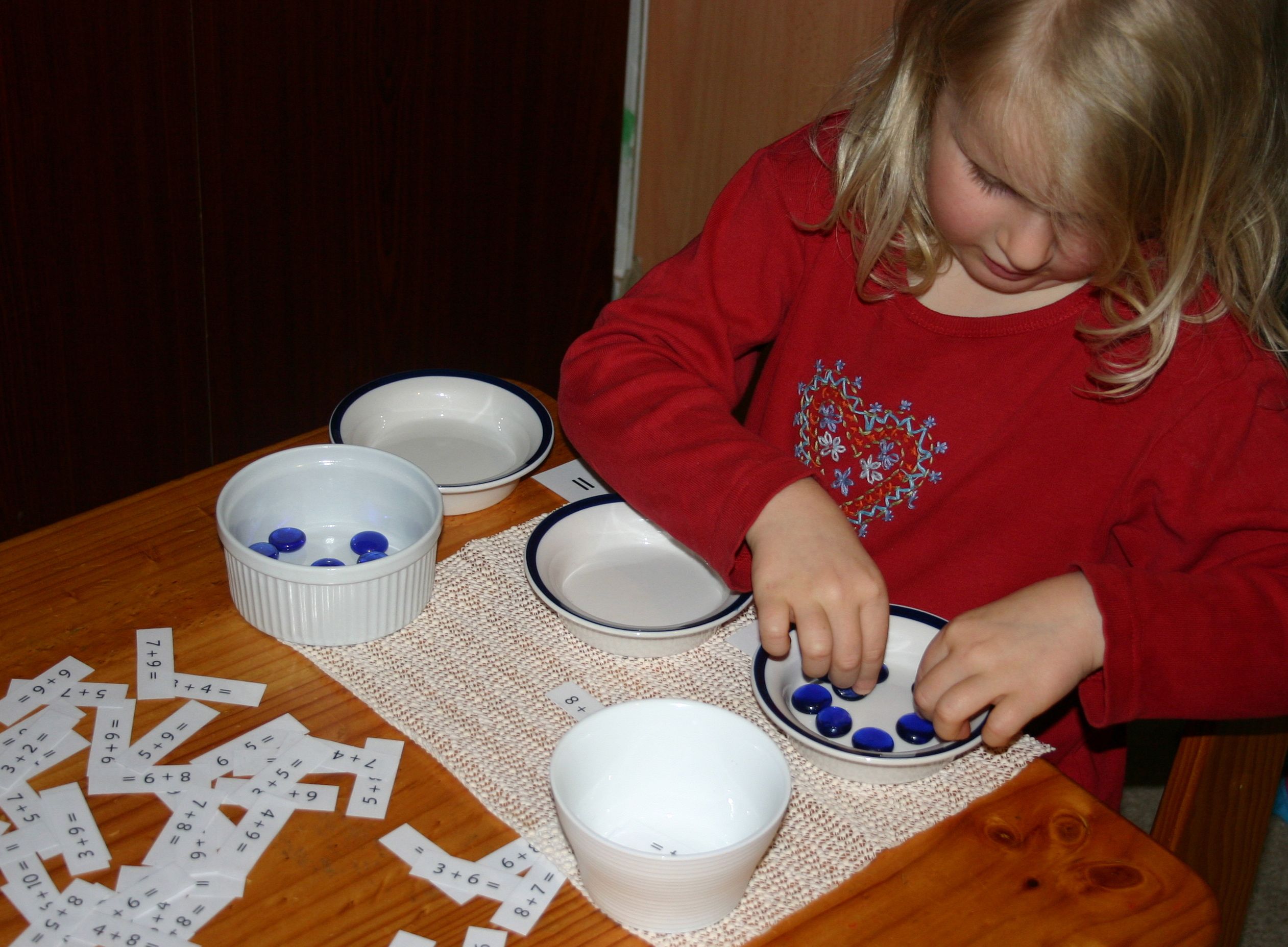
Continuing on with my mathematics tray ideas this week (introduction and addition trays here, subtraction trays here), here are some multiplication ideas for learning times tables. We made our own homemade Montessori multiplication board using pegboard wood for a cheap alternative. For another easier method using a rubber bath mat, see this post. While the Montessori multiplication boards are an excellent idea, my children found it quite tedious placing the beads into each little hole every time, preferring to use the blocks from our Math-U-See sets, MAB’s or other manipulatives instead.

Whichever way you choose to present multiplication, make it visual, tactile and concrete to begin with, before moving to abstract concepts. The following tray ideas are for children who already understand the concept of multiplication and simply need some more practise of their basic facts (their times tables) in order to commit them to memory.

times table popstick start finish game

Threading beads onto pipe cleaners (bend the ends to keep the beads from slipping off) is a home-made alternative to the Montessori bead materials. They become the manipulatives, with the multiplication problems written on popsicle sticks. The popsticks are laid out, making sure that the word “start” and all the answer sides are upright. The child turns over the “start” stick and uses the bead strings to solve the problem on the other side. They find the answer to that problem on the next stick and turn it over to reveal a new sum on the other side and continue on in the same way until they reach the “finish” stick. If at any time they turn over the finish stick before they have completed all the other sticks, it indicates they have made an error along the way.
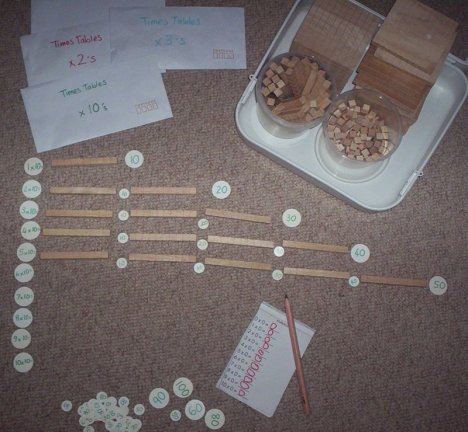
mab multiplication

Wooden MAB’s (multi-based arithmetic blocks) are the “old fashioned” mathematics manipulative that I grew up with. They can be used in place of bead chains for many math concepts. Here they are set out for learning the 10 times table (multiplying by 10’s.) The sum is on the left and the small circles show a running total, with the large circle answer at the end of the chain. A small pad is included for recording the answers.
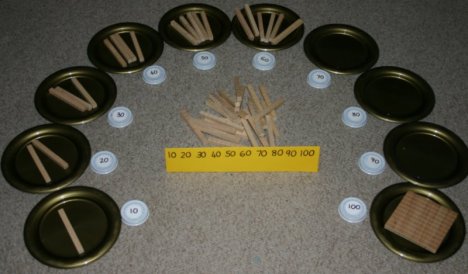
count by 10s MABs

These plates are actually set up for skip counting in the photograph, however with the addition of some multiplication problems, lend themselves very well to practising times tables.
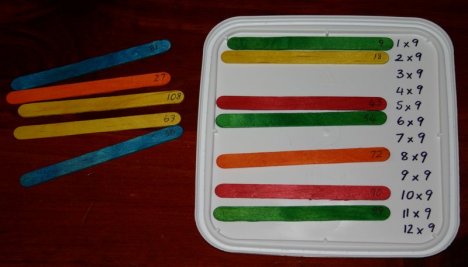
icecream lid popstick 9 times table

Popsicle sticks with answers are matched to multiplication problems on an icecream container lid.
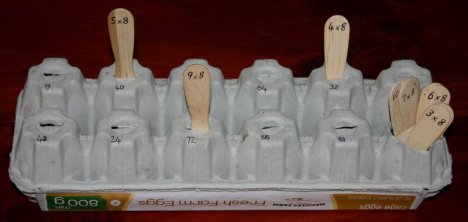
egg carton 8 times table

Popsicle sticks with the problem are slid into slots with matching answers on the egg carton.
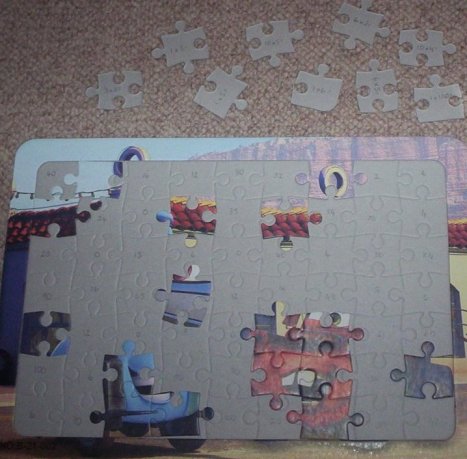
multiplication times table puzzle

A cheap (yet difficult) puzzle was a fun way to practise. Answers are written on the back board to match the puzzle piece with the corresponding problem. The puzzle must be difficult enough that the child cannot easily cheat by just following the picture, rather than working out the sums. (Not that any of your children would ever do that!!)
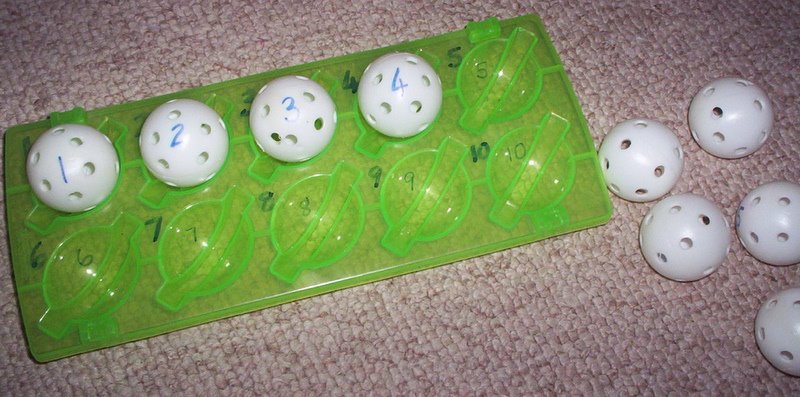
white ball to iceblock tray match 1 to 10

Plastic balls with problems are matched to the answers in an iceblock tray.
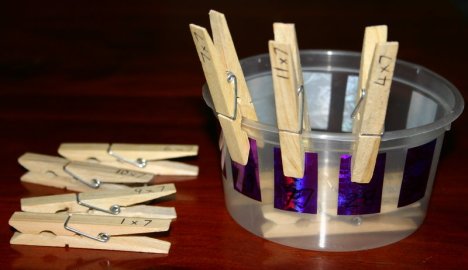
wood peg on cont 7 table

Pegs with problems are pegged on to the answer segment on the container, which doubles as a storage place.
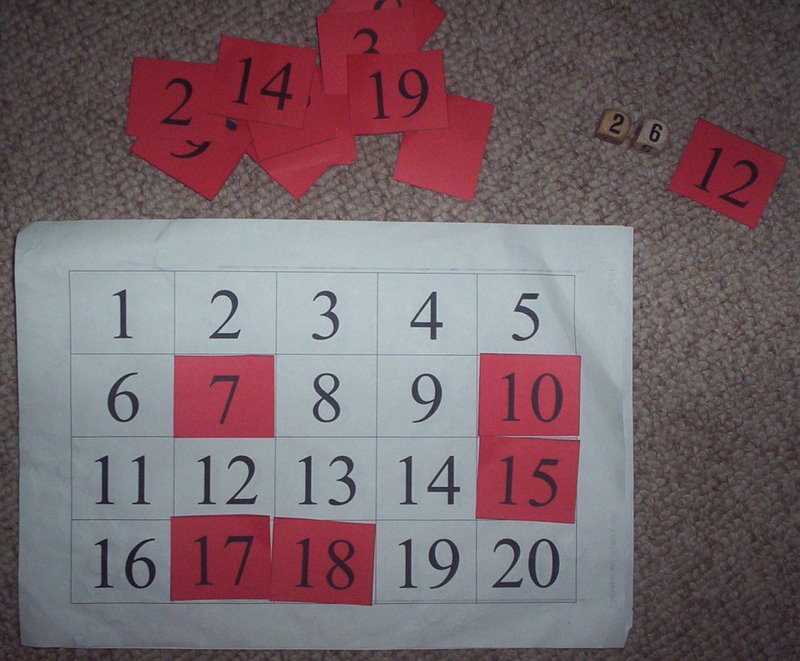
mixed operation bingo

Dice are thrown (you need 3) to create any combination of addition, subtraction or multiplication problem and the answer is covered on the board. The idea is to continue until all answer squares have been covered. This is for children who already have a fairly good mastery of their basic number facts and tables.
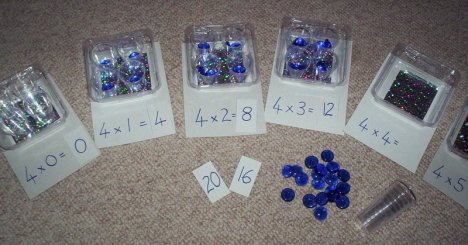
4 times table multipication jewel cont

Each square container holds 4 little plastic shot glasses for practising the 4 times table. Jewels are counted into each glass and totalled to find the answers.
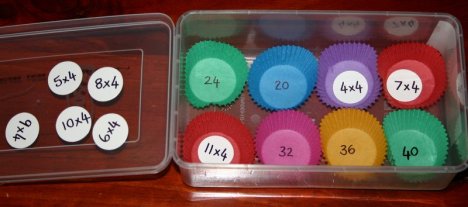
pattipan in box 4 times tables

A plastic lunchbox filled with pattipan answers to match problems on circle.
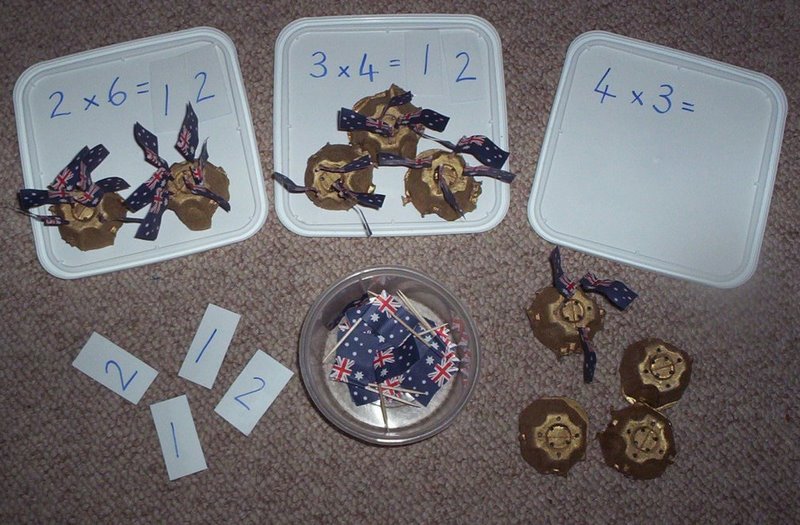
castle flag multiplication

The correct number of flags are inserted into the castles, with the castles showing how many groups.
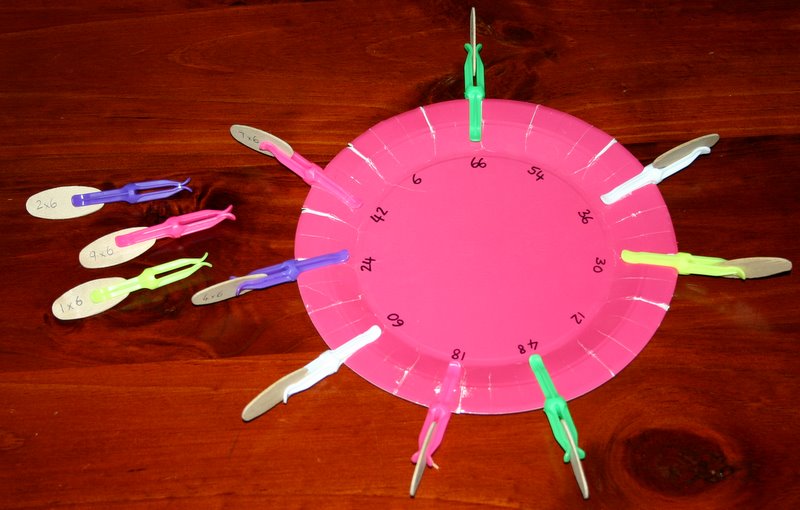
pink plate plastic pegs 6 times

Pegs are slid on to the matching answers on the paper plates. A manipulative is needed for working out the problems unless the child is able to complete them mentally.
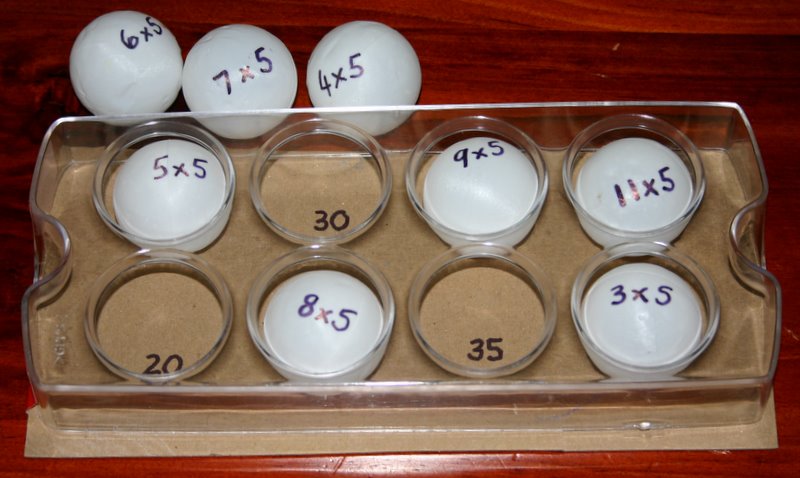
ping pong ball egg tray 5 times table

Ping pong ball problems are matched to the answers in an egg holder from the fridge.

Montessori subtraction trays: Hands-on mathematics

subtraction tray IMG_8368

These Montessori style hand-on subtraction activity ideas are great for preschoolers and young children who need plenty of experience with concrete materials to consolidate basic mathematical skills. (See my last post for more info.)

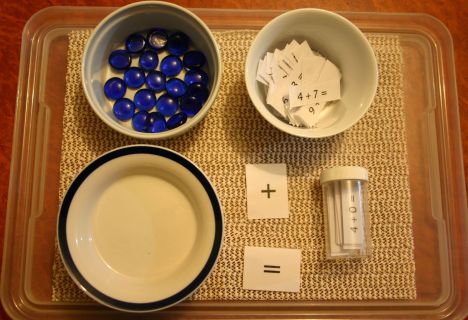
As with the addition trays, the subtraction facts that  the child has already memorised are added to the screw-top jar to provide a visual indicator of their progress.

Initially, the subtraction problems are split into sets; subtract 0, subtract 1, subtract 2 and so on and only 1 set is out at a time.  Once they know the sets fairly well individually, we combine the lot, taking out the ones they have mastered and working on what is left. As with addition, learning to take away 0, 1, 2, and 10  is very easy, so starting with these gives the child a boost of confidence as they quickly master the first sets, filling that jar almost immediately.

sub tray set out IMG_8371

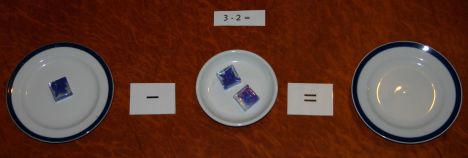
The subtraction materials are set out as above. The first and last plate are deliberately different from the second to provide a visual reminder of the relationship between the two. Subtraction must be done in order (numbers are not interchangeable as they are for addition and multiplication problems) so the child first counts out the number of objects they are starting with into the first plate. The smaller plate shows what has been taken away (removed, subtracted etc.) and what is left on the first plate is scooped over to the final plate, providing the answer.

When the novelty of the plate tray wears off, I present the subtraction problems the child has not mastered in different formats to provide extra practise and revive interest in the activity.

icecream cont sub pegging

Subtraction problems on pegs are pegged onto the side of the container with the correct answer. The counters are the manipulative. Provide more than one container or a multi-sided container if you want a broader scope of answers.

Cinderella's slipper subtraction

These subtraction cards are a set from Kmart that we were given. A dry erase marker can be used to mark the answers on the cards. The “glass” slippers are wedding favours. My girls love this activity just because they get to handle the tiny shoes! An attractive material will draw them in every time. Add an interesting story to the tray (How many spare slippers Cinderella keeps in her closet?) and you will have them begging to have a go.

bead string subtraction

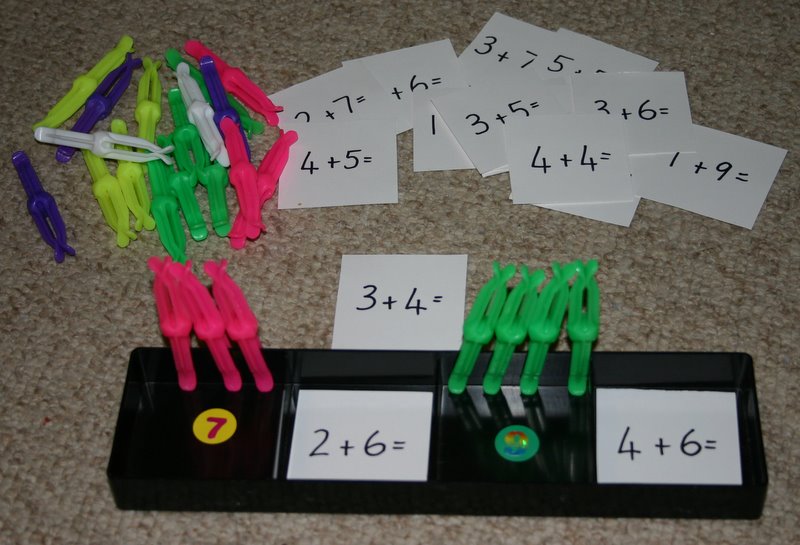
The same subtraction card set paired with any manipulative of your choice gives you a fresh “new” activity. This time the children were doing the problems in their heads and finding the correct bead string for the answers – good for those who find writing a chore. There is exactly the right number of bead strings so if the strings do not match the last cards this alerts the child to an error that they can find and address.

It doesn’t take too much extra time or effort to keep learning engaging and enjoyable. Have a look around your house or check out your local discount variety store for a couple of different kinds of manipulatives and you are on your way.

Posts you may find useful:

List of useful materials to collect and buy for hands-on tray activities  

Building focussing and concentrating skills in toddlers

Workboxes – homeschooling multiple ages

Surviving new babies, sick kids and interruptions 

Montessori addition trays: hands-on mathematics

add tray C using IMG_8374A strong foundation in basic mathematical skills will set children up for later success. Too many children learn how to complete math problems by following a formula or method that they simply do not understand. They pass the tests, but when the difficulty of the problems increases, or they are presented in a different format than the one they are used to, the child flounders.

Teaching children using concrete materials (items that can be seen and handled) before moving to abstract concepts (problems worked out on paper) is absolutely vital to make sure they understand the connection between the methods they are using and how and why they work.

The Montessori method for mathematics is brilliant, especially for young children. It is very systematic and progresses from skill to skill in small steps, with each stage building on the one before to ensure understanding and mastery is gained before moving to the next step in the ladder. Concepts that are not covered in your standard state school math book are intentionally introduced and explained in a way that can easily be grasped by even very young children.

Many children seem to simply absorb these small skills along the way, almost accidentally, but the children who struggle with maths are usually the ones who never intuitively grasped the shortcuts, mental methods and other little tricks and understandings that their more successful peers just seemed to somehow “get” without direct instruction.

One of the foundational skills that later math problems build on is adding, subtracting, multiplying and dividing small numbers. Many children will make mistakes when solving a more advanced problem, simply because they make a basic error with one of these simple calculations. Spending time in the early years ensuring that children master their basic maths facts is a must for success and speed later on.

Here is a Montessori addition tray and some other Montessori inspired ideas for teaching young children to add small numbers, mastering their addition facts as they complete them.adding tray jewels IMG_8361This is how our addition tray looks on the shelf. Only one child at a time is using it, so it is set up in such a way as to mark their individual progress. Every week or so I “test” their mastery of the addition facts and those problems that they are able to solve mentally (without thinking time) are placed into the screw-top container. They are pulled out for occasional review, but no longer need daily practise. This provides some intrinsic motivation as they see the pile in the dish growing smaller and smaller and the container getting fuller and fuller. They love it when we exclaim over how many they know now.
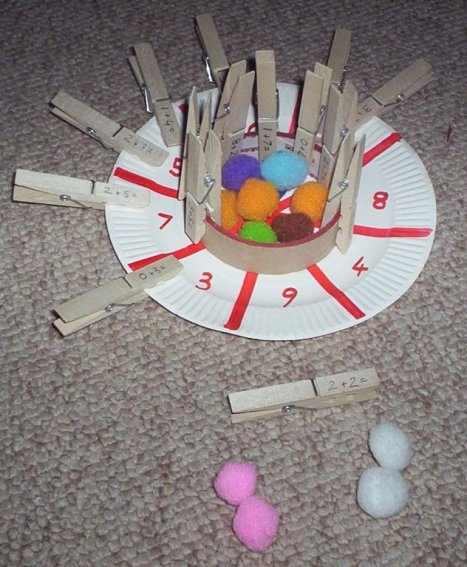
Initially, I split the facts into sets; plus 1, plus 2, plus 3  and so on and only have 1 set out at a time.  Once they know the sets fairly well individually, we combine the lot, taking out the ones they have mastered and working on what is left. Obviously, learning all the plus 0, plus, 1 plus 2 and plus 10 facts is very easy, so starting with these gives the child a boost of confidence as they quickly plow through the first sets, filling that jar almost immediately.

adding tray set out IMG_8362The activity is set out in the child’s workspace like this. The correct number of jewels are counted into the first and second dish, before both sets are scooped together into the final dish for them to find the answer by counting. It provides a very clear visual display of what happens when you add two numbers together.

Because some children will take a long time to recall all of the addition facts, I give them lots of different kinds of materials to count and present the problems in different ways. Here are some of the Montessori inspired, hands-on workjobs  that I have used with both my own children as we homeschool and in a classroom situation when I was a teacher.

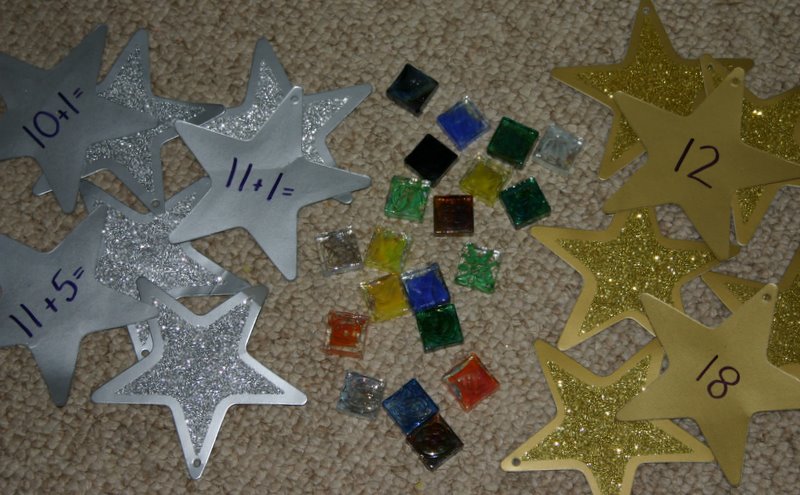
peg & pompom paper plate addition to 10These pegs are labelled with the addition facts and the pompoms serve as the counting material. Once the child has found the answer, the peg is clipped onto the correct segment of the paper plate. It is self-checking as there is only one peg for each segment – any double-ups means that they need to redo those pegs to discover the correct answer. The holder for the pegs is the centre from a used roll of masking tape.cutlery noodle additionThis was a favourite with my children. As always, making up a funny story to go with the activity turned it into something really fun. Those greedy restaurant patrons were at it again and the children had to figure out who’s cutlery was whose and put it into the correct cup. Only one knife, spoon and fork should be in each cup, so again, any double-up means that the child needs to redo the problem. The noodles serve as the counting material.sticker addition red sort trayThis activity is very quick to make. The sticker cards are the manipulatives with problems written onto card strips. Once solved, each strip is placed into the segmented dip tray in top of it’s answer. peg addition black 4 hole trayNumber stickers on the base of the 4 segment tray determine where each problem card is placed. The pegs are slipped onto the sides to count and solve the problem.gold & silver start additionThe silver stars have the problem and the gold stars hold the answers. The child counts the jewels to solve the addition sum and matches the silver star to it’s mate.
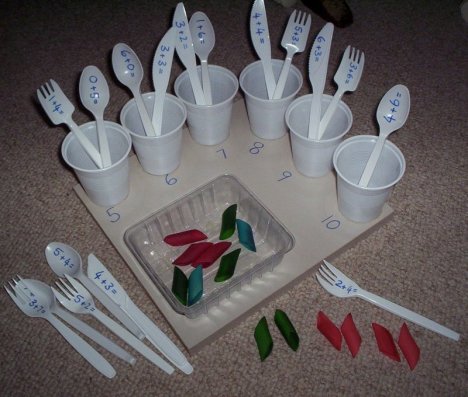
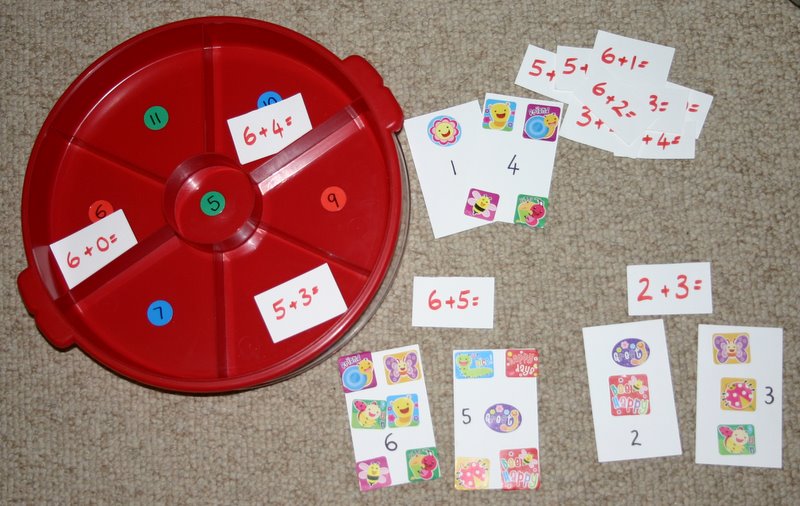
Presenting attractive materials and a variety of experiences will make learning these basic skills enjoyable for your child and set them up for success in the future.

Other posts you may find useful:

Montessori tray activities for toddlers

Montessori counting trays 1 to 5

Homeschooling with toddlers and preschoolers

Teaching children to read – where to begin?


Arsenic hour and toddler meltdowns

IMG_8182

Arsenic hour is that late afternoon time period where the short people in the household tend to have their meltdowns. Slightly hungry in the lead-up to dinner, tired from a day full of stimulation and unable to display the self-control necessary for “keeping it together” until dinner is served, young children (especially toddlers) tend to struggle during this time and easily tip over the edge. So how can we, as Mothers of young ones, structure our day to minimise the conflict and stress that is often experienced during arsenic hour?

Start by looking at your overall day. Who is in charge? You or your child? Who is making all the choices? Evaluate your overall day in light of this and see if some or much of the conflict is simply caused by you trying to get a reluctant toddler to do something they do not want to do after making their own decisions for the majority of the day. (See “choices” for a fuller explanation.)

Look at your routine. Do you have a flexible structure to the day with a good flow of events? It should include a mixture of time with Mum, time with siblings and time alone, physical activity, quiet time, structured play times etc. (See “routines” for ideas of what to include throughout your day.)

What time are you serving dinner? Are you expecting your young child to wait until Dad comes home in the late evening and trying to feed them when what they really need is to be getting into bed? Family meal times are a priority for us and very important, but if you husband is home later than is practical, consider feeding your toddler early and bringing them back to the table when Dad arrives for finger foods, a snack or a healthy dessert so that they can participate with the family. The bonus with this is that all your mealtime/manners training can be done on-on-one with the toddler, leaving the family table free from conflict.

IMG_7663

Bathtime can be difficult if left until after dinner. There has been seasons when I have bathed all the younger children at around 4.30pm when they are still coping relatively well and are unlikely to get into conflict situations. I can then pop them at the table, in the highchair or on their mat, with a suitable activity to keep them usefully occupied on a worthwhile task while I am free to finish dinner prep and serve them their meals.

Do not test your obedience levels during this time. What do I mean by this? Do not give directions to your toddler and expect them to obey. Rather than say, “Junior, go and get into your highchair please,” simply walk over to Junior, take his hand and cheerfully state “It’s time for highchair activities” as you walk hand in hand with him to the chair, pick him up and pop him in. When it is time for Suzie’s bath, rather than say “Suzie, go and get your PJ’s and go to the bathroom”, you grab the PJ’s and walk little Suzie to the bathroom, undressing her and plopping her in the bath. Don’t forget to give a 5 minute warning before making these announcements.IMG_7743

Having a good routine throughout the day, coupled with these practical suggestions will help make this time as enjoyable as any other period in the day.

Other posts you may find helpful:

Getting dinner on the table

Activities to make for babies and young toddlers

Playdough for toddlers – no biscuit cutters please!

Dolls houses in a shoebox

G's shoebox dolls house IMG_8279

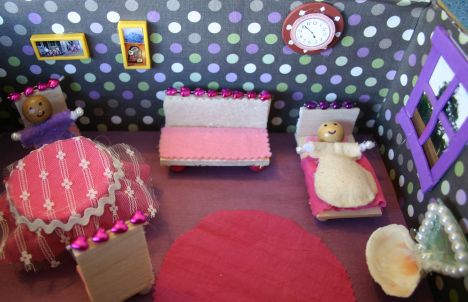
Dolls houses in a shoebox are a wonderful travel activity, take away toy for holidays, table activity, quiet time or room play idea or highchair activity for younger children. They are very portable,  simple to make (these examples were created by my 5 1/2 and 8-year-old daughters) and the possibilities for open-ended imaginative play are endless. We will be making them with a group of girls for our 8 year old’s birthday party next month and with a little bit of preparation, they will be an easy craft to engage a group of young ladies for a couple of hours.c's shoebox dolls house IMG_8272

I will be adding some miniature food (novelty erasers from a discount variety store) plus a couple of ceramic ornaments to use in their little houses and the girls will create the furniture, make wooden peg doll babies (instructions in my next post) and decorate their rooms.mini dolls house furniture IMG_8275

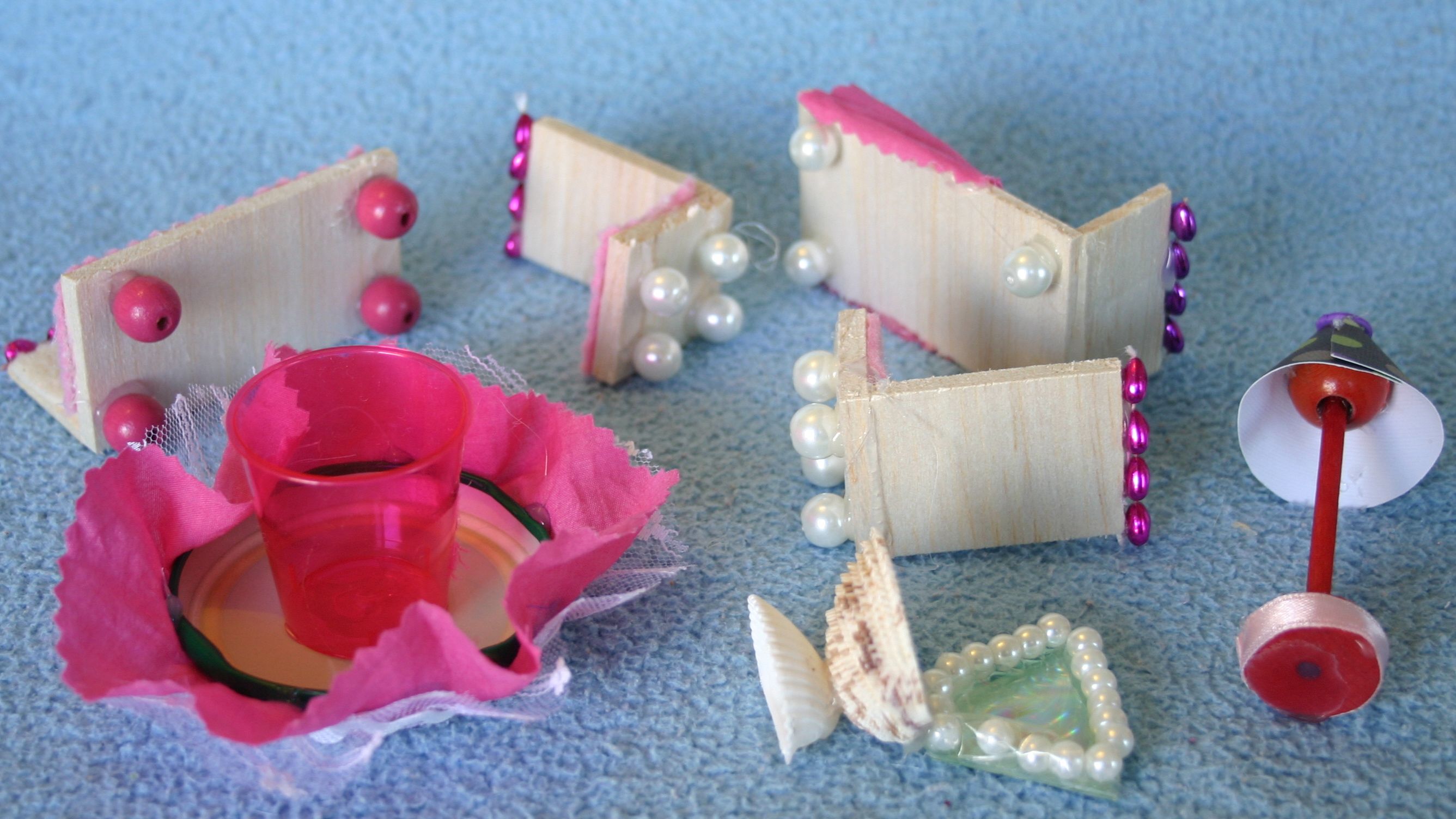
The furniture is made from balsa wood hot glued together with beads for legs and felt pieces for cushions. We cut up cheap plastic bead necklaces to decorate the top of the chairs. A jar lid glued to a plastic shot glass and covered with a circle of fabric and ribbon forms the table. The mirror is a piece of CD surrounded by beads and glued to two shells as the base. The lamp is a small craft stick with a large wooden bead on top and a circle of card cut to form the lamp shade. It stands in a wooden circle that came with the sticks.

A printed clock face glued to a plastic disk, plus some old tiles from a board game with miniature photos inside, decorate the walls. Photos and magazine pictures of outdoor scenes give our rooms a view.mini dolls house furniture bottoms IMG_8278The girls were able to wall-paper and “carpet” their boxes, plus put together all the contents in a couple of hours and with a little more preparation our party guests should be able to complete theirs in an hour and a half.

Lots of fun for all ages and a lovely gift for any little girl.

Other posts you may like:

Wooden clothes peg dolls house furniture

My next post (still to come) on simple peg dolls from pipecleaners and wooden beads.

Montessori counting trays 1 to 5

It constantly amazes me how much we can get through in only 15-30 minutes of focussed time. I really encourage all those overwhelmed homeschool Mothers with multiple children that you only need a small window each day to teach basic reading, writing and arithmetic skills.

Montessori style hands-on activities make it enjoyable and interesting for the children and encourage them to be active participants and motivated learners. I have a good stockpile of useful materials collected and organised and in an hour I put together these counting activities for my 3 year olds who have just started doing some tray activities with me on a daily basis. For a more detailed idea of how to introduce these, see here.

counting 1 to 5 rocks IMG_8137

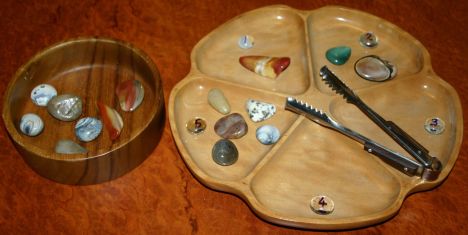
Natural materials like wood and rocks are very appealing. My older children love these rocks and all wanted a quick go of this tong transfer activity. The jewel beads are numbered 1 to 5 and placed in order around the segmented tray before the correct number of rocks are transferred into each section.
counting 1 to 5 doves IMG_8137

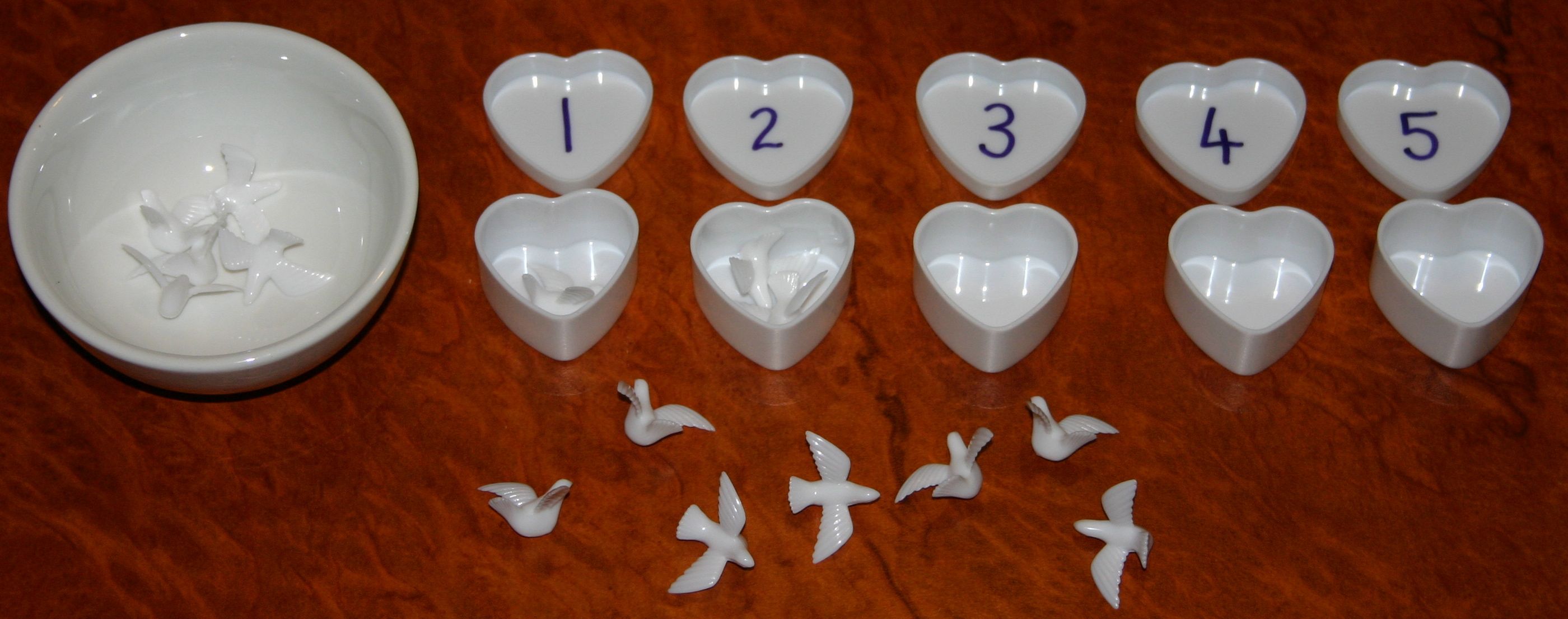
These doves and little heart boxes are wedding favours from our local discount store. They are so cute the kids can’t resist playing with them. Half the battle to get children to learn is won when they are interested in what you are presenting to them. Make up a little story to go with it and they will be eating out of your hand. I told mine that the birds have been specially trained by the King and Queen to fly back to their own love heart bed for the night and gave them a couple at a time to count in order to figure out which bed they had to put them into. Taking the lids off to discover what number was inside was a good opening and closing activity in itself and added to the mystery. We also used a number strip to match the lids to as they do not yet recognise the numerals.

counting 1 to 5 jars IMG_8137

A simple popsicle counting tray. You could colour-code the sticks for beginners to sort by colour first before counting and placing into the correct jar. These colours could also match the sticker on the jar for an added self-checking aspect.

counting 1 to 5 fruits IMG_8137

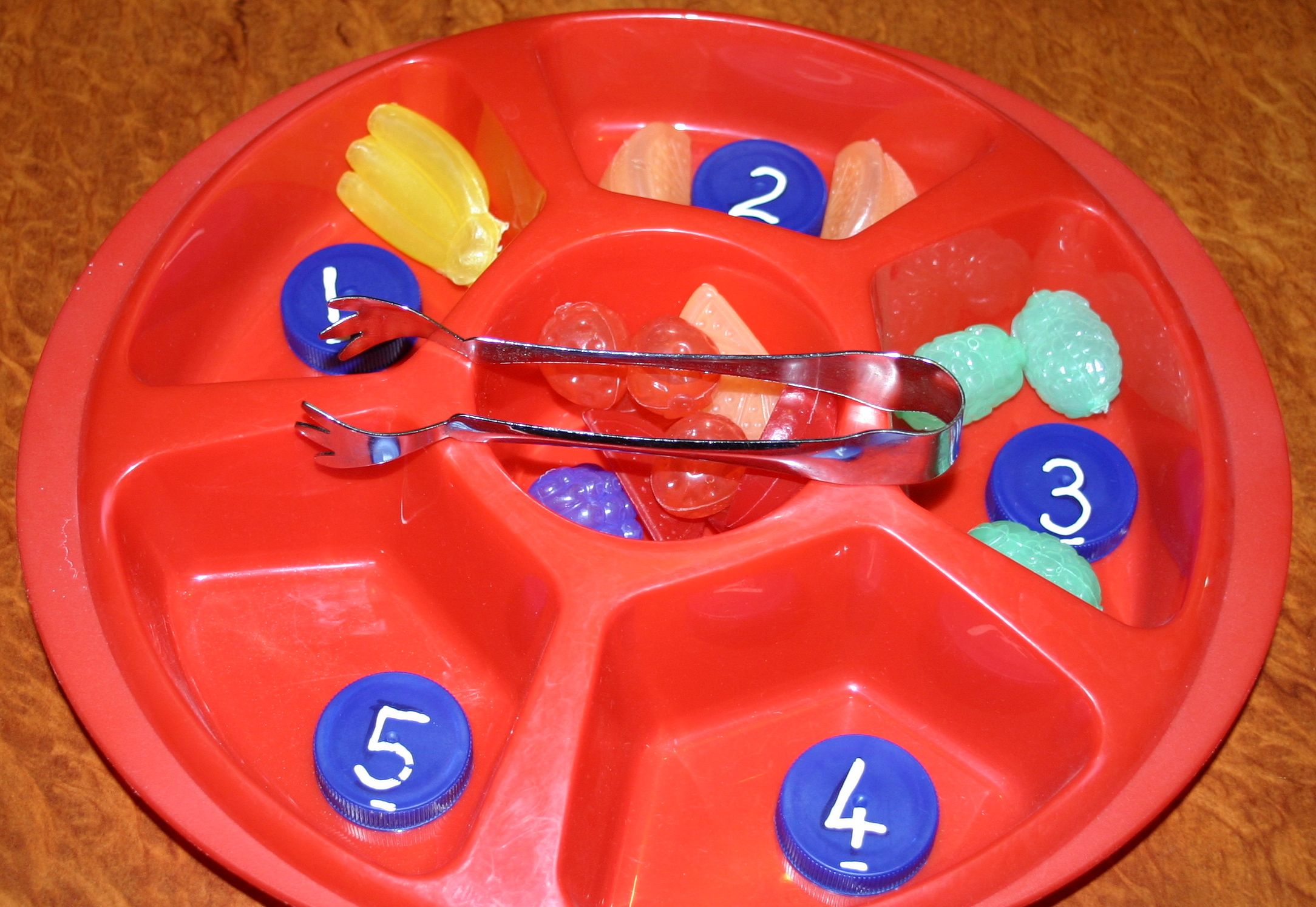
These iceblock fruits (the kind that come filled with water for freezing and adding to drinks) have been a hit from day one. They are a lot brighter and more attractive than they look in the photo and combined with some milk bottle lid numbers (liquid papered on) and a chip and dip tray from the local op shop, this took me about 2 minutes to put together.

counting 1 to 5 gold plates IMG_8137

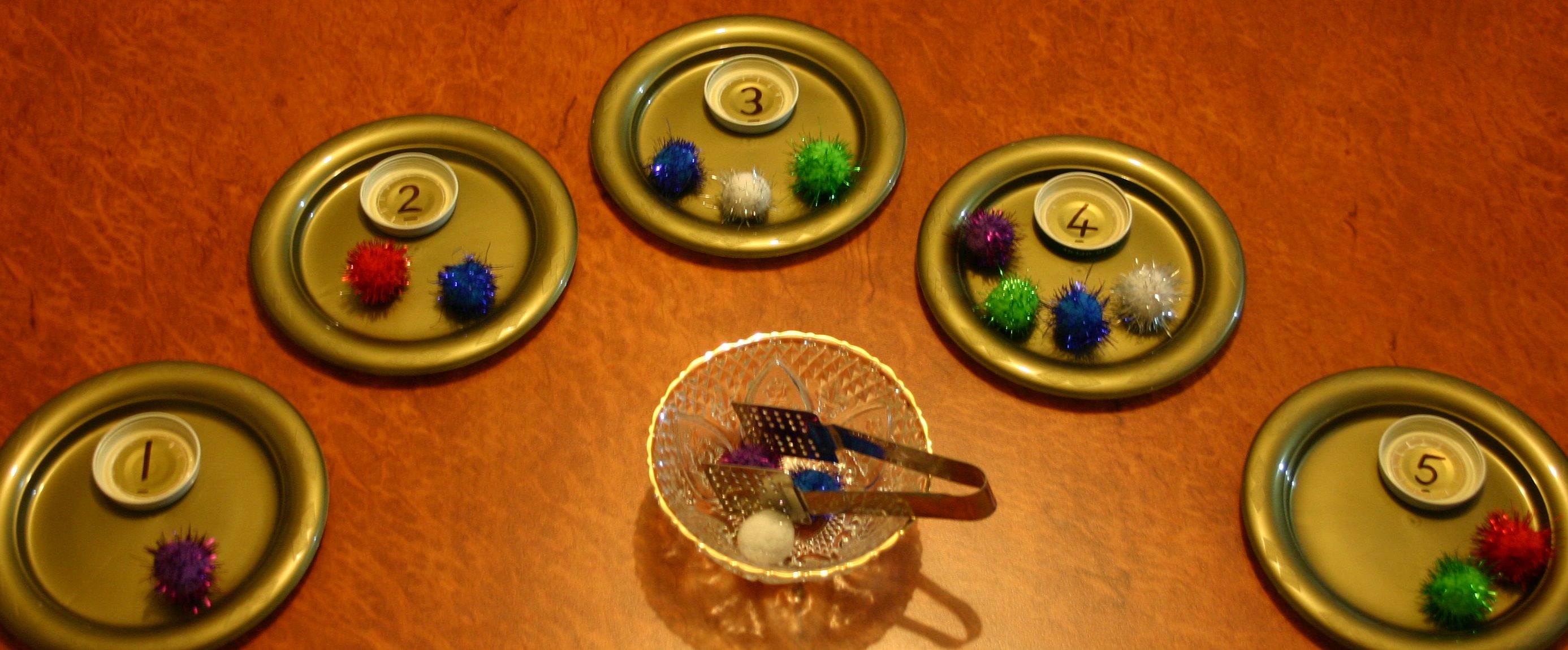
Sparkle pompoms, some gold plastic disposable plates and teabag tongs  with baby food jar lid numbers make another easy activity tray. If you make up a funny story about guests at a restaurant who are ordering different amounts of food and tell the children that they (as the chef/waiter) need to deliver exactly what the customer wants, they will be enthralled. My guests got progressively more greedy as the numbers increased and this had the twins giggling along. Somehow my children always find it funny when we pretend play about bad manners!

counting 1 to 5 clips IMG_8137

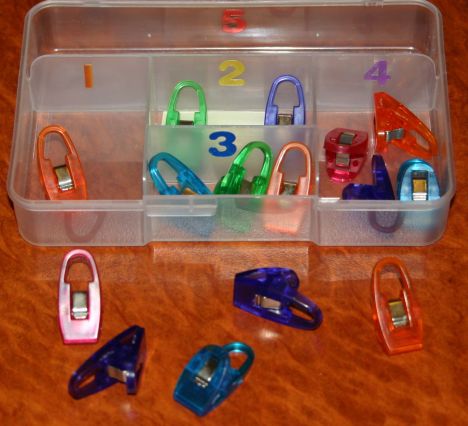
These clips were a mistake right from the start. One side is shorter than the other and they are quite stiff so the children can’t get a good grip to press them open and clip them onto things. I let them have a try but we usually just end up sorting them into the compartments. I’ve kept them because they are bright colours and the kids do find them an attractive material to handle.

Six trays in an hour of prep (most of which was getting the stuff out and packing it away when I’d finished) and I am set for a good few weeks. I’m guessing that by the time the interest in these wears off, they will both be able to count to 5 and ready to move on to counting to 10 trays. Or back to initial sounds, or 3 letter words or… whatever takes our fancy next.

More posts you may be interested in:

Montessori tray activities – starting out

More ideas for 1 to 5 counting

Make your own baby and toddler Montessori toys 

circle time

Montessori style practical life tray activities for toddlers

Today’s post is a potpourri of Montessori tray activity ideas. They cover a range of skills and fall into a number of practical life categories, but all are great for teaching your toddler to sit and concentrate for an extended period. I have spoken to a number of Mums recently about the difficulty they have in getting their toddlers to sit for any length of time at the one activity. One method that has helped me to achieve this with my toddlers is to include highchair time, table time, and mat or blanket time in our flexible routine. These are times when Mum chooses what the toddler will play with and where they will play. (See choices.)

I use my Montessori style tray activities for highchair time with my young toddlers or during table time for my older children. For those little ones who are “done” with an activity after only a minute or two, I have used a timer to extend them. I put it on for 5 minutes and let them know that I will give them a new activity to play with when the timer is done. They may choose to be finished with their current activity and just sit and wait for the next one or (and this is what usually happens very quickly) they will realise that since there will be nothing else to do until the timer finishes, they will choose to go back to the activity they have been given and work on it for a little longer. The timer I use is a visual timer so they can see how much time is left as it counts down. It also has an option to turn off the beeper so that if they have become engaged in a task the beep of the timer does not disturb their concentration. As they become more able to concentrate for an extended period, the time is lengthened accordingly and eventually the timer is no longer necessary.

The older preschoolers who have developed sufficient self control and concentration are given the freedom to choose their own tray activity, take it to a designated space, work on the task, pack it up and return it to the cupboard before choosing another activity.

If you are getting started for the first time with an 18 month to 2 year old, 5 minutes for each activity is reasonable and the entire session may only last for 15 to 20 minutes to begin with. A two year old will quickly work up to a 30 minute session, but still may need a change of activity after 5 minutes. If I was planning a half hour session of highchair time (long enough to cook dinner) I will organise the 6 activities I need to be on hand before I start. (It may be a good idea to keep them out of view to begin with to prevent their attention being diverted by another activity that looks more interesting!) As the child gets older, the complexity of the activities increases and their ability to concentrate without needing to change improves and therefore the number of activities I need to have ready becomes less. My 3 year olds will need only 1 or 2 different activities for a half hour period depending on what I have provided them with. They are also given some choice over which activity they work on.

The other benefit of having toddlers sit in a confined area to complete these tray tasks is that I can give them breakable and delicate equipment without fear that they will be accidentally damaged and also keep an eye on them with small attractive materials like coloured beads that little children are quite likely to want to pop in their mouths.

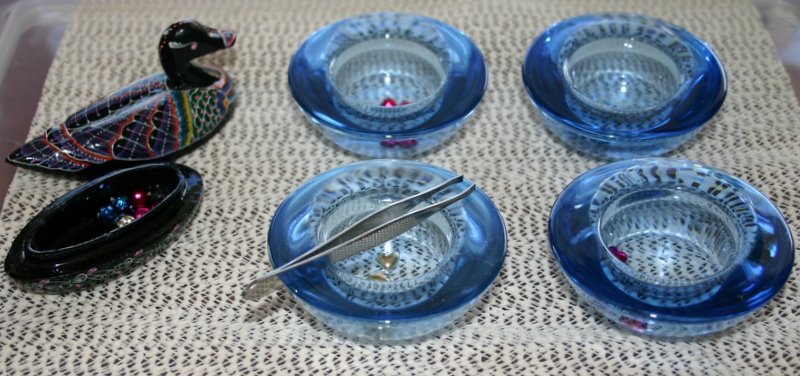
Now for some activities! Tweezer transfer activities are great for fine motor skills and require a similar grip to that used for pencil grip when writing. Transfer activities can easily lead into other beginning math skills such as sorting by colour. This duck container holds 4 colours of beads to be sorted into the 4 bowls. Younger children will have fun simply transferring them randomly and very young children may need a small spoon to transfer with, rather than the tweezers.

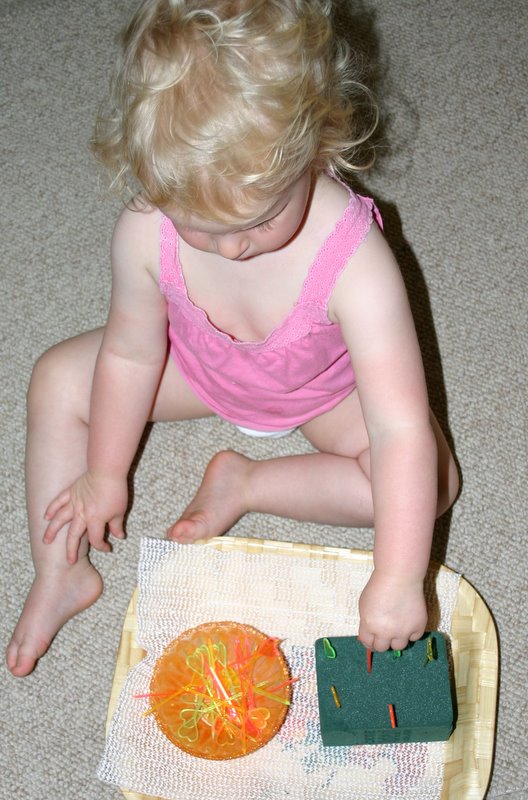
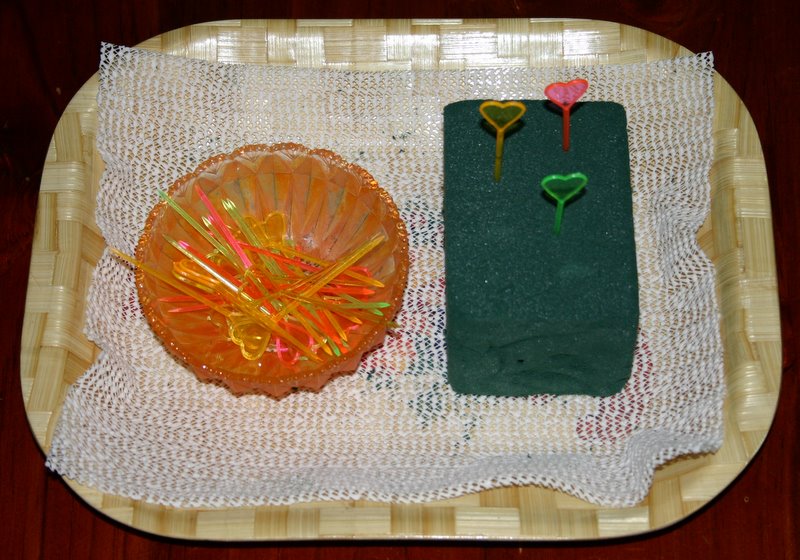
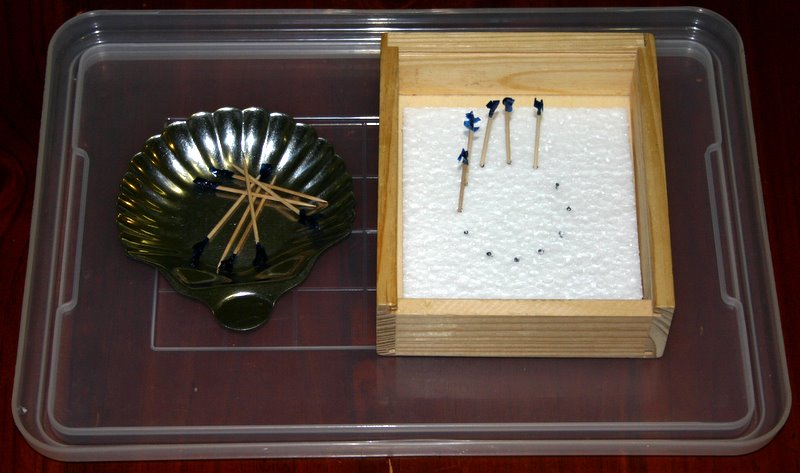
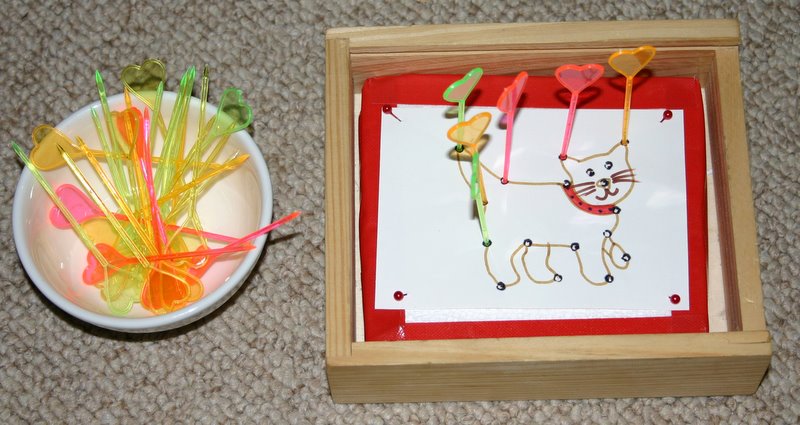
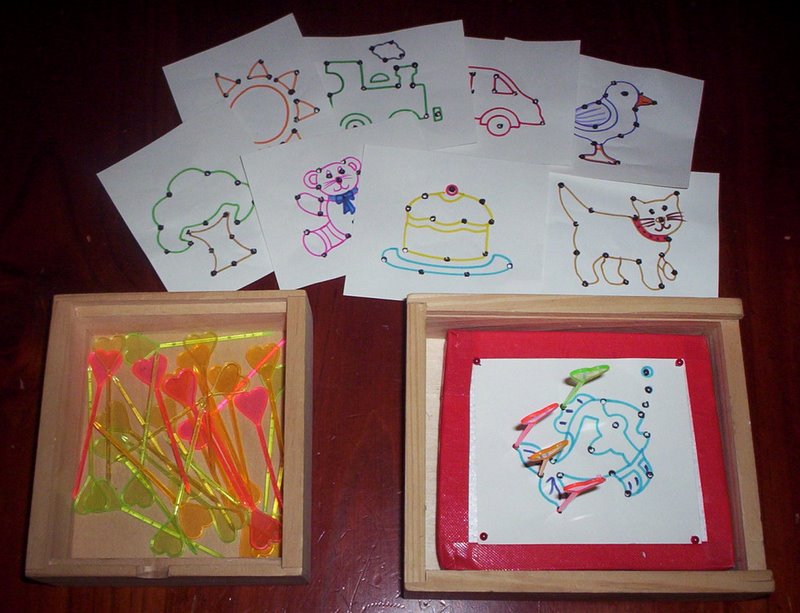
Great for even the youngest toddler, poking toothpicks into floristry oasis encourages pincer grip development. I found that the green oasis crumbled very easily so I would recommend covering it in open weave fabric to contain any dust. I have since been told that the grey oasis is much tougher and shouldn’t crumble or create dust. Foam blocks also work well. (See shape, cat and assorted pictures below.)

The follow-on activity was to place the toothpicks into marked holes to form simple shapes and then on to pictures.

Keep the number of dots on each picture to a minimum for little ones. Too many make it difficult to get their hand in for the next toothpick.

These pictures are drawn onto card and pinned onto styrofoam pieces cut to fit into the wooden box.

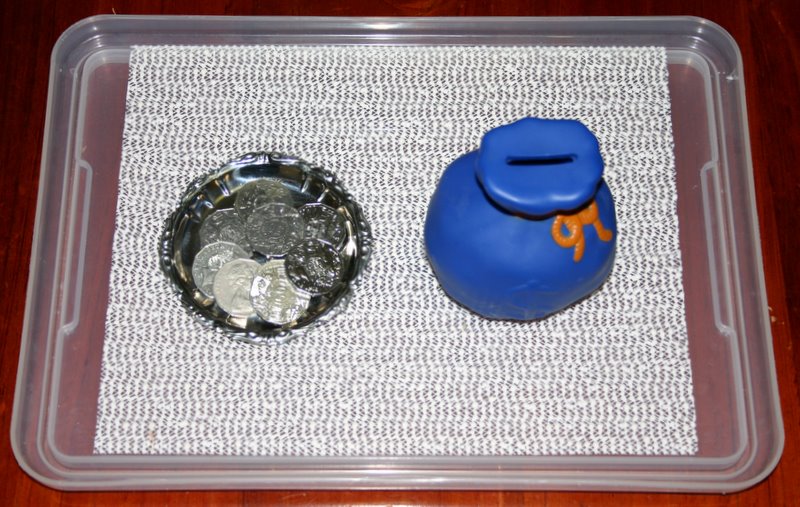
Posting coins through money-box slots. I left the bottom open so that the children can simply shake the coins out the bottom and do it again.

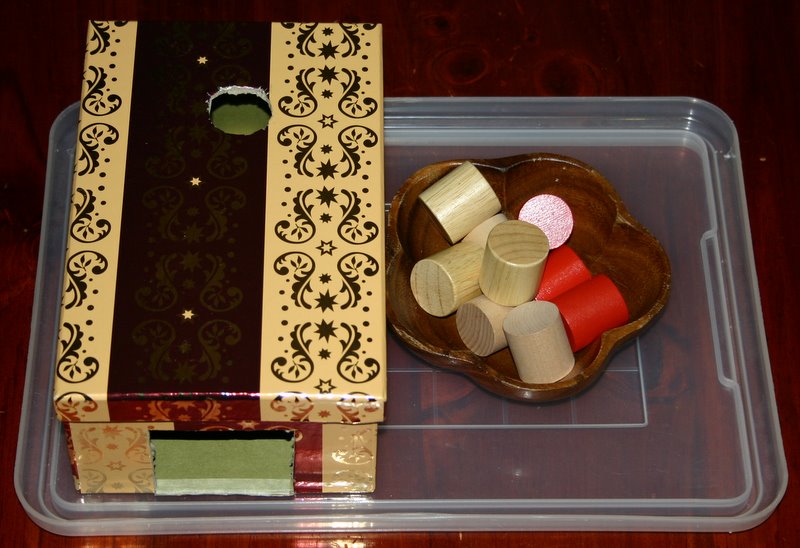
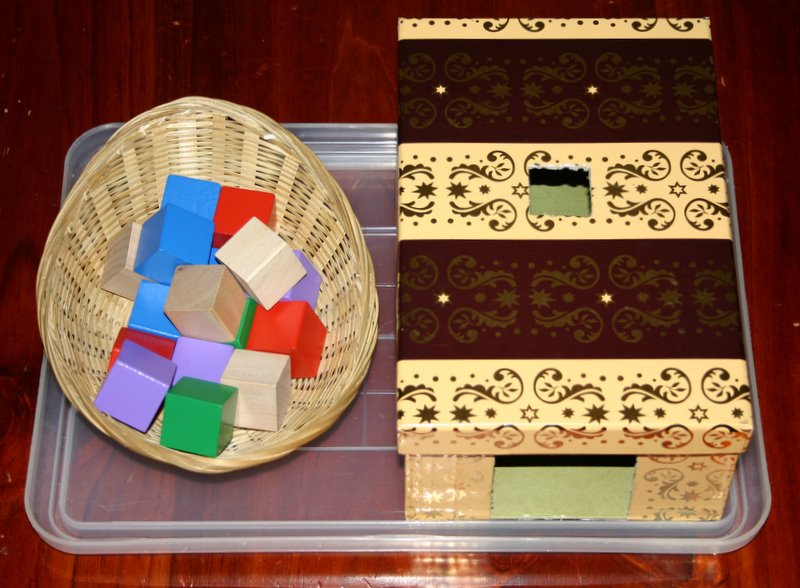
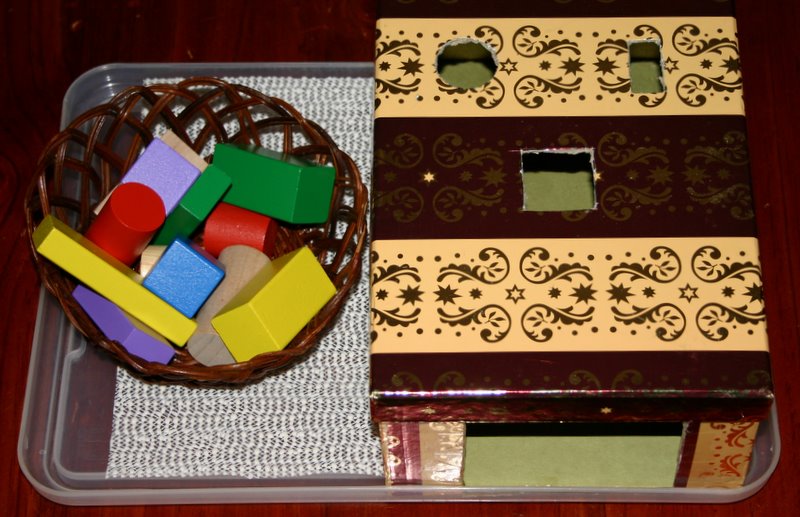
Posting wooden shapes is a good intro to shape recognition . Start with cylinders because it doesn’t matter which way the child puts it into the hole. Squares are next as they must line up but will still go in no matter which way up they are. The open slot at the front of the box allows the child to reach in and/or tip the shapes back out and for the little ones is very much part of the attraction.

Add other shapes such as triangles or a combination of shapes to increase the level of difficulty.

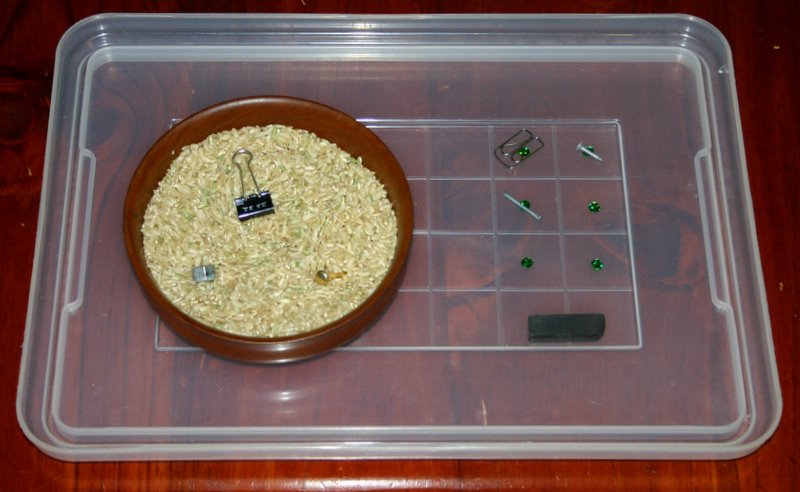
This magnet activity is fun. Hide lots of little items in a bowl of rice. The child moves a strong magnet around in the rice to find which items will stick. The number of spots on the tray designates how many magnetic items they need to find.

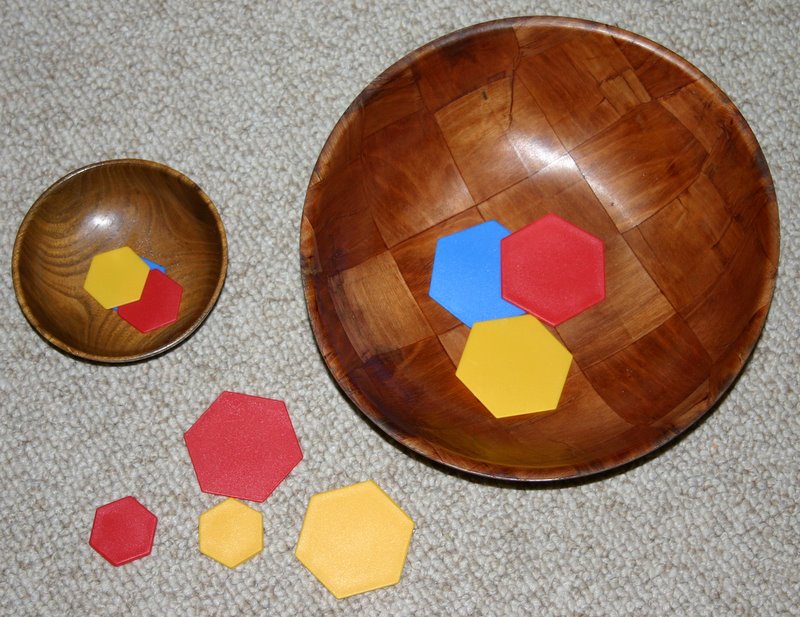
Sorting objects according to attributes is another basic mathematical concept. This beginning sorting activity has a large bowl for the large/big objects and a small bowl for the small objects. My just turned 2 year olds can usually handle this one.

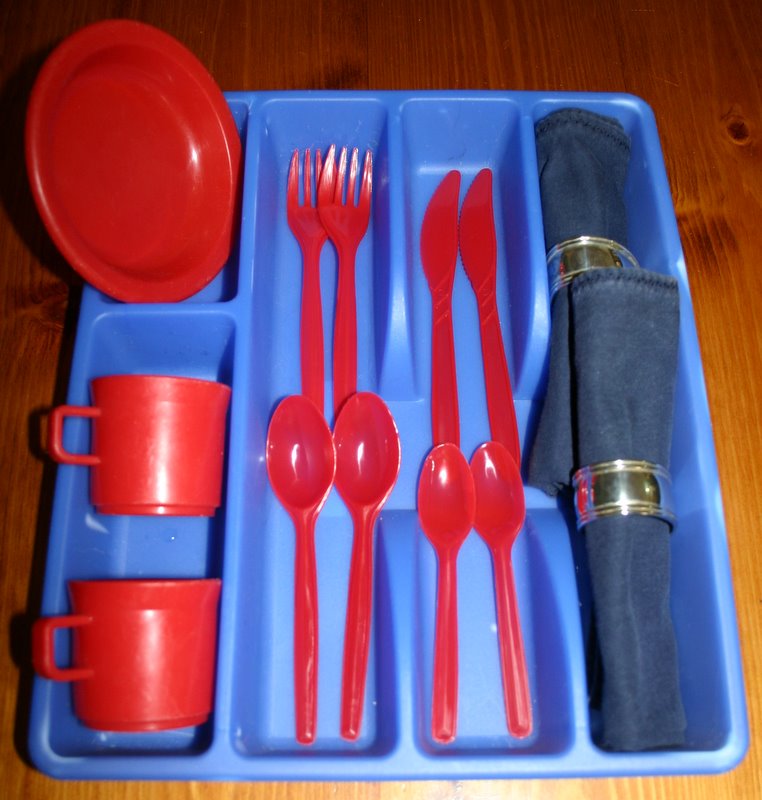
Learning to set the table is a household chore for us and learned very easily by actually doing it! Little ones however find it lots of fun to practise this skill with a couple of teddies and some play food. Provide 2 place mats (plastic, fabric or just a sheet of paper) with the outline of the items on them for little ones to match each item to so that they know when they have done it “properly.”

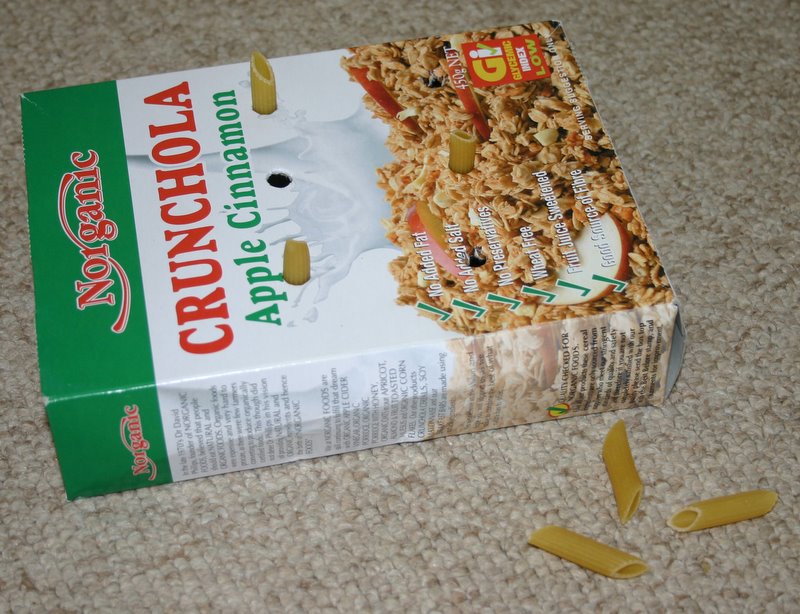
This one is for the very young. Babies do love to put things in and out of containers and if you keep changing the items and type of container, this style of activity is good for months. It is great for fine motor skills and concentration and pretty much free to make. Whip one up in just a minute or two and watch the intense concentration as they use that all important pincer grip (necessary for writing later) to grasp the end of the pasta and carefully post it into the holes. Use this activity for mat time, highchair time, table time or with straws (so they don’t eat the pasta when you are not closely supervising them) for playpen time or room time.

With all of these activities, if your child finds them too difficult and is still frustrated after you have shown them how to do it and given them some time to practice, put it away and reintroduce it in a couple of weeks or months. Many of the Montessori style activities are very developmentally based and when introduced at the right time will be stimulating and extending to a toddler, not frustrating and overly difficult.

Teaching young children to sit and concentrate for extended periods is a vital foundation for later learning and helps you as Mum to keep the house and family running as you can get your own tasks finished knowing that your little ones are happily and safely occupied with a valuable learning experience.

Homeschooling with toddlers and preschoolers

Twin's tot school activities

Whether you like to call them Montessori tray activities, tot school, preschool, workboxes, workjobs, shoebox tasks or Ziploc bag activities, providing younger siblings with engaging, educational and worthwhile tasks to do while you homeschool older siblings is vital for a smooth day with well occupied children.

While you can get some schooling done while little ones are napping, I prefer to get the bulk of our formal schooling completed as early in the day as possible when the children (and I) are freshest. Last year we had around an hour while the younger ones were in room time (playpen time for littlies) and we could also use mat time (or blanket time.) Now that we have older children though, this is not long enough to complete all of their workload and the twins are turning 3 so a new era has dawned!

The twins will be “starting school” with the big kids. They will now be included in our morning circle time, followed by table activities before they go off to room time. The list of possible table activity ideas is almost endless but our “school” trays will be more Montessori in style.

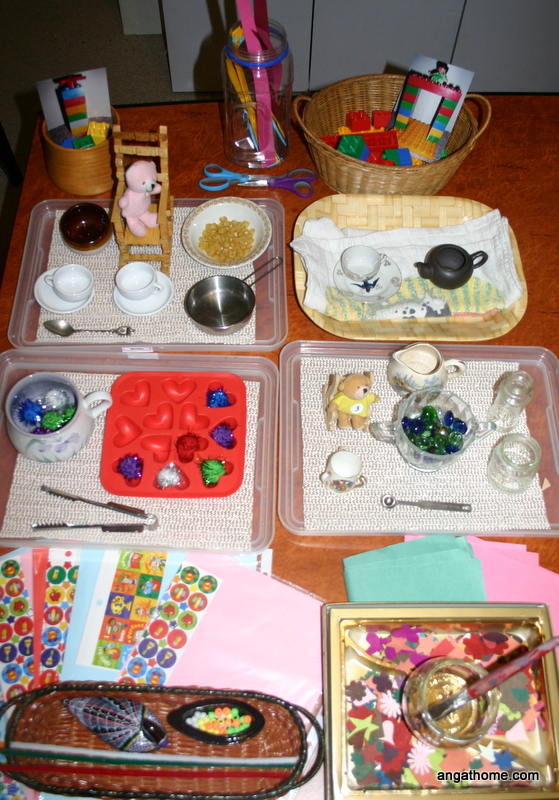
As I have done in the past, I have chosen a list of categories for each tray and put one example of each category out on the shelf. When it comes time to update the trays in a couple of weeks as interest declines, I will simply swap out the materials but keep the type of activity the same. (See starting out.) This term our trays are gluing, cutting, stickers and drawing, tong transfer, spooning/teddy play, scooping/teddy play, threading. Duplo copying and water pouring. 

The best thing about this year’s preparation is that in the past I have taken photographs of all our tray activities along the way. This meant that I could simply hand the older children a couple each and ask them to go and get everything in the photo and assemble the activity. I pointed out that this was an opportunity to bless their little brother and sister. They quite enjoyed doing it, especially as I gave them latitude to change the activities a little with different pretty pots and equipment to suit their own tastes. In about an hour we had a whole term worth of trays set up and ready to go. (Plus the extra half hour to put away all the mess that the children created as they were collecting the gear but I wont mention that!)

Teaching toddlers to count: 1 to 5 workjobs and Montessori style tray activities

Here are some more counting activities for toddlers and preschoolers who are learning to count from 1 to 5. If your child has learnt the number order by rote (ie. can count out loud to 5) and is beginning to develop one-to-one correspondence (matching one verbal number to each object being counted) then they are ready to start simple hands-on counting activities like these. You may even like to set out only the numbers 1 to 3 to begin with. If you are new to teaching toddlers how to count, it might be helpful to read this post first.

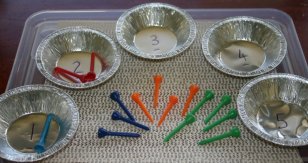
I ask the children to order the pie tins from 1 to 5 and sort out the golf tees by colour before counting each group and placing them into the correct pie tin. Use a number strip for young children to follow until they know the number order without help.

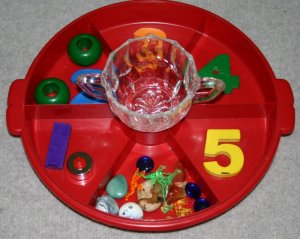
Kinesthetic learners (and all young children) love the hands-on style of these activities and despite the fact that  this group is far from my favourite set of tray activities, I included them to show you how a quick search around the house will furnish you with plenty of materials to set up your own.

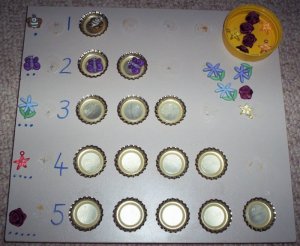
This is one of the first counting activities I introduce. The shapes are sorted by type, matched to the example at the start of the row and counted into the bottle tops. Beginners will often just fill up the bottle tops without having any idea of the numbers, but I simply have them read the number and count the objects as we take them out and pack them away.

Unfortunately this workjob doesn’t photograph well but the shiny silver contact paper and blue jewels are very attractive to little ones. The box comes from a packet of plastic food wrap. The jewels are placed into plastic shot glasses which are numbered from 1 to 5.

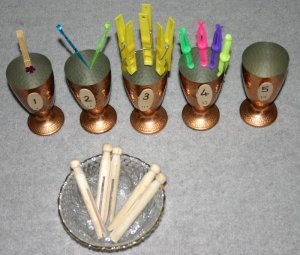
I bought these secondhand metal goblets for our pretend play home corner because they are unbreakable. Pegs of many varieties slide nicely over the thin sides. Placing dots under the numerals means that children who do not recognise their numbers can count how many dots there are until they can recall the numeral name.

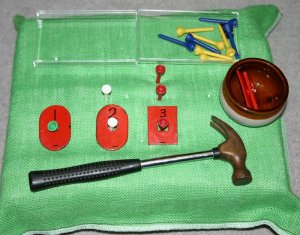
All my young ones have enjoyed hammering golf tees and other items into these polystyrene foam blocks covered with loose weave hessian-like fabric. The red washers come from a set of many shapes and sizes raided from Grandad’s shed with the numerals marked on them in permanent marker.

Chip and dip trays are handy for many different activities.These wooden numbers came from a baby puzzle toy and the items are an eclectic assortment from my Montessori materials drawers.

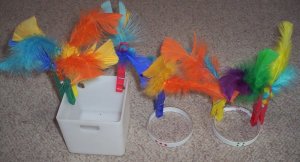
Pegging is good for fine motor development. The child counts the number of feathers on each peg and matches the peg to the correct number of dots on the card circles left from used sticky tape rolls. The box is just the storage for the feathers and rolls.

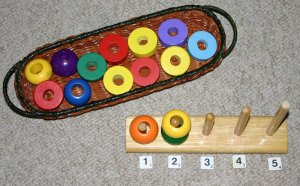
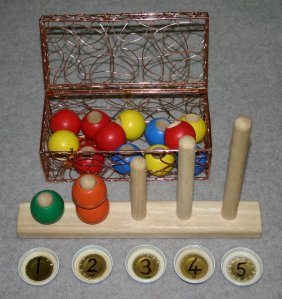
These beads and frame are a commercially produced toy that I picked up secondhand for a couple of dollars. Keep an eye out for this kind of material at op shops and swap-meets. The tiles are from an old game I bought for $2 at a secondhand store. I threw out the game and just kept the tiles.

Another commercially produced toy picked up for a couple of dollars with baby food jar lids for the numbers.

Scooping tray activities for toddlers and preschoolers

Scooping is one of the easiest Montessori style tray activities for toddlers and can be introduced at the same time as they are perfecting their spooning skills during meal times – giving them a little extra practise when spills are not so difficult to clean up!

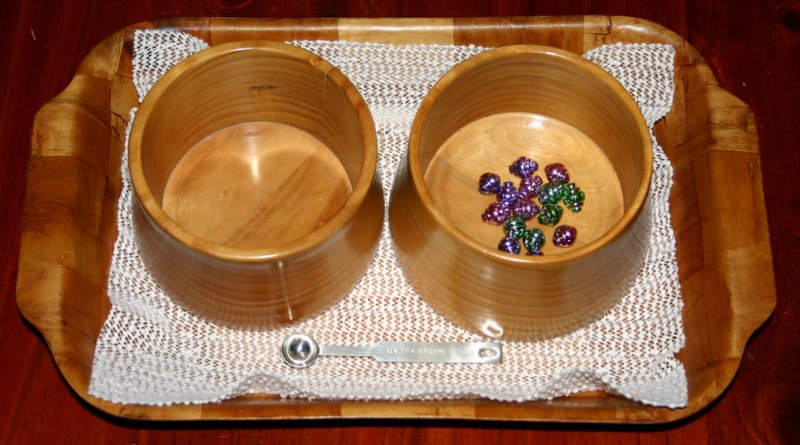
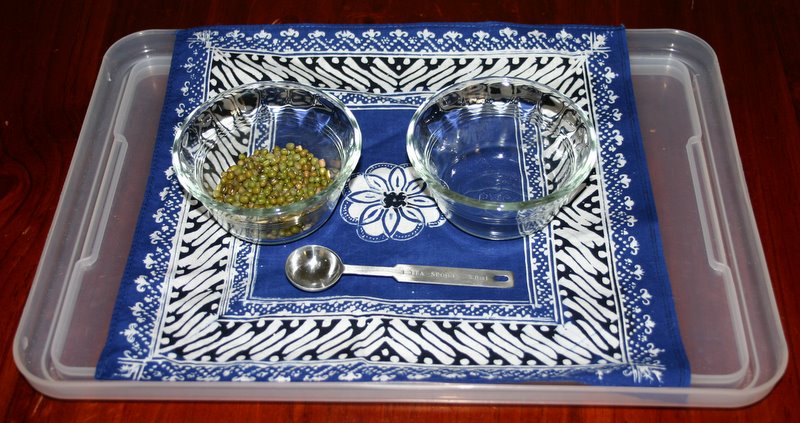
Start with large, non-slippery objects that fit easily into a scoop (see mega marbles) and move to more fiddly materials like the popcorn or rice examples below. All you need is two containers (one to  to scoop from and one to scoop into), something to scoop with (spoon, scoop, ladle, etc.) and something to scoop (pompoms, noodles, rice, jewels, marbles, beads, dried beans, pasta etc.)

Have a look through your art and craft supplies, kitchen cupboards and junk drawers and you will be surprised at what you can put together in just a few minutes.

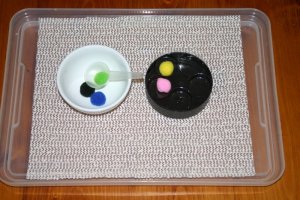
These pompoms are scooped into a plastic chocolate container insert with depressions in it. The scoop comes from a washing powder container.

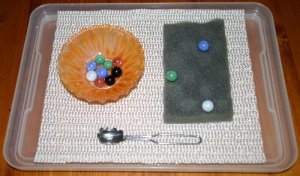
This is a piece of packing foam that has indentations all over it; perfect for filling with marbles. The scoop is a pasta spoon from a child’s cooking set.

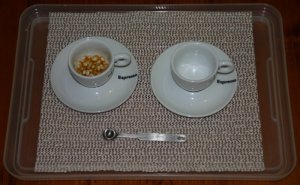
Dry popcorn kernels in espresso coffee cups with a 1/2 teaspoon measuring spoon.

Montessori trays are traditionally presented with the material to be scooped on the left hand side to help with left to right directionality for later reading and writing skills.

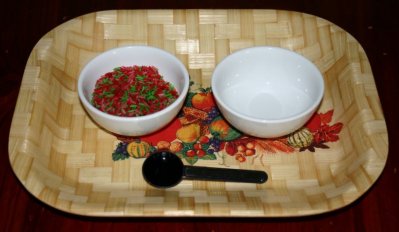
Green split peas are scooped from bowl to bowl.

Coloured rice is a very attractive scooping material.
When my toddlers were older and no longer finding simple scooping activities very interesting, I gave them this tray with a variety of containers to scoop, pour and tip with. They loved it.