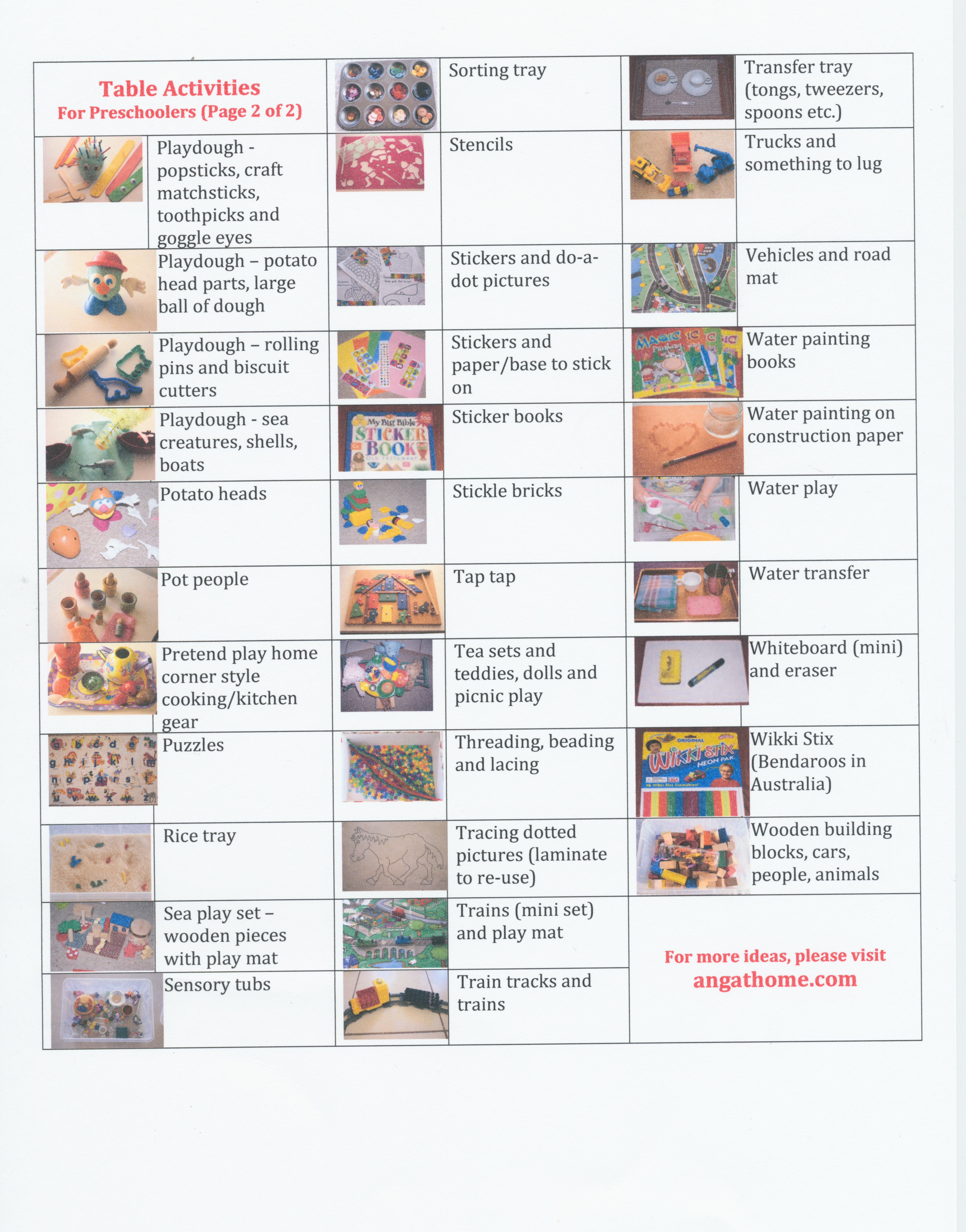
Sensory tubs; A rainy day and new baby activity

sensory table aerial shot all 6 IMG_0273

With a new baby on the way and wet weather kicking in, some plans for rainy day activities have become my priority. I have used mini sensory tubs in the past with great success as individual activities, but this time I want to keep several little people busy at once. After trawling the web and building up an inspiring Pinterest list of ideas, the last step in the plan was to find a suitable container.
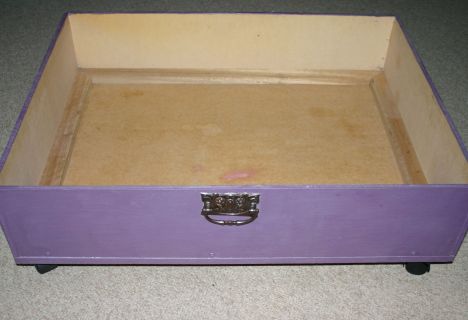
sensory table empty IMG_0255

While a large, shallow plastic tub will certainly do the trick, as will a scrubbed out water play table, I was lucky enough to find a secondhand wooden under-bed drawer that is ideal. It is on castors so I can push it to wherever we want to use it and then simply cover it up and roll it back under the gamesroom table to get it out of the way. Being wood, it is also strong enough that if the children lean on the sides it won’t break.

sensory table set up IMG_0255

After raiding the pantry for some oats as the first play experience, I fished through the cupboard for suitable play accessories. Bowls, trays, scoops, tongs, measuring cups, ladles and jugs were laid out in an “invitation to play” as I have recently heard it termed. (Basically just placing materials in a way that attracts children to the activity.) I know some people don’t like to use food as play because they feel that it is wasteful, but I do keep my basic manipulatives (rice, oats, pasta etc.) and reuse them over and over again. I have rice in a container in the cupboard that has probably been used for 7 or 8 years now.

sensory tub all 6 better background IMG_0272

Initially all 6 children were excited to play (Yes, even the 11-year-old boy!) so I added some extra accessories (jars with clip lids, plates, jugs and teacups) to cope with the numbers. This turned out to be a little difficult to manage however and with friction developing (read bickering, arguing and annoying each other) I directed the older three to go and find another activity and leave the younger three in peace.

sensory tub 3 youngest sharing tea IMG_0285

This was a much more amicable arrangement and much baking, cooking and food preparation was enjoyed for almost an hour in total.
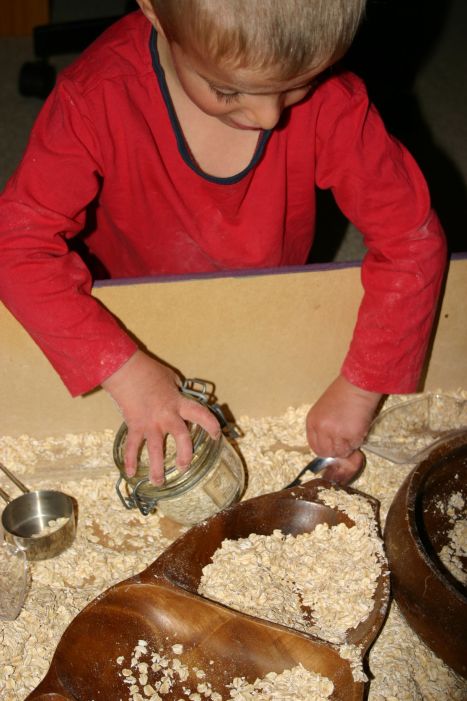
sensory tub clip top jar IMG_0289

Of course the 2 clip-lid jars turned out to be the favourite accessory so some patience and sharing practise was required! (Why is there always one item that everyone wants?)  Note that his hand is firmly attached to the top and I don’t think was removed for more than a second at a time to ensure that nobody else got hold of the jar!
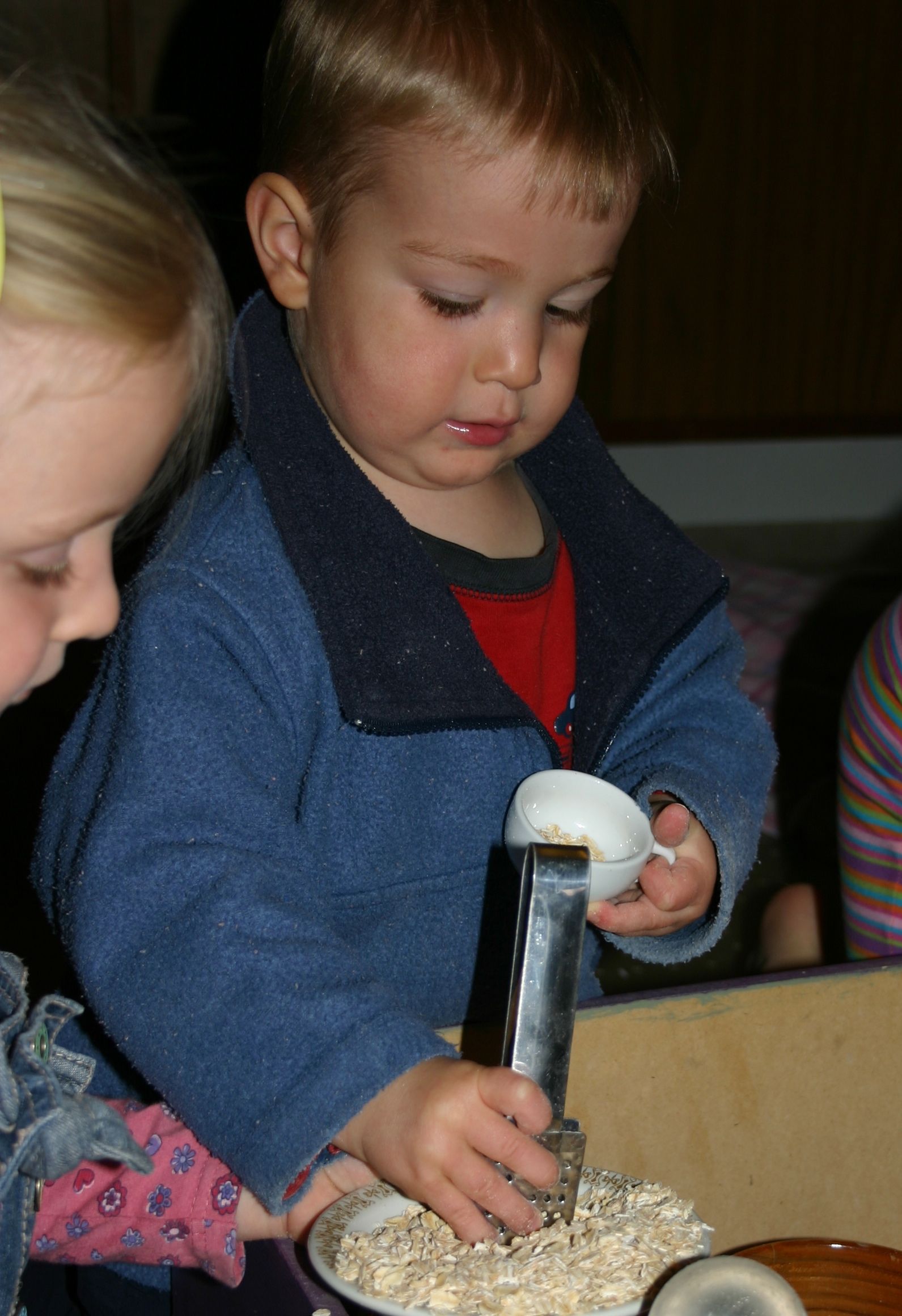
sensory tub tongs IMG_0283

Tongs are such great practise for fine motor skills and help develop finger strength for pencil grip later on.

The one rule I made before we started playing was that the oats and containers had to stay in the tray, not on the sheet. This did require some reminding when all 6 were playing as there wasn’t enough room for them to spread out everything they wanted to do, but once three children were using the sensory tub I only needed to remind the youngest a couple of times to keep the oats inside. Any deliberate spilling would mean that the offending child was done with the activity.

I cover the box with a large sheet when it is not in use and it is this same sheet which is spread on the floor to catch any accidental spills. When play is finished, I roll the box off and pick up the sheet by the 4 corners, simply tipping the spilled oats back into the tub. There were a few strays left behind but as we have a new vacuum cleaner it was quite a novelty for the little boys to fight over take turns cleaning up the couple of oats that got away. On hard floors a quick swish with the dustpan would have done the job.

I can see hours of fun ahead throughout the winter season and we will keep this as a special rainy day only activity. I plan to change the accessories every week or so to keep interest up (leaving the oats in place) and completely change the entire contents about every month. With the amount of ideas I have listed for items to add to a sensory tub, I have enough to keep going for years!

What are your favourite rainy day activities?

(After using our oats tub for a week or so I have made a few adjustments; see here.)


Preschool at my house this week – large family homeschooling (with toddlers!)

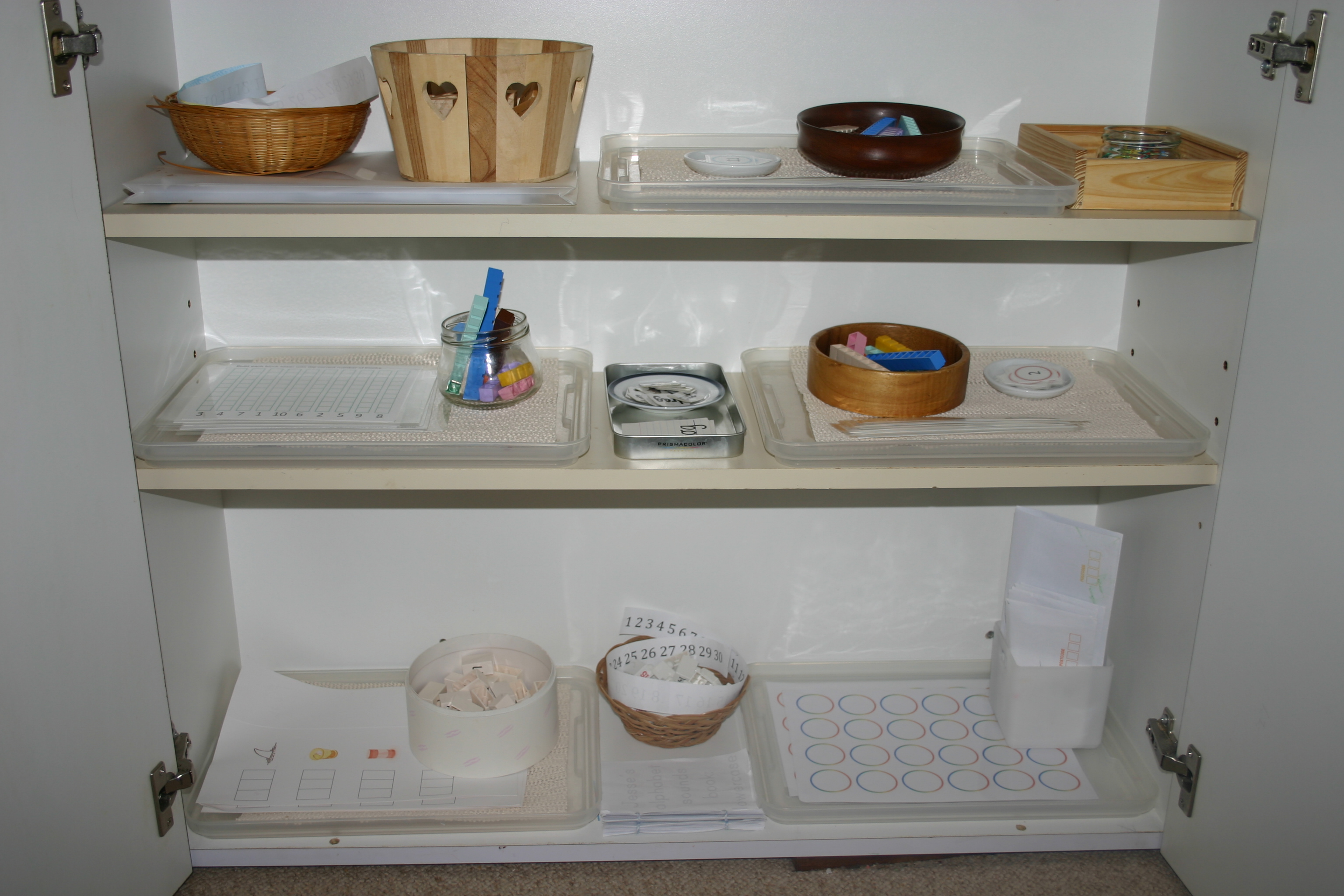
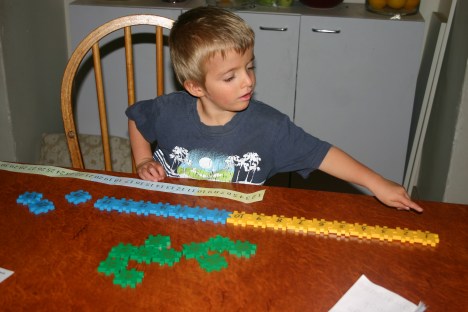
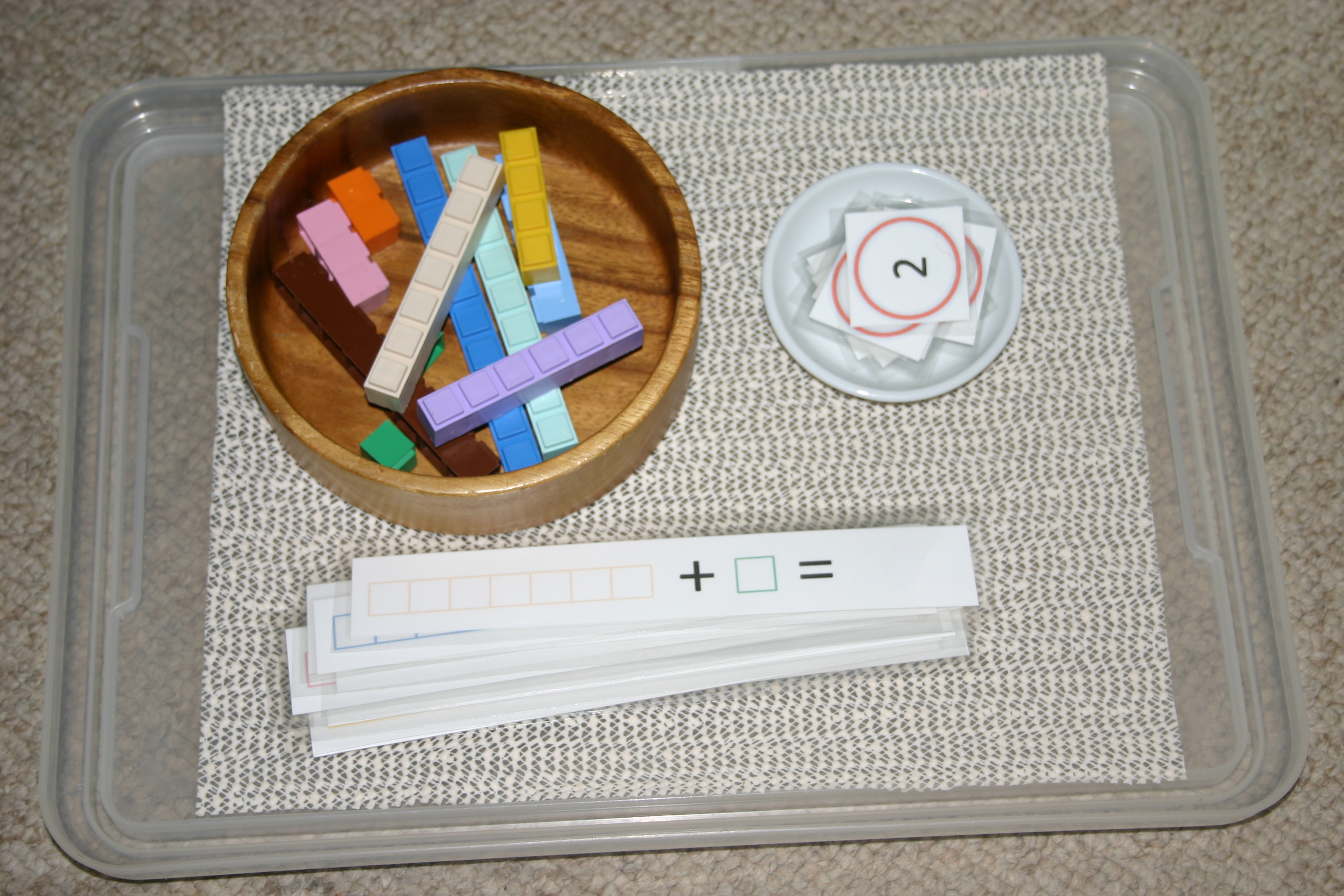
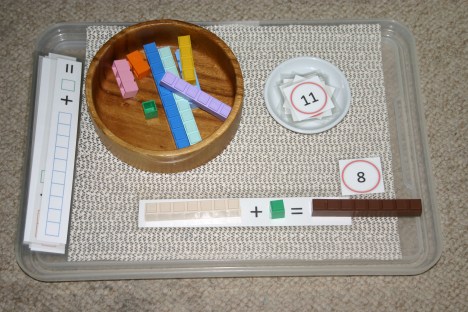
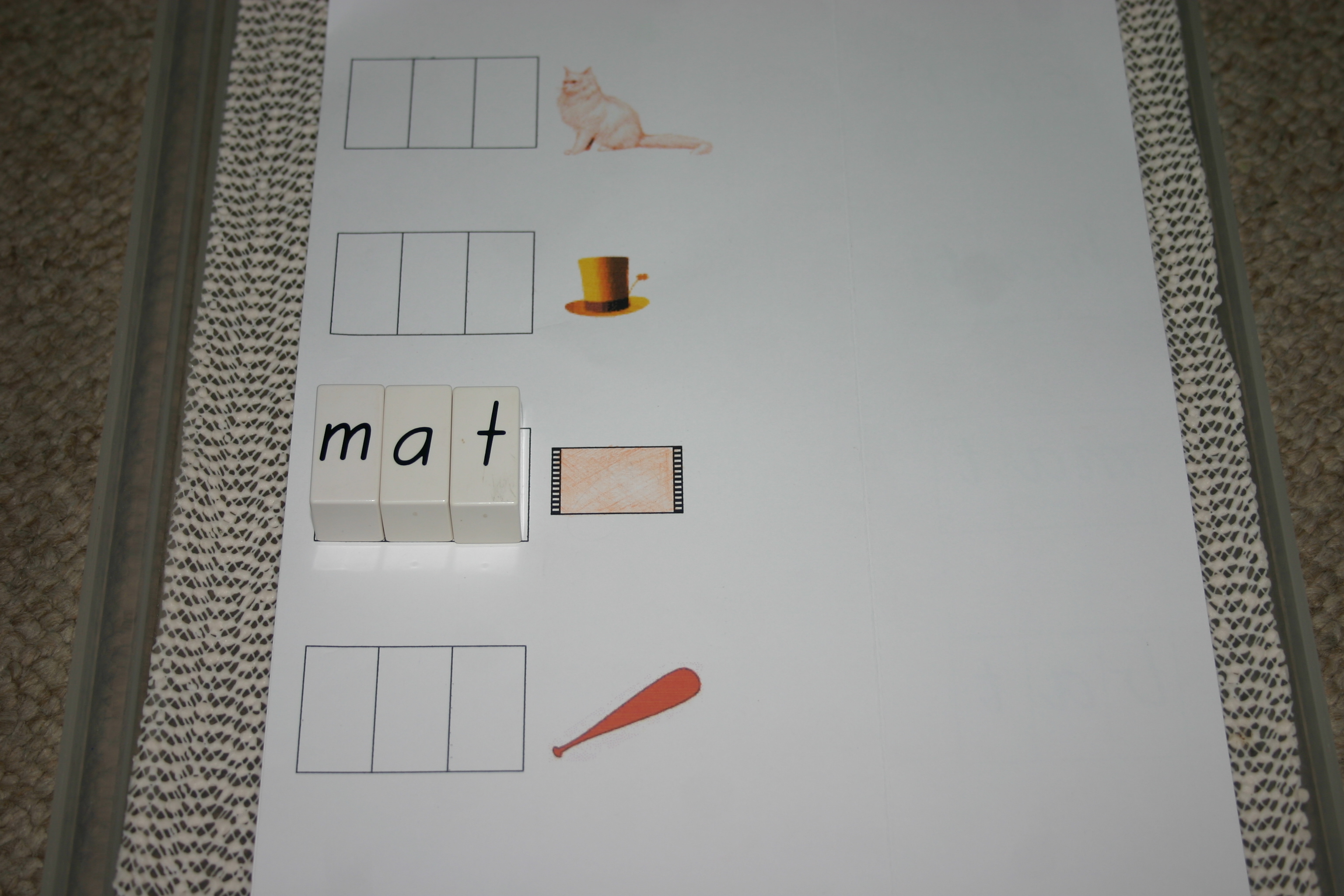
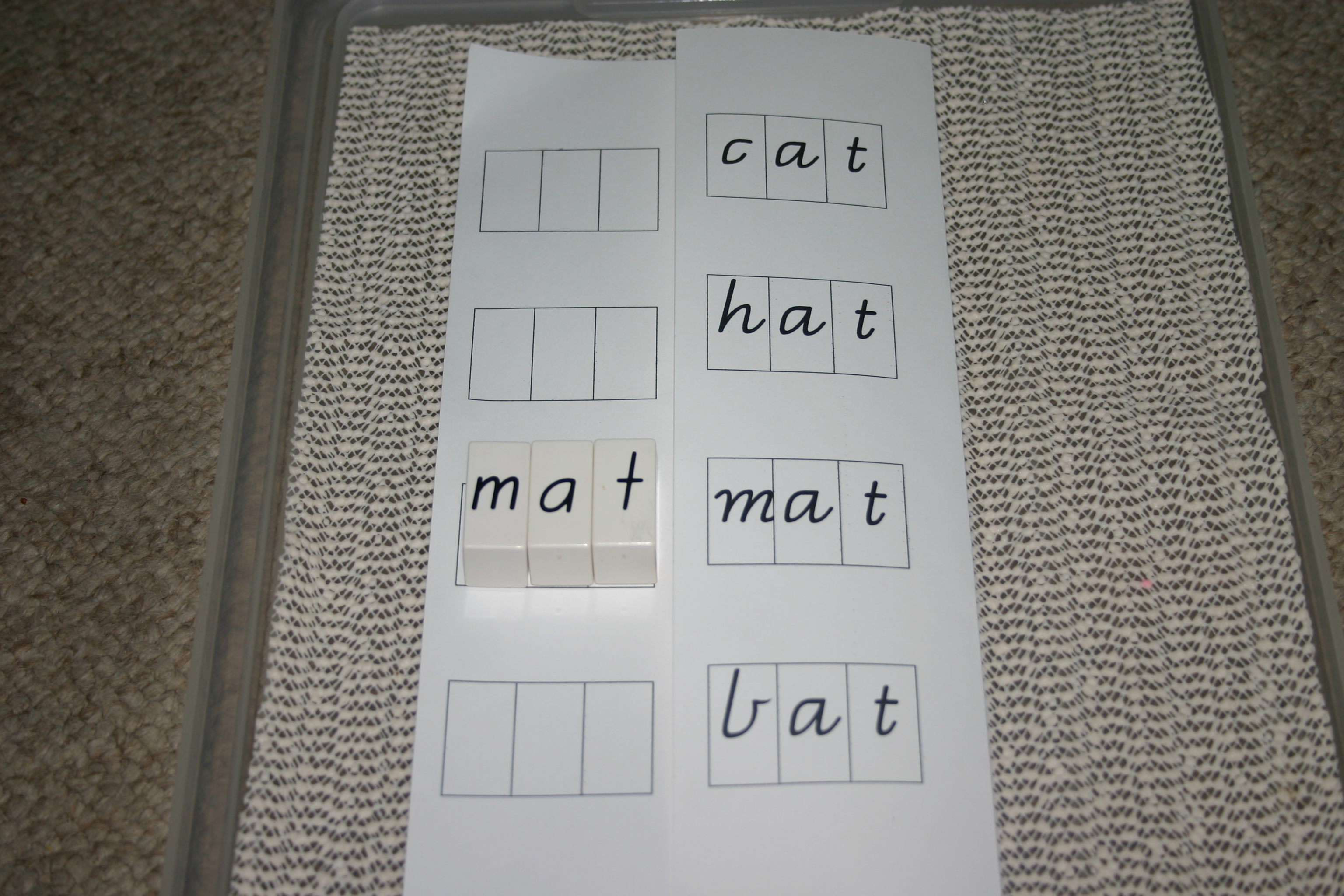
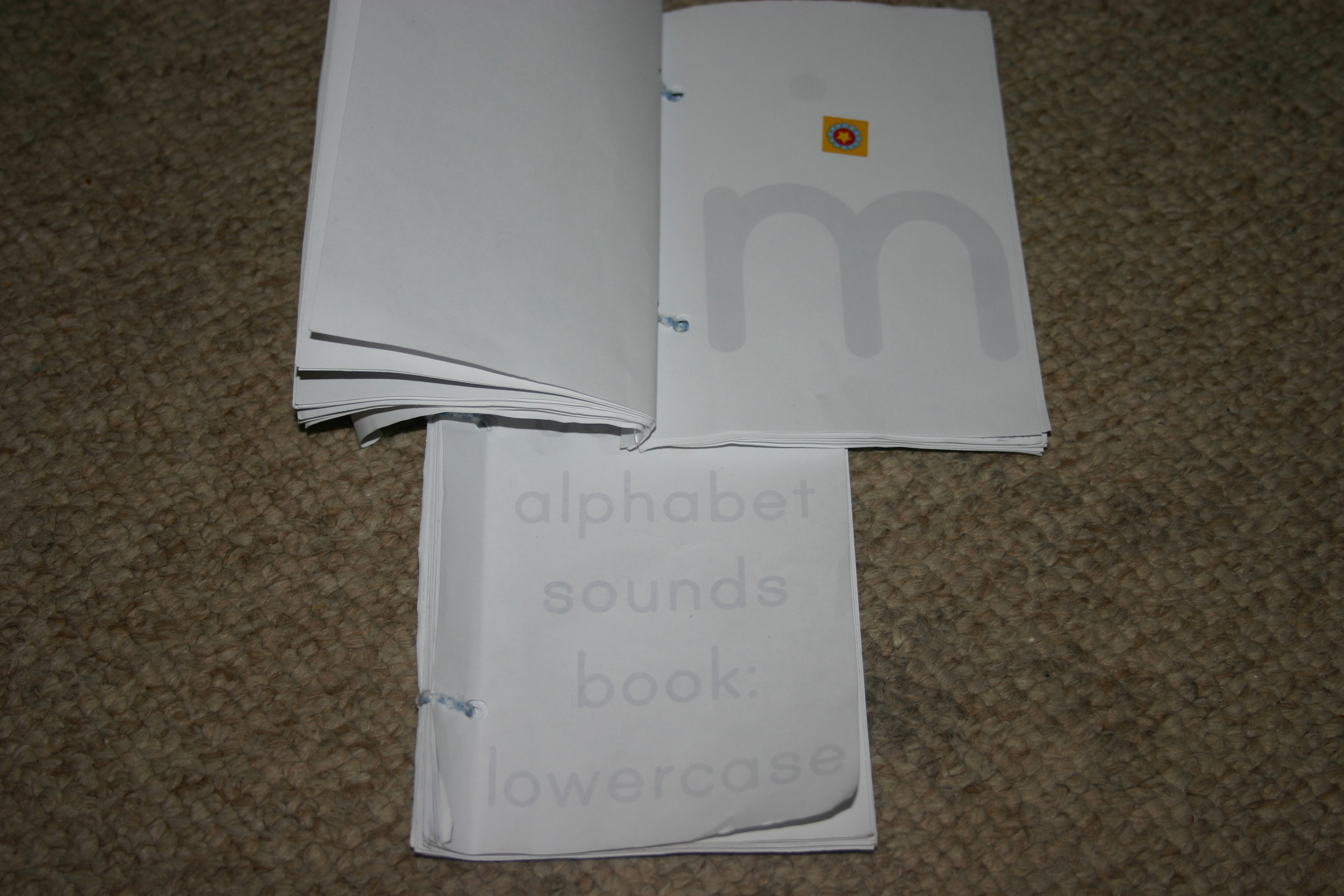
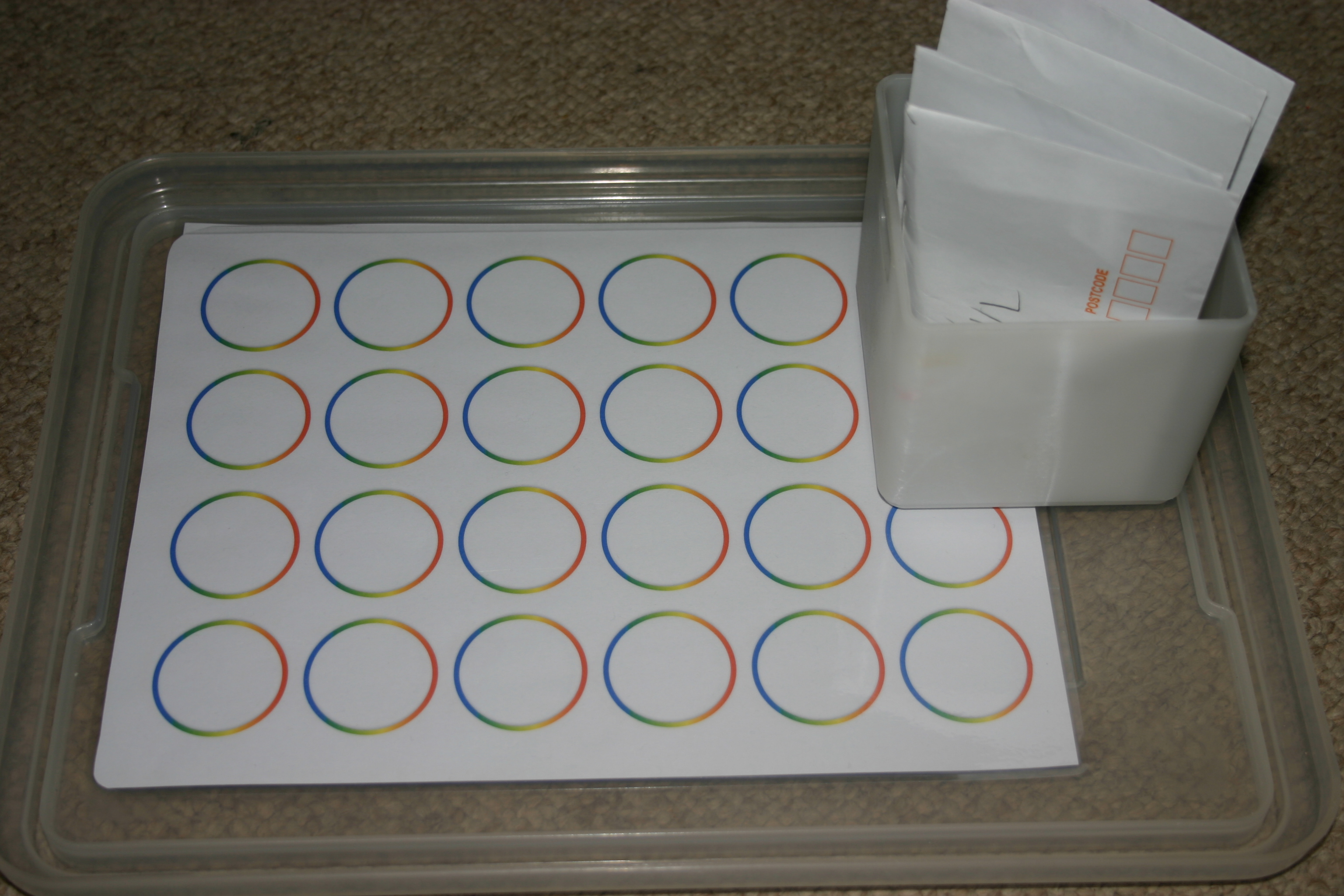
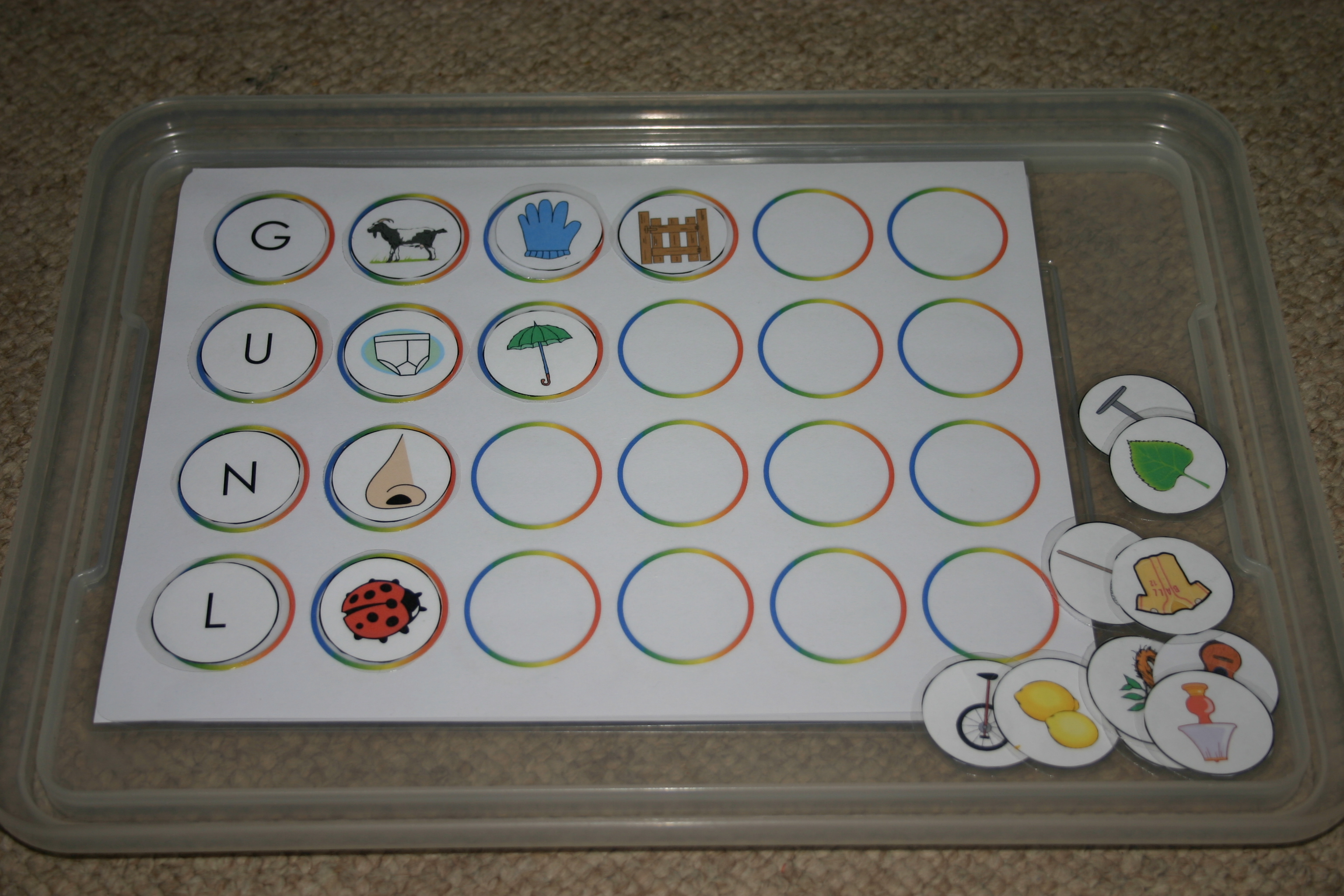
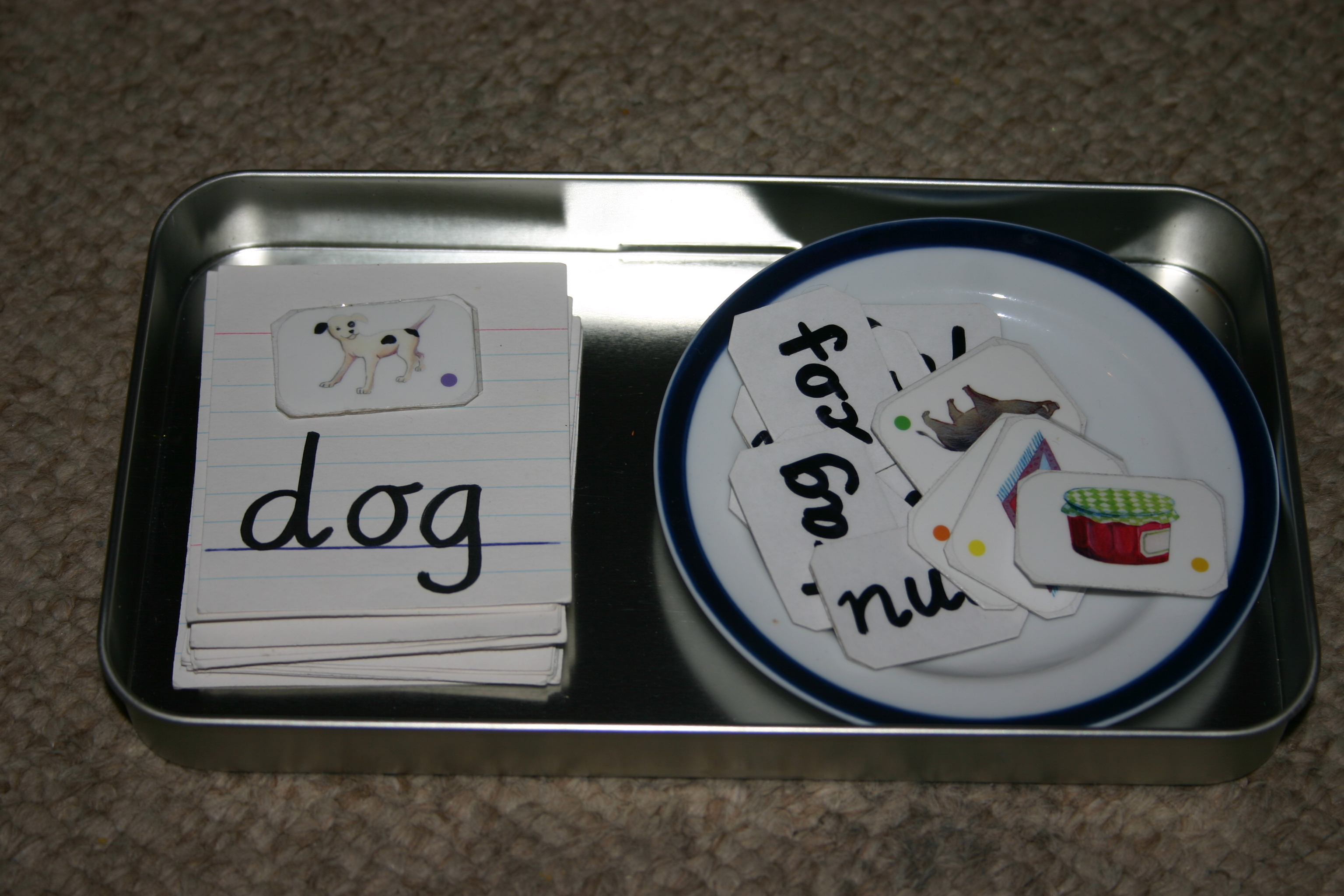
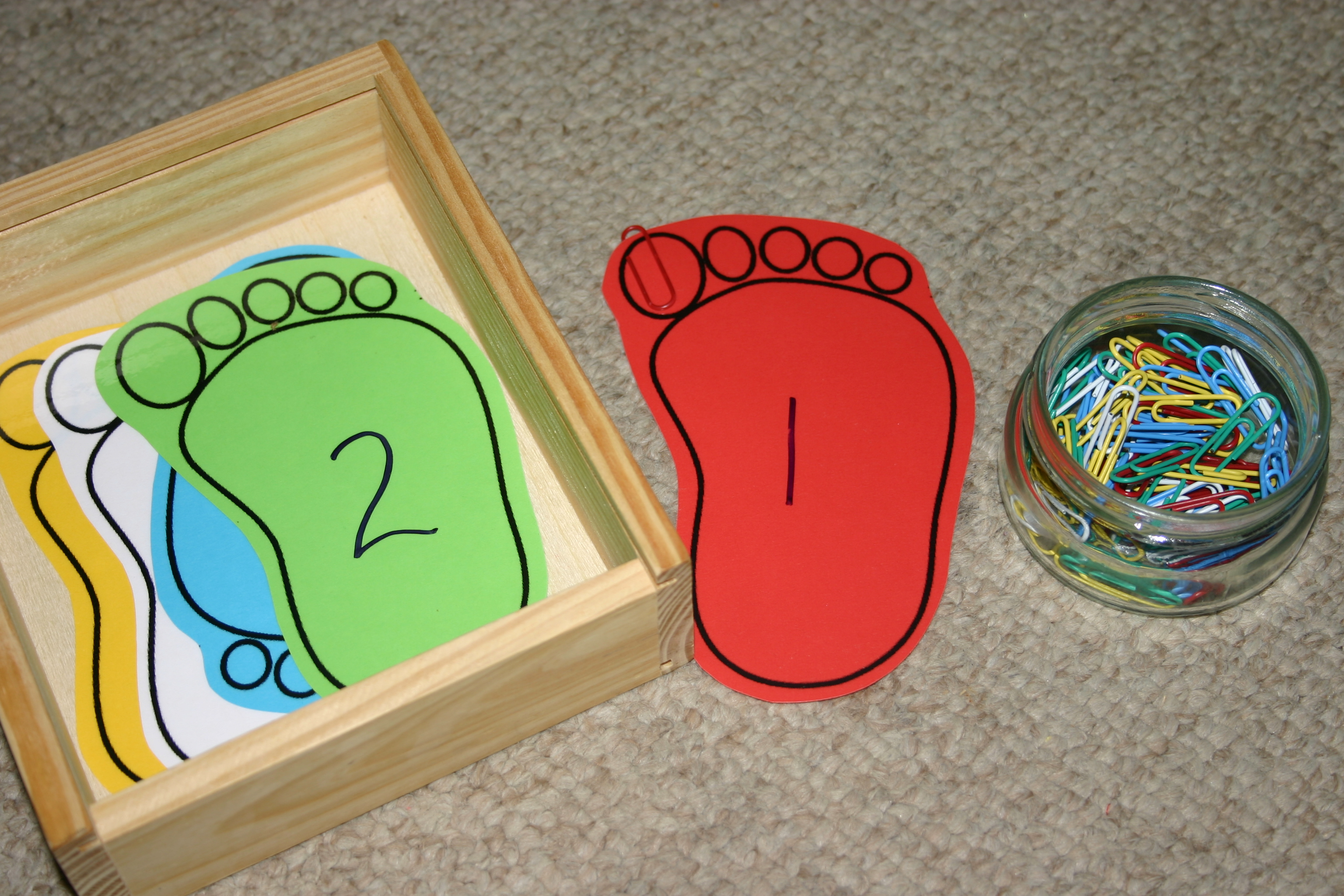
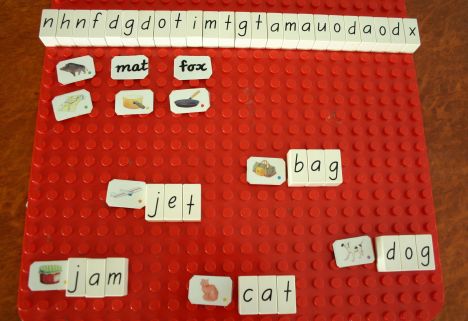
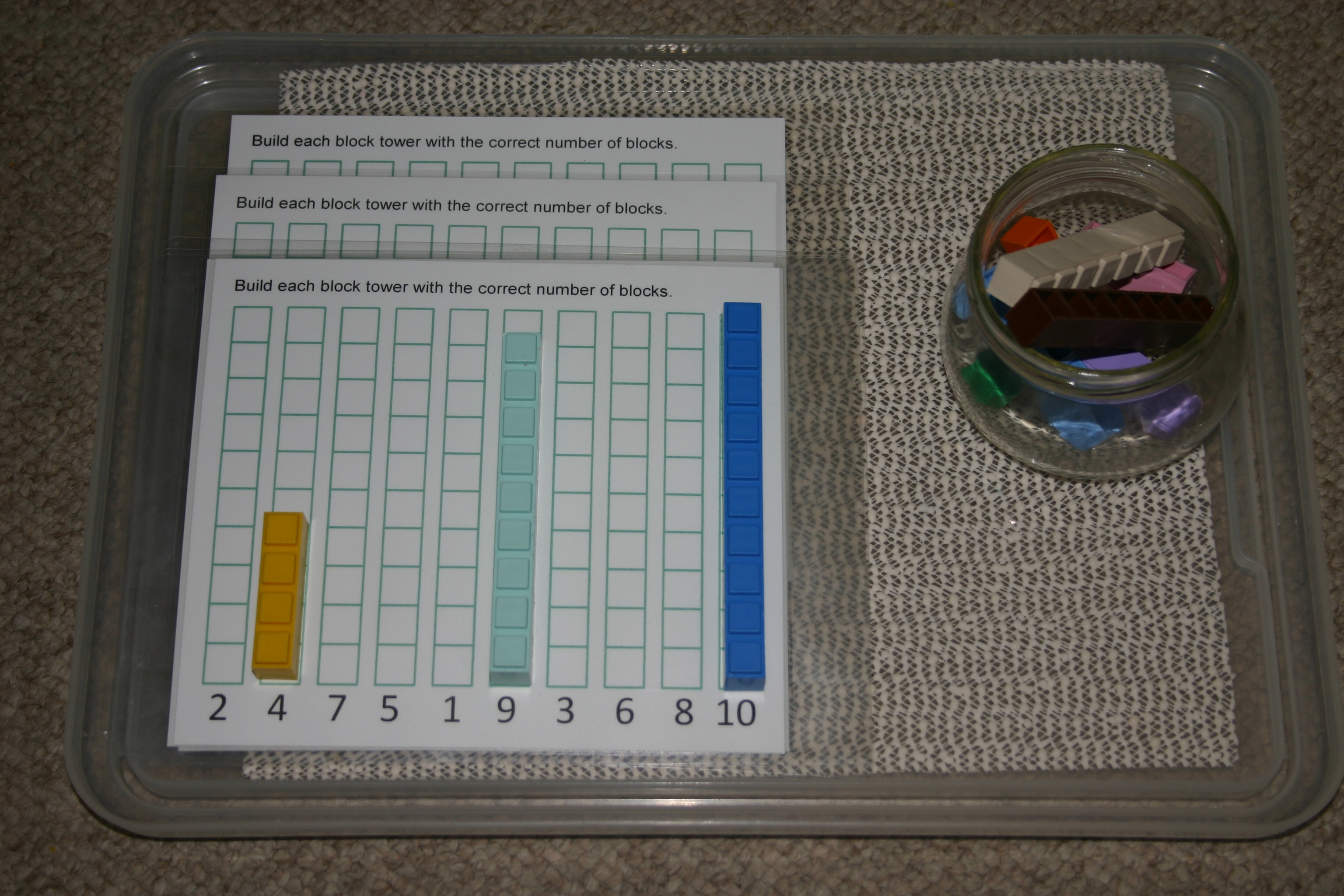
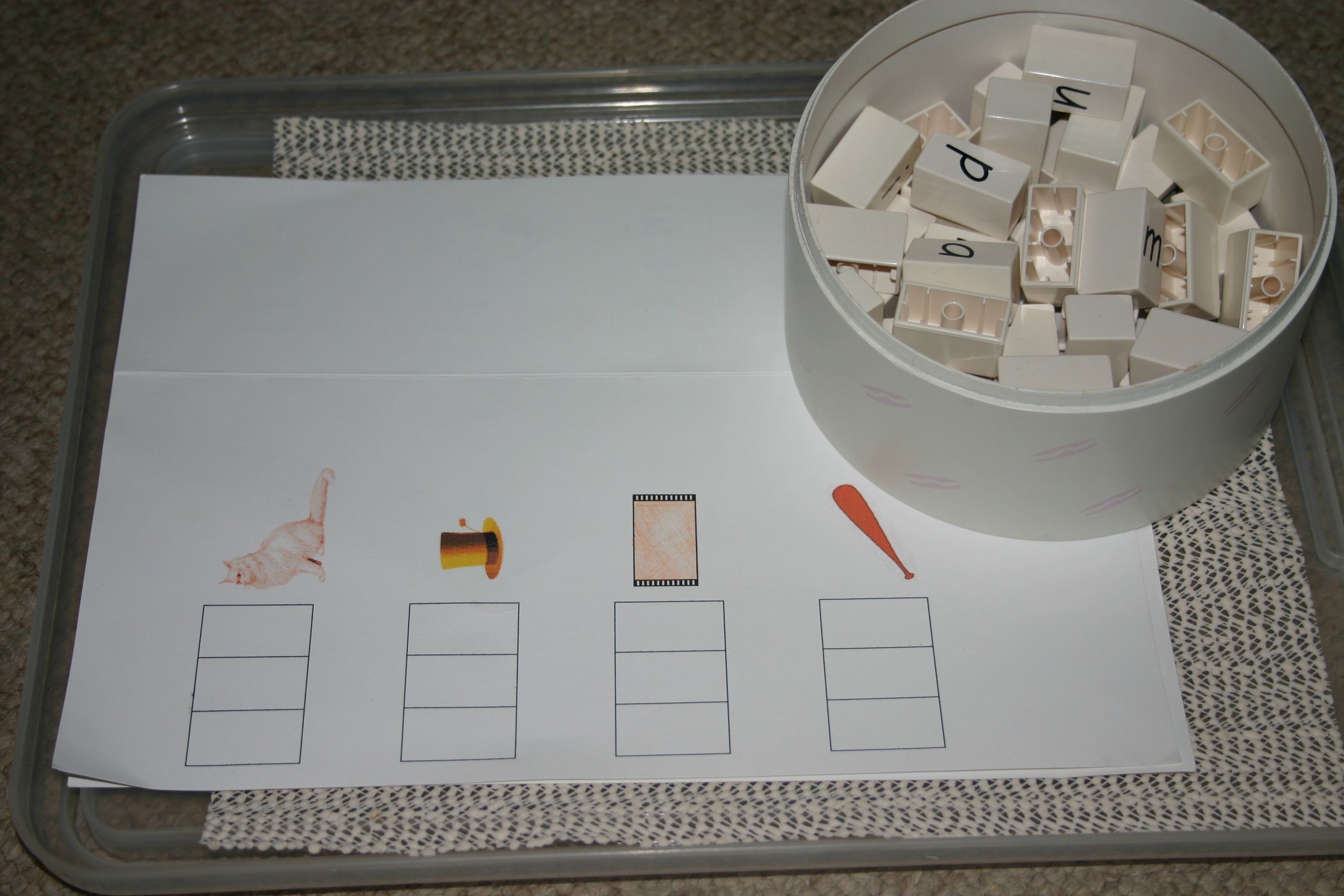
IMG_0115 It was time for an update of the activities available for my preschoolers this week. This cupboard is only used for “school” time with Mummy once a day by the twins (4 years) and contains our more formalised school activities – number and letter work etc. (Last months activities are here.) We are making the most of the next 2 months before baby number 7 is due to work on preschool skills. Once bub arrives these activities will be changed to more play based choices and able to be used independently, rather than requiring my direct supervision. Please keep in mind that I am not suggesting all 4 year olds are ready for this level of work. I work steadily with my children, moving ahead as far as their understanding and development allows. I do not stick to teaching skills by grade or age, but rather follow each child’s development as far as they are able. This changes from child to child and the ideas here are more traditionally at pre-primary to year 1 school level. It is more important that children learn to sit and concentrate, follow instructions, learn Godly character etc. than a list of rote learning or academic skills. The twins happen to be able to cope with these activities and show an interest in them so I will go with that for now. If it becomes burdensome and onerous for them, we will take a break. IMG_0097 I found these plastic tiles at an op shop. I have no idea what their original use was, however they link together nicely for this number sequencing activity. Having 3 colours meant I could quickly separate out only the 1 to 10 blocks, then add the 11 to 20 and finally 21 to 30 as they were able to complete the “path” as we called it. I provided a coloured number strip to use as a guide while they were still learning the numeral sequence. IMG_0104 IMG_0099 This is the same activity using a different style of block. These came from a build-your-own 3D desk calendar I bought for $1. You could also purchase Coko bricks which are almost identical and can be used on Duplo base boards. The twins have learnt to count to 30 out loud and have fairly good one-to-one correspondence so we are now working on recognising and sequencing numerals to 30. IMG_0105 IMG_0119 We use Mathusee in the early years (moving on to Saxon math later) but as my preschoolers are not ready to do a lot of written work I used the sequence of skills from the Primer book to develop a bunch of hands-on activities. These block manipulatives also come from the Mathusee resources. In the example above, the children need to recognise the numeral and count to find the right block to place above it. Click  HERE for a FREE PRINTABLE. IMG_0120 IMG_0121 Another Mathusee based activity; basic addition facts using the manipulatives and numeral answers. The number strips I have out at the moment are plus 1 and plus 2. Learning basic addition facts now will help with more difficult mathematical skills later on. Click the links below for FREE PRINTABLES: Plus  1 Plus 2 Plus 3 Plus 4 Plus 5 Plus 6 Plus 7 Plus 8 Plus 9 Plus 10 IMG_0122 We have moved on from letter names and sounds and identifying initial sounds to 3 letter words. These are Coko bricks and each board has groups of consonant vowel consonant (CVC) words with the same endings to keep it simple. The children carefully sound out the words and find the matching bricks to make them. IMG_0123 IMG_0124 The back side of the card has the answers to make the activity self-checking. No printable for this one sorry – the pictures are not mine! IMG_0125 These alphabet sounds books were simply a book form of flashcard. We use them to review the letter names and sounds and sticker the letters they know. I found the school font I wanted to use online, enlarged it and printed them out. IMG_0126 This is an initial sounds activity. Free printable circle pictures and letters are available from this blog. I made a simple backing page to use them in a slightly different way than the original author intended. The sets are sorted into 3 or 4 initial sounds in each envelope to keep it simple and avoid having the whole alphabet mixed up together. For a FREE PRINTABLE of my circles backing page click here. IMG_0127 IMG_0128 I made these consonant-vowel-consonant (CVC) 3 letter word matching cards using pictures from cheap sticker books. The children choose a picture and find the matching word card before turning the picture over to check their answer on the back. IMG_0129 A basic counting and/or colour matching activity from an activity bag swap I posted on a while back. The concept is far too easy for the twins now but I wanted something for fine motor skills so popped this one out again. The idea is to slide the correct number of paperclips onto each foot after ordering the numerals from 1 to 5. You may also require them to match the colours at the same time.
Flowers of Godly character

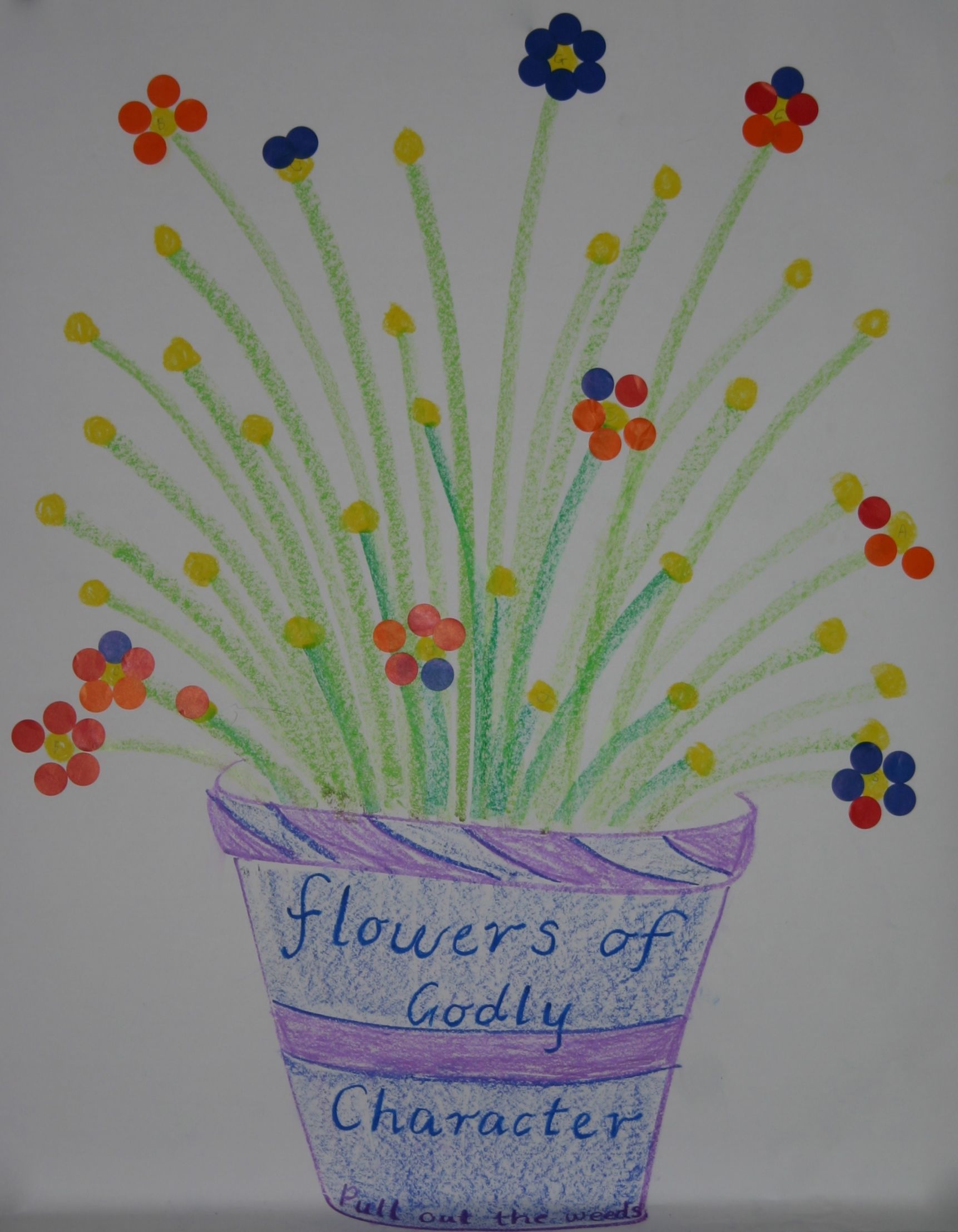
flower pot Godly character reward chart IMG_0076

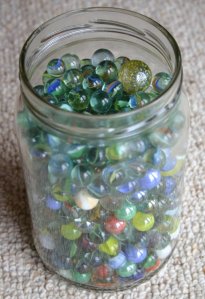
After holidays, sickness and general out of routine grumps hit our house recently, we needed something to lift the tone of sibling relationships. We have used several different systems for boosting kind behaviour and general character recognition in the past, but this time I wanted something similar to our praise plates; without a “prize” at the end. Our marble jar and treasure tree charts worked well although there was an end goal or reward that we were working towards – see the marble jar is full for a full explanation of the difference between bribes, rewards and goal incentives.

Our treasure tree reward system.

Our treasure tree reward system with a slightly different ending than planned.


After reading “The Weed With An Ill Name” we have had a lot of discussions and prayer based on the concept of pulling the character “weeds” out of our hearts and replacing them with Godly character “flowers.” I decided to base our system around this idea and build on the interest that was already there by calling our chart “Flowers of Godly Character – Pull out those weeds!”

Each yellow centre is given the child’s initial who is “growing” the flower and as Godly character is displayed they are able to add a petal. Five petals complete a flower and another is started. Having each flower initialed means they are able to see the flowers they have grown, but the pot of flowers is something the whole family is working together to grow.

No reward other than being able to see the flowers you have planted being added to the pot is given, but even so, the children have huge smiles and are very happy to be awarded a petal.

For more ideas on building character and family identity see:

Sizzlers and grace

Filling their love tank: the 5 love languages of children

Spoiled walls; bickering and sibling conflict

101 family night ideas Relationships – joyful or difficult, they all need the 5 A’s

Sharing bedrooms; pros and cons

IMG_6286 4 in mummy and daddys bed

To share or not to share? Bedrooms, not beds that is! Some of us have a choice and others have children sharing bedrooms as a necessity. Over our parenting years we have experienced both – siblings in separate rooms and bunking in together.

Some of the benefits of sharing we have seen are:

  • closer relationships and bonding between brothers and sisters as they share their space together.
  • a sense of responsibility and big brother/sister pride (in a good way) as the older children take care of younger siblings. We heard a great story a while back about a younger child who thought of their older brother as his ‘guardian in the ceiling’ during the night. My eldest son commented at the time that he couldn’t wait to be his little brother’s guardian.
  • older siblings are aware of issues in the night and can get help from Mum and Dad without the entire house needing to be woken up or in some cases solve the problem quickly themselves. In the event of a disaster (fire etc.) young children have an older child to help get them safely out. We also discuss and role-play what to do in these situations because it is abundantly clear to us through our own experience that even children who you think would react well in a crisis don’t necessarily have any idea of what to do. (But that’s a post for another day!)
  • a sense of security. Our children dislike being in their rooms alone now if a sibling is away for some reason and are much happier sharing .
  • character flaws come to the forefront and need to be dealt with! It doesn’t sound like a plus but it really is. Children who have their own little private world can hide a lot of selfish attitudes and other problems because they are not challenged in this area. My children’s flaws are out there on display! Hopefully these will be much improved in the long run because they are forced to face them and work on them now. Learning to share your space and respect others is a skill.
  • extra room. We know families who choose to have several siblings sharing in each bedroom so they can use another bedroom as a toy room, computer room, office etc. to give the family more living space during the day. For some, the bedroom is simply that – a room for beds and sleeping and nothing else. The family is then together in the common spaces of the house which leaves no problems with a child (particularly a teenager) isolating themselves from the rest of the family.

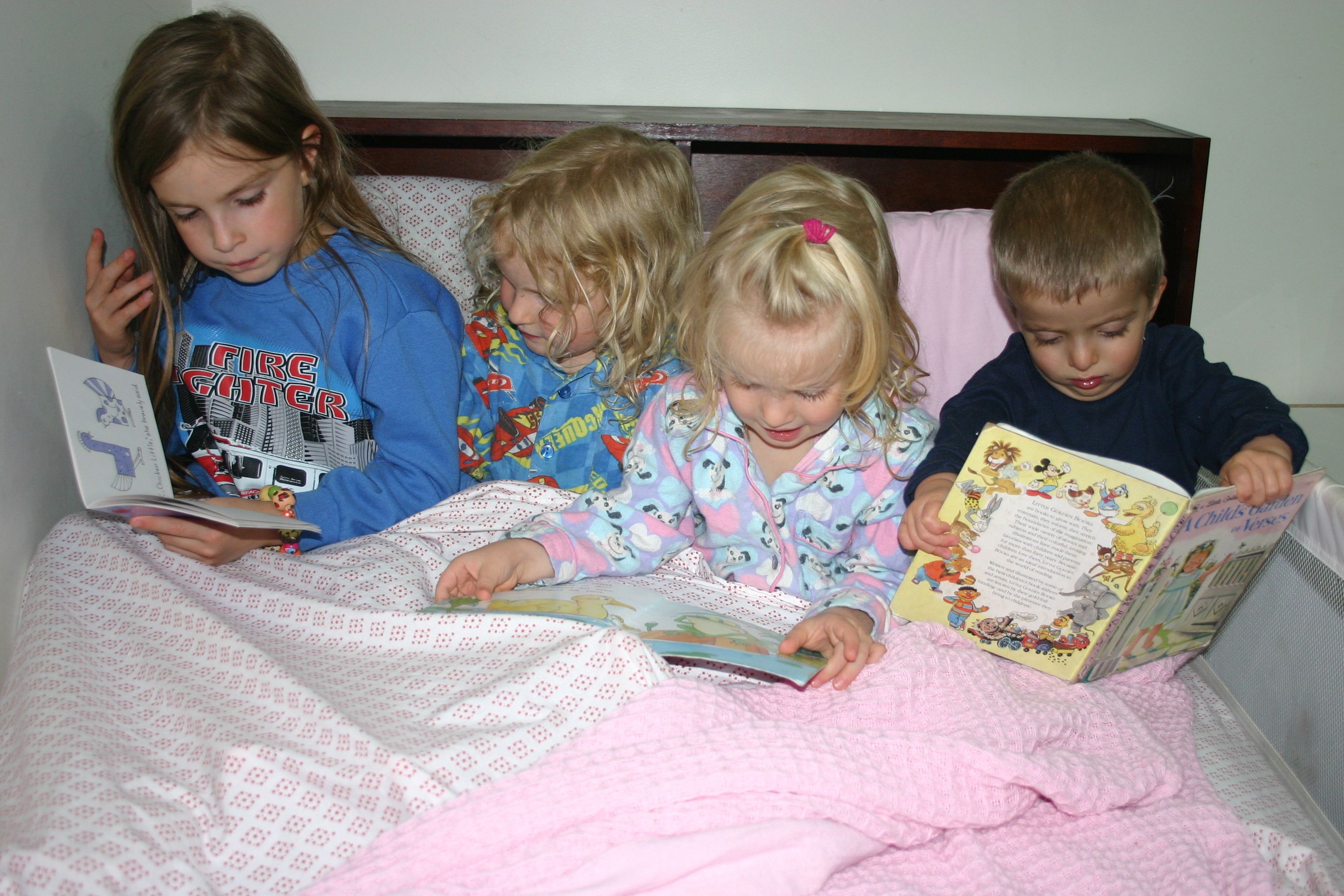
IMG_6642 4 reading in s bed

The negatives we have faced are:

  • changing sheets on top bunks.
  • having to deal with behavioural issues at night when you just want to sit down and relax. (Children talking and keeping themselves or others awake. Early risers waking others up in the morning.)
  • sorting out fights over who made the mess and who should be cleaning it up.
  • one child disturbing another during the night going to the toilet, sleep talking etc. (Most of ours sleep through anything, or fall back to sleep in seconds if woken.)

Looking at these two lists, we still feel that the positives outweigh the potential negatives, but we have had to work on overcoming the issues. We have used several different methods over the years, depending on circumstances (age of children, mix of personalities etc.) that have been helpful to us. Some of these are:

  • getting Daddy to change the top bunk sheets on a weekend when they need doing, especially when I am pregnant 🙂
  • proactively managing our morning routine right from the time a child first moves from their cot into a big bed. See this post on moving to a big bed and managing morning routines for a full explanation of how we do this.
  • teaching children to respect each other’s belongings. They are not allowed to take their brother or sister’s personal items without getting permission first.
  • ensuring that every child has their own space and some belongings that are off-limits to others. Each child has a private area in the form of a desk and shelving, bookshelves or cupboard.  Sometimes this space is in their bedroom, sometimes in another room.
  • staggered bedtimes so hopefully the first child is asleep or at least very dopey by the time the second gets to bed.
  • allowing some quiet talking in the dark for a short period after lights out. (Also a great way to build positive relationships between siblings.) One of us will say goodnight and turn out the lights. The children are allowed to talk quietly to each other until the second parent comes to say goodnight, then quiet is expected.
  • playing an audio bible CD, an audio story or music on a portable stereo very quietly so that they have to be quiet to hear it.
  • setting consequences for those who simply won’t stop disturbing the other child(ren.) Sometime this does mean chastisement, but we have also used other consequences such as the offending child having to pay back sleep time lost with interest! This can take the form of a compulsory nap the following day, going back to bed during play time the next day or going to bed much earlier the following night. Children who wake others up in the morning may also pay back sleep time, be chastised, do all the morning jobs of the children they have woken up, or perhaps sit in the laundry during morning reading time instead of staying in their beds to read with the others. Ours very quickly get to the stage they want to share a room and REALLY don’t want to go back by themselves so if we have the luxury of a spare room sometimes the consequence was that they went back out alone for the night. They hate that!

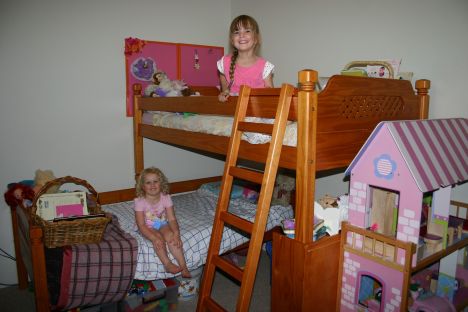
IMG_5088 g and c bunk together

Some other points to keep in mind:

  • Make sure day sleeps are not too long (or need to be dropped entirely) so that they are ready for bed and sleep straight away.
  • Make sure they get adequate physical exercise during the day.
  • Ensure children drink a lot of water earlier in the day. Children who do not drink enough will have trouble falling asleep, want to drink a lot at night/just before bed and end up needing to get up repeatedly to go to the toilet (or wet the bed) later in the night. Don’t focus on getting them not to drink before bed, focus on getting them to drink in the morning and throughout the day instead.
  • Some children (especially older babies/young toddlers) put themselves to sleep by having a little chat and sing to themselves or teddy in the dark on their beds. This isn’t a problem when they have their own room but it does drive older children who are trying to sleep crazy! For us it really did seem to be more a developmental stage than outright disobedience – a voice control issue rather than defiance. Working on voice control during the day by having some set times where they read books or do an activity when they are not allowed to speak helps with this.
  • Some people say that having children sharing right from the beginning eliminates many problems. We have never done this, always having our babies in their own rooms so that they do not disturb other children when waking for feeds. Each child has transitioned to a big bed around the 2 year mark (a few months before the next baby arrives) and so far we have always had the luxury of this being in their own room. We can then work on staying in bed, morning routines and all the rest without disturbing older children. They shift into shared arrangements somewhere between 3 and 5 depending on the arrival of subsequent babies! We will eventually run out of space to do this but so far so good.

The blessing we have received in our many children far outweighs the inconvenience of having to share bedroom space. After all, God tells us that children are a blessing. He doesn’t mention needing their own room as a prerequisite to welcoming a large family!

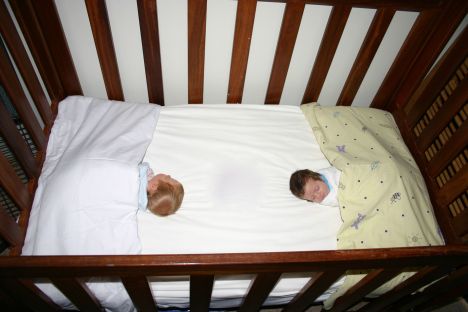
IMG_4048 twins in cot

Biblical courtship V’s cultural dating

outdoor dress-ups

I have read a few parenting books recently dealing with a variety of issues, dating being among them. The prevailing theme has been along the lines of “how to protect your child’s purity while they date.” As I read them my prevailing thought has been “Why are you putting your children into those situations?” ALL of the issues they talked about avoiding can be totally avoided by refusing to participate in the worldly practise of dating.

One of the main problems is that we are so used to the way things are (and were for most of us) that we forget to look at these things with a biblical worldview. Everybody (and by everybody I mean everybody in our Christian communities, peers and friends) is doing it so we figure it’s ok. I would like to suggest that there is an alternative and while it seems radical, out of touch, fundamental and just downright naive and ridiculous (to name but a few!) but it may just be a whole lot more like God’s way of doing it.

Before you think to yourself “My kids are young, we’ll worry about this later” – stop and realise that dropping the idea of courtship onto a teen for the first time will not go well to say the least! Preparing your children for a pure and biblical marriage starts now; in the early years. Our children witness relationships around them all the time and we use the discussions that arise as springboards to plant the seeds of biblical worldview.

Biblical courtship is against the mainstream to say the least but there are families out there who are successfully implementing it (some of whom we have seen in action) and far from being arranged marriages these unions have been blessed indeed. Before closing your mind to the idea, have a listen to this sermon on dating by Paul Washer and read a book or two on the subject. You may just find yourself with a whole new worldview.

While I do not necessarily agree with everything in the following titles, reading through a variety of books on the subject helps me to consolidate what I do believe. With that in mind, some titles I recommend are:

A Dating Sermon (free audio) by Paul Washer

It’s (Not That) Complicated Anna Sofia & Elizabeth Botkin

Before You Meet Prince Charming Sarah Mally

What He Must Be (If He Wants to Marry My Daughter) Vodie Baucham

Her Hand In Marriage (Biblical Courtship in the Modern World) Douglas Wilson

(In the interest of disclosure, if you choose to purchase these titles at Book Depository after clicking these links I do get a 5% bonus for sending you their way, however I never recommend resources unless I have personally read and loved them and have them sitting in my bookshelf as titles that have shaped my beliefs and parenting practice.)

Preschool at my house – large family homeschooling (with toddlers!)

finger painting cleanup IMG_9912

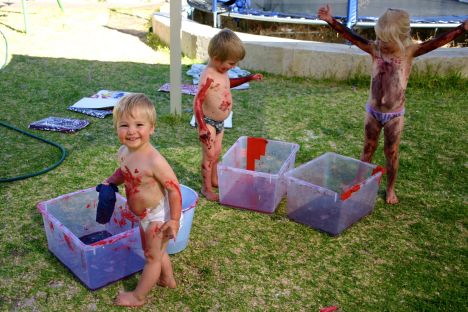
Fingerpainting – 5 minutes of actual finger painting (in the bottom of the tubs) then 45 minutes of cleaning up! First the tubs, then the kids. They did seem to have fun though.

I have been asked a few times recently what I am doing for preschool with my 4-year-old children. There have been no major changes to how we have always done things; we just take the sitting and focussing skills they have already been learning during mat time, playpen time, room time, highchair time and other periods of focussed play and apply them to the next level of hands-on learning.

We have been focussing on basic counting skills, learning our letter namessounds and identifying initial sounds (moving on to 3 letter words) and other hands on activities that promote fine motor skills. (Plus some other kindergarten style activities that are pretty much just for fun.) I work with just the twins for 20 minutes each morning, which gives them some focussed time with Mummy before I go on to the older children while the twins do independent activities on their mats.

This short period of time I know by experience (coupled with the learning they receive during our daily flexible routine, reading times etc.) is enough to give them a strong start in all the learning areas as they get older. Preschool need not be particularly complicated, formal or arduous to be effective and it does not need to take all day. We do some more formalised work at this age because they are ready for it and enjoy doing “real school” like the big kids. If these two factors were not in place I would back off until they were ready.

Here is a snapshot of the activities we have been doing over the last 2 weeks.

twins school cu0pboard 2 IMG_9839

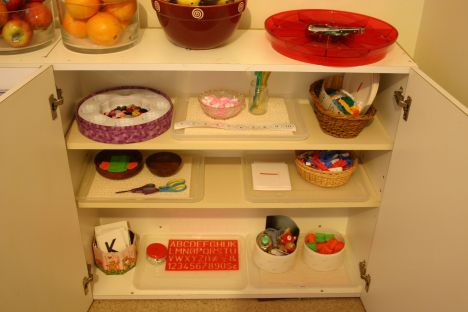
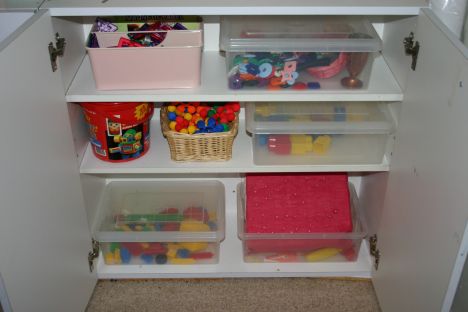
Our preschool activity cupboard for “school with Mummy” time.

mat activities IMG_9858

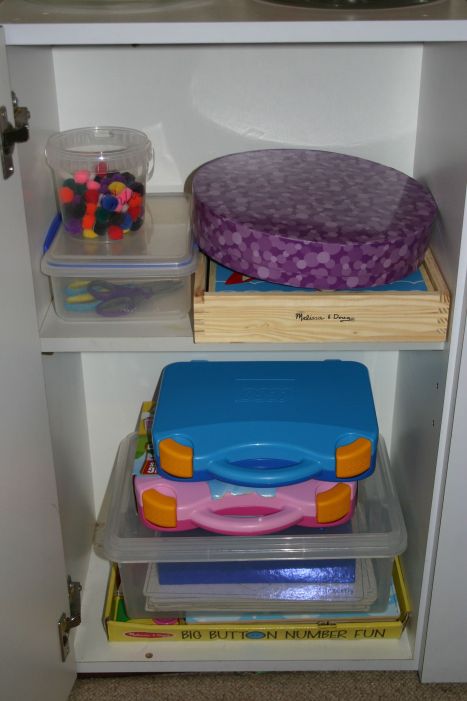
Mat time activities cupboard – Lego, counting button puzzle, pattern blocks and puzzle cards, button sorting, cutting and magnetic pompoms.

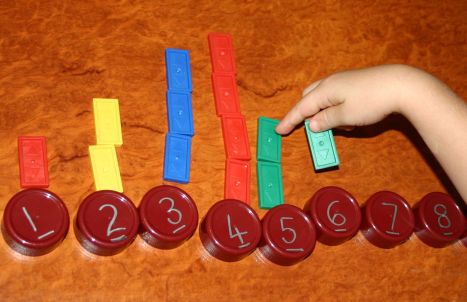
numbered lids counting 1 to 10 IMG_9917

Counting 1 to 10. Spice jar lids marked with metallic pens and some plastic tiles to count.

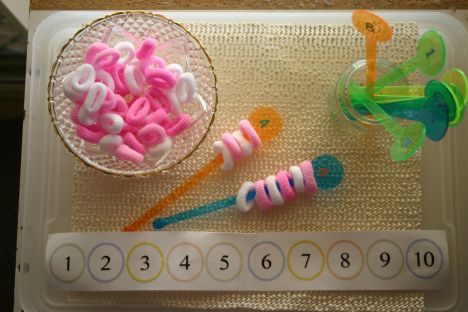
hair lacky counting IMG_9833

Hair elastics and swizzle sticks marked 1 to 10. The number strip is to follow until they know the order of the numerals.

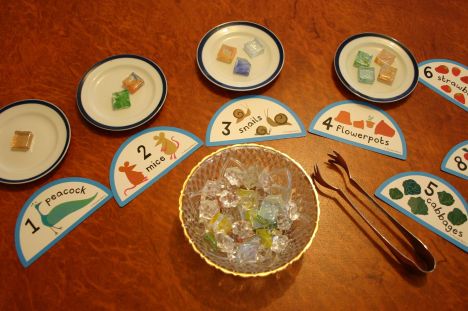
jewels and creature cards counting IMG_9926

Another number sequencing and counting to 10 activity, combined with some tong work for pincer grip strength.

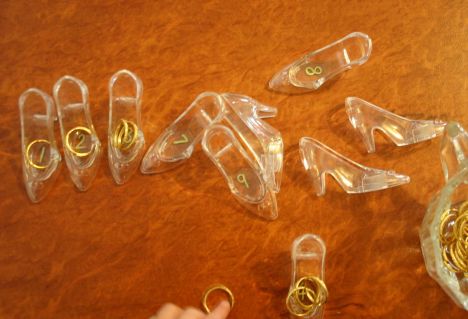
glass slippers IMG_9923

Counting golden rings to match numbered “glass” slippers (wedding favours.)

initial sounds worksheets J IMG_9973

Initial sounds activity sheets. Just a bunch of pictures to decide if they do (circle them) or don’t (cross them out) start with the correct sound. Large letter in centre of page to practise letter formation in. Doing some written work makes them feel like the big kids – they love it! Takes 5 minutes so not at all taxing for me or them.

plate addition 2 IMG_9966
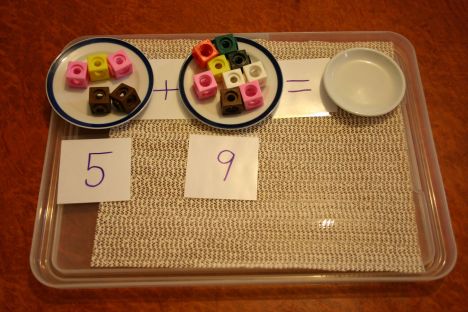
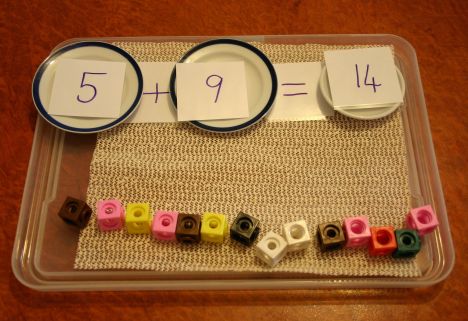
Addition tray. Now the twins can order numerals to 10 and display reasonable 1-to-1 correspondence we have started basic adding and subtracting activities.
plate addition IMG_9965

Ideally the plate for the total would be bigger than the other plates! The idea is that the two plates are tipped together into the last plate to find the total. I find however that having the blocks in a line makes it easier for them to count without re-counting the same block repeatedly.

twins doing addition trays IMG_9971

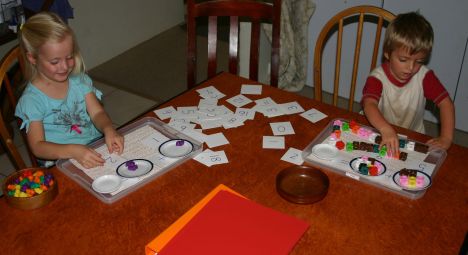
These school activities are definitely not independent as yet. The moment I left to take a couple of photos, my son started building trains with the blocks!

duplo 3 letter words IMG_0001

The twins have developed their ability to hear the initial sound in words and we are now working on 3 letter consonant-vowel-consonant (CVC) words. The next sound most children hear is the last sound in the word, followed by the middle sound. These letter tiles are Coko bricks that are compatible with Duplo boards. Good for beginning activities for non-writers or those who find writing tedious.

s sunflowers IMG_9870

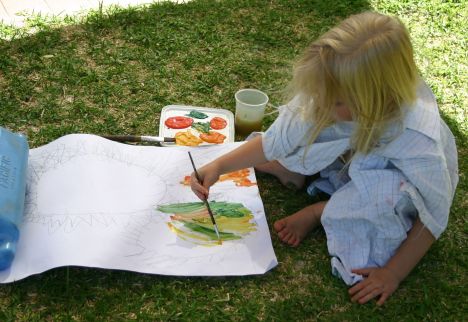
Art – 4 year old’s version of Van Gogh’s sunflowers. We actually got around to doing a proper picture study. Forgot to take photos of the older children’s work, but some of them were better than mine!

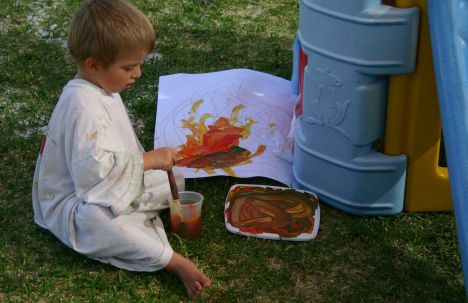
j sunflowers IMG_9868

Who cares about sunflowers? I can mix all my colours into a great brown sludge!!

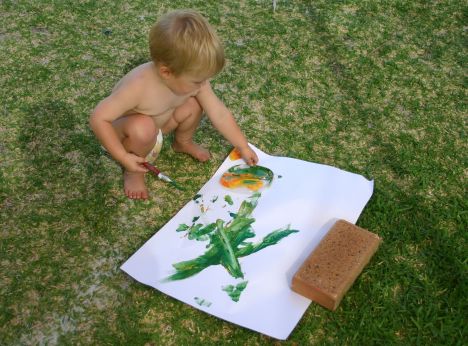
a sunflowers IMG_9873

Toddler version of sunflowers. He actually didn’t want to paint anything at all. I practically had to make him do it just for the photo 🙂 Doesn’t like dirty hands!

twins school cupboard IMG_9859

What do you do with a toddler while you homeschool? Heaps of things!! Here are just a few and if you follow my blog at all you know there are many more ideas to be had. Step one – train them to sit and focus. Step 2 – find some engaging activities. Step 3 – pop them in the playpen when they have had enough of highchair time, followed by a good session of running around outside to burn off energy. That’s just the current morning routine while the older children get the bulk of their work done. It has changed many times.

magnet activity a IMG_9830

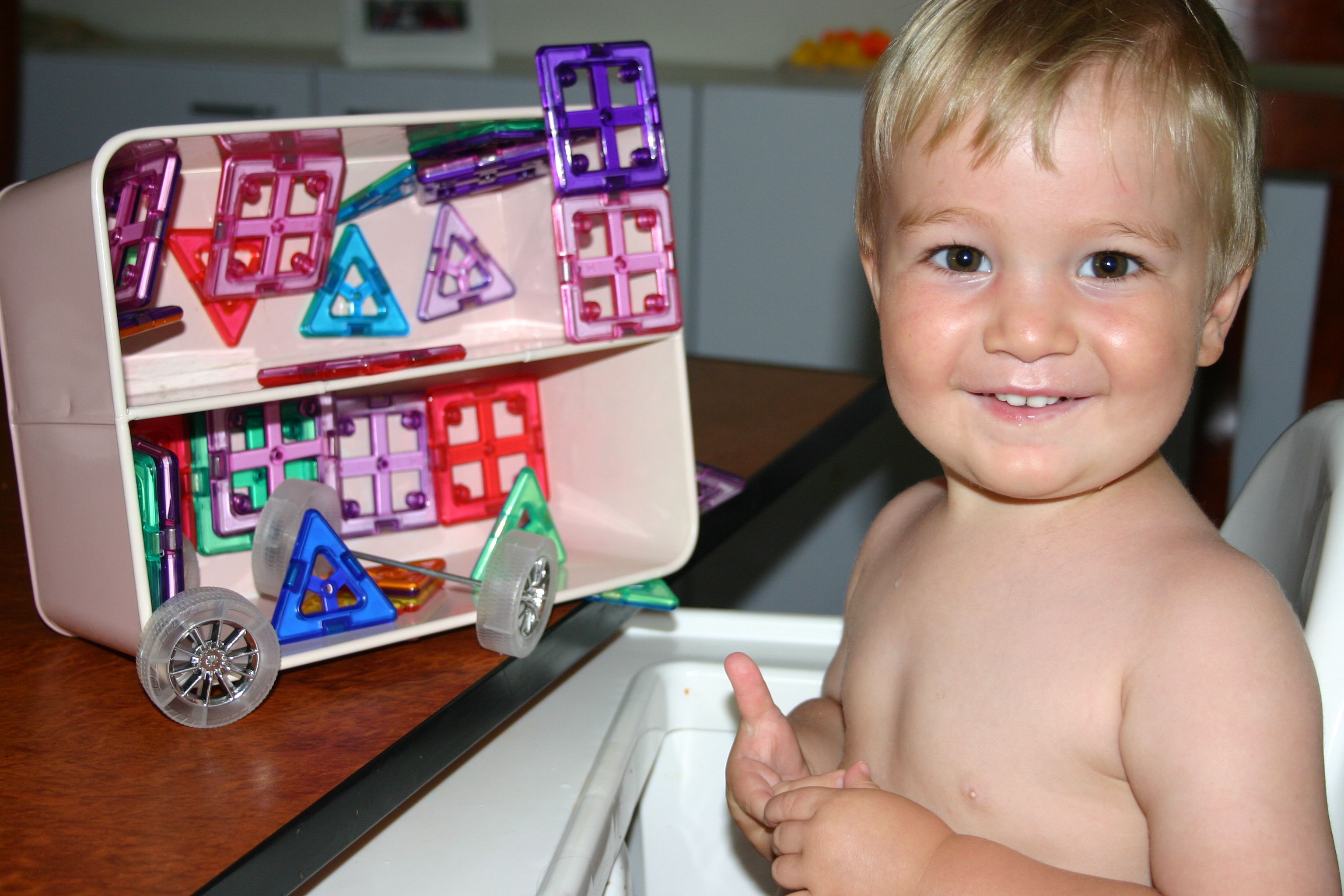
Magnetic blocks in a metal box. Stroke of genius to store them this way – NOT!! This was the only container I had and when I put them in it occurred to me that it would make a great building platform. Pure luck!

asher dressed up IMG_9937

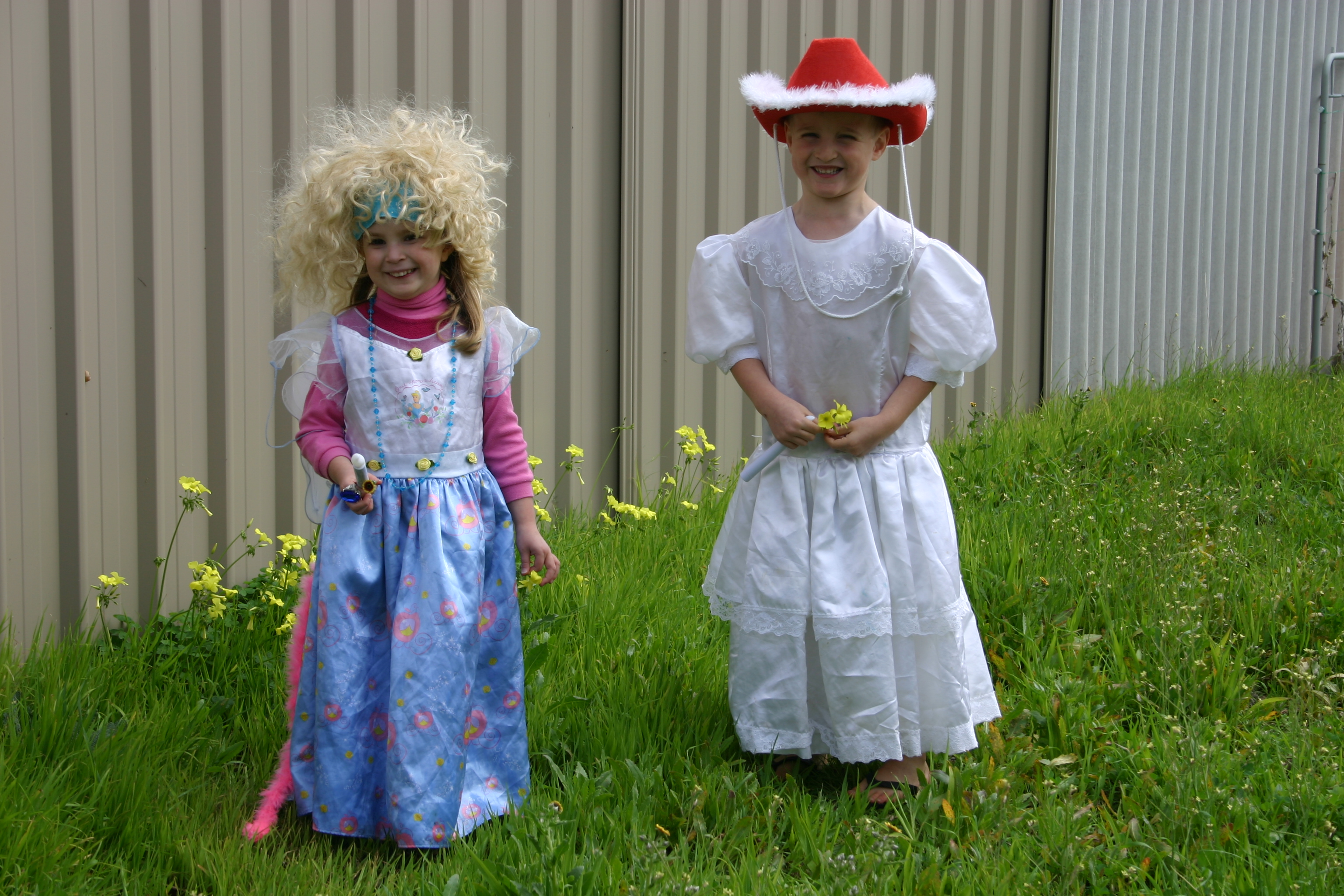
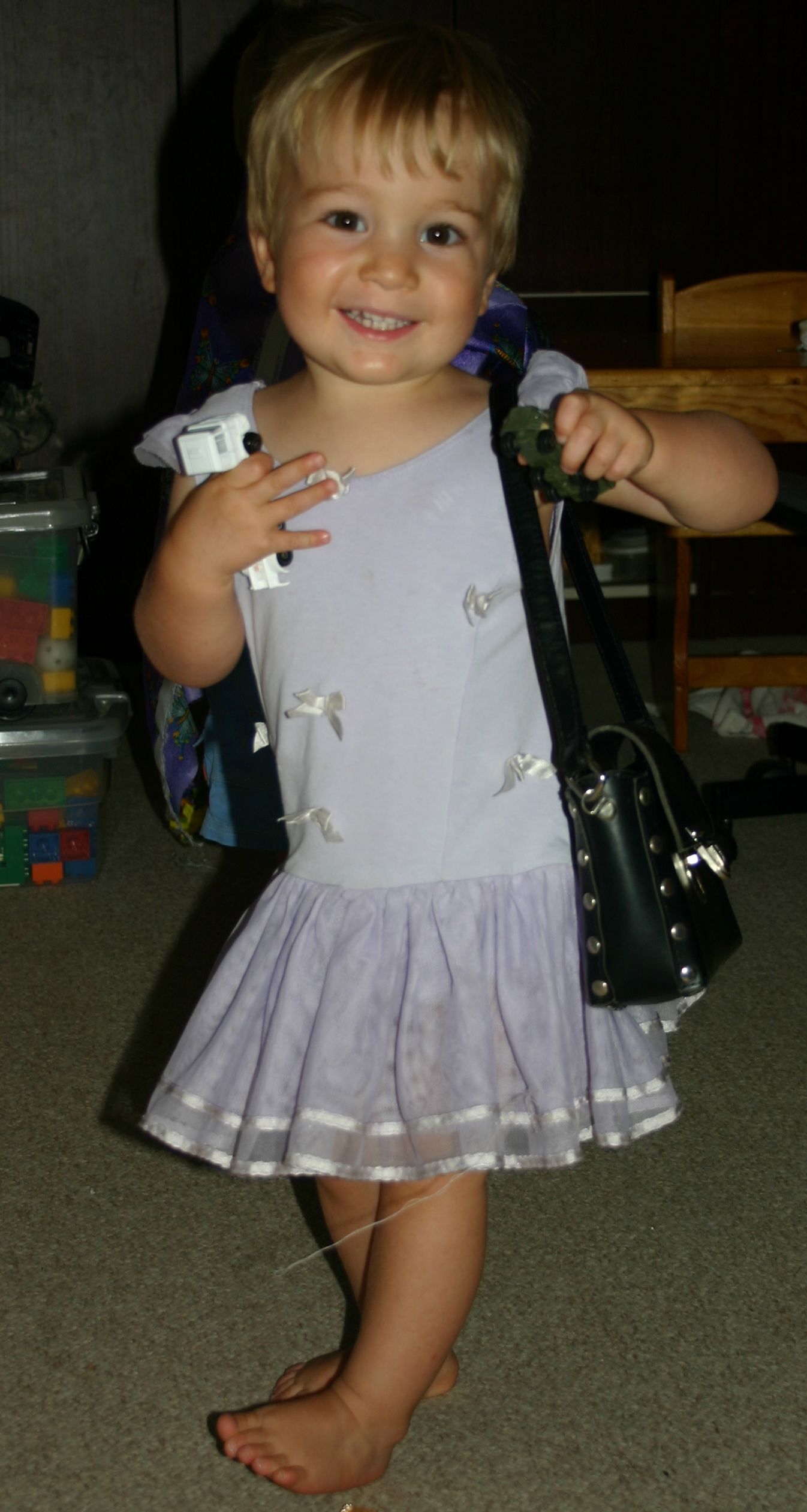
What has this got to do with school time? Nothing at all! Just another one of those great embarrassing photos we are storing up for our kid’s 21st birthdays. Plus, he’s so cute! For those who are worried about the girlie outfit, please note that he is carrying 2 trucks!


Montessori style hands-on tray activities for toddlers and preschoolers

Activities for young children are cheap and easy to put together and the peace they will bring to your daily routine is priceless! Teaching your little ones to sit and concentrate for extended periods is one of the key skills every parent should be working on in the early years and one that will pay dividends in the future. Choose a variety of attractive materials that will stimulate their interest and be prepared to change them fairly regularly. It is important that the activity is not too difficult nor too easy. A little bit of a challenge will keep them interested – too challenging and they will be unable to succeed. If you present a tray that is too difficult, simply remove it and put it away for the future. Chances are they will love it in just a few short months.

I have written several posts detailing how to train your children to sit in their highchair, mat or playpen and the practicalities of when and how to change activities. Getting started takes a little extra time, but once you have built “tray time” into your day, it will become something your child looks forward to. Place them somewhere near you so you can chat and interact while you are cooking or doing some other task that enables you to encourage them in what they are doing when they need it and keep an eye on those smaller objects that they may find tempting to put in their mouths. Here are several ideas for the 2 to 5 age-range (approximately) that I have used in the past with my own children.

Sliding oversized paperclips onto matching coloured cardboard squares.

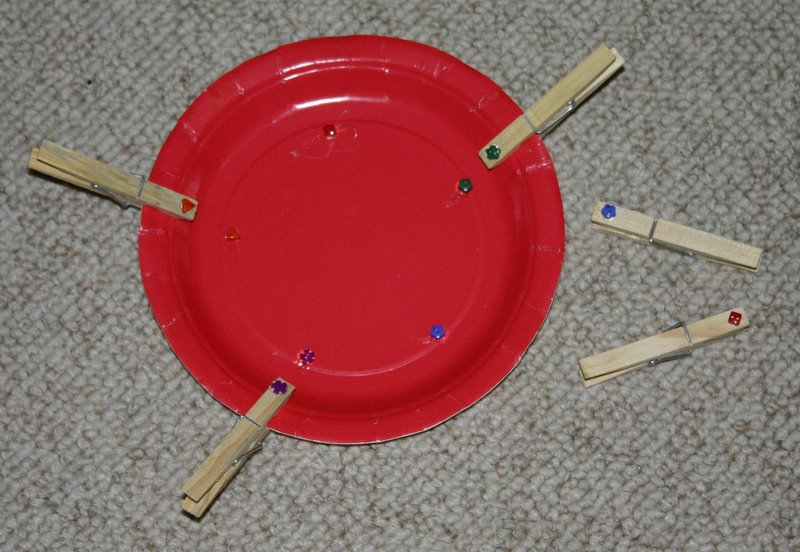
Matching clips to coloured popsticks. Great pincer-grip training for later writing. Make sure the clips you get have long enough handles and are not too stiff to open. These clips have one short and one long side and the children were not able to grip them properly.

Sorting popsticks by colour.

Tong transfer combined with colour sorting. The flowers came from a cheap plastic Hawaiian lei.

Duplo colour sort.

Tong transfer combined with bead colour or shape sort.

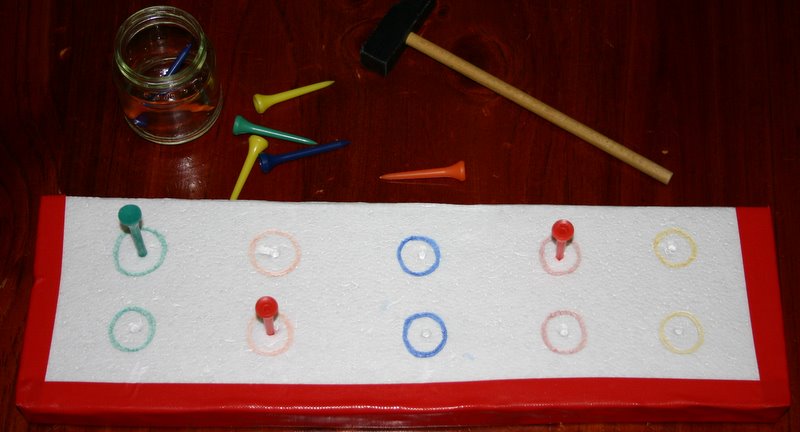
Golf tee hammering by colour. A piece of foam salvaged from packaging and a light wooden hammer from a Tap Tap game.

Colour and shape match combined with pincer grip practise while pegging.

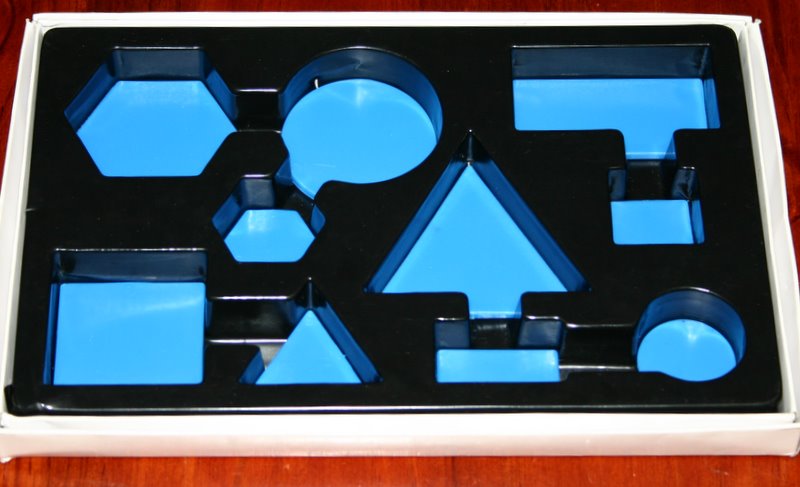
Shape puzzle. This is a commercial set of attribute blocks. I remove all bar one set of the same colour and thickness and use it as a simple shape puzzle. Once they master this, I add other colours and thicknesses back in.

Pattern blocks are lots of fun. Leave them out on a small table and even your older children will not be able to resist putting a bunch together to make a picture. Young children enjoy the matching cards you can purchase to go with them.

Geoboard matching. Little ones just experiment with elastic bands but older children can do a variety of extension activities. Matching and copying geometric shapes is one.

Shape matching cards. You could use them for basic card games as well.

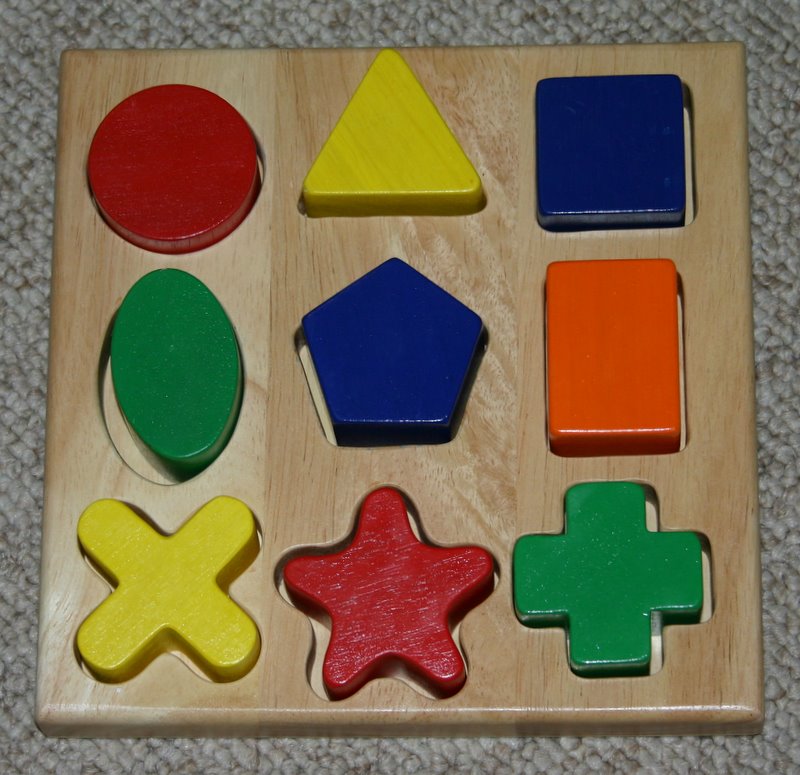
Good quality wooden puzzles are always attractive for children.

Chunky, simple puzzles are a good start for younger kids.

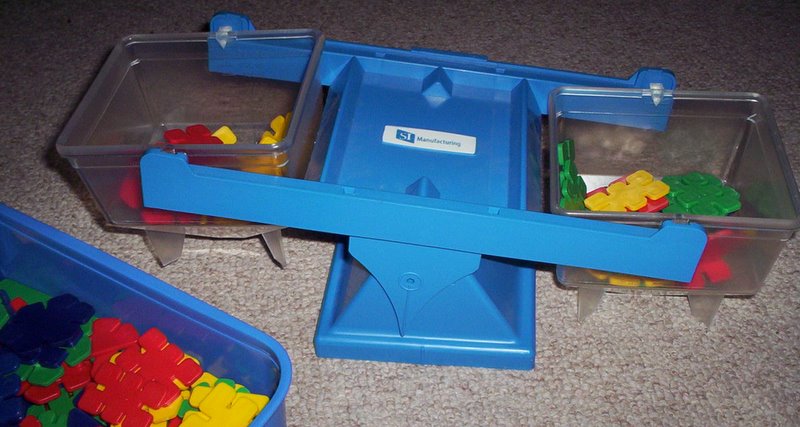
The concepts of heavier, lighter, full, empty etc. can be developed while playing with a set of balance scales.

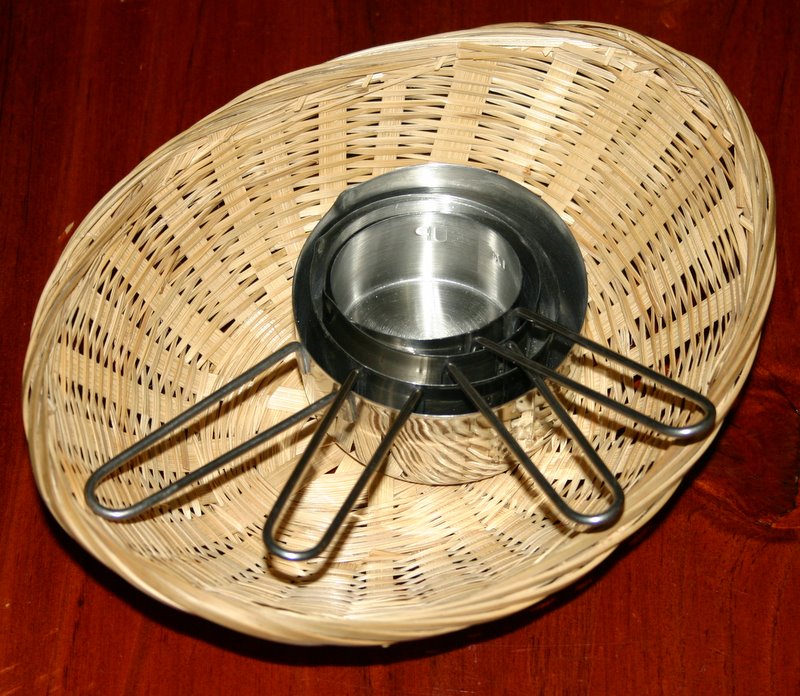
Stacking and nesting objects develops the concept of size seriation; in this case, measuring cups.

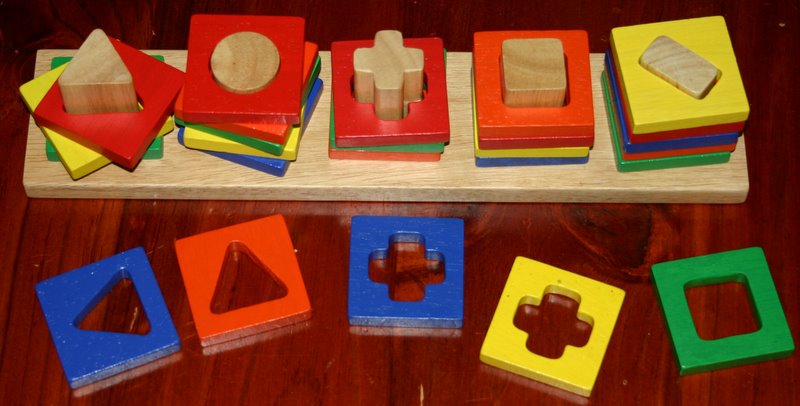
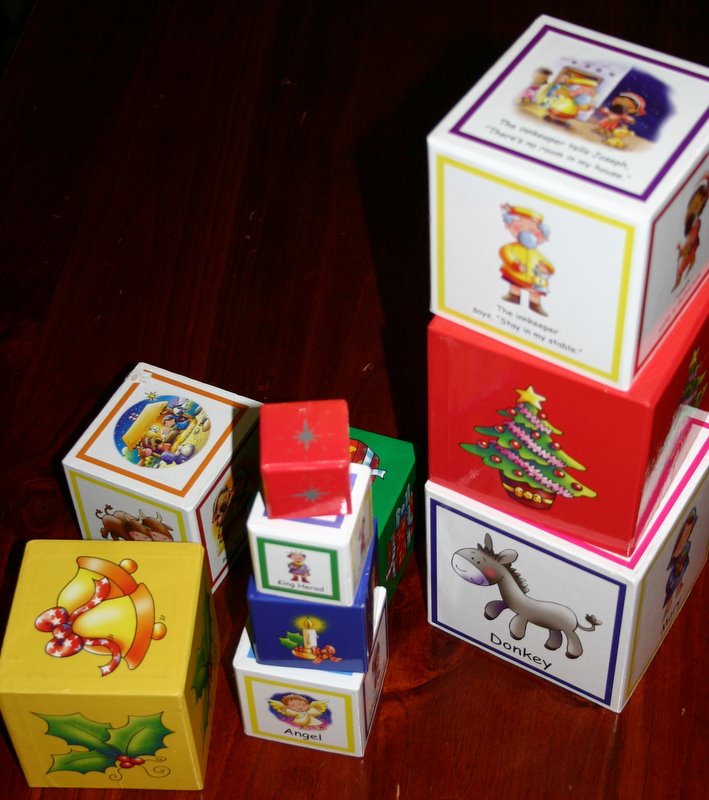
This is a cardboard stacking box set that does the same as the Montessori pink tower. Not as nice but a lot cheaper!

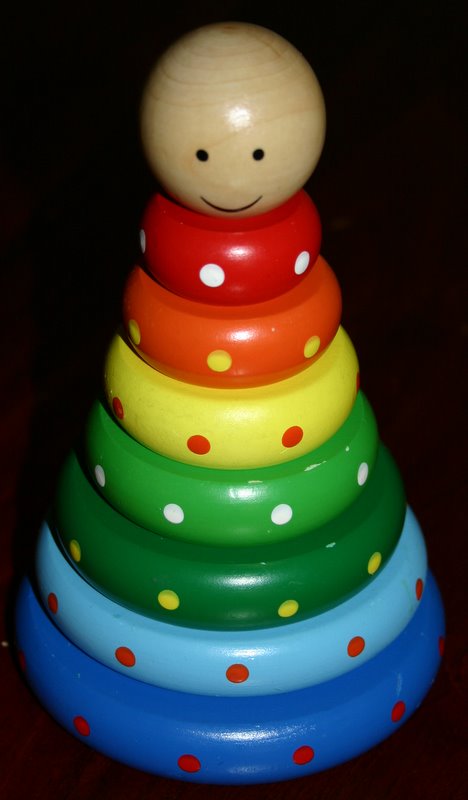
Graduated wooden rings.

Picture to picture matching.

Matching picture halves is a good introduction to puzzles for those who get overwhelmed with too many pieces. Start with just a few pairs and work up.

Spinny Spellers

The twins are starting more of a preschool type programme this year. Lots of counting, letter sounds and recognition and the like and on to three-letter CVC (consonant-vowel-consonant) words. A nifty little tool for teaching these three-letter words is the spinny speller. I have seen nuts and bolts versions and some very nice commercially produced Montessori products, but here is my home-made version. A little rickety perhaps but they will do the job!

spinny spellers

Often spinny spellers have a random assortment of consonants and vowels. The children spin the blocks and sound out the resulting combination to practise reading 3 letter words. I separated mine into one for each vowel so that every word will always have the same centre sound to make it simpler for beginners. The letter combinations I chose make as many real words as possible but occasionally nonsense word combinations will come up which is just part of the fun.

I used a small wooden craft dowel from Spotlight with 2 wooden beads glued to the ends to stop the blocks falling off. The cube blocks are cut from a length of wood and I hand-drilled the holes. (Thus the wonky alignment – couldn’t be bothered measuring the centres and just did it by eye – should have measured!) Just thread the blocks onto the dowel, leave a little space for them to spin around and glue the beads on the end. Write your chosen letters on with a permanent marker and you are done.

Mega list of table activities for school aged children

Here is the last post in a 3-part series of table activities for babies to school-aged children. Today’s chart of ideas is for the older group. By this age, my children are usually free to choose their own activity (within reason) as long as they display a good attitude on the few occasions I do choose for them. (See choices.) Much of what is on this list are items that are owned by individuals (birthday gifts etc.) so they are not out for public access, but having them on a list prompts them to get out items they may forget for a while.

As with the baby and toddler ideas and preschool children’s ideas, this is a large file and will take some time to download.

table activities for school age children – click here for free download

table activities for school aged children

Mega list of table activities for preschoolers

Following on from yesterday’s post (list of highchair and table activities for babies and toddlers), here is my collection of preschool ideas to use for any time a quiet, attention grabbing activity is needed. Please see yesterday’s post for links to articles on how to train your children to sit for an extended period of time, even at a young age. Even the most interesting activity will not stop a child from wandering about if that is what they are used to doing.

There were too many ideas to fit on the one page, so there are 2 pages to download. Please be aware that because of the large number of photographs on the posters, the downloads may take a long time to come through. Just walk away and have that cuppa!

I mentioned giving no choices for toddlers yesterday. My preschoolers are beginning to have some choice of activities. They are given a small selection to choose from and occasionally I choose for them. If they resist the choices I make, then they lose the freedom to choose for themselves until this attitude improves. (See choices post for a full explanation of why we do this.)

You’ll notice some activities are repeats from the toddler list. I have done that so those who do not have a toddler do not need to print out that chart as well as this one. Having said that though, you may find ideas from the older (coming next post) or younger category that I haven’t repeated may still be of interest to your child.

table activities for preschoolers master list download

table activities for spreschoolers p1

table activities for spreschoolers p1 1

table activities master list for preschoolers download

For older posts with heaps more activity ideas, please follow this link; Workjobs & Montessori activities for highchair, mat or table time(mathematics, language, practical life & others)